
How the Amended TSCA Increased Criminal Liability for Chemical Companies (2026 Guide)
Summary
The Frank R. Lautenberg Chemical Safety for the 21st Century Act strengthened TSCA by expanding the EPA’s information-gathering and chemical-review powers, while also making enforcement more consequential for companies that knowingly withhold or falsify required information. For EHS managers, manufacturers, importers, and processors, the practical lesson is simple: weak chemical data controls can now create both civil exposure and criminal risk.
Introduction
TSCA was amended because the original 1976 law gave EPA too little practical leverage to obtain data, complete timely reviews, and act quickly on chemical risks. EPA’s current TSCA summary explains that the original statute authorized reporting, recordkeeping, testing, and restrictions, but the 2016 Lautenberg reforms added mandatory existing-chemical evaluations, stronger transparency, and more usable authority for EPA.
The criminal-enforcement side became more serious because TSCA already contained criminal provisions for knowing or willful violations, and EPA’s enforcement materials show that those provisions can include imprisonment and substantial fines for conduct that places others in imminent danger or involves deliberate reporting failures. That matters to compliance teams because a reporting gap that looks administrative on paper can become a felony-level problem when it is tied to intent, concealment, or endangerment.
What TSCA is?
TSCA, enacted in 1976, is EPA’s core federal chemicals law for managing chemical substances in commerce. The EPA says it covers reporting, recordkeeping, testing, and restrictions for chemicals and mixtures, while excluding some product categories such as food, drugs, cosmetics, and pesticides.
The law applies to a wide range of industrial activities, including manufacture, importation, processing, distribution, and, in some cases, use and disposal. In practice, TSCA matters most where a company controls chemical identity, formulation data, import documentation, exposure information, or downstream use data.
TSCA needed reform because EPA often lacked sufficient authority and timely data to identify and address risks before harm occurred. That gap made the old framework slower, less transparent, and less effective at forcing companies to disclose information needed for risk decisions.
Why did TSCA change?
The original TSCA was criticized for making it difficult to require testing and difficult to restrict chemicals once concerns emerged. EPA's reform summary says the Lautenberg law created mandatory evaluation of existing chemicals, imposed deadlines, and improved transparency so EPA could make better-informed decisions.
Another problem was inadequate reporting. If regulators cannot get accurate hazard, exposure, and use data from the regulated community, they cannot evaluate risks reliably or enforce requirements consistently. That is one reason the 2016 amendments increased the practical importance of compliance systems, data quality, and document retention.
Lautenberg act overview
President Obama signed the Frank R. Lautenberg Chemical Safety for the 21st Century Act on June 22, 2016, and EPA describes it as a major update to TSCA. EPA also notes that the law brought mandatory existing-chemical evaluations, risk-based assessments, and greater public transparency for chemical information.
This is often described as the biggest TSCA reform in decades because it changed not just the process but the enforcement environment around the process. The law made it easier for EPA to demand information and harder for companies to argue that lack of agency action meant lack of obligation.
Expanded liability
EPA authority
EPA can require reporting, recordkeeping, and testing under TSCA, and the amended framework strengthened the agency's ability to ask for information relevant to risk evaluation. EPA's enforcement page also shows that criminal liability can attach to knowing or will ful violations of reporting, recordkeeping, access, and other TSCA requirements.
Stronger reporting
Under TSCA, reporting expectations extend beyond a single form. EPA's Section 8(e) guidance says manufacturers, importers, processors, and distributors must notify EPA immediately when information reasonably supports a substantial risk conclusion for health or the environment.
That means companies need controls for health data, toxicity studies, exposure information, environmental effects, and adverse event reports. If those inputs are scattered across sites, suppliers, laboratories, or business units, the risk of missed reporting grows quickly.
Concealing information
If a company knowingly conceals chemical risk information, the issue is no longer just poor administration. EPA's criminal provisions include knowing or willful failures to comply with TSCA reporting requirements, and they specifically cover conduct involving false or withheld information where the legal elements are met.
Examples of problematic conduct include false reporting, record alteration, destruction of records, or failing to disclose information that reasonably supports a substantial risk conclusion. Those failures can support civil penalties even when intent is unclear, and they can support criminal action when the evidence shows knowledge, willfulness, or endangerment.
Knowing endangerment
TSCA criminal enforcement becomes especially serious when conduct involves "knowing and willful" violations that place another person in imminent danger of death or serious bodily injury. EPA's criminal guidance identifies imprisonment and large fines as possible outcomes for those offenses.
In plain language, "knowing endangerment" means the company or responsible individual knew the conduct was illegal and knew it exposed people to serious harm. That is a much higher threshold than ordinary noncompliance, but it is exactly why document control, internal escalation, and timely legal review matter.
Penalties table
| Violation | Before Amendment | After Amendment |
| Misdemeanour fine | Lower TSCA-era penalties and less practical enforcement leverage | EPA’s criminal guidance reflects penalties that can include up to $50,000 per day for certain knowing or willful violations, depending on the offense. |
| Felony penalty | Limited practical use in many legacy enforcement cases | Knowing and willful violations that create imminent danger can lead to imprisonment and major fines. |
| Organization penalty | Corporate exposure existed, but deterrence was weaker | Corporations can face fines up to $1,000,000 per violation in serious criminal cases described by the EPA. |
| Individual penalty | Personal exposure was present but less emphasized in practice | Individuals can face up to $250,000 and prison in serious criminal TSCA cases. |
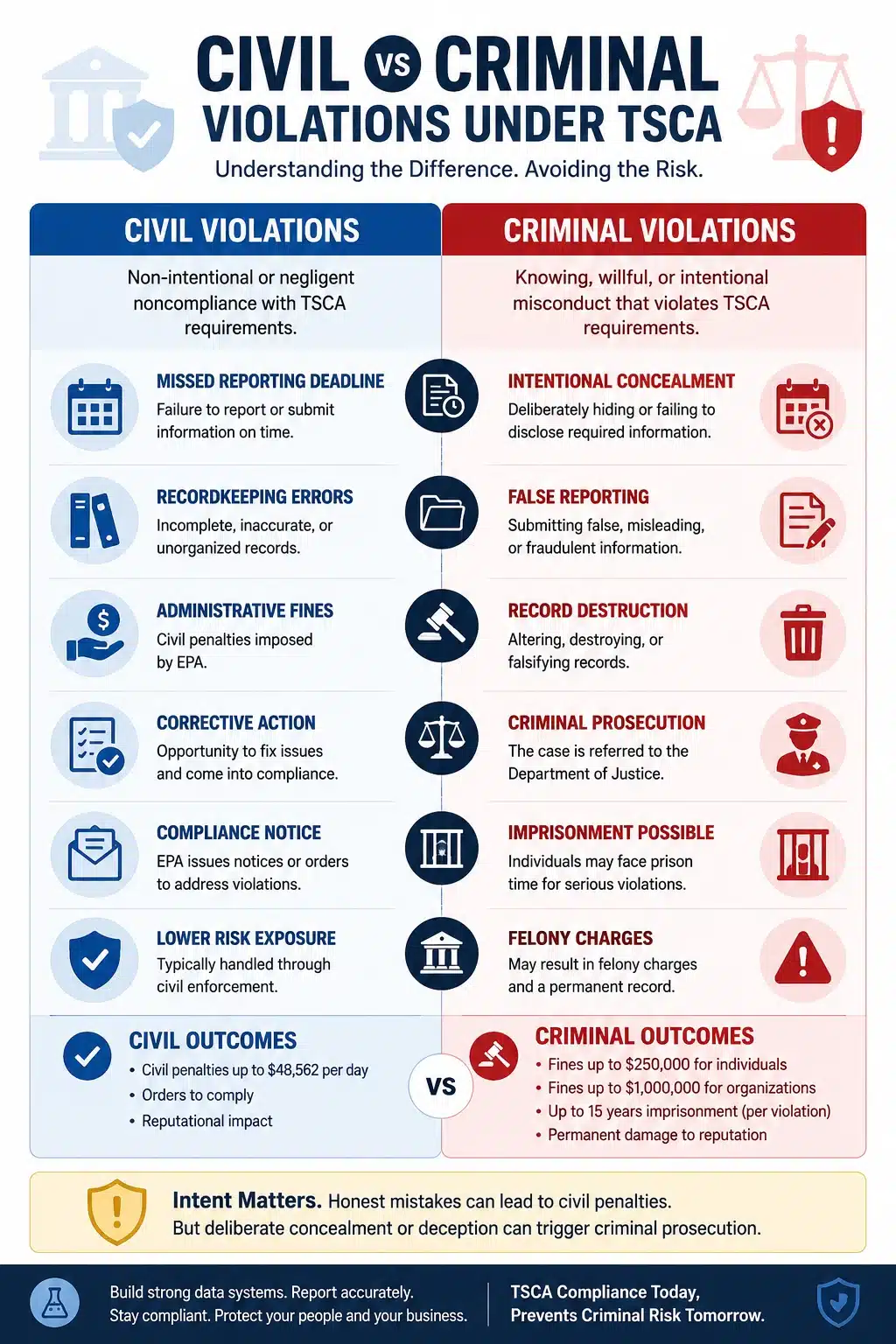
Civil vs criminal
| Civil violation | Criminal violation |
| Reporting errors | Intentional concealment |
| Administrative penalties | Criminal prosecution |
| Corrective actions | Imprisonment possible |
| Monetary penalties | Felony charges possible |
Civil cases usually involve missed deadlines, incomplete submissions, or recordkeeping failures that can be fixed through corrective action. Criminal cases generally involve knowledge, will fulness, falsification, concealment, or behaviour that endangers people.
Most affected companies
Chemical manufacturers are heavily affected because they often control the upstream data needed for TSCA reporting, testing, and risk evaluation. Importers are also exposed because EPA’s 2026 case against a chemical supplier highlighted failures involving imports, CDR reporting, and compliance certification.
Processors, industrial manufacturers, distributors, and contract manufacturers can also be affected when they receive or generate information that triggers reporting duties or when they rely on supplier data that turns out to be incomplete. Laboratories are not always the primary regulated party, but they can still generate the evidence that triggers TSCA obligations.
Reportable information
Companies should treat the following as high-priority TSCA data categories: chemical identity, hazard information, toxicity studies, exposure data, environmental effects, adverse health information, risk evaluations, and Section 8(e) substantial risk information. EPA's TSCA overview and Section 8(e) guidance both make clear that substantial-risk reporting is meant to get critical risk information into the agency's hands promptly.
A useful rule is that if the information could change a risk decision, a supplier communication, a site response, or a regulatory filing, it should be reviewed immediately by the compliance team. That is especially true where the data come from incident reports, lab findings, exposure monitoring, or customer complaints.
Section 8(e)
TSCA Section 8(e) requires immediate notification when a person who manufactures, imports, processes, or distributes a chemical obtains information that reasonably supports a conclusion that the substance or mixture presents a substantial risk of injury to health or the environment. EPA's guidance and FAQ pages confirm that the point is to notify EPA quickly, not after an internal review drags on for weeks.
The practical reporting window is tight, and EPA's historical guidance describes the submission as due within 15 working days after obtaining the information. Common violations include treating a possible risk signal as "not final," delaying escalation, or assuming another business unit will report it.
Possible violations
Examples of potential criminal violations include concealing toxicity data, destroying safety records, submitting false information, failing to report substantial risk data, ignoring EPA requests, and knowingly violating EPA orders. EPA’s criminal TSCA page specifically addresses knowing or willful reporting violations and other deliberate noncompliance behaviors.
The most dangerous compliance failure is not a simple typo; it is a decision to suppress, delay, or alter information after the company has reason to believe the information matters to EPA. That is where internal documentation, escalation logs, and legal review become essential.
How does the EPA investigate?
EPA investigations may begin with inspections, record reviews, information requests, employee interviews, or referrals from other agencies or internal intelligence. EPA’s enforcement materials show that criminal provisions can be pursued when the facts support knowing or willful misconduct.
In a recent example, EPA announced a 2026 administrative complaint against a chemical supplier for alleged TSCA reporting and import-related failures, including omitted use information and certification issues. The case is a good reminder that enforcement is not limited to old legacy problems; current import and reporting practices are under active scrutiny.
Compliance checklist
- Maintain complete chemical records.
- Report substantial risk information promptly.
- Keep SDSs current.
- Document supplier communications.
- Conduct internal compliance audits.
- Train regulatory staff.
- Monitor EPA rule changes.
- Use digital compliance software.
These steps matter because TSCA liability often turns on whether the organization can show it had a reasonable, functioning system for collecting and escalating risk information. A well-documented process is not a defense to intentional misconduct, but it can be critical in preventing errors from becoming enforcement cases.
SDS management connection
Accurate SDS management supports TSCA compliance by keeping hazard information current, helping teams identify reportable signals, and improving document control. It also makes inspections easier because the company can show where information came from, when it changed, and who reviewed it.
For multi-site organizations, good SDS control reduces duplicate records, missing supplier updates, and version confusion. That matters because if the same chemical exists in several locations, a single outdated SDS or untracked hazard update can affect reporting decisions across the enterprise.
The role of CloudSDS
A centralized SDS repository helps organizations find current documents quickly, track versions, and maintain audit trails. Automatic updates, chemical inventory integration, user permissions, and multi-site access controls can also reduce the chance that a reportable risk signal gets lost in email or spreadsheets.
This is best understood as compliance infrastructure, not promotion. In TSCA work, the value of a digital system is that it improves consistency, supports defensible document retention, and shortens the path from new information to internal review and external reporting.
Common mistakes
The most common TSCA mistakes are using outdated SDSs, missing supplier updates, weak retention practices, duplicate records, no audit process, and poor employee training. Another high-risk failure is assuming that a site-level issue does not matter because corporate compliance has not asked for it yet.
The higher the number of sites, suppliers, or imported chemical products, the more likely these mistakes are to happen. That is why TSCA compliance should be managed as a system, not as a set of occasional form submissions.
Enforcement trends
EPA's 2026 TSCA activity suggests a sharper focus on reporting quality, import compliance, CDR submissions, and data integrity. EPA's announced action against a chemical supplier also shows more scrutiny of omitted use information and false or incomplete certifications.
For compliance teams, the message is that TSCA is no longer just a paperwork statute. It is increasingly a data-governance statute, and poor data governance can now trigger serious enforcement consequences.
Timeline
- 1976: TSCA enacted as the federal framework for chemical reporting, testing, and restrictions.
- 2016: Frank R. Lautenberg Chemical Safety for the 21st Century Act signed into law, amending TSCA.
- 2020s: EPA expanded implementation, risk evaluation activity, and enforcement attention around reporting and imports.
- 2026: EPA enforcement activity continued to emphasize reporting failures and chemical import documentation.
Decision tree
Use this quick sequence when a new chemical issue appears:
- Does the information relate to a chemical substance or mixture you manufacture, import, process, or distribute?
- Does the information reasonably support a substantial risk conclusion for health or the environment?
- Is EPA already adequately informed from another lawful source?
- If not, please escalate promptly for TSCA Section 8(e) review and possible reporting.
- Preserve records, drafts, test results, and internal communications until the compliance decision is finalized.
Comparison table
| Regulation | Primary purpose | SDS overlap |
| TSCA | Controls reporting, testing, recordkeeping, and restrictions for chemicals in commerce. | High, especially for hazard, identity, and risk data. |
| OSHA Hazard Communication Standard | Ensures workers are informed about chemical hazards in the workplace. | High, through SDS availability and labeling. |
| FIFRA | Regulates pesticides. | Limited, because many pesticide products are excluded from TSCA. |
| RCRA | Governs hazardous waste management. | Moderate, especially for waste profiles and disposal records. |
TSCA and OSHA HazCom overlap heavily in SDS management, but they are not the same rule. TSCA is about chemical control in commerce and reporting to EPA, while HazCom is about worker hazard communication in the workplace.
Glossary
- TSCA Section 8(e): The provision requiring immediate notification of substantial-risk information.
- Substantial risk: Information that reasonably supports the conclusion that a chemical presents a serious risk to health or the environment.
- Knowing violation: A violation committed with awareness of the facts and legal duty.
- Willful violation: Deliberate noncompliance, not an accidental mistake.
- Imminent danger: A condition presenting immediate risk of death or serious bodily injury.
- Risk evaluation: EPA's formal process for assessing chemical risk under TSCA.
FAQ
What is the Frank Lautenberg Act?
It is the 2016 law that amended TSCA and strengthened EPA's chemical safety authority.
How did it change TSCA?
It added mandatory existing chemical evaluations, deadlines, and stronger transparency.
What criminal penalties exist under TSCA?
The EPA describes fines and prison exposure for knowing or willful violations.
Can companies face criminal charges for failing to report chemical risks?
Yes, when the facts show knowing or willful noncompliance.
What is TSCA Section 8(e)?
It is the substantial-risk reporting requirement.
What is knowing endangerment?
It is conduct that knowingly and willfully places others in imminent danger.
Can executives be personally liable?
Yes, depending on the facts and their involvement.
What industries are covered by TSCA?
Manufacturers, importers, processors, and distributors are common focus areas.
What records should companies maintain?
Chemical identity, hazard, toxicity, exposure, and reporting records.
Key takeaways
The Lautenberg Act significantly expanded EPA authority under TSCA and made chemical data governance much more important. Companies now face greater liability for intentionally concealing or failing to report chemical risk information, especially when the conduct is knowing, willful, or tied to endangerment.
Strong documentation, current SDSs, and proactive reporting reduce enforcement risk. Digital SDS and chemical management systems improve audit readiness and make it easier to detect, preserve, and escalate reportable information before it becomes a legal problem.
References
- U.S. Environmental Protection Agency — TSCA summary and Lautenberg Act overview. https://www.epa.gov/assessing-and-managing-chemicals-under-tsca/frank-r-lautenberg-chemical-safety-21st-century-act
- U.S. Environmental Protection Agency — Criminal Provisions of TSCA. https://www.epa.gov/enforcement/criminal-provisions-toxic-substances-control-act-tsca
- U.S. Environmental Protection Agency — TSCA Section 8(e) reporting guidance and FAQ. https://www.epa.gov/assessing-and-managing-chemicals-under-tsca/guidance-documents-substantial-risk-notifications-under
- U.S. Environmental Protection Agency — 2026 TSCA enforcement announcement involving a chemical supplier. https://content.govdelivery.com/accounts/USEPAAO/bulletins/419e0be
- U.S. Environmental Protection Agency — Guidance on regulations issued under TSCA. https://www.epa.gov/assessing-and-managing-chemicals-under-tsca/guidance-regulations-issued-under-toxic-substances
Simplify Your SDS Management
CloudSDS gives your team instant access to 23M+ safety data sheets with AI-powered search, automated updates, and full OSHA/GHS compliance — all from one platform.
Leave A Comment