
Last Updated on August 6, 2026
What Are the Ways to Label Hazardous Chemical Containers?
Summary:
Every container that holds a hazardous chemical needs a clear, accurate label. This isn't just good practice. It's an OSHA requirement under the Hazard Communication Standard (HazCom). A proper label tells workers what's inside a container, what risks it carries, and how to handle it safely. In this guide, we'll walk through every type of container you might need to label, the exact information OSHA requires on a label, when labels aren't required (yes, there's an exception), and how to build a labeling system that stays accurate as your inventory grows. We'll also look at how digital tools like QR codes and SDS management software make labeling faster and far less error prone.
Introduction
Your organization should know how to label a container that holds any hazardous product. A container that does not show the right information can be risky for employees and users who need it. But labelling just any way does not work. It has to be done as regulatory bodies suggest. This article guides you through it and shares tips on best practices.
Why does proper chemical labeling matter?
1. It protects workers from immediate harm.
A clear label is often the only warning a worker gets. So, before touching, mixing, or inhaling something dangerous, they can read the labels and be aware of the hazards.
2. Prevents accidental misuse
With the right labelling, users get the right information. Without it, chemicals can get mixed up or poured into the wrong container. They can also use it for wrong tasks which may lead to spills, fires, or toxic reactions.
3. It keeps you compliant with OSHA.
Unlabeled or poorly labeled containers are one of the most common citations of OSHA issues during workplace inspections. As a result, the right labelling practices help organizations stay compliant with the federal agency.
4. It supports emergency response.
The labels are mainly the primary source of information during emergencies. In a spill, fire, or exposure incident, first responders rely on labels to know what they're dealing with and how to treat it.
5. It builds a culture of safety.
When labeling is consistent and taken seriously, it signals to every employee that safety is a real priority. Labelling is not at all paperwork.
6. It reduces liability and downtime.
Accidents caused by unlabeled containers can lead to injuries, lawsuits, and shutdowns. All of these increases the company's cost which proper labelling can reduce.
What is a hazardous chemical container?
A hazardous chemical container is any vessel, big or small, permanent or temporary, that holds a substance capable of causing harm. Based on the type of container, OSHA’s labeling rules vary. Here’s what it means:
1. Manufacturer containers
These are the original containers a chemical arrives in, like drums, bottles, or cans from the supplier. They come pre-labeled by the manufacturer and must keep that label intact and legible for as long as the container is in use.
2. Secondary containers
When you transfer a chemical from its original container into another one for storage or use, that new container is a “secondary container.” It needs its own label unless it qualifies for the immediate-use exception (more on that below).
3. Transfer bottles
Smaller bottles used to move chemicals from a bulk source to a work area also count as secondary containers and generally need labels showing the chemical name and hazards.
4. Spray bottles
Diluted cleaning or industrial chemicals kept in spray bottles must be labeled too, especially if the bottle will be used over multiple shifts or by more than one person.
5. Portable containers
Any container that gets moved around a facility, buckets, jugs, or totes, needs a label so that wherever it ends up, the hazard of information travels with it.
6. Bulktanks
Large storage tanks holding chemicals in bulk need labels or placards that are visible from a safe distance, often with additional signage required by fire codes.
7. Process vessels
Tanks or vessels used during manufacturing or chemical processing need hazard labeling too, even if they’re part of a fixed, in-plant system.
8. Pipelines
Pipes carrying hazardous chemicals through a facility should be labeled or color-coded at regular intervals and at valves, so workers always know what’s flowing through them.
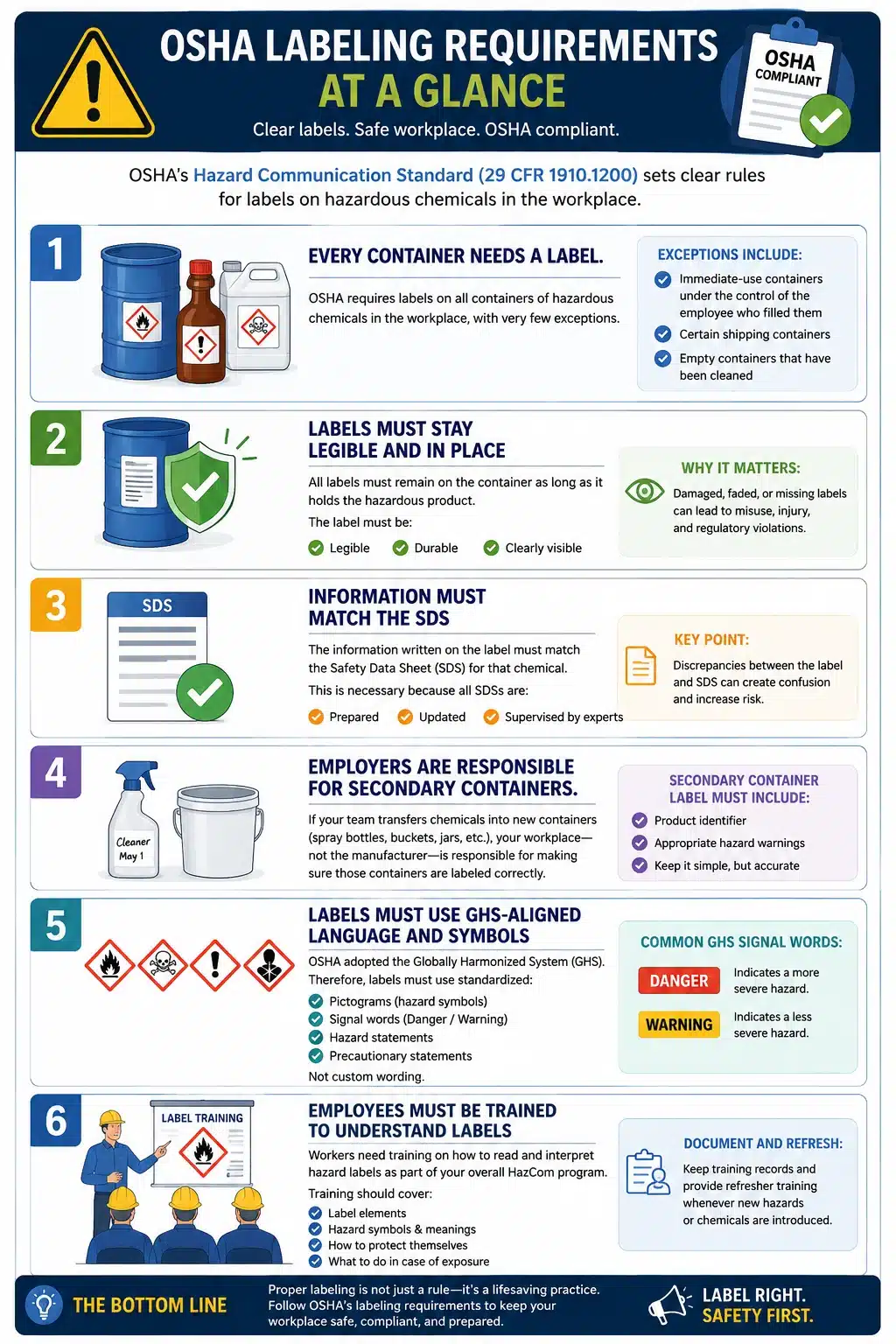
What are the labeling requirements according to OSHA?
1. Every container needs a label.
OSHA's Hazard Communication Standard (29 CFR 1910.1200) requires labels on all containers of hazardous chemicals in the workplace, with very few exceptions.
2. Labels must stay legible and in place
All the labels must remain on the container as long as it holds the hazardous product. The label must be clear and readable.
3. Information must match the SDS
The information written on the label must match the SDS also. This is necessary because all the SDSs are prepared and updated under the supervision of experts.
4. Employers are responsible for secondary containers.
If your team transfers chemicals into new containers, your workplace—not the manufacturer—is responsible for making sure those containers are labeled correctly.
5. Labels must use GHS-aligned language and symbols
OSHA adopted the Globally Harmonized System (GHS), so labels must use standardized pictograms, signal words, and hazard statements rather than custom wording.
6. Employees must be trained to understand labels
Workers need training on how to read and interpret hazard labels as part of your overall HazCom program.
| OSHA HazCom | GHS |
| U.S. regulation
|
International classification system
|
| Requires workplace hazard communication | Standardizes labels globally
|
| Enforced by OSHA
|
Adopted by many countries |
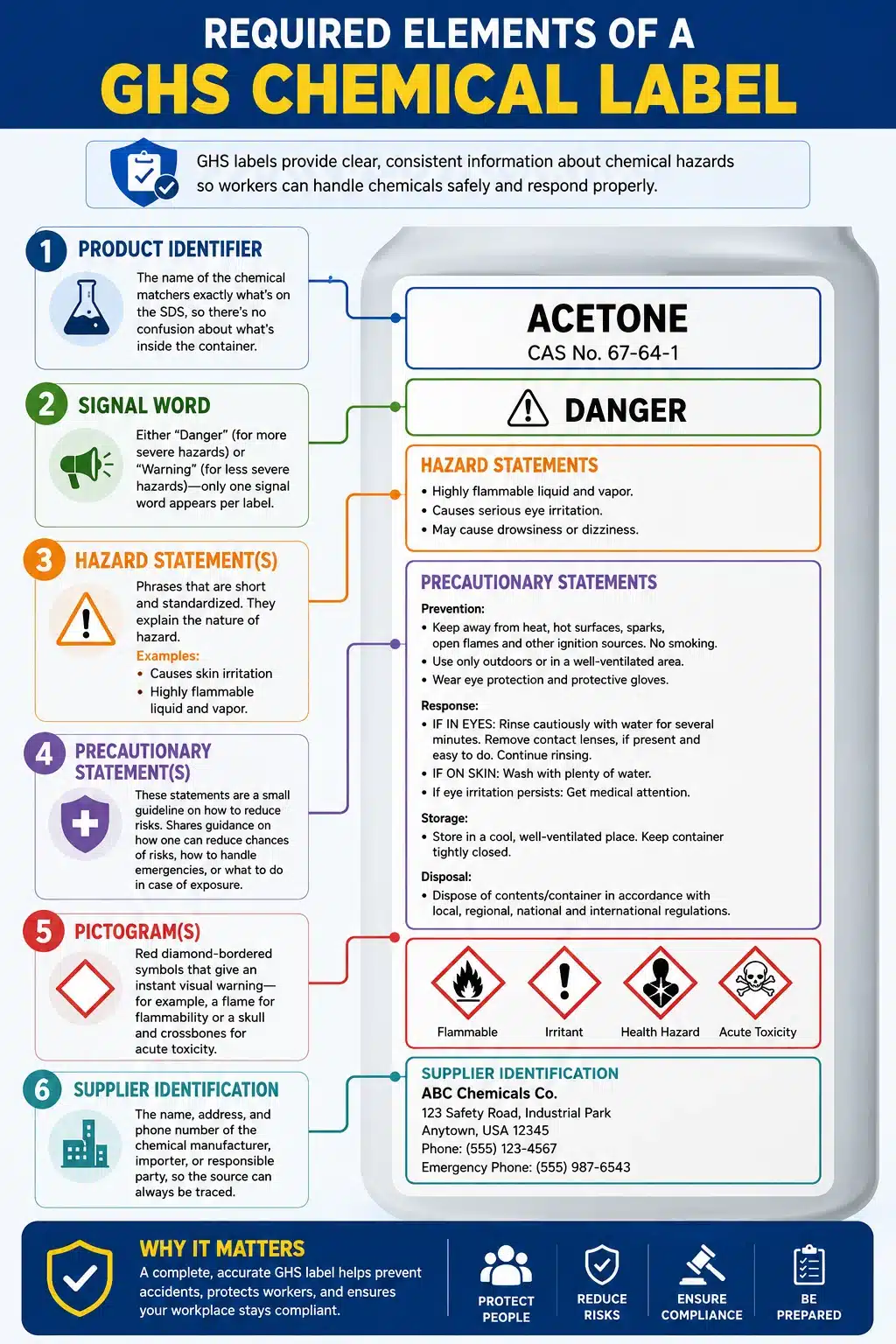
Required elements of a GHS chemical label
1. Product identifier
The name of the chemical matches exactly what's on the SDS, so there's no confusion about what's inside the container.
2. Signal word
Either "Danger" (for more severe hazards) or "Warning" (for less severe hazards)—only one signal word appears per label.
3. Hazard statement(s)
Phrases that are mainly short and standardized. They explain the nature of hazard. For instance, a hazard statement may look like "Causes skin irritation" or "Highly flammable liquid and vapor."
4. Precautionary statement(s)
These statements are a small guideline on how to reduce risks. Shares guidance on how one can reduce chances of risks, how to handle emergencies, or what to do in case of exposure.
5. Pictogram(s)
Red diamond-bordered symbols that give an instant visual warning—for example, a flame for flammability or a skull and crossbones for acute toxicity.
6. Supplier identification
The name, address, and phone number of the chemical manufacturer, importer, or responsible party, so the source can always be traced.
Primary vs secondary container labels
| Requirement | Primary container | Secondary container |
| Product identifier | ✓ | ✓ |
| Hazard information | ✓ | ✓ |
| Supplier information | ✓ | Usually not required |
| Full GHS label | ✓ | Workplace label acceptable |
OSHA’s immediate-use exception
1. Definition
OSHA allows workers to skip labeling a secondary container only if the chemical is under “immediate use,” meaning it’s used entirely, right away, during the same work shift, by the same person who transferred it.
2. Conditions
All of these must be true at once: the chemical is used up completely, during the same shift, by the same person who poured or transferred it, and it never leaves that person’s direct control.
3. Examples
A worker pours a small amount of solvent into a cup, uses it immediately to clean a part, and disposes of any leftover before their shift ends this could qualify.
4. Labels are not required
Only in the narrow scenario above. If the container will be set down, walked away from, stored, or handed off to someone else — even briefly — a label is required.
5. Common misunderstandings
Many workplaces assume “immediate use” means “used the same day” or “used by my team.” In reality, it must be the same person, same shift, and the container must be emptied right after use. If there’s any doubt, the safest choice is always to label it.
Which containers must be labeled?
| Container | Label required? |
| Original manufacturer drum | Yes |
| Secondary spray bottle | Yes |
| Temporary beaker (immediate use) | No |
| Bulk storage tank | Yes |
| Chemical waste container | Yes |
| Process vessel | Depends on workplace identification system |
How to create a compliant chemical label
1. Identify the chemical
Confirm the exact name and formulation of the chemical you're labeling, matching it to its source documentation.
2. Review SDSs
A review of the SDS is important. So, find the required Safety Data Sheet (SDS) for that chemical and verify the pictograms, information for precautions, and hazard classification.
3. Determine hazards
Based on the SDS, identify which physical, health, and environmental hazards apply to this specific chemical.
4. Select pictograms
The next task is choosing the right GHS pictograms that fit with the hazards identified. Remember that your team must never reuse pictograms from a similar chemical product.
5. Add signal word
Start adding signal words to the label. For instance, add words like "Danger" or "Warning". The choice of the words depends on the severity of the danger as mentioned on the SDS.
6. Add hazard statements
Check the SDS again to find the hazard statements that you'll have to copy. This way, all the wording stay consistent.
7. Add precautionary statements
Now you'll have to find out the precautionary statements. So, extract the relevant handling, storage, and emergency response instructions from the SDS.
8. Printable label
Your label material should be ideal for the container type. So, be careful while choosing the label material and printer built for your container type. Choose options which are chemical-resistant and waterproof.
9. Verify accuracy
Your team will have to check twice the labels it has currently generated. Also, check one more time when it's going to be used on a container.
How to use SDS to create labels?
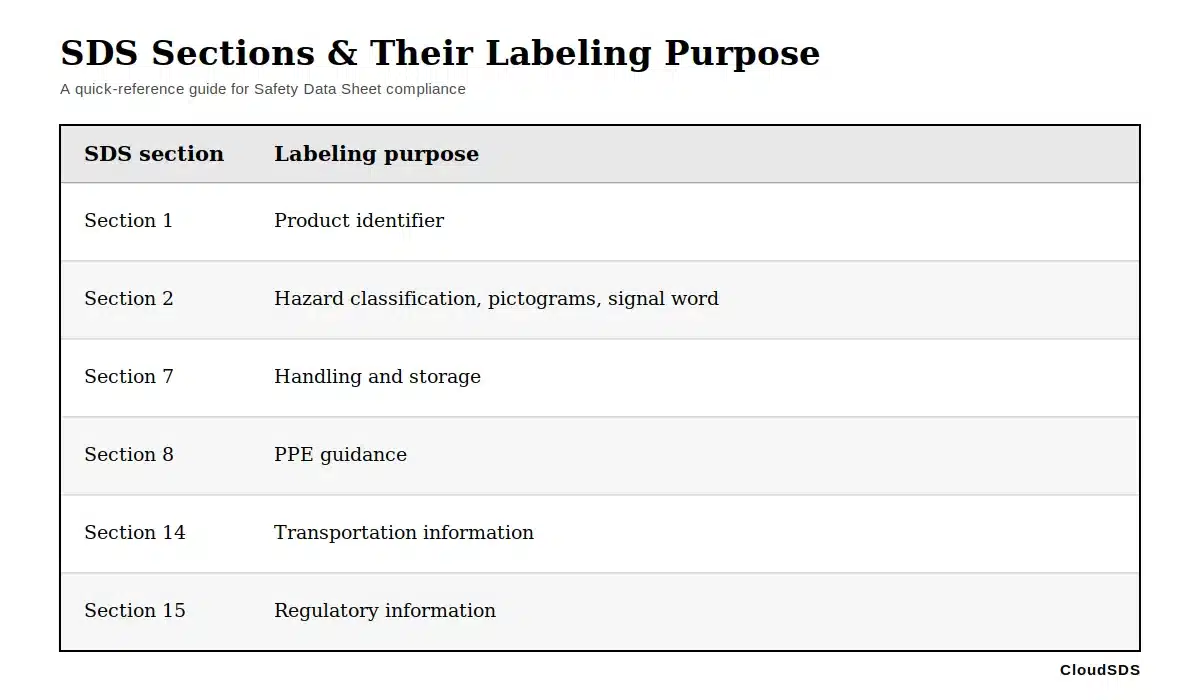
GHS pictogram explained
| Pictogram | Meaning | Example chemicals |
| Flame | Flammable | Ethanol |
| Corrosion | Corrosive | Hydrochloric acid |
| Skull | Acute toxicity | Sodium cyanide |
| Gas cylinder | Compressed gas | Nitrogen |
| Health hazard | Carcinogen | Benzene |
What are the label placement best practices?
1. Visibility
Place labels where they can be seen immediately, without needing to move or tilt the container.
2. Durability
Choose label materials rated to survive the container environment, whether that’s a warehouse shelf or an outdoor tank.
3. Waterproof materials
In areas with moisture, spills, or washdowns, waterproof labels prevent smearing or peeling.
4. Chemical resistance
Labels on containers that may come into contact with solvents or corrosive substances need coatings that resist chemical damage.
5. Readability
Text and symbols should be clear enough to read from a normal working distance, not squinted up close.
6. Font size
Use a font size large enough to read quickly, especially for the product name and signal word.
7. Color contrast
Strong contrast between text and background—like black text on white or yellow—makes labels easier to read under poor lighting.
Label inspection and maintenance
1. Inspection frequency
Set a regular schedule — monthly or quarterly, depending on your facility — to check labels for fading, damage, or missing information.
2. Replacing damaged labels
Any label that's torn, faded, or unreadable should be replaced immediately, not left in place until the next scheduled check.
3. Updating labels after SDS revisions
When a manufacturer updates an SDS, the corresponding container labels need to be updated too, so the information stays consistent.
4. Documentation
Keep records of label inspections, replacements, and updates so you can show a clear compliance history if needed.
5. Audit readiness
Well-documented, consistently maintained labels make OSHA inspections and internal audits far smoother and faster.
Digital labeling and QR codes
1. QR codes linked to SDSs
A QR code on a label can link directly to the chemical’s current SDS, giving workers instant access to full hazard details from their phone.
2. Mobile access
Workers can scan a label on the shop floor and pull up safety information immediately, without searching through binders or shared drives.
3. Barcode systems
Barcodes help track chemical inventory, container locations, and usage history alongside the label itself.
4. Digital chemical inventory
Linking labels to a digital inventory system makes it easy to see what chemicals you have, where they are, and when they were last reviewed.
5. Smart labeling solutions
Some systems can auto-generate updated labels whenever an SDS changes, reducing the risk of outdated information staying in circulation.
How SDS management software simplifies labeling
1. Centralized SDS library
All your Safety Data Sheets live in one searchable place, so there’s never a question about which version is current.
2. Automatic SDS updates
When a manufacturer revises an SDS, the software updates it automatically, keeping your source data accurate without manual tracking.
3. Label generation
Compliant, GHS-formatted labels can be generated directly from the SDS data, cutting out manual data entry errors.
4. QR code integration
Labels generated through the software can include QR codes that link straight back to the correct SDS.
5. Version control
The software keeps a clear history of SDS and label versions, so you always know what changed and when.
6. Multi-site consistency
Facilities across multiple locations can pull from the same centralized system, ensuring every site uses the same accurate labels.
7. Audit trails
Every update, label generation, and SDS revision is logged, giving you a ready-made record for compliance audits.
8. Regulatory updates
As OSHA and GHS requirements evolve, the software helps keep your labels aligned with the latest rules, without you having to track changes manually.
Conclusion
Each label on the containers of hazardous materials are vital documents as they can save lives and reduce chances of accidents. So, make sure your organization is doing it the right way. Moreover, take the help of the right tool like an SDS management software which will help you extract the data automatically without making any errors. So, stay compliant and stick to the right labeling method.
Key takeaways:
- OSHA requires labels on nearly every container of hazardous chemicals, from the original manufacturer's drum to a small spray bottle you filled yourself.
- A compliant GHS label needs six required elements: product identifier, signal word, hazard statements, precautionary statements, pictograms, and supplier information.
- The "immediate-use exception" lets workers skip labeling in very specific, narrow situations, but it's widely misunderstood.
- Labels must be visible, durable, and readable throughout the life of the container, not just on day one.
- Digital labeling, QR codes linked to SDSs, barcode systems, and SDS management software reduce manual errors and keep labels updated automatically.
- Regular label inspections and SDS-triggered updates are essential for staying audit-ready.
FAQs
1. What information must appear on a hazardous chemical label
A chemical label is not complete without these 6 important things: name of the product and manufacturer, contact information, signal words, pictograms, hazard statements, and precautionary statements.
2. Do all secondary containers require labels
Not always. If you pour a chemical into a smaller container and use it right away, during the same shift, and you're the only one using it, you don't need a label. But if the container is filled for someone else to use, it must be labeled then.
3. What is OSHA's immediate exemption?
This rule says you don't need a label on a container if the chemical is transferred, used completely, and the container is empty or cleaned all within the same work shift by the same person. Step away or hand it to someone else, and the exemption no longer applies.
4. Can workplace labels be handwritten?
Yes. OSHA allows handwritten labels. But remember, they have to be legible and must include all the required information.
5. What is the difference between OSHA and GHS labels?
They're basically the same thing. OSHA adopted the GHS (Globally Harmonized System) labeling rules as part of its Hazard Communication Standard. So a label that meets GHS format also meets OSHA's requirements in the US.
6. Which SDS section contains label information?
Various sections contain information which should be present on a label. So, yes not a specific section. Users must pay attention to section 2 from which shares the signal word, the pictograms, precautionary and hazard statement.
7. Are NFPA diamonds the same as GHS labels
No. NFPA diamonds are a separate rating system (using numbers 0–4) mainly used by fire departments and emergency responders. GHS labels use pictograms and phrases meant for everyday workers. Many workplaces use both, but they're not interchangeable.
8. How often should chemical labels be inspected?
OSHA has not mandated the number of inspections. However, the organization must check the labels while they check the chemical inventory. At least once a month is always necessary.
9. What happens if a chemical label becomes unreadable
The label must be replaced with the right one. Keeping the container with unreadable labels can be very risky.
10. Can QR codes replace chemical labels
No. QR codes can be added to give quick access to the SDS or extra safety info, but they can't replace the required label elements like the signal word, pictograms, and hazard statements.
11. Who is responsible for workplace labeling?
The employer. OSHA requires employers to make sure every hazardous chemical in the workplace is properly labeled, and to keep labels legible and up to date.

Simplify Your SDS Management
CloudSDS gives your team instant access to 23M+ safety data sheets with AI-powered search, automated updates, and full OSHA/GHS compliance — all from one platform.
Leave A Comment