
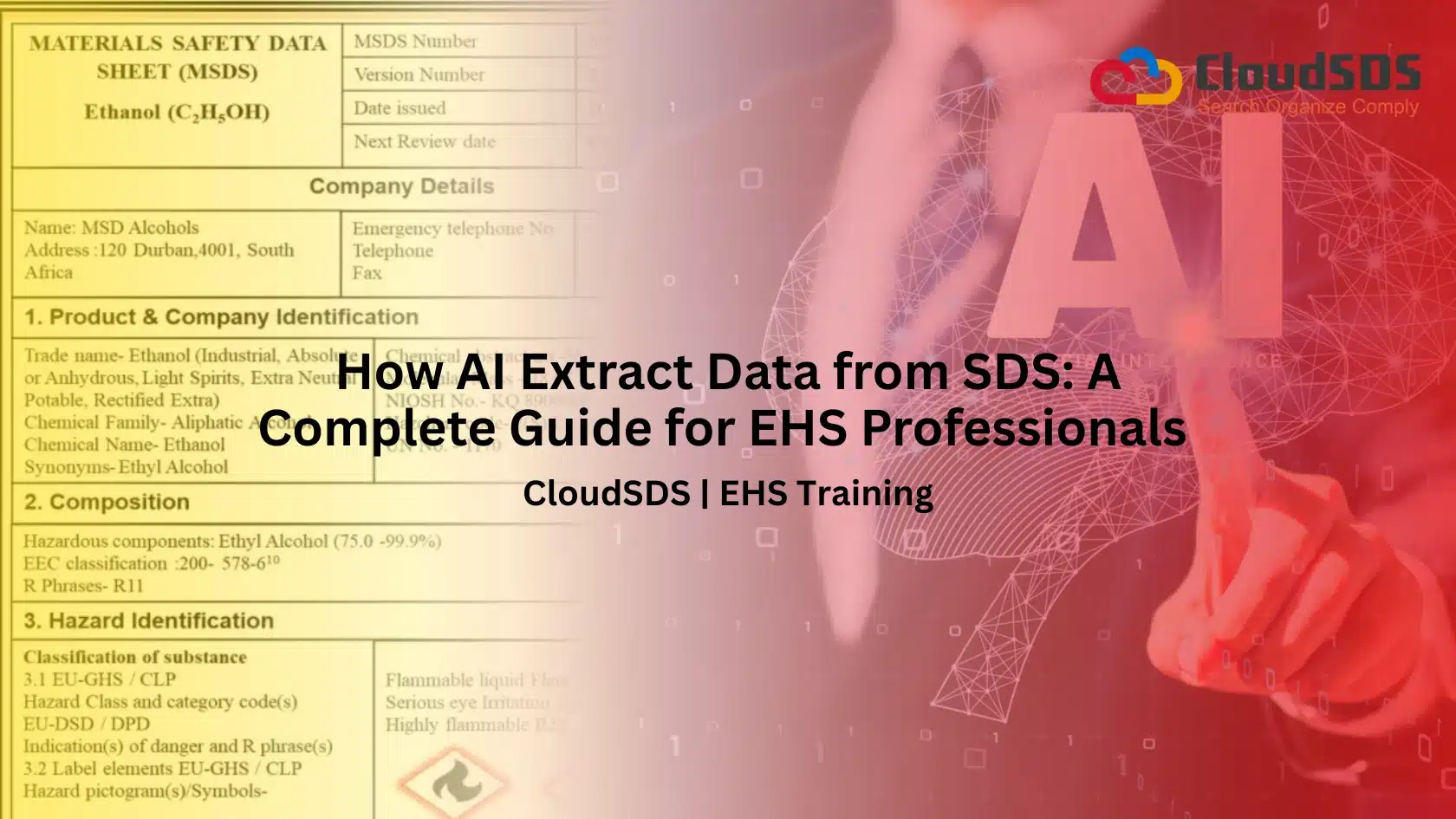
AI extracts data from Safety Data Sheets (SDSs) by using technologies such as Optical Character Recognition (OCR), Natural Language Processing (NLP), machine learning, and Large Language Models (LLMs) to convert unstructured documents into structured, searchable data. It automatically identifies chemical names, CAS numbers, hazard classifications, PPE requirements, exposure limits, and regulatory information, reducing manual data entry and improving accuracy. This enables organizations to maintain up-to-date chemical inventories, support OSHA Hazard Communication and GHS compliance, and make faster, data-driven EHS decisions.
Why Safety Data Sheets Are Difficult to Manage Manually
Manual management of Safety Data Sheets (SDS) becomes cumbersome and difficult with increasing chemical inventories. Many organizations have hundreds or thousands of SDSs from many manufacturers that each contain critical safety, handling, storage, and regulatory information. The data is manually extracted, assessed, input, and updated, requiring a large amount of time and effort. Employees experience the higher risk of human error, missing data, and duplicate entries. It is quite challenging to keep track of changes to SDS, maintain current chemical inventories, and provide people with the latest safety information, especially when there are many factories involved.
 Why traditional SDS management doesn’t scale
 Why traditional SDS management doesn’t scale
- Someone must regularly monitor it for updating (manual) spreadsheet data, and it is prone to data entry errors, duplication, and version control issues.
- It is common for file names in shared folders to be inconsistent. In many cases, it seems that there are duplicate documents and old versions of SDS.
- As volumes of SDS increase, manual chemical information indexing becomes more time-consuming and burdensome.
- Thousands of SDSs from various locations. It’s an administrative burden.
- SDSs come in different formats/layouts and require a lot of human effort to review and extract data.
- Keeping abreast of SDS amendments and presenting the latest to personnel is difficult.
- Looking up some substances, risks, or regulations can take hours.
- But with an increase in documents, so can human errors that create compliance and safety problems.
- Regulatory reporting, audits, and chemical inventory management are more complicated and require more resources.
- Traditional EHS methods are unable to deliver real-time visibility, scalability, and automation that modern EHS operations require.
Definition of SDS data extraction
SDS data extraction makes the process of information transformation from SDS documents to organized data easier. This process of automation enables users to easily search, analyze, and manage.
What information can be extracted from AI?
AI is able to extract key SDS details. It includes
- The product name.
- The manufacturer’s name.
- CAS numbers.
- Hazard classifications.
- GHS pictograms.
- Signal words.
- PPE requirements.
- Exposure limits
- First-aid instructions.
- Storage requirements.
Why extracting SDS data matters
Benefits include:
- Quicker access to safety information becomes possible.
- The chemical inventory management and reporting have been upgraded.
- OSHA & GHS compliance improved.
- Emergency responses become updated.
- Manual labor and data-entry errors have become reduced.
How AI extracts data from SDS: a step-by-step guide
Step 1 – SDS Acquisition
The AI extraction process begins by collecting safety data sheets from multiple sources. These documents may arrive in different formats, layouts, and languages, making standardization the first challenge.
Common Sources
- PDF files
- Scanned paper documents
- Supplier websites
- Email attachments
- ERP and document management systems
- Cloud-based SDS repositories
Challenges
- Different document templates from manufacturers
- Low-resolution or blurry scans
- Multi-language SDSs
- Missing or incomplete pages
- Rotated or skewed documents
Goal: Gather all SDS documents into a centralized system for automated processing.
Step 2 – Optical Character Recognition (OCR)
Once the SDS is collected, OCR converts scanned or image-based documents into machine-readable text. This enables AI to process information that would otherwise be locked inside images or scanned PDFs.
OCR Extracts
- Product names
- Chemical names
- CAS numbers
- Section headings
- Hazard statements
- Tables
- Labels
Common Challenges
- Poor image quality
- Folded or damaged pages
- Watermarks
- Multi-column layouts
- Small fonts and handwritten notes
Output: Searchable digital text ready for AI analysis.
Step 3 – Natural Language Processing (NLP)
After the text is extracted, NLP analyzes the meaning of the content instead of simply reading words. It identifies important entities, understands chemical safety terminology, and extracts structured information from every SDS section.
NLP Identifies
- Chemical names
- CAS numbers
- GHS hazard classifications
- Signal words
- Hazard and precautionary statements
- PPE requirements
- Exposure limits
- First-aid measures
- Storage and handling instructions
- Disposal guidance
Example
SDS Text:
“Causes severe skin burns and eye damage.”
AI Extracts
- Hazard Category: Skin Corrosion Category 1
- Health Hazard
- Required PPE
- First-Aid Recommendations
Output: Key safety information is identified and prepared for classification.
Step 4 – Data Classification & Structuring
AI organizes the extracted information into standardized database fields so it can be searched, reported, and integrated with EHS systems.
| Extracted SDS Data | Classification |
|---|---|
| Sulfuric Acid | Product Name |
| 7664-93-9 | CAS Number |
| Skin Corrosion Category 1 | Hazard Classification |
| Wear Chemical-Resistant Gloves | PPE Requirement |
| Flush Eyes with Water | First Aid |
| Store in Corrosion-Resistant Container | Storage Requirement |
Benefits
- Standardized records
- Faster search
- Easier reporting
- Better chemical inventory management
Step 5 – AI Validation & Quality Assurance
Before data is published, AI validates the extracted information to improve accuracy and reduce errors. It compares extracted values with chemical databases, checks for missing fields, and identifies inconsistencies.
Validation Checks
- Missing information
- Duplicate SDSs
- Incorrect classifications
- Formatting inconsistencies
- Supplier revisions
- Confidence scores for extracted fields
When confidence is low, the document can be flagged for human review to ensure accuracy.
Step 6 – Structured Database & EHS Integration
After validation, the extracted data is stored in a centralized, searchable database where it can support multiple EHS and compliance processes.
The structured data can be used for:
- Chemical Inventory Management
- SDS Management Systems
- Workplace Label Generation
- GHS Compliance
- Regulatory Reporting
- Emergency Response
- Employee Safety Training
- API Integrations with ERP and EHS platforms
Key technologies for AI SDS extraction
1. Optical Character Recognition (OCR)
OCR converts scanned SDS documents, PDFs, and photos into text that a computer can read. This means the AI takes care of the safety information electronically.
2. Natural Language Process (NLP)
NLP enables AI to comprehend the language of chemical safety and pull out vital information like risks, PPE requirements, exposure limits, and first aid techniques.
3. Machine Learning
However, machine learning can improve extraction accuracy through training on vast amounts of SDS data, and it can constantly improve its ability to identify and classify information.
4. Large Language Models (LLMs)
LLMs are here to add context to help AI understand complex safety declarations, regulatory jargon, and chemical-specific language.
5. Computer Vision
Computer vision AI can identify and extract information from visual elements in SDSs, such as
- GHS images.
- Tables.
- Product labels.
- Document layouts.
By combining these technologies, we are automating SDS processing and converting unstructured documents into accurate, searchable data.
AI helps solve common challenges
1. Problem 1 – Thousands of SDSs
Dealing with a large number of SDSs across multiple locations can be time consuming and challenging.
AI Solution:
AI automatically extracts, organizes, and indexes SDS data to help make large document collections more manageable.
2. Problem 2 – Missing Data
Manual data entry leads to incomplete or missing information.
AI Solution:
AI detects missing fields and marks incomplete records for review, enhancing data quality.
3. Problem 3 – Old SDSs
This could mean organizations are using outdated SDSs unknowingly, which could cause compliance issues.
AI Solution:
AI checks SDS records and can flag documents that need to be updated or replaced.
4. Problem 4 – Duplicate Records
This can lead to multiple versions of the same SDS, leading to confusion and data inconsistencies.
AI Solution:
AI detects duplicate entries and cleans and maintains an SDS database.
5. Problem 5 – Slow queries
Searching for specific chemical safety information manually can be time consuming.
AI Solution:
AI allows for quick searching of SDS databases with keywords, retrieving relevant information immediately.
Manual data entry vs AI SDS extraction
Organizations with vast chemical inventories may find manual SDS processing challenging. AI-powered extraction has enormous advantages in speed, accuracy, and scale.
| Category | Manual Processing | AI Extraction |
| Speed | Hours or days of data entry | Processes documents in minutes |
| Accuracy | Prone to make human error | Consistent and highly accurate |
| Scalability | Difficult to manage large SDS volumes | Easily handles thousands of SDSs |
| Cost | High labor costs | Reduces manual effort and operational costs |
| Searchability | Limited and time-consuming | Instant, keyword-based searches |
AI SDS Extraction for Chemical Inventory
The AI extracts chemicals, product names, CAS numbers, and manufacturers from the SDS sheets automatically without any manual input.
i) Inventory Reconciliation
You may then compare the extracted SDS data to your existing inventory records to see whether compounds are missing, out of date, or don't match.
ii) Hazard Classification
AI records hazard classifications, GHS categories, signal phrases, and precautionary remarks to help organizations comprehend chemical hazards.
iv) Chemical Tracers
Structured SDS data allows for accurate tracking of chemicals across facilities, departments, and storage locations.
v) Reporting Compliance
Simplify regulatory reporting with AI-powered tools that deliver searchable, current chemical and danger data for OSHA, GHS, and environmental compliance programs.
The Future of AI for SDS Management
Artificial intelligence is reshaping SDS management by making chemical safety information faster to access, easier to understand, and more proactive. Future SDS platforms will go beyond document storage to provide intelligent search, real-time safety guidance, predictive compliance monitoring, and automated data management.
1. Conversational SDS Search
Instead of searching by chemical name or CAS number, users will be able to ask questions in natural language. AI will search the entire SDS library, understand the user’s intent, and deliver accurate answers within seconds.
For example:
- What chemicals require face shields?
- Which chemicals require respiratory protection?
- Show all flammable liquids in our inventory.
This conversational approach makes it easier for employees to find critical safety information quickly, especially during emergencies.
2. AI Safety Assistants
AI-powered safety assistants will provide instant answers to safety-related questions by analyzing SDS data in real time. Employees can receive guidance on PPE, first aid, spill response, storage, and handling without manually searching through lengthy documents.
For example:
- Show emergency measures for hydrochloric acid.
- What PPE is required for handling acetone?
- What should I do if this chemical comes into contact with my skin?
This enables faster decision-making and improves workplace safety.
3. Predictive Compliance Monitoring
Future AI systems will continuously monitor SDS libraries, chemical inventories, and regulatory updates to identify compliance risks before they become violations. They can detect missing or outdated SDSs, regulatory changes, incomplete documentation, and other compliance gaps, allowing safety teams to take corrective action proactively.
4. Autonomous SDS Updates
AI will automatically monitor supplier databases for new SDS versions, identify changes, and update records without manual intervention. Advanced systems may also update chemical inventories, notify affected teams, and maintain a complete version history, helping organizations keep their safety information accurate, current, and audit-ready.
Frequently Asked Questions
1. Can AI Read Any Kind of Safety Data Sheet?
Most AI solutions can read PDFs, scanned documents, digital files, and supplier-uploaded SDS's in a variety of formats.
2. How Accurate is AI SDS Extraction?
The accuracy really depends on the quality of the document and the AI system used. However, new solutions with validation processes can achieve excellent levels of accuracy.
3. Can AI do the work of human review?
No. AI automates the data extraction and validation process, but there is still a human element in quality assurance and exception handling.
4. Can an AI read a scan of a PDF?
Yes. OCR tech makes it possible for AI to read scanned PDFs and photos and convert them into machine-readable text for extraction.
5. How Does AI Handle SDS Updates?
AI can monitor SDS repositories and find updated documents and flag/auto-update outdated records
6. Can AI Help with OSHA Compliance?
Yes. AI enables companies to accurately maintain SDS records, improve hazard communication, meet reporting needs, and simplify OSHA compliance operations.
Conclusion
The AI-enabled data extraction has been a game changer for the organizations. This helps firms manage chemical safety information. AI uses OCR, NLP, machine learning, and large language models (LLMs). The use of these is to turn unstructured safety data sheets into structured, searchable intelligence. After using these models, organizations can increase compliance. The process of information retrieval becomes smoother and faster. speed up information retrieval, improve reporting, and help manage chemical inventories. As chemical inventories rise, AI is helping firms reduce manual data entry, enhance data accuracy, and keep safety records up to date. Using AI-enabled SDS extraction is a practical move for EHS teams to achieve improved operational efficiency, regulatory compliance, and worker safety.

Leave A Comment