 Skip to content
Introduction
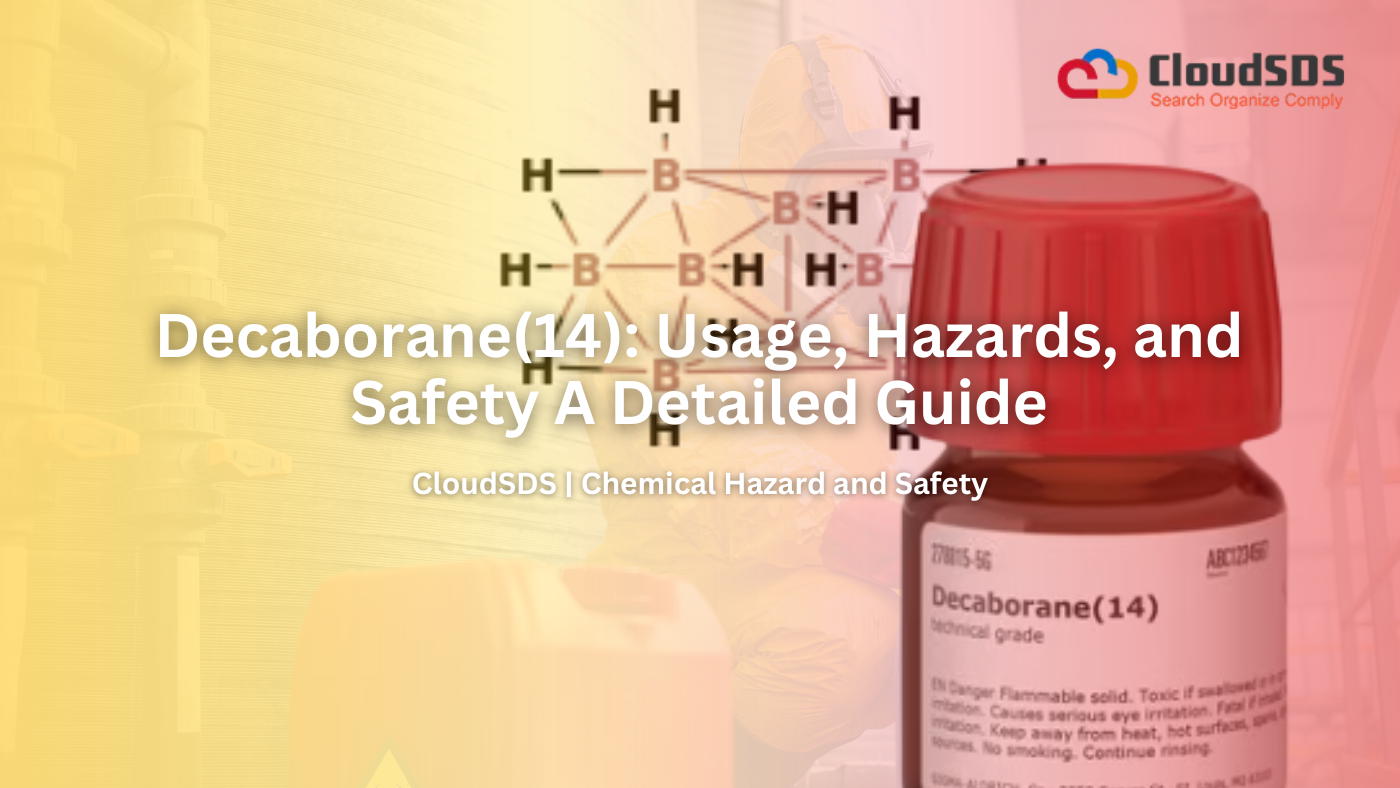
Decaborane(14), also known simply as decaborane, is a white crystalline boron hydride with the molecular formula B₁₀H₁₄. Its structure consists of a “nido” decaborane cage, bearing ten boron atoms and fourteen hydrogen atoms arranged in a polyhedral framework. Since its initial isolation in the mid-20th century, decaborane has become indispensable in several cutting-edge technologies due to its reducing properties, volatility, and ability to deliver boron in reactive forms. However, these same attributes underlie its significant hazards, including acute toxicity, flammability, and potential for explosive reactions under certain conditions.
Chemical and Physical Properties
✅Molecular formula: B₁₀H₁₄
✅Appearance: White to colorless crystalline solid with a bitter, chocolate-like odor
✅Melting point: 99–100 °C (211 °F)
✅Boiling point: 213 °C (415 °F)
✅Density: 0.94 g/cm³ at 25 °C
✅Vapor pressure: 0.067 hPa at 25 °C
✅Flash point: 80 °C (176 °F)
✅Explosive limits in air: LEL 0.2 vol%
✅Solubility: Soluble in non-polar and moderately polar organic solvents; hydrolyzes slowly in water, releasing boric acid and hydrogen.
Industrial and Laboratory Applications
Decaborane’s unique electronic structure and high boron content make it valuable across diverse fields:
-
Semiconductor Doping
Decaborane is used for low-energy ion implantation of boron in silicon wafers. In plasma environments, it decomposes to yield monoatomic boron ions, achieving precise p-type doping profiles in microelectronic devices.
-
Chemical Vapor Deposition (CVD)
In plasma-assisted CVD processes, decaborane serves as a precursor for boron-containing thin films (e.g., metal borides, boron nitride nanosheets), enhancing wear resistance, corrosion protection, and neutron absorption coatings.
-
Carborane Synthesis
As a key boron reagent, decaborane enables the synthesis of higher carboranes (C₂B₁₀H₁₂), closo-decaborate ([B₁₀H₁₀]²⁻), and carba-closo decaborate ([CB₉H₁₀]⁻), which find applications in medicine, catalysis, and materials science.
-
Catalysis and Reducing Agent
Its reducing power facilitates organic transformations: reductive amination of acetals, hydrogenation of alkenes, and dehalogenation of α-halocarbonyls. In polymer chemistry, it catalyzes olefin polymerization, influencing polymer architecture and properties.
-
Propellant Additive
Decaborane’s high energy density led to its historical use as an additive in specialized rocket fuels, enhancing specific impulse. Derivatives such as vinyl decaborane-polyester copolymers (“dekene”) were also explored for advanced propellant systems.
Hazard Profile:
Decaborane poses several significant health, physical, and chemical hazards:
-
Acute and Chronic Toxicity
Routes of exposure: Inhalation, dermal contact, ingestion.
Acute effects:
- Respiratory irritation, chest tightness, cough, pulmonary edema.
- Neurological symptoms: dizziness, headache, incoordination, muscle spasms, tremors, seizures.
- Gastrointestinal distress: nausea, vomiting.
Chronic effects:
- Repeated exposure may damage the nervous system, causing tremors, spasms, loss of coordination, and cognitive impairment.
- Potential liver and kidney toxicity over prolonged exposure.
- Not classified as a carcinogen or reproductive hazard due to insufficient data.
-
Flammability and Reactivity
- Flammable solid: Ignites in oxygen at 100 °C and decomposes violently with oxidizers.
- Explosive mixtures: Forms impact-sensitive mixtures with halocarbons (e.g., carbon tetrachloride) and ethers (e.g., dioxane), which can detonate on shock.
- Incompatibilities: Strong oxidizing agents, halogenated solvents, amides, acetone, acetonitrile, dimethyl sulfoxide; moisture at elevated temperatures promotes hydrolysis.
Occupational Exposure Limits
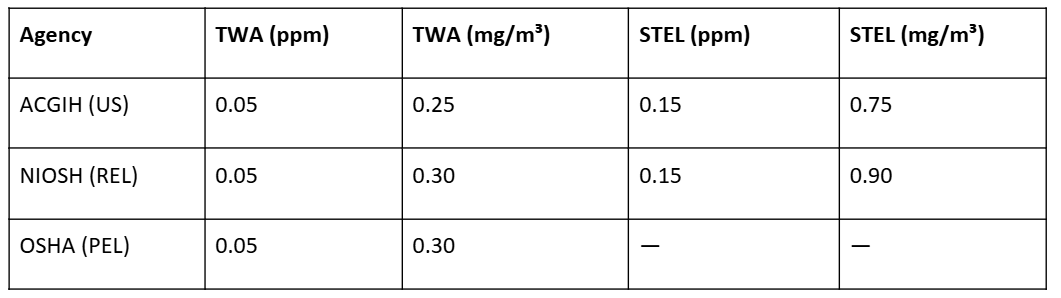
(All values as TWA unless otherwise noted)
Safety and Handling Recommendations
Effective risk management for decaborane requires a combination of engineering controls, administrative measures, and personal protective equipment (PPE).
-
Engineering Controls
- Containment: Use glove boxes or sealed reaction vessels with inert atmosphere (e.g., nitrogen) for manipulations.
- Ventilation: Local exhaust ventilation (fume hoods) rated for flammable and toxic gases.
- Explosion-proof equipment: Electrical fittings, lighting, and instrumentation in work areas to prevent ignition sources.
-
Administrative Controls
- Training: Personnel must receive specialized training on decaborane hazards, emergency procedures, and spill response.
- SOPs: Standard operating procedures detailing safe transfer, storage, and disposal practices.
- Labeling and signage: Clearly mark storage areas and containers with hazard warnings and handling instructions.
-
Personal Protective Equipment
- Respiratory protection: Air-purifying respirators with cartridges rated for organic vapors and toxic gases, or supplied-air respirators in high-concentration scenarios.
- Skin and eye protection: Chemical-resistant gloves (e.g., nitrile or butyl rubber), lab coat or coveralls, and full-face shield or safety goggles.
- Emergency gear: Safety shower and eyewash station within 10 m of the work area.
-
First Aid Measures
- Inhalation: Move victim to fresh air; administer oxygen or artificial respiration if needed; seek immediate medical care.
- Skin contact: Remove contaminated clothing; wash thoroughly with water and soap; transport to healthcare facility if irritation persists.
- Eye contact: Flush eyes with lukewarm water for at least 15 minutes; obtain medical attention.
- Ingestion: Do not induce vomiting if more than 30 minutes have elapsed; administer activated charcoal if victim is conscious; seek medical care immediately.
-
Storage and Disposal
- Storage: In tightly sealed containers under inert atmosphere in a cool, dry, well-ventilated area away from oxidizers, heat sources, and incompatible materials.
- Transport: Classified as UN 1868; package according to relevant DOT/ADR regulations for flammable solids.
- Waste disposal: Collect contaminated materials as hazardous waste; incinerate in chemical incinerators equipped with afterburners and scrubbers. Do not discharge into waterways.
-
Emergency Response
In the event of fire or major spill:
- Evacuate non-essential personnel and isolate the area.
- Firefighting: Use dry chemical powder, foam, or inert gas; water spray may spread burning material.
- Spill control: Avoid generating dust; cover spill with inert absorbent (e.g., dry sand); collect in sealed containers for disposal.
- Decontamination: Wash affected area with copious water; ventilate thoroughly before re-entry
Conclusion
Decaborane(14) is a powerful reagent and functional material precursor crucial to modern technology, from semiconductor fabrication to advanced coatings and propellant systems. Its high toxicity, flammability, and reactive nature necessitate comprehensive hazard assessment and rigorous safety controls. Adhering to best practices in engineering, administrative protocols, and use of appropriate PPE ensures the benefits of decaborane can be harnessed while minimizing risks to health and the environment.
Leave A Comment