 Skip to content

In the high-stakes world of industrial operations, robust hazard analysis isn’t just a smart business strategy. It’s a non-negotiable legal imperative mandated across the United States. Federal agencies like the Occupational Safety and Health Administration (OSHA) and the Environmental Protection Agency (EPA) lay down stringent requirements, compelling companies to meticulously identify, evaluate, and control potential risks inherent in their processes and facilities.
From chemical spills to mechanical failures, industries are legally obligated to conduct thorough hazard analyses, often under specific mandates like OSHA’s Process Safety Management standard, to prevent catastrophic accidents, protect workers, and safeguard surrounding communities. Ultimately, this comprehensive legal framework underscores a fundamental truth: proactive hazard analysis isn’t merely a best practice. It’s a critical compliance pillar designed to keep everyone safe and operations running smoothly.
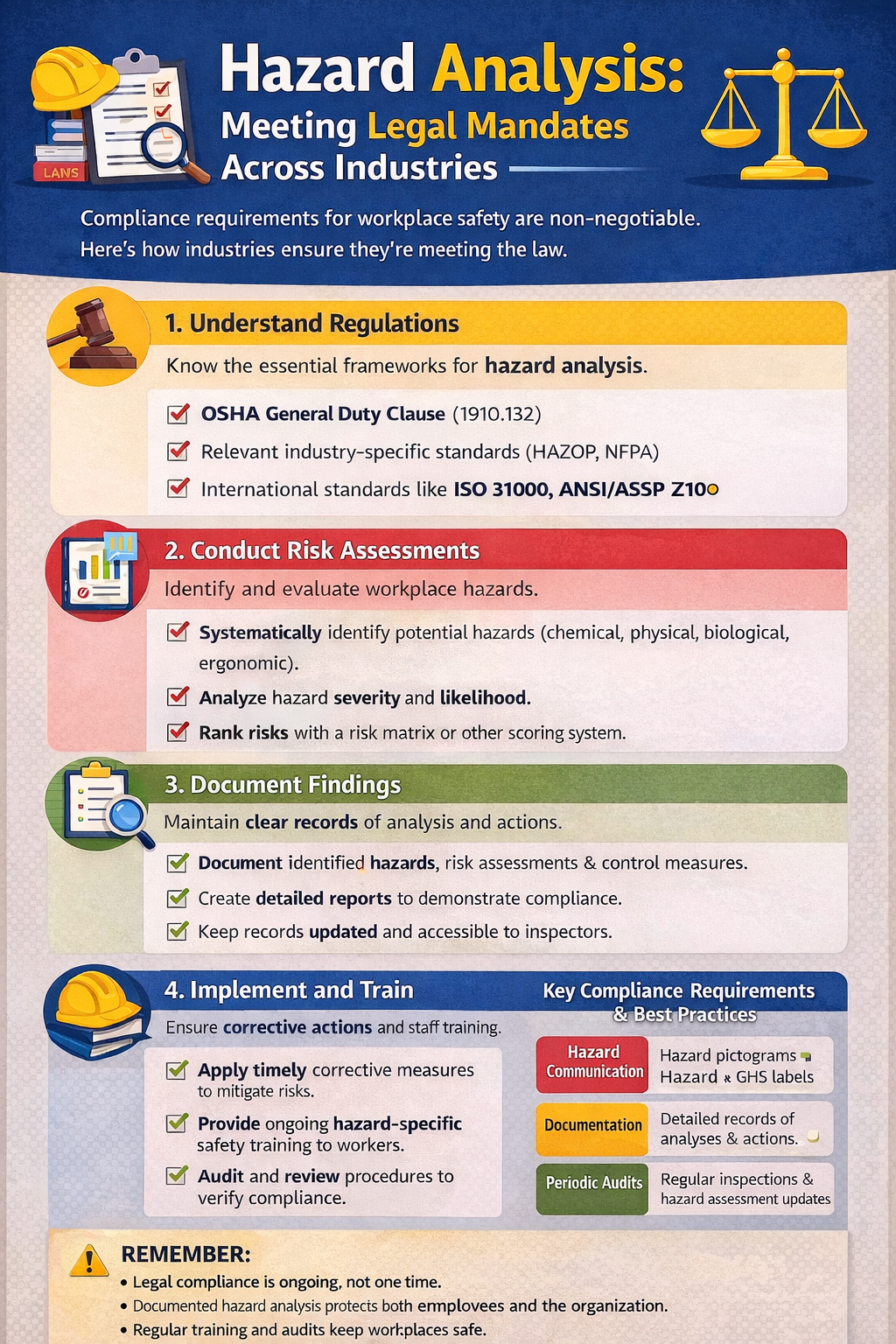
Hazard Analysis: Meeting Legal Mandates Across Industries
Hazard analysis is a critical process in industries to identify, evaluate, and control risks associated with hazardous materials, processes, and operations. Legal requirements mandate these analyses to prevent accidents, protect workers, and ensure compliance across global jurisdictions.
Introduction to Hazard Analysis
Hazard analysis systematically identifies potential sources of harm in industrial settings, such as chemical reactions, equipment failures, or human errors. Industries must conduct these analyses to comply with regulations that evolved from major disasters like Bhopal and Seveso.
Governments enforce hazard analysis through standards like OSHA in the US, REACH in the EU, and the Factories Act in India. These frameworks require documentation, team involvement, and periodic reviews to mitigate risks effectively. Failure to comply with results in severe penalties, including fines and operational shutdowns.
Key Legal Frameworks in the US
-
OSHA Process Safety Management (PSM)
OSHA’s PSM standard (29 CFR 1910.119) applies to processes involving highly hazardous chemicals above threshold quantities, such as flammables over 10,000 pounds. Employers must perform a Process Hazard Analysis (PHA) to identify, evaluate, and control hazards like fires, explosions, or toxic releases.
PHAs must address seven key issues:
- Design and technology of the process
- Impact of process changes
- Human factors
- Safeguards like detection systems
- Facility siting
- Consequences of deviations
- Worst-case scenarios
PHAs are required initially, every five years, and after significant changes, using methods like HAZOP or What-If analysis. Non-compliance incurs fines up to $129,336 per willful violation, with criminal penalties if fatalities occur.
-
Hazard Communication Standard (HCS)
Under HCS (29 CFR 1910.1200), chemical manufacturers evaluate hazards and produce labels and Safety Data Sheets (SDSs) in a 16-section GHS-aligned format. Employers train workers on pictograms, signal words, and hazard statements for physical and health hazards.
This ensures workers understand risks from mixtures and unclassified hazards. Updates in 2012 harmonized with GHS, mandating criteria for classifying health and physical hazards.
-
EPA Risk Management Program (RMP)
EPA’s RMP under the Clean Air Act requires facilities handling toxic or flammable substances to develop plans including hazard assessments, prevention programs, and emergency responses. A PHA or Hazard Assessment updates every five years, with public submittals.
-
EU Regulatory Landscape
a. REACH Regulation
REACH (EC 1907/2006) requires companies to assess chemical hazards based on production volume, submitting data to ECHA for classification under CLP. This includes toxicological and ecotoxicological information for risk management.
Higher volumes demand advanced testing, allowing read-across or QSARs. Chemical Safety Assessments identify uses and controls, ensuring safe handling across the supply chain.
b. Seveso III Directive
Seveso III (2012/18/EU) mandates operators of upper/lower tier establishments with dangerous substances to prepare Safety Reports with hazard analyses, including domino effects and neighboring risks. Emergency plans and public information are required.
-
Indian Legal Requirements
Factories Act, 1948: Section 2(cb) defines hazardous processes exposing workers to injury, poisoning, or disease, requiring site appraisals, emergency standards, and safety committees. Factories must maintain safe plant systems and handle hazardous substances without health risks.
Post-Bhopal, the Environment (Protection) Act, 1986 strengthened penalties up to five years imprisonment and fines.
-
PESO Regulations
The Petroleum and Explosives Safety Organization (PESO) mandates approvals for handling explosives, petroleum, and pressure vessels, including hazard assessments for storage and transport. Non-compliance leads to penalties and license revocation.
Sector-Specific Mandates
1. Chemical and Process Industries
HAZOP studies, while not always directly mandated, fulfill PSM, Seveso, and Factories Act risk assessment duties. They systematically review P&IDs for deviations using guide words like “no” or “more.”
2. Food Industry: HACCP
HACCP principles, mandated by FDA/FSIS, require:
- Hazard analysis of biological, chemical, and physical risks.
- Identifying Critical Control Points (CCPs).
- Establishing limits, monitoring, corrective actions, verification, and records.
- Combustible Dust: NFPA 652
Facilities generating combustible dust must complete a Dust Hazard Analysis (DHA) by deadlines like September 2020, evaluating explosion risks and mitigation.
3. Combustible Dust: NFPA 652
Facilities generating combustible dust must complete a Dust Hazard Analysis (DHA) by deadlines like September 2020, evaluating explosion risks and mitigation.
International and Voluntary Standards
-
ISO 45001:2018
This OHSMS standard requires hazard identification through context analysis, worker participation, inspections, and incident reviews. Steps include scoping, hazard listing, risk assessment, and controls via a hierarchy (elimination to PPE).
-
ILO Guidelines
ILO promotes hazard identification across sectors like agriculture and mining, linking to control measures for noise, heights, and chemicals.
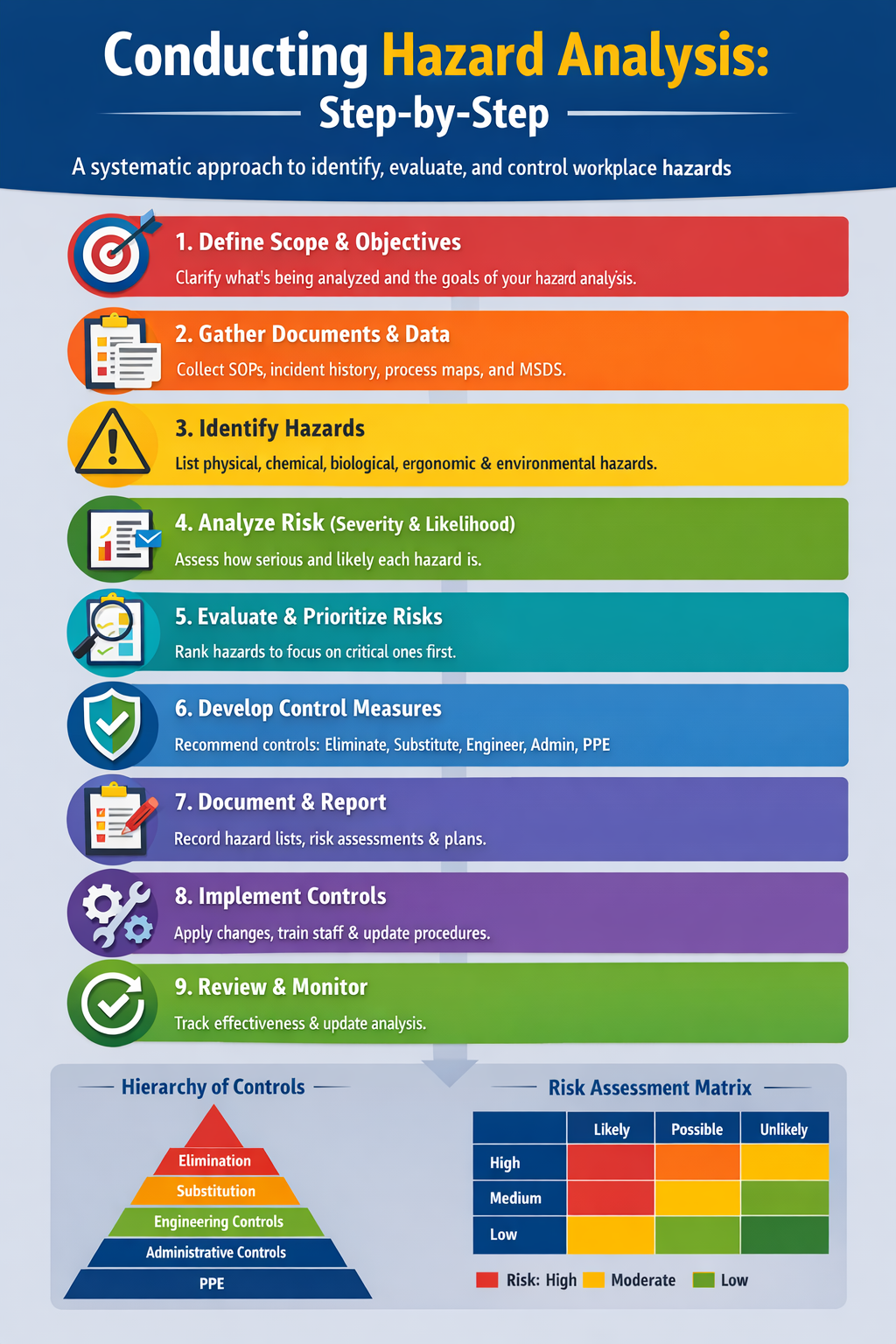
Conducting Hazard Analysis: Step-by-Step
-
Scope Definition: Determine processes, areas, and objectives.
-
Hazard Identification: Use walkthroughs, checklists, interviews for mechanical, chemical, and ergonomic risks.
-
Risk Evaluation: Apply matrices to assess likelihood x severity, considering exposures and controls.
-
Control Implementation: Prioritize elimination, substitution, engineering, admin, PPE.
-
Monitoring and Review: Audit, update post-incidents or changes.
Common PHA Techniques
- HAZOP: Node-by-node deviation analysis.
- What-If: Scenario questioning.
- Fault Tree Analysis: Top-down failure modeling.
- FMEA: Failure mode effects.
Teams include operators, engineers, and safety experts.
Compliance Challenges and Best Practices
Challenges include resource limits in SMEs and keeping analyses current amid changes. Best practices:
- Integrate digital tools for real-time tracking.
- Train multidisciplinary teams annually.
- Document everything for audits.
In India, adherence to ISO alongside Factories Act aids global trade.
Future Trends
Emerging regulations are integrating climate risks and AI-driven tools into hazard analysis, while GHS continues to drive global standardization. These trends aim to make industrial safety more proactive and aligned worldwide, especially relevant for EHS professionals managing chemical and workplace hazards.
-
Climate Risk Integration
New rules like California’s SB 261 mandate TCFD-aligned climate risk disclosures from 2026, requiring industries to assess physical hazards such as floods alongside operational vulnerabilities. EU’s CSRD and emerging EPA/OSHA initiatives expand hazard analysis to include GHG emissions and extreme weather impacts on worker safety. This shift treats climate events as core hazards in risk assessments, boosting resilience in sectors like manufacturing.
-
AI Predictive Analysis
AI tools now analyze real-time data from sensors and historical incidents to forecast hazards, aligning with OSHA compliance by preempting violations. In 2026, predictive platforms in LMS and EHS systems will detect anomalies, recommend training, and integrate with IoT for automated monitoring, reducing incidents by up to 45%. Industries are adopting these for proactive hazard control, as seen in hazard management for market growth.
-
GHS Global Harmonization
OSHA’s 2024 HCS update, incorporating GHS Rev 8, sets deadlines like January 2026 for new substances’ labels and SDS, refining classifications and formats. This fosters worldwide consistency in hazard communication, easing trade while updating mixture rules through 2028. Ongoing revisions address CBI disclosures and training, supporting your SDS management focus.
Conclusion
Industries across the United States are bound by stringent legal requirements to conduct comprehensive hazard analyses, a critical step in ensuring workplace safety. These mandates, often spearheaded by agencies like the Occupational Safety and Health Administration (OSHA), compel employers to systematically identify potential hazards—from chemical exposures and machinery malfunctions to ergonomic risks and natural disasters—and rigorously assess their
Leave A Comment