 Skip to content

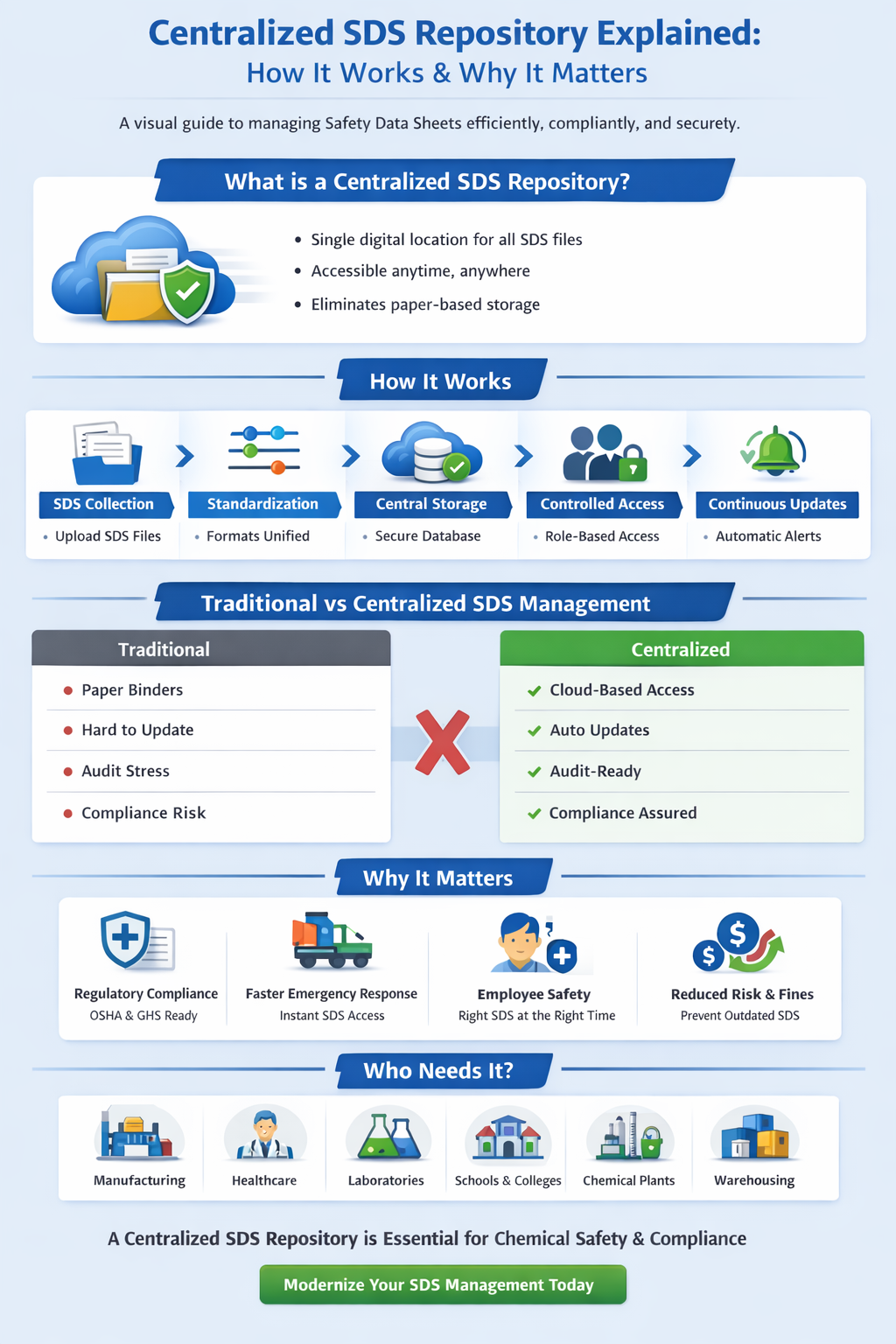
A centralized SDS repository is a secure, unified digital location where organizations store, manage, and access all Safety Data Sheets from a single platform. Unlike decentralized binders, shared drives, or scattered folders, a centralized SDS repository supports real-time updates, version control, and controlled user access—critical for modern regulatory compliance. Traditional storage methods often fail during audits because documents may be outdated, missing, or difficult to retrieve quickly, thereby increasing compliance risk under standards such as OSHA Hazard Communication. By contrast, advanced SDS document management systems ensure every chemical record is current, searchable, and audit ready. Additionally, digital SDS storage improves operational efficiency by enabling instant access for workers, safety teams, and compliance managers across multiple sites. This not only strengthens workplace safety by ensuring hazard information is always available, but also supports faster incident response, streamlined inspections, and stronger governance over chemical data across the enterprise.
Why Centralization Is Critical in Modern SDS Management
Modern organizations manage significantly larger chemical inventories than a decade ago, often sourcing materials from multiple global suppliers. This expansion increases the volume, complexity, and update frequency of Safety Data Sheets, making decentralized storage models unsustainable. A centralized SDS management approach allows companies to maintain a single verified version of each document, automatically update revisions, and eliminate duplicate or outdated records. As supply chains diversify, centralized systems help standardize chemical safety information across procurement, EHS, and operations teams, ensuring consistency in hazard communication and regulatory reporting.
At the same time, multi-site operations and remote work environments have changed how safety information must be accessed. Facilities, field teams, contractors, and remote EHS leaders all require immediate access to accurate SDS data. Centralized platforms support role-based, cloud-enabled access, enabling workers to retrieve chemical hazard information from any location without relying on physical documents or local servers.
Regulatory audits and enforcement actions are also becoming faster and more data driven. Agencies increasingly expect organizations to produce SDS records instantly, demonstrate version control, and show proof of worker access. Centralization enables automated audit trails, document tracking, and compliance reporting, reducing the risk of citations and operational disruptions.
Most critically, real-time SDS access during emergencies can directly impact worker safety and incident outcomes. Whether responding to chemical spills, exposures, or fires, teams must quickly identify hazards, PPE requirements, and first-aid measures. Centralized SDS management ensures emergency responders and workers can access accurate, current chemical safety data immediately, supporting faster, safer decision-making in high-risk situations.
How a Centralized SDS Repository Works (Step-by-Step)
1. SDS Collection from Suppliers and Manufacturers
A centralized SDS repository begins with systematic collection of Safety Data Sheets directly from chemical manufacturers, distributors, and suppliers. Modern SDS document management platforms often automate this process through supplier portals, API integrations, or bulk uploads. This ensures organizations always receive the latest revision when a supplier updates hazard classifications, exposure limits, or regulatory information. Automated collection reduces manual tracking, minimizes missing documents, and ensures regulatory alignment with standards such as OSHA HazCom and global GHS frameworks.
2. Standardized Naming and Metadata Tagging
Once collected, each SDS is standardized using consistent naming conventions and enriched with metadata. Metadata may include product name, manufacturer, CAS number, revision date, hazard classification, and storage location. This structured data layer is essential for digital SDS storage because it enables advanced filtering, regulatory reporting, and faster audit preparation. Standardization also prevents duplicate records and ensures chemical information remains consistent across sites and departments.
3. Secure Cloud Storage and Intelligent Indexing
The repository then stores SDS documents in a secure cloud-based environment with encryption, backup redundancy, and disaster recovery controls. Intelligent indexing allows the system to map documents to chemical inventories, locations, and operational workflows. This ensures SDS data is not just stored but is fully connected to procurement systems, EHS platforms, and incident management tools, improving overall safety intelligence.
4. Search and Retrieval Across Locations
Authorized users can instantly search and retrieve SDSs using multiple parameters such as chemical names, suppliers, hazard class, or site location. This capability is critical for multi-site organizations where workers, safety teams, and emergency responders may need immediate access to hazard data without depending on physical storage systems.
5. Controlled Access for Workers, EHS Teams, and Auditors
Role-based access control ensures workers can view relevant SDSs, EHS leaders can manage and update records, and auditors can review compliance documentation without compromising system security. Detailed audit trails track who accessed or modified documents, strengthening regulatory defensibility.
Core Features of a Centralized SDS Repository
-
Single Source of Truth
A centralized SDS repository provides a single verified version of every Safety Data Sheet across the organization, eliminating duplicate and outdated files stored in multiple locations. Version history and change tracking allow EHS teams to monitor updates, regulatory changes, and approval workflows. This improves audit readiness and ensures that workers always have access to current hazard information. A single source of truth also strengthens coordination among procurement, operations, and safety teams, reducing compliance risk and improving consistency in chemical data.
-
Advanced Search & Filtering
Advanced search allows users to quickly find SDSs using chemical name, product code, CAS number, UN number, manufacturer, or hazard class. Filtering helps safety teams group chemicals by risk level, storage requirements, or location. This is critical during audits, inspections, and incident response situations where fast access to hazard data is required. Strong search capabilities transform digital SDS storage into a proactive safety and compliance tool.
-
Role-Based Access Control
Role-based access ensures workers can view SDSs relevant to their tasks, while EHS teams and administrators can manage documents and compliance with workflows. Controlled access can also be provided to contractors and visitors who require hazard awareness. Access logs and audit trails track document activity, supporting regulatory compliance and protecting sensitive chemical data.
-
Mobile & Offline Access
Mobile access enables workers and safety teams to retrieve SDSs instantly on shop floors, in warehouses, or at remote sites. Offline availability ensures SDS data remains accessible during network failures or emergencies. Automatic synchronization updates documents once connectivity returns, ensuring long-term accuracy. This ensures continuous access to critical chemical safety information across all operational environments.
Centralized Repository vs Decentralized SDS Storage
Centralized SDS repositories significantly reduce compliance and operational risks compared to decentralized storage methods like binders or shared drives. Manual systems often contain outdated or missing Safety Data Sheets, increasing the likelihood of regulatory violations and safety incidents. Centralized systems maintain current documents automatically, ensuring consistent hazard communication across all locations.
Audit readiness is also stronger with centralized repositories. Digital systems provide instant document retrieval, version history, and access logs, while decentralized systems require manual document collection and often lack proof of document control. This can delay audits and increase the chance of non-compliance findings.
Time-to-access is another key difference. Centralized SDS systems allow users to locate documents in seconds using search tools. At the same time, paper binders or scattered folders may take several minutes to navigate—especially during emergencies when speed is critical.
Decentralized storage also increases duplication and error rates because multiple versions of the same SDS may exist without update tracking. Centralized repositories eliminate this by maintaining a single source of truth.
Compliance & Regulatory Benefits
✅️ Meeting OSHA Hazard Communication Immediate Access Requirements
A centralized SDS repository directly supports the OSHA Hazard Communication Standard (29 CFR 1910.1200), particularly the requirement that employees have immediate access to Safety Data Sheets during their work shift. Digital repositories eliminate delays caused by searching physical binders or disconnected storage systems, ensuring workers can quickly retrieve hazard, PPE, and first-aid information when needed. Centralized platforms also help organizations demonstrate that SDS access is consistently available across shifts, locations, and operational environments. This reduces citation risks and strengthens the overall effectiveness of the hazard communication program.
✅️ Global Regulatory Alignment Across GHS, WHMIS, REACH, CLP, and EPCRA
Modern organizations often operate across multiple regulatory jurisdictions, requiring SDS management systems to support global compliance frameworks. A centralized repository helps standardize chemical safety information aligned with GHS classification and labeling requirements, while also supporting region-specific frameworks such as WHMIS (Canada), REACH and CLP (European Union), and EPCRA (United States emergency planning and reporting). Centralized SDS document management ensures regulatory data is consistent, updated, and easily reportable, reducing the administrative burden on EHS teams managing multinational chemical inventories.
✅️ Audit Evidence, Access Logs, and Documentation Trails
Regulators increasingly expect organizations to provide documented proof of SDS availability, update history, and worker accessibility. Centralised repositories generate automated audit trails that record document uploads, revisions, approvals, and user access history. These documentation trails simplify audit preparation and allow organizations to respond to regulatory requests quickly. Digital records also help demonstrate training alignment, hazard communication distribution, and document lifecycle management, which are key elements of modern compliance inspections.
✅️ Legal Defensibility During Inspections and Incident Investigations
In the event of regulatory inspections, workplace incidents, or legal disputes, centralized SDS systems provide strong defensibility through documented evidence of compliance actions. Access logs can prove workers had SDS availability, version history can show hazard updates were implemented, and document control records can demonstrate due diligence. This level of documentation helps organizations reduce liability exposure, support insurance investigations, and defend against regulatory penalties by proving proactive chemical safety management practices.
Integration with Inventory, Training & Emergency Response
➤ Linking SDSs to Chemical Inventory Locations
A centralized SDS repository becomes significantly more valuable when directly linked to chemical inventory systems. By mapping SDSs to specific storage locations, departments, and usage areas, organizations gain real-time visibility into chemical hazards at each site. This integration supports faster risk assessments, improves chemical tracking accuracy, and ensures workers have access to the correct SDS for the exact chemical present in their workspace.
➤ Auto-Assignment of SDS-Based Training Modules
Modern SDS platforms can automatically trigger training workflows based on chemical hazards and exposure risks. When new chemicals are introduced or SDSs are updated, relevant employees can be automatically assigned hazard communication or task-specific training modules. This ensures training remains aligned with current hazard data and reduces manual training administration.
➤ Emergency Response Quick-View Access
Integrated SDS systems can generate emergency quick-view dashboards highlighting first-aid measures, spill response procedures, fire-fighting guidance, and required PPE. This allows supervisors and emergency teams to quickly access life-critical safety instructions without having to navigate full SDS documents during incidents.
➤ QR-Code Access from Containers and Work Areas
QR codes placed on chemical containers, storage cabinets, or workstations allow workers to instantly access SDSs using mobile devices. This eliminates delays, improves hazard awareness at point-of-use, and strengthens real-time compliance with hazard communication requirements.
Operational & Safety Impact
- Reduced Incident Response Time
Centralized SDS access ensures emergency responders and workers can immediately retrieve hazard data, improve decision-making speed and reduce exposure severity.
- Improved PPE Selection and Hazard Awareness
Consistent SDS access improves worker understanding of chemical hazards and ensures proper PPE selection based on current safety data.
- Fewer Workflow Disruptions
Workers spend less time searching for SDSs, reducing production delays, and improving operational efficiency.
- Reduced Downtime During Inspections
Instant SDS retrieval enables organizations to respond quickly to audit requests, minimizing operational interruptions during regulatory inspections.
Data Governance, Security & Reliability
- Encryption and Data Protection
Modern SDS repositories use encryption, access controls, and secure authentication protocols to protect sensitive chemical and supplier data.
- System Uptime and Redundancy
Cloud-based SDS systems are designed with redundancy and high-availability architecture to ensure continuous system access.
- Version Validation and Tamper Resistance
Automated version control ensures only approved SDSs are accessible while maintaining full document history.
- Backup and Disaster Recovery
Automated backups and disaster recovery protocols protect SDS data from system failures, cyber threats, or physical disasters.
Common Mistakes When Building an SDS Repository
- Treating It as a Static Document Dump
Simply uploading SDSs without indexing, metadata, or workflows limits system value and reduces compliance effectiveness.
- No Ownership or Update Process
Without defined SDS ownership, documents may become outdated, increasing compliance and safety risks.
- Poor Naming Conventions
Inconsistent naming makes SDS retrieval difficult and increases the risk of duplication.
- No Linkage to Inventory or Usage Locations
Disconnected SDS systems prevent accurate hazard visibility at the point of use.
- Lack of Offline or Mobile Access
Without mobile or offline access, workers may lose SDS access during emergencies or field operations.
Best Practices for Implementing a Centralized SDS Repository
- SDS Gap Assessment and Cleanup
Start by identifying missing, duplicate, or outdated SDSs and standardizing the document library before system migration.
- Standardized Metadata and Taxonomy
Use consistent naming structures and tagging standards to support searchability and reporting.
- Supplier SDS Intake Workflows
Automate supplier SDS submission, review, and approval processes to ensure continuous document accuracy.
- Review and Revalidation Schedules
Implement routine SDS review cycles to ensure regulatory and hazard data remains current.
- User Training and Adoption Strategy
Provide training on system usage and SDS access to ensure organization-wide adoption and compliance.
Role of AI & Automation in Modern SDS Repositories
Artificial intelligence and automation are transforming how organizations manage Safety Data Sheets by shifting SDS repositories from passive document storage systems into intelligent safety and compliance platforms. As chemical inventories grow and regulatory expectations become more data-driven, AI-enabled SDS systems help EHS teams manage large volumes of chemical data with greater accuracy, speed, and predictive insight.
1. Auto-Classification of Hazards and Pictograms
AI tools can automatically analyze SDS content to identify hazard classifications, GHS pictograms, signal words, and regulatory categories. This reduces manual data entry, improves classification accuracy, and ensures hazard information remains consistent across labels, training systems, and compliance reports. Automated classification also helps organizations quickly onboard new chemicals into safety programs.
2. Expiry and Revision Alerts
Automation enables continuous SDS lifecycle monitoring by generating alerts when SDSs approach review deadlines or when suppliers release updated versions. This ensures organizations always maintain current chemical hazard data and reduces the risk of outdated SDSs remaining in circulation. Automated notifications also support proactive compliance management instead of reactive document updates.
3. Risk Scoring and Prioritization
AI-driven risk scoring helps organizations identify high-risk chemicals based on toxicity, exposure frequency, regulatory classification, and usage location. This allows EHS teams to prioritize training, monitoring, substitution programs, and engineering controls for the most hazardous substances first, improving overall risk management efficiency.
4. Intelligent Search and Summaries
Natural language search allows workers to ask safety questions and instantly retrieve relevant SDS data. AI-generated summaries highlight key hazards, PPE requirements, and emergency response steps, helping workers quickly understand critical safety information without having reviewed full SDS documents.
Industries That Benefit Most from Centralized SDS Repositories
✔ Manufacturing
Manufacturing organizations often manage large chemical inventories across multiple facilities, making centralized SDS repositories essential for maintaining consistent hazard communication, regulatory reporting, and audit readiness. Real-time SDS access helps reduce workplace safety risks, supports standardized chemical handling procedures, and improves production continuity across sites. Centralized systems also help align procurement, operations, and EHS teams with consistent chemical safety data.
✔ Healthcare and Laboratories
In healthcare and laboratory environments, staff must access chemical, biological, and pharmaceutical safety data instantly to manage exposure risks and ensure safe handling. Centralized repositories support strict regulatory, accreditation, and inspection requirements while improving emergency response readiness. Quick access to first-aid, exposure control, and storage guidance helps reduce incident severity and improves safety compliance.
✔ Education (Schools and Colleges)
Educational institutions benefit from centralized SDS management by improving laboratory chemical control and supporting regulatory safety requirements. Digital SDS access enables faculty, lab technicians, and safety teams to retrieve hazard information during experiments or emergencies quickly. This supports safer learning environments and strengthens chemical safety training programs.
✔ Chemical Distribution
Chemical distributors use centralized SDS repositories to improve supply chain compliance, transport safety, and customer SDS-sharing requirements. Centralized systems ensure customers receive accurate, up-to-date SDSs while helping distributors meet global shipping and regulatory standards.
✔ Energy and Utilities
Energy and utility organizations rely on centralized SDS access to support hazardous-material handling across field operations, maintenance activities, and plant environments. Quick SDS retrieval improves emergency preparedness and supports regulatory compliance.
✔ Logistics and Warehousing
Logistics and warehousing operations benefit from centralized SDS systems by ensuring accurate hazard communication during chemical storage, handling, and transport. This reduces incident risk, improves worker safety, and supports compliance with transport regulations.
Conclusion
Centralized SDS repositories have become foundational to modern chemical safety and compliance strategies across global industries. By consolidating documents, automating updates, and enabling real-time access, they reduce risk, improve audit readiness, and support faster operational decisions. Integration with AI, analytics, and regulatory databases ensures that organizations remain aligned with evolving GHS, OSHA, and global hazard communication requirements. Beyond compliance, centralized systems strengthen worker protection, standardize chemical information management, and lay a scalable foundation for digital EHS transformation. As regulatory complexity and chemical data volumes grow, centralized SDS platforms will remain critical for transparency, operational resilience, and risk management across supply chains.
Leave A Comment