

Last Updated on September 18, 2026
What Is a Chemical Hygiene Plan? OSHA Requirements Explained
Introduction
If your lab works with hazardous chemicals, OSHA doesn't just expect you to have safety data sheets on hand and call it a day. Under 29 CFR 1910.1450—the Occupational Exposure to Hazardous Chemicals in Laboratories standard, often called the "Laboratory Standard"—covered employers must develop and follow a written Chemical Hygiene Plan (CHP). The regulation lays out eight specific elements the plan has to address, and OSHA's non-mandatory Appendix A adds practical guidance on top of that.
This guide walks through what a CHP actually is, who's on the hook for having one, what the eight required elements cover in practice, and how to build, audit, and maintain a plan that holds up to both an OSHA inspection and day-to-day lab work. It also covers where a CHP overlaps—and differs from—a Hazard Communication program, since the two get confused constantly.
A CHP that works is never just a binder of SDSs or a repurposed generic safety manual. It's a document specific to your facility, your chemicals, and your procedures.
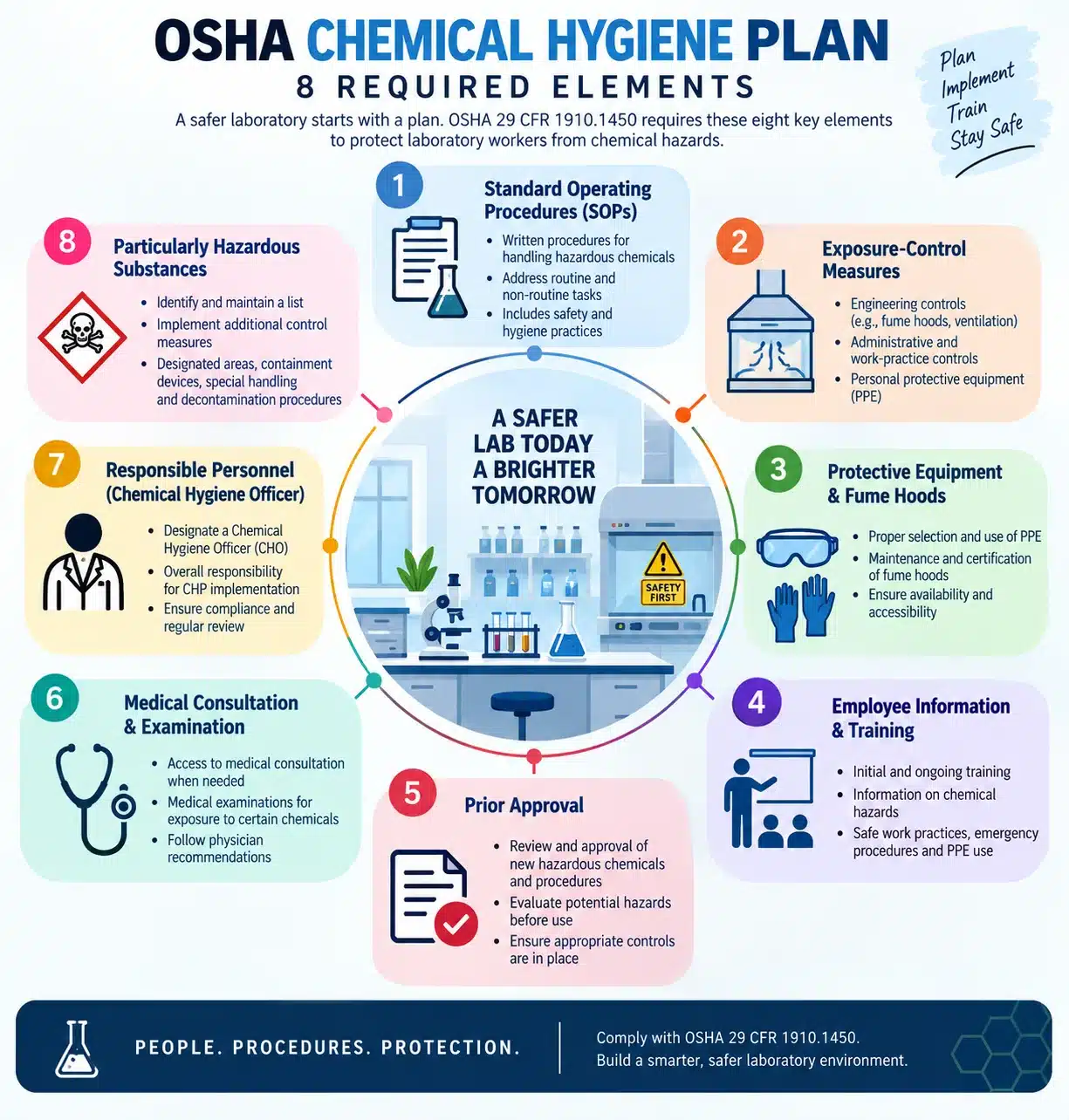
What is an OSHA Chemical Hygiene Plan?
At its core, a CHP is a written program an employer develops and puts into practice for a specific laboratory or facility. It has to reflect the actual chemicals, procedures, and equipment used at that location—not a boilerplate description of general lab safety.
A properly built CHP address:
- Procedures and work practices for handling hazardous chemicals safely, from routine bench work to higher-risk operations
- Engineering controls, such as fume hoods and local exhaust ventilation
- PPE requirements tied to specific tasks and chemical hazards
- Employee protection measures designed around the actual exposure risks present in that lab
Just as important is what a CHP is not:
- It is not simply a collection of safety data sheets. SDSs describe a chemical’s hazards; a CHP describes how your facility controls those hazards in practice.
- It is not a generic laboratory safety manual copied from another institution or a template vendor and left unmodified.
- It is not interchangeable across facilities. A CHP written for one lab’s chemical inventory and workflows doesn’t automatically protect employees in a different lab, even within the same organization.
- It does not replace your Hazard Communication program obligations under 29 CFR 1910.1200. The two programs work together but satisfy different requirements.
OSHA’s own framing is that the CHP must be capable of protecting employees from the health hazards actually presented by the hazardous chemicals used in that workplace—which is why a plan pulled from a template and never adapted tends to fail inspection scrutiny.
Who needs a chemical hygiene plan?
Not every workplace that stores or uses chemicals falls under the Laboratory Standard. OSHA's Laboratory Standard applies specifically to "laboratory use" of hazardous chemicals, a defined term with real boundaries.
When does OSHA's Laboratory Standard apply?
Under §1910.1450(b), "laboratory use of hazardous chemicals" means handling or use where all of the following are true:
- Chemical manipulations are conducted on a laboratory scale: Meaning containers and quantities that a single person can easily and safely handle.
- Multiple chemical procedures or chemicals are used: The work isn't a single repetitive operation with one substance.
- The work is not part of, or does not simulate, a production process: It's not manufacturing or production-scale work happening to occur inside a room labeled "laboratory."
- Protective laboratory practices and equipment: These are available and in common use to minimize the potential for employee exposure.
All four conditions generally need to be present for an activity to count as "laboratory use" under the standard.
Examples of workplaces that may require a CHP
- Research laboratories (academic, government, or private)
- University teaching and research labs
- Testing and analytical laboratories
- Certain hospital and clinical laboratories performing lab-scale chemical work
- R&D facilities working at bench scale rather than pilot or production scale
- Non-production quality laboratories
When the laboratory standard may not apply
This is where a lot of confusion happens, because OSHA is explicit that simply performing chemical work in a room called a "laboratory" doesn't automatically bring that work under the Laboratory Standard. Activities that typically fall outside its scope include:
- Chemical production intended for commercial sale, even if it happens in a lab-like setting
- Certain quality-control testing that is really a production-line function rather than laboratory-scale analysis
- Laboratory building maintenance activities (custodial work, HVAC maintenance, etc.)
- Any activity that doesn't meet all four conditions of "laboratory use" described above
Employers in this gray area—pilot plants, scale-up operations, or QC labs tied closely to a production line—should evaluate their specific activities against the four-part definition rather than assuming coverage (or exemption) based on room labeling alone.
What does OSHA require in a chemical hygiene plan?
Under §1910.1450(e)(3), a CHP must address eight specific elements. Here's the quick-reference map before we go element by element:
| Required element | What the CHP should address |
| Standard operating procedures | Safe procedures for hazardous chemical work |
| Exposure control measures | Engineering controls, PPE, and hygiene practices |
| Protective equipment | Fume hoods and other protective equipment, including proper function |
| Employee information and training | Hazard information and safety training requirements |
| Prior approval | Activities that require authorization before work begins |
| Medical consultation and examination | Procedures following significant exposure |
| Responsible personnel | Chemical Hygiene Officer and other assigned responsibilities |
| Particularly hazardous substances | Additional controls for select carcinogens, reproductive toxins, and highly acutely toxic substances |
The 8 required elements of an OSHA Chemical Hygiene Plan
1. Standard operating procedures (SOPs)
The CHP must establish standard operating procedures relevant to safety and health when laboratory work involves hazardous chemicals. These SOPs should cover:
- Routine chemical handling tasks performed regularly in the lab
- Higher-risk or non-routine procedures
- Chemical-specific procedures for substances with unusual hazards
- Equipment-specific procedures (autoclaves, reaction vessels, centrifuges, etc.)
- Spill and accidental-exposure response
- Chemical waste handling and disposal
Example: An SOP for handling a highly toxic solvent should specify required ventilation (e.g., fume hood use), PPE, approved storage location and container type, safe transfer methods, spill-response steps, and disposal procedure—not just a note to “use caution.”
2. Exposure-control measures
This element requires the CHP to describe criteria the employer uses to determine and implement controls—not just list the PPE employees happen to wear. OSHA expects the plan to follow the standard hierarchy of controls:
Engineering controls → administrative/work-practice controls → PPE
The plan should discuss:
- Fume hoods and local exhaust ventilation
- Chemical containment (closed systems, glove boxes, etc.)
- Safe work practices that reduce exposure without relying on PPE alone
- General laboratory hygiene practices (no eating/drinking at the bench, handwashing, etc.)
- PPE selection tied to the specific hazard, not a generic list
A plan that jumps straight to “wear gloves and goggles” without explaining how engineering and administrative controls factor into the decision misses this requirement.
3. Fume hoods and other protective equipment
The CHP must address the proper functioning of fume hoods and other protective equipment, along with:
- Inspection and testing procedures, and how often they occur
- What employees should do if equipment appears to be malfunctioning
- Maintenance responsibilities and scheduling
- How deficiencies are documented and tracked to resolution
One important note: OSHA’s Laboratory Standard does not itself specify a numeric performance criterion (like a particular face-velocity range) for fume hoods. If your CHP cites a specific airflow number, that figure should be attributed to the applicable consensus standard, your institution’s own engineering specification, or recognized guidance (such as ANSI/AIHA Z9.5)—not presented as an OSHA Laboratory Standard requirement.
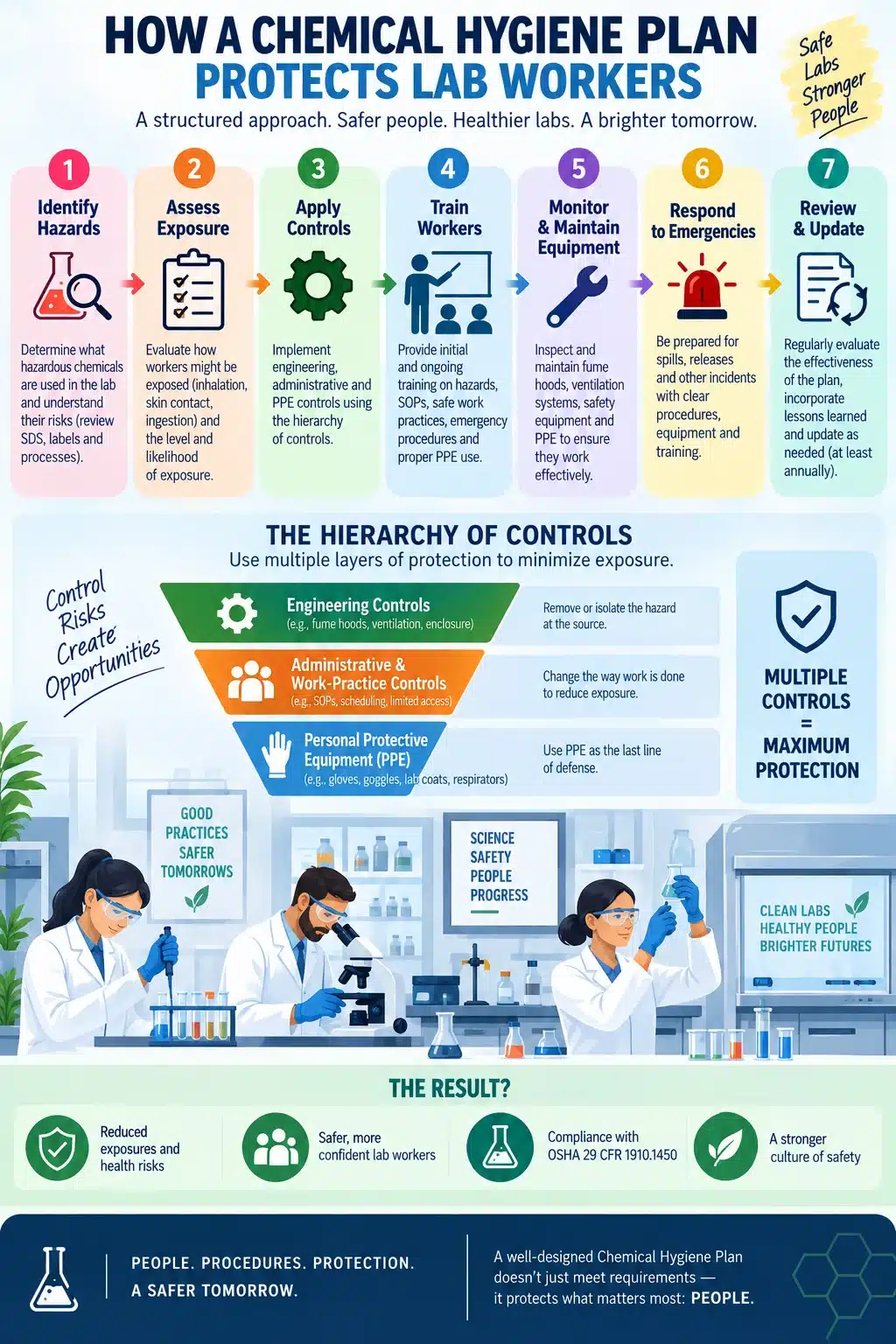
The 8 required elements of an OSHA Chemical Hygiene Plan
1. Standard operating procedures (SOPs)
The CHP must establish standard operating procedures relevant to safety and health when laboratory work involves hazardous chemicals. These SOPs should cover:
- Routine chemical handling tasks performed regularly in the lab
- Higher-risk or non-routine procedures
- Chemical-specific procedures for substances with unusual hazards
- Equipment-specific procedures (autoclaves, reaction vessels, centrifuges, etc.)
Example: An SOP for handling a highly toxic solvent should specify required ventilation (e.g., fume hood use), PPE, approved storage location and container type, safe transfer methods, spill-response steps, and disposal procedure—not just a note to “use caution.”
2. Exposure-control measures
This element requires the CHP to describe criteria the employer uses to determine and implement controls—not just list the PPE employees happen to wear. OSHA expects the plan to follow the standard hierarchy of controls:
Engineering controls → administrative/work-practice controls → PPE
The plan should discuss:
- Fume hoods and local exhaust ventilation
- Chemical containment (closed systems, glove boxes, etc.)
- Safe work practices that reduce exposure without relying on PPE alone
- General laboratory hygiene practices (no eating/drinking at the bench, handwashing, etc.)
- PPE selection tied to the specific hazard, not a generic list
A plan that jumps straight to “wear gloves and goggles” without explaining how engineering and administrative controls factor into the decision misses this requirement.
3. Fume hoods and other protective equipment
The CHP must address the proper functioning of fume hoods and other protective equipment, along with:
- Inspection and testing procedures, and how often they occur
- What employees should do if equipment appears to be malfunctioning
- Maintenance responsibilities and scheduling
- How deficiencies are documented and tracked to resolution
One important note: OSHA’s Laboratory Standard does not itself specify a numeric performance criterion (like a particular face-velocity range) for fume hoods. If your CHP cites a specific airflow number, that figure should be attributed to the applicable consensus standard, your institution’s own engineering specification, or recognized guidance (such as ANSI/AIHA Z9.5)—not presented as an OSHA Laboratory Standard requirement.
4. Employee information and training
Employees need to know, at minimum:
- The chemical hazards present in their work area
- Signs and symptoms associated with exposure to the hazardous chemicals they work with
- Applicable permissible exposure limits (PELs) or other recommended exposure limits
- Where the CHP is kept and how to access it
- How to access SDSs
- Safe handling procedures and required PPE
- Emergency procedures
Training is required:
- At the time of initial assignment to a work area with hazardous chemicals
- Before assignment to new tasks or exposure situations not previously covered
- On a refresher basis, at a frequency the employer determines appropriate
The CHP should specify who delivers this training, how it’s documented, and how frequently refreshers occur—not just state that “training will be provided.”
5. Prior approval of hazardous laboratory activities
The CHP should identify which activities require approval before work begins. Typical triggers include:
- Work involving particularly hazardous substances
- Unusual or non-standard procedures
- Large-scale reactions relative to normal lab practice
- Novel experimental work without an established SOP
- Procedures with unusual or elevated hazard potential
The plan needs to name who has authority to grant approval (a PI, lab director, or chemical hygiene officer, for example) and what criteria they apply—vague language like “as needed” won’t satisfy an inspector looking for a defined process.
6. Medical consultation and examination
The CHP should describe:
- Circumstances that trigger medical consultation—most notably, a significant exposure event
- What counts as signs or symptoms that warrant medical attention
- When a follow-up medical examination is provided
- The employer’s responsibility to make consultation and examination available, generally at no cost to the employee
Keep this section limited to the procedural framework (who to notify, how access to medical consultation is arranged) rather than attempting to provide medical guidance—that’s outside the scope of a CHP and belongs with occupational health providers.
7. Chemical Hygiene Officer and other responsibilities
OSHA requires the CHP to designate personnel responsible for implementation, including a Chemical Hygiene Officer (CHO), and to establish a Chemical Hygiene Committee if appropriate for the organization's size and complexity.
Chemical Hygiene Officer—typically responsible for:
- Providing technical guidance on chemical hygiene matters
- Overseeing CHP development, implementation, and updates
- General program oversight and coordination across labs
Laboratory supervisors—typically responsible for:
- Ensuring employees under their supervision follow the CHP
- Delivering or arranging required training
- Ensuring necessary controls and PPE are available and functioning
- Reporting hazards or deficiencies up the chain
Laboratory employees—typically responsible for:
- Following CHP procedures relevant to their work
- Using required controls and PPE correctly
- Reporting unsafe conditions or equipment problems
- Participating in required training
A CHP that names a CHO in the title only, without describing what that role actually does, leaves a gap the inspector commonly flags.
8. Particularly hazardous substances (PHS)
This element deserves more space in a CHP than it typically gets, since the consequences of under-addressing it are significant.
What counts as a particularly hazardous substance? OSHA's Laboratory Standard identifies three categories:
- Select carcinogens
- Reproductive toxins
- Substances with a high degree of acute toxicity
Additional protections are required for PHS work. OSHA specifically calls out four considerations the CHP should address for work with these substances:
- Establishment of a designated area for the work
- Use of containment devices, such as fume hoods or glove boxes
- Procedures for safe removal of contaminated waste
- Decontamination procedures
If your chemical inventory includes any PHS-category substances, the CHP should name them specifically and describe the controls above rather than relying on general lab safety language to cover them.
How to create a chemical hygiene plan
Building a CHP from scratch — or overhauling one that's fallen out of date — is easier to manage as a sequence of steps rather than trying to write all eight elements at once.
- Step 1: Determine whether the laboratory standard applies. Confirm the work meets the four-part definition of "laboratory use" covered above.
- Step 2: Identify chemicals and laboratory activities. Build or update a current chemical inventory and map it against the procedures actually performed.
- Step 3: Review SDSs and hazard information. Pull hazard classification, exposure limits, and handling/storage guidance for every chemical in the inventory.
- Step 4: Conduct chemical- and procedure-specific risk assessments. Identify which activities carry elevated risk and which chemicals qualify as particularly hazardous substances.
- Step 5: Select appropriate controls. Apply the hierarchy of controls—engineering controls first, then administrative practices, then PPE—for each identified hazard.
- Step 6: Develop laboratory SOPs. Write procedures specific to your equipment, chemicals, and workflows rather than adapting generic templates unchanged.
- Step 7: Define PPE and emergency procedures. Match PPE requirements to specific tasks and hazards, and document spill, exposure, and emergency-response steps.
- Step 8: Establish training requirements. Define initial and refresher training content, frequency, and documentation methods.
- Step 9: Assign CHP responsibilities. Designate a chemical hygiene officer, define supervisor and employee responsibilities, and establish a chemical hygiene committee if appropriate.
- Step 10: Implement, review, and update the CHP. Put the plan into practice, then commit to at least an annual review cycle with updates as conditions change.
OSHA's non-mandatory Appendix A supports this approach, recommending that labs conduct risk assessments before work begins—identifying hazards, evaluating the associated risks, selecting appropriate controls, and preparing for emergencies before, not after, an incident.
What should a chemical hygiene plan include? (Checklist)
Use this as a build-out or gap-analysis checklist:
- Scope and applicability statement
- Laboratory-specific hazard identification
- Current chemical inventory
- SDS access procedures
- Risk-assessment procedures
- Standard operating procedures
- Engineering controls
- PPE requirements by task/hazard
- General laboratory hygiene practices
- Fume hood inspection and use procedures
- Employee training program (initial and refresher)
- Prior-approval procedures for high-risk work
- Medical consultation and examination procedures
- Chemical Hygiene Officer and responsibility assignments
- Particularly hazardous substance procedures
- Emergency response procedures
- Spill response procedures
- Chemical waste handling procedures
- Exposure monitoring procedures (where applicable)
- Equipment inspection procedures
- Recordkeeping practices
- Annual review process
How SDSs Support a Chemical Hygiene Plan
Safety data sheets and a CHP are related but distinct documents. SDSs are the raw hazard data for a given chemical; the CHP is where that data gets translated into facility-specific action. The relationship generally runs:
SDS → hazard identification → risk assessment → SOP → controls → PPE → emergency response
What SDS information should laboratories use?
When building or updating SOPs and control measures, the most relevant SDS sections are typically:
- Section 2—Hazard identification, for classification and hazard statements
- Section 4—First-aid measures, to inform emergency-response procedures
- Section 7—Handling and storage, to inform SOPs and storage practices
- Section 8—Exposure controls/PPE, for exposure limits and recommended protective equipment
- Section 10—Stability and reactivity, for incompatibility and storage-segregation decisions
- Section 11—Toxicological information, to support risk assessments and PHS classification
Why accessible SDSs matter
OSHA requires employers to maintain SDSs received with incoming shipments of hazardous chemicals and to keep them readily accessible to employees during their work shifts. A CHP that references SDSs but doesn’t specify how employees actually locate and retrieve them in practice—a physical binder location, a digital system, or both—leaves a practical gap even if it’s technically compliant on paper.
Chemical Hygiene Plan vs. Hazard Communication Program
These two programs are often conflated, but they serve different regulatory purposes and aren’t substituted for one another.
| Category | Chemical Hygiene Plan | HazCom Program |
| Primary regulation | 29 CFR 1910.1450 | 29 CFR 1910.1200 |
| Focus | Laboratory chemical exposure prevention | Hazard communication |
| Scope | Covered laboratory use | Broader workplace chemical hazards |
| SOPs | Core CHP component | Not the central requirement |
| SDSs | Must be accessible | Core HazCom element |
| Chemical Hygiene Officer | Required under CHP | Not a HazCom requirement |
The two programs overlap — both rely on SDS access and hazard communication to employees — but a facility covered by the Laboratory Standard needs both a compliant CHP and a compliant HazCom program. One doesn't satisfy the other.
Chemical Hygiene Plan vs. SDS
- Chemical Hygiene Plan: A facility-specific safety program describing how your lab identifies hazards, controls exposure, trains employees, and responds to incidents.
- SDS: A chemical- or product-specific document describing that substance’s hazards, handling requirements, and emergency information, independent of any particular facility.
A laboratory needs both because they answer different questions: the SDS tells you what a chemical’s hazards are; the CHP tells you what your facility does about them.
How often should a chemical hygiene plan be reviewed?
Minimum review frequency: At least once a year.
When it should also be updated, outside the annual cycle:
- New chemicals are introduced to the inventory
- New laboratory procedures are adopted
- New equipment is installed
- New or previously unrecognized exposure risks are identified
- After an incident, near-miss, or exposure event
- Changes in personnel or assigned responsibilities (e.g., a new CHO)
- Changes to applicable regulatory requirements
OSHA requires employers to review and evaluate the effectiveness of the CHP at least annually and to update it as necessary—an annual review that never results in any changes is often, in practice, a sign the review wasn’t substantive.
Chemical Hygiene Plan recordkeeping
Recordkeeping for a CHP spans both regulatory requirements and good-practice documentation. It’s worth distinguishing between the two so your program doesn’t confuse “nice to have” records with mandatory ones.
Typical categories include:
- Exposure monitoring records
- Medical consultation and examination records
- Training documentation (dates, content, attendees)
- CHP revision history
- Equipment inspection and performance records
- Incident and near-miss documentation
- Chemical inventory records
Not every category above carries the same regulatory weight—exposure monitoring and medical records, for instance, have specific retention requirements tied to other OSHA standards (such as 29 CFR 1910.1020 for employee exposure and medical records), while training logs and CHP revision history are best-practice documentation that supports your ability to demonstrate compliance during an inspection.
Common Chemical Hygiene Plan mistakes
-
Using a generic CHP without laboratory-specific procedures
A template downloaded from another institution and left unedited rarely matches your actual chemical inventory or workflows—and inspectors notice quickly.
-
Failing to update the CHP after introducing new chemicals
A new hazardous chemical entering the lab should trigger a review of whether existing SOPs and controls actually cover it.
-
Treating SDS access as a substitute for a CHP
Having SDSs on file satisfies part of your HazCom obligations, not your Laboratory Standard obligations.
-
Not defining CHO responsibilities
Naming a chemical hygiene officer without describing what they actually do leaves the role hollow in practice and on paper.
-
Failing to address particularly hazardous substances
Generic controls aren't enough for select carcinogens, reproductive toxins, or highly acutely toxic substances—these need the designated-area, containment, and decontamination provisions described above.
-
Not documenting control or equipment problems
A fume hood that's flagged as malfunctioning but never logged or tracked to resolution undermines the CHP's protective-equipment element.
-
Making the CHP difficult for employees to access
A CHP stored in a location or format of employees can't easily reach during a shift and doesn't meet its practical purpose, even if the content is technically complete.
-
Failing to review the CHP annually
Skipping the annual review—or treating it as a formality—is one of the more common gaps found during inspections.
Chemical Hygiene Plan audit checklist
| Audit question | Yes/No |
| Is the CHP current? | ☐ |
| Was it reviewed within the last 12 months? | ☐ |
| Is it readily accessible to employees? | ☐ |
| Are SOPs available and up to date? | ☐ |
| Are employees trained on the CHP? | ☐ |
| Are SDSs readily accessible? | ☐ |
| Is a chemical hygiene officer designated? | ☐ |
| Are particularly hazardous substance procedures documented? | ☐ |
| Are fume hoods and protective equipment functioning properly? | ☐ |
| Are medical consultation procedures established? | ☐ |
FAQs about OSHA Chemical Hygiene Plans
-
What is a chemical hygiene plan?
A written, workplace-specific program required under 29 CFR 1910.1450 that describes how a laboratory protects employees from hazardous chemical exposure through procedures, controls, PPE, and training.
-
Is a chemical hygiene plan required by OSHA?
Yes, for employers whose employees engage in laboratory use of hazardous chemicals as defined under the Laboratory Standard.
-
Who needs a chemical hygiene plan?
Facilities where laboratory-scale, non-production chemical work is performed with protective practices and equipment in common use—research labs, testing labs, and many academic and clinical laboratories.
-
What are the eight required elements of a CHP?
Standard operating procedures, exposure-control measures, protective equipment, employee information and training, prior approval of certain activities, medical consultation and examination, designation of responsible personnel, and provisions for particularly hazardous substances.
-
Who is responsible for a chemical hygiene plan?
Overall responsibility typically sits with a designated chemical hygiene officer, supported by laboratory supervisors and employees, each with defined roles under the plan.
-
What does a chemical hygiene officer do?
Provides technical guidance on chemical hygiene, oversees CHP development and implementation, and coordinates the program across the facility.
-
How often must a CHP be reviewed?
At least annually, with additional updates whenever chemicals, procedures, equipment, or risks change.
-
Does every laboratory need a CHP?
Only those meeting the laboratory standard’s definition of covered laboratory use—not every room where chemicals are handled—qualify.
-
What is the difference between a CHP and a HazCom program?
A CHP addresses laboratory-specific exposure control under 29 CFR 1910.1450; a HazCom program addresses broader workplace hazard communication under 29 CFR 1910.1200. Covered labs need both.
-
Does a CHP replace SDSs?
No. SDSs provide chemical-specific hazard data; the CHP describes the facility’s program for controlling those hazards, informed in part by SDS content.
-
What are particularly hazardous substances under OSHA’s Laboratory Standard?
Select carcinogens, reproductive toxins, and substances with a high degree of acute toxicity.
-
Can a chemical hygiene plan be stored electronically?
Generally, yes, provided it remains readily accessible to employees during their work shifts—the standard’s accessibility requirement, not the storage medium, is what matters.

Simplify Your SDS Management
CloudSDS gives your team instant access to 23M+ safety data sheets with AI-powered search, automated updates, and full OSHA/GHS compliance — all from one platform.
Leave A Comment