
Last Updated on April 13, 2026
Working with a few risky chemicals is fine when your team takes precautions. However, certain chemical products can be highly risky, which your employees should never use. The list of such products, including aldrin 1 and cadmium compounds, is extensive. Therefore, restricting their usage in an organization that handles multiple products needs an additional filter. But does that even exist? Well, the answer is yes, and it is the banned chemical feature of the SDS management software from CloudSDS.
Regulatory bodies worldwide continuously identify and restrict hazardous substances. For instance, frameworks like REACH empower authorities to prohibit or limit chemicals that pose unmanageable risks. Substances such as asbestos and PCBs are classic examples that are now heavily restricted due to their harmful effects. The banned chemical feature is a perfect tool that organizations can utilize to meet such regulatory requirements. Besides, it allows your organization to maintain safety at the workplace, which is non-negotiable.
How does the banned chemical feature protect your organization from unnecessary hazards? Continue reading, as this article shares some useful points that your organization must know to avoid unnecessary noncompliance troubles.
What Is the Banned Chemicals Feature?
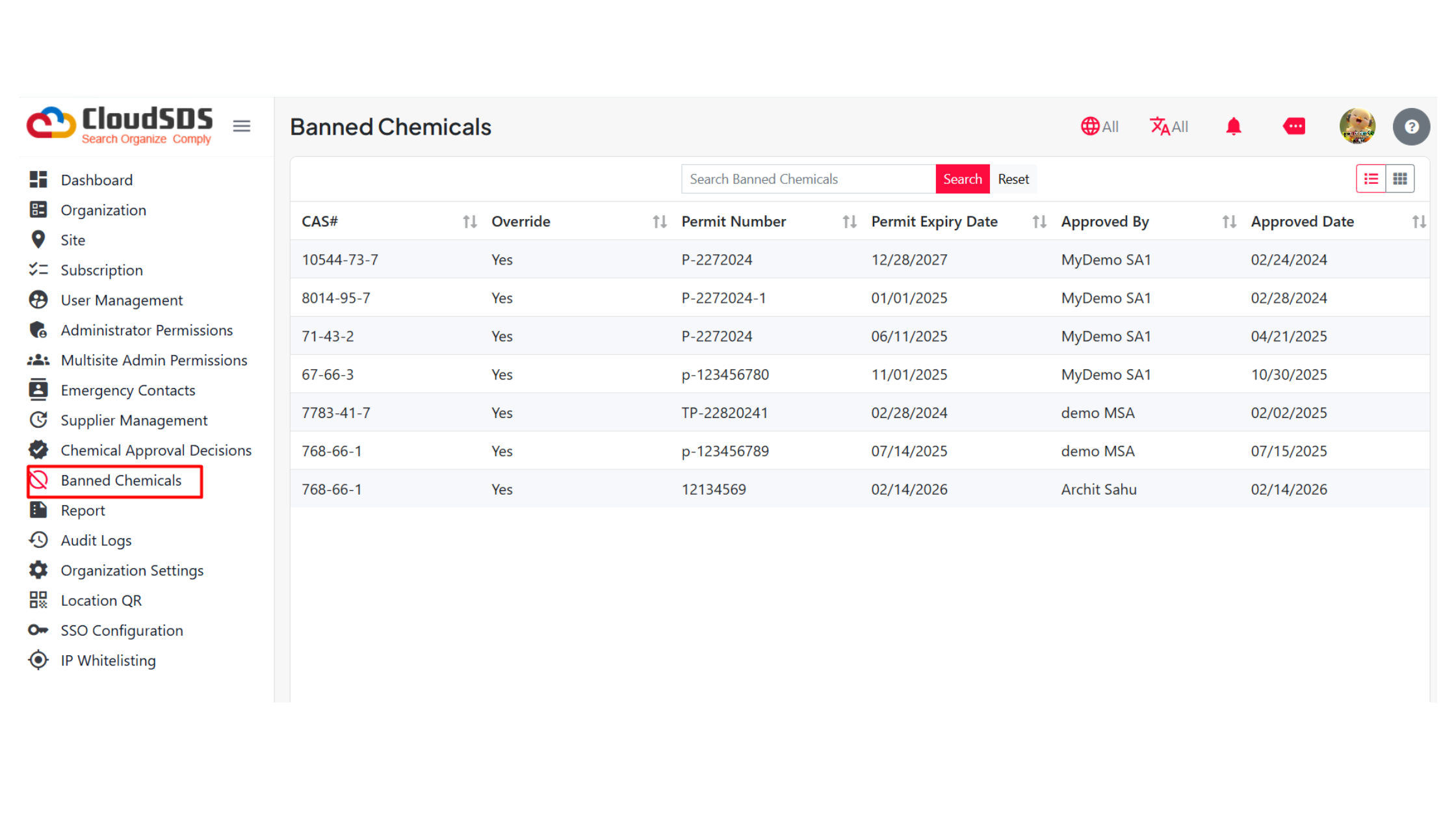
The banned chemicals feature of the SDS management software from CloudSDS is designed to automatically identify, track, and manage chemicals that are
- Restricted by global or regional regulations
- Prohibited for specific uses or industries
- Flagged as high-risk substances
This feature allows your organization to restrict the entry of chemical products identified as highly risky by regulatory bodies. Besides, the list of these chemicals may also include all substances whose usage has already been restricted by your organization.
Why managing banned chemicals is a challenge
-
Lack of visibility
Many companies retain Safety Data Sheets (SDSs) in a lot of different places, such as emails, shared files, spreadsheets, and even real binders. This scattered approach makes it difficult to keep track of all the chemicals in use.
So:
- Teams might fail to recognize that they are keeping old or non-compliant versions of SDS.
- It is possible to miss chemicals that are restricted.
- There is no source of reliable information about chemical safety.
It's difficult to find banned chemicals without centralized visibility, and it takes a long time and a lot of work.
-
Compliance risks
OSHA and REACH are two examples of regulatory frameworks that require organizations to educate consumers about the hazards of chemicals by putting labels on them and training them.
Now, the issues are
- The regulations are constantly changing.
- Different places have different lists of medications that are not allowed.
- When you keep track of things by hand, you're more likely to miss important changes.
If you can't detect or report a restricted chemical, it could lead to the following:
- Big fines and penalties
- Legal responsibilities
- Unsuccessful audits and violation of compliance
Businesses often only find out about these loopholes during inspections, which is too late.
-
Worker safety hazards
Organizations often add chemical products to this group because they are hazardous for human health. Failure to discover or clean these contaminants correctly endangers workers.
Exposure can cause major health problems, such as
- Carcinogenicity: Being around it for a long time may make you more likely to get cancer.
- Respiratory damage: Breathing in harmful fumes can hurt your lungs and produce difficulties that last for a long time.
- Skin corrosion: Touching it directly could cause burns, agony, or long-term harm.
Employees could handle these substances without the right protection if they aren't tracked and informed about them. This makes it more likely that people will get wounded at work or have long-term health problems.
Key features of the banned chemicals feature of the SDS management software from CloudSDS
-
Centralized banned chemical list
The system allows organizations to create a list of products whose usage are restricted. Thus, an organization can create a list of products that are
- Banned globally
- Restricted regionally
- Listed as hazardous substances
With this feature, your organization won't have to track records or lists of banned chemicals while storing or purchasing any new products. It also reduces any chances of errors.
-
Real-time alerts and notifications
CloudSDS instantly alerts when it detects a banned chemical. This feature is always helpful for:
- Safety managers
- Compliance officers
- Procurement teams
Whenever any of the employees try to add any restricted product to the inventory, an alert message is shared. This ensures immediate action before risks escalate.
-
Regulatory mapping
The feature aligns your chemical inventory with major regulatory frameworks such as
- REACH
- GHS classifications
This feature ensures your organization stays compliant across multiple regions. Moreover, this feature keep your team always one step ahead of the chemical safety management process.
-
Easy to banned chemical database
All flagged substances are stored in a centralized dashboard, allowing users to:
- View banned chemicals in one place
- Track usage across departments
- Monitor compliance status
With this centralized database, it is always easy to access a list of restricted products, regardless of where someone is. Furthermore, this list is accessible 24/7.
-
Easy-to-manage list
This list of banned chemicals is also simple to maintain. Your team can always add new products to the list and keep it updated. Moreover, this list can always be edited, as you can introduce changes to all the information available in it. Thus, your team can maintain an updated list of harmful products and always stay safe from chemical hazards.
Benefits of the banned chemicals feature
1. Better safety at work
By getting rid of or flagging toxic chemicals, businesses lower the risk of exposure and make the workplace safer.
2. Better compliance with rules
Stay in line with both global and local rules without having to keep track of changes manually.
3. Less risk of legal and financial problems
Your team can avoid:
- Penalties for not following the rules
- Legal responsibilities
- Shutdowns of operations
4. Making decisions faster
Real-time alerts enable quick action, preventing delays or disruptions in chemical safety management.
5. Better control of inventory
Get a full view of:
- What substances are being used?
- Where they are kept
- If they comply with the regulations
6. Improved brand image
Companies that take the initiative to handle chemical safety earn the trust of
- Buyers of the products
- Workers
- Authorities in charge of rules
Why the banned chemical feature is the future of effective chemical safety management
-
Keeps up with all regulatory changes
The rules for using banned or restricted chemicals are constantly changing. An advanced banned chemical feature keeps your firm in line by automatically updating and flagging changes in real time, so you don't have to do it manually.
-
Easily keeps track of large chemical stocks
As chemical inventories grow, it gets almost impossible to find banned substances manually. This function searches through a comprehensive list, which saves time and cuts down on mistakes.
-
Allows you to manage several places from one platform
You won't have to create multiple lists or devices to ban the entry of harmful products into your organization and all its locations. This feature gives you a single, centralized view that makes sure safety and compliance standards are the same everywhere.
-
Grows with the business
As your firm gets bigger, it gets tougher to obey the rules. This SDS management software from CloudSDS is a cloud-based system that grows quickly, so you can handle additional chemicals, users, and locations without sacrificing safety or efficiency.
Conclusion
Managing banned chemicals is not just about compliance—it's about protecting people, operations, and the environment.
The Banned Chemicals Feature in CloudSDS transforms how organizations handle chemical safety by combining automation, intelligence, and real-time insights.
In a world where chemical regulations are constantly evolving, having a system that proactively identifies risks is no longer a luxury, it's a necessity.
- Identification Details:
It shares data such as product identifiers, and manufacturer or supplier details along with their address.
- Hazards Identification:
This document also shared details on hazard classification, signal words, and hazard and precautionary statements.
- Composition or Ingredients: An SDS shares details on chemical ingredients, including hazardous components and some other relevant information.
- First Aid Measures: Users can also find some useful first-aid measures that allow them to handle emergencies.
- Fire-Fighting Measures: Employees of a facility have suitable extinguishing techniques, and understand all the hazards from combustion products.
- Accidental Release Measures: It shares helpful emergency procedures, containment methods, and cleanup procedures for the employees.
- Handling and Storage: Users can also find precautions for safe handling and storage, including the incompatibilities of the chemicals, the ideal storage conditions, and packaging materials.
- Exposure Controls or Personal Protection: An employee can also find details on appropriate engineering controls, personal protective equipment (PPE), and exposure limits.
- Physical and Chemical Properties: Knowing the physical state, appearance, odor, pH, melting point, boiling point, flashpoint, vapor pressure, etc. is possible from this document.
- Stability and Reactivity: Chemical stability, and the possibility of hazardous reactions are also crucial for users to know to stay safe.
- Toxicological Information: It shares all the possible routes of exposure, acute or chronic effects, symptoms of exposure, and toxicity data.
- Ecological Information: The users can also find ideas about the product’s capacity to damage the environment.
- Disposal Considerations: It shares some appropriate disposal methods for hazardous products also along with disposal considerations, and waste treatment methods.
- Transport Information: All the transport precautions are vital and users can find information in detail.
- Regulatory Information: Employees will also know all the safety, health, and environmental regulations by going through this document.
Simplify Your SDS Management
CloudSDS gives your team instant access to 23M+ safety data sheets with AI-powered search, automated updates, and full OSHA/GHS compliance — all from one platform.
CloudSDS’s SDS search is the easiest way to find out the required SDS in seconds. It can conducted by following the below steps easily:
-
Free Account Creation:
Users must sign up first to create a free account to view and download all of the SDSs or to get access to CloudSDS’s Global SDS repository.
-
Easy Search:
Start the search by entering either the product name or other data fields such as manufacturer name, and CAS number. In case you have the complete details of the product, enter all the details and start your search to find the specific product.
-
Advanced SDS Search:
Users can also take advantage of an advanced search that helps narrow down the entire process. Take advantage of an advanced search option to reduce the total number of search results.
Find Any SDS in Seconds
Search 23M+ safety data sheets by product name, manufacturer, or CAS number — free and instant.
A safety data sheet or SDS has the following benefits:
-
Provides Safety Information:
It offers important details regarding the dangers of chemicals. In this way, it aids people in comprehending possible concerns related to their handling, disposal, storage, and use. Additionally, it offers some particular safety advice.
-
Regulatory Compliance:
This document is necessary as proof to stay compliant with all legal requirements. After all, it contains not just hazard information but also safety tips.
-
Employee Training:
It is also required to train employees on how to handle hazardous chemicals. Besides, its tips on emergency control allow workers to save themselves and their colleagues from chemical exposures.
-
Emergency Preparations:
SDSs contain instructions for responding to chemical spills, leaks, fires, and exposure incidents. It also shares tips on taking prompt and effective emergency response actions.
Simplify Your SDS Management
CloudSDS gives your team instant access to 23M+ safety data sheets with AI-powered search, automated updates, and full OSHA/GHS compliance — all from one platform.
The chemical inventory list includes the details of all the chemicals that any manufacturing facility uses. It’s mainly a comprehensive catalog with details of all the chemicals stored or used on-site, along with relevant safety information.
The following details should be included in a complete chemical inventory list:
- Chemical Name: The chemical’s common name, scientific name, synonyms, and trade names should be mentioned in the list.
- Quantity: It must have information on the amount of each chemical currently in stock or stored at the facility.
- Location: The specific storage location should also be shared in this list for the users or workers.
- SDSs: All the relevant safety data sheets should be included here with hazard information and handling precautions.
- Expiration Date: The expiration date of the chemicals must be mentioned if applicable.
- Usage Information: Details about how the chemicals should be used in the workplace must be included here.
- Regulatory Compliance: This should also include information about the legal requirements for the handling, labeling, storage, and disposal of hazardous chemicals.
- Emergency Contact Details: Contact details for emergency response personnel or departments should also be included to tackle chemical spills, leaks, or accidents.
Simplify Your SDS Management
CloudSDS gives your team instant access to 23M+ safety data sheets with AI-powered search, automated updates, and full OSHA/GHS compliance — all from one platform.
Facilities need to rely on a proper technique to handle the chemical inventory. Check out the following details to know more about the process.
-
Identification and Documentation:
The process begins by identifying all hazardous chemicals present in the workplace. Therefore, you need to maintain a comprehensive inventory list. The list must include the names of the chemicals, and quantities, and also should share the locations where they are stored. Keeping the relevant safety data also makes the process more accurate.
- Labeling and Segregation:
To properly manage all your chemical inventory ensure that all chemical containers are properly labeled. These container labels should also display clear and accurate information about the contents. The labeling is only complete when it includes all the hazard information along with the right pictograms.
- Storage and Handling:
You must understand the importance of storing chemicals in designated areas. The place has to be well-ventilated, secure, and equipped with appropriate safety measures. It’s also important to follow manufacturer instructions and regulatory guidelines for the sake of proper handling and storage practices.
- Regular Inspections and Audits:
It’s vital to conduct proper and thorough regular inspections of chemical storage areas. Why? It will help identify potential hazards, leaks, or safety issues. Therefore, facilities must perform audits of the chemical inventory daily to ensure effective chemical safety management.
- Taking Help of Software:
To simplify the process take the help of chemical inventory management software. This software helps track chemical usage details along with reports and analysis. Moreover, auto tracks the inventory which reduces time and improves overall efficiency.
- Regular Updates:
Regular review and updates are also necessary. Therefore, organizations must maintain the inventory list to reflect changes in the inventory levels. Thus, updating new chemical acquisitions, or updates to safety regulations is possible which helps manage the inventory.
Simplify Your SDS Management
CloudSDS gives your team instant access to 23M+ safety data sheets with AI-powered search, automated updates, and full OSHA/GHS compliance — all from one platform.
A Hazardous Chemical Inventory is a comprehensive list or database that provides detailed information about the hazardous chemicals present in a facility. From this inventory, users can find data on the names and quantities of chemicals. Additionally, it shares the chemical’s locations within the facility, associated hazards, storage requirements, and some relevant safety precautions.
According to OSHA, facilities need to maintain an inventory of this type to ensure effective chemical safety management and public safety. It also helps handle emergencies and mitigate risks to the health and safety of workers and the environment.
Simplify Your SDS Management
CloudSDS gives your team instant access to 23M+ safety data sheets with AI-powered search, automated updates, and full OSHA/GHS compliance — all from one platform.
One glance at the current market size of the SDS management software reveals how businesses are feeling its requirements. That’s why the market value is expected to reach USD 90-133 billion by 2030 with a CAGR of 24-30%. This suggests that facilities will have a wide range of options to select from when determining which is best for their particular needs. What precisely should they search for? To streamline workflows and improve efficiency, finding the best SDS management software is the key.
Simplify Your SDS Management
CloudSDS gives your team instant access to 23M+ safety data sheets with AI-powered search, automated updates, and full OSHA/GHS compliance — all from one platform.
Simplify Your SDS Management
CloudSDS gives your team instant access to 23M+ safety data sheets with AI-powered search, automated updates, and full OSHA/GHS compliance — all from one platform.
Leave A Comment