
Last Updated on April 30, 2026
Introduction
The updated OSHA’s Hazard Communication Standard (HCS) is aligned with GHS Revision 7, and it introduces substantive changes to hazard classification, labeling, and SDS requirements. Employers must revise their written HazCom programs and deliver updated training by July 19, 2026, for substances and January 19, 2028, for mixtures, per the HCS 2024 final rule and the January 15, 2026, extension notice.
Manufacturers, importers, and distributors must update SDSs and labels on that same HCS‑2024 timeline, after which employers must align internal procedures and training. During this transition, dual compliance with either the 2012 or 2024 HCS is allowed, but it is essential that the entire program be updated to avoid citations.
Understand the 2024 HCS / GHS Rev 7 Updates
The final regulation for 2024 changes several aspects, but the most important ones are the following:
- New or improved hazard classes include chemicals under pressure, desensitized explosives, and nonflammable aerosols.
- Updated standards for flammable gases (including flammable gases category 2), various physical dangers, and health impacts like skin corrosion subcategories (1A, 1B, and 1C) and aspiration toxicity.
The written HazCom program must clearly mention these new hazard classifications and criteria, and it must explain how your company will find, classify, and share these dangers with all of its sites and operations.
Assess Your Current HazCom Program
Begin by reviewing your existing written HazCom program against 29 CFR 1910.1200, ensuring it clearly describes how:
- Hazards are identified and classified.
- Chemicals are labeled in the workplace.
- SDSs are maintained and made accessible.
- Employee training is conducted, and records are kept.
Conduct a gap analysis:
- List all chemicals in your inventory, prioritizing substances (due to the earlier July 19, 2026 deadline) and then mixtures.
- Examine SDSs for new hazard categories (e.g., nonflammable aerosols, desensitized explosives, and chemicals under pressure) and reclassified physical or health hazards.
- Verify whether your program addresses small container labeling, secondary containers, pipes/hoses, stationary process equipment, and trade secret claims under updated concentration-based criteria.
Document findings in a matrix that compares pre‑2024 classifications with GHS Rev 7 outcomes, particularly for solvents, flammable liquids, and pressurized systems.
Update the Hazard Classification Section.
Revise your “Hazard Determination” section to reference GHS Revision 7 criteria explicitly. For example:
“Hazards are classified per updated HCS 2024 and GHS Revision 7, including new and revised hazard classes such as desensitized explosives, nonflammable aerosols, chemicals under pressure, flammable gases category 2, and skin corrosion subcategories (1A, 1B, 1C).”
Make sure that appendices include a list of chemicals that need to be reclassified (for example, solvents classified as a potential hazard by inhalation, where there are more than 10 percent hydrocarbons present). This should be enforced, meaning SDSs have to be revised and communicated following May 19, 2026, when the suppliers begin to issue revised SDSs and labels.
Revise Labeling Procedures for GHS Rev 7
Your written program must detail updated labeling procedures that reflect the 2024 HCS, including:
- Application of updated signal words (“Danger” in higher hazard categories).
- Revised hazard statements aligned with GHS Rev 7 (e.g., for skin corrosion subcategories).
- Use of consolidated or alternative labeling for small containers, where outer packaging information or attached labels are required.
- The labeling scope includes coverage of pipes, hoses, and stationary process equipment.
For portable containers, specify that labels must include:
- Product identifier (matching the SDS).
- Pictograms.
- Signal words.
- Hazard statements.
- Supplier information (name, phone, address).
In multisite operations, standardize labeling through digital tools or SDS management platforms (e.g., CloudSDS or similar EHS‑SDS systems) to ensure consistent label content and format across facilities.
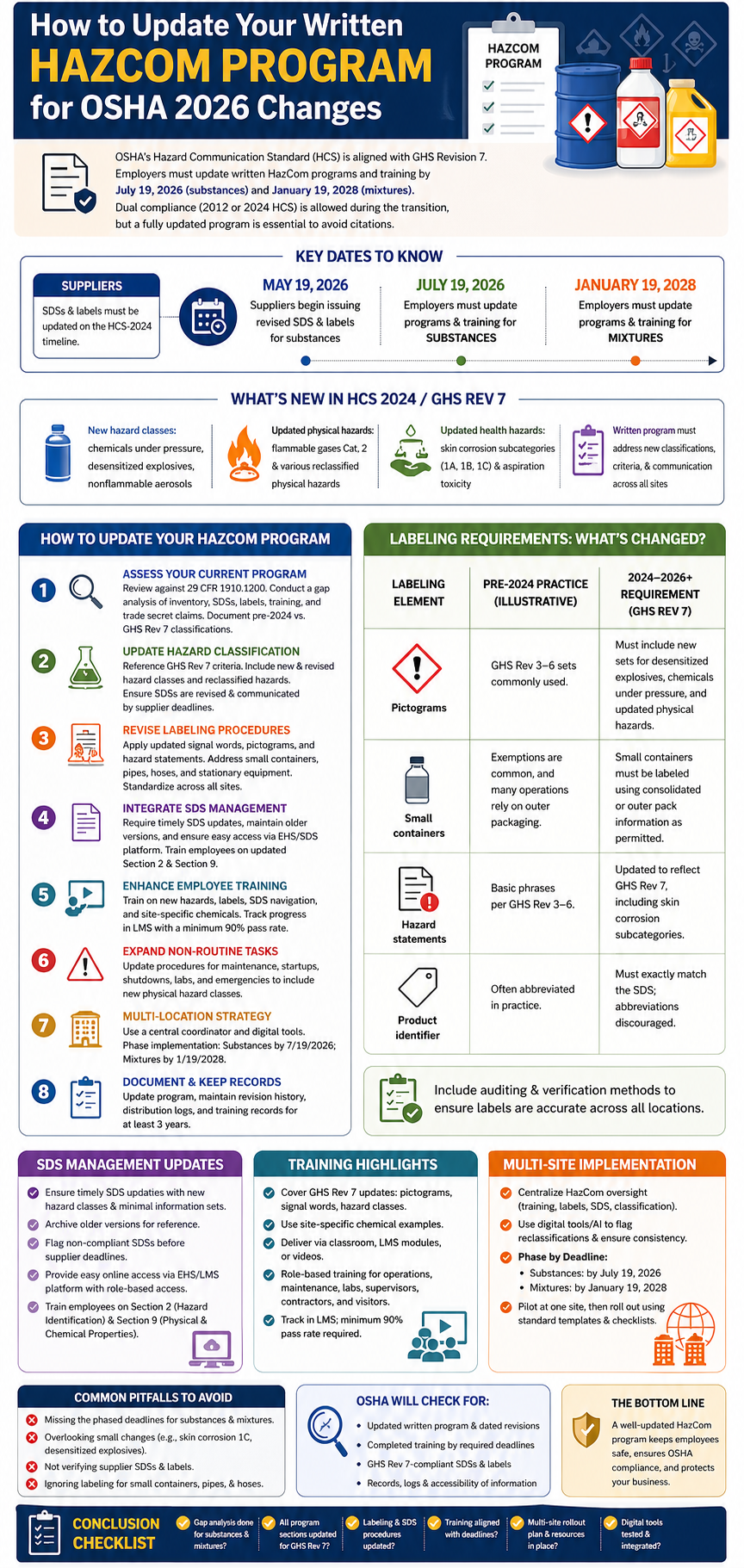
| Labeling Element | Pre-2024 Practice (illustrative) | 2024–2026+ Requirement (GHS Rev 7) |
|---|---|---|
| Pictograms | GHS Rev 3–6 sets commonly used. | Must include new sets for desensitized explosives, chemicals under pressure, and updated physical hazards. |
| Small containers | Exemptions are common, and many operations rely on outer packaging. | Small containers must be labeled using consolidated or outer pack information as permitted. |
| Hazard statements | Basic phrases per GHS Rev 3–6. | Updated to reflect GHS Rev 7, including skin corrosion subcategories. |
| Product identifier | Often abbreviated in practice. | Must exactly match the SDS; abbreviations discouraged. |
To make sure that labels are correct throughout internal inspections and pre-OSHA audit reviews, your program should include methods for auditing and verifying.
Integrate SDS Management Updates
Make your SDS management section require:
- Timely SDS updates show additional danger classes and more minimal information sets under GHS Rev 7.
- Maintain outdated SDS versions for future reference or incident investigation.
- Marking SDSs that don’t follow the rules that were sent before the supplier deadlines (May 19, 2026, for chemicals; July 19, 2027, for combinations).
Specify how SDS access will be structured:
“SDSs will be available online via the company’s EHS or learning platform (e.g., LMS/SDS management system), searchable by updated GHS categories and substance/mixture status, with role-based access for shifts, contractors, and visitors.”
For operations at more than one site, use a central EHS-SDS platform to sync SDS repositories and create procedures for:
- You should set up rules for rejecting or flagging SDSs that vendors don’t update on time.
- Letting providers higher up know when SDSs don’t match GHS Rev 7 classifications.
- Teaching workers and managers how to read Section 2 (Hazard identification) and Section 9 (Physical and chemical attributes) in the new format.
Enhance Employee Training Requirements
Make sure your training section clearly talks about:
- GHS Rev 7 adds new label features such as pictograms, danger statements, and signal words.
- Updated danger classes and categories, such as desensitized explosives, chemicals under pressure, and skin corrosion subcategories.
- Chemicals from your inventory that have been classed for use on specific sites (for example, flammables, aerosols, and pressured systems).
Example integration:
“Annual refreshers will address GHS Rev 7 changes, using examples drawn from the site-specific chemical inventory. Training will emphasize hazard recognition, label interpretation, and SDS navigation for updated Section 2 and Section 9.”
Specify how things will be delivered:
- In-person classes for high-risk enterprises.
- Modules or films based on LMS show how to handle chemicals and how to avoid accidents.
- Content varies based on roles, including operations, maintenance, and lab workers.
Use your LMS to keep track of progress, give tests on new pictograms and hazard statements, and enforce a minimum pass rate (for example, 90%) before certification. Contractors and visitors must show proof of similar training or complete onboarding sessions.
Expand Procedures for Nonroutine Tasks
Add new physical hazard classes to the sections on maintenance, shutdowns, starts, and emergencies. These classes include aerosols, pressurized systems, and reclassified flammables. Use clear terminology like this:
“Before tasks involving reclassified flammable chemicals or pressurized systems, supervisors must review updated SDSs and confirm that appropriate engineering controls, PPE, and ventilation are in place.”
Connect spill response and emergency procedures to the new physical hazard classes, such as how to deal with leaks from pressurized equipment or gas systems that can catch fire. Under the new HCS criteria, research of chemicals and trade secret formulations should be covered in labs and R&D settings. This will make sure that important hazard information is still shared even when exact identities are kept secret.
Multilocation Implementation Strategy
For operations or manufacturing that happen in more than one place:
- Choose a central HazCom coordinator or EHS lead to be in charge of training, labeling, SDS updates, and categorization.
- Use AI-powered SDS management or classification solutions to automatically highlight reclassifications and verify that updates are the same across all sites.
- Implementation of phases by type:
- Substances: Full program upgrades, labeling, and training must be done by July 19, 2026.
- Mixtures: Ensure compliance by January 19, 2028.
Test the new program at one busy location, then use standardized templates and checklists that are ready for an audit to roll it out to more sites. Use OSHA guidelines and industry templates (if you can find them) to speed up the process and connect them to your current EHS software so you can keep track of compliance in real time.
Documentation and Recordkeeping
Change your section on documentation and recordkeeping to say that:
- Signed approval of the modified written HazCom program, with a specific timeline for the changes.
- A log of the revision history that lists the most important changes, such as new danger classifications, modifications to labels, and changes to how to access SDS.
- Distribution logs that show which departments and sites got the updated program.
- OSHA says that training records must be kept for at least three years after an employee leaves the company.
For digital programs, set up version control rules (such as using SharePoint or the EHS platform) and keep audit checklists that check:
- Sections of the program were changed for GHS Rev 7.
- Labels and SDSs are up to date for each site.
- Training finished before the due date.
Common Pitfalls to Avoid
- If you don’t pay attention to the progressive deadlines for substances and mixes, you could end up partially complying and getting citations.
- Neglecting training on small changes, like the skin corrosion category (1C) or desensitized explosives, increases the risk of mistakes and accidents.
- If you don’t check SDSs and labels to make sure your suppliers are following the rules, OSHA inspections may find holes in your program.
- If you don’t follow the standards for labeling small containers and pipes/hoses, it will be easy to see violations during walkthroughs.
Sample Updated Program Outline
This is how your newly written HazCom program can appear:
- Purpose and Scope: Make sure they are in line with the most recent HCS 2024 and GHS Revision 7.
- New hazard classes are listed, and the mechanism for classifying them is explained.
- Labeling: As above, a listing of detailed techniques and labeling elements.
- SDS Management: Rules for accessing, updating, and archiving.
- Training: what it covers, how often it happens, how it is given, and what the pass rate needs to be.
- Non-routine tasks: special steps for labs, maintenance, and emergencies.
- Appendices: a list of items in stock, instances of substances that have been classed, and sample SDS templates.
Leveraging Technology for Compliance
Use or improve an SDS management platform, like CloudSDS or a similar EHS-SDS system, to:
- Automatically receive SDS upgrades and mark them as GHS Rev 7.
- Connect the new classifications to the training and inventory modules.
- Make compliance reports for audits at the site level.
Link it to your LMS, enabling the system to automatically initiate training for the affected roles upon classifying a chemical. This lowers the possibility of OSHA fines (up to $15,625 for each significant violation) and improves the safety of culture in the workplace.
Preparing for OSHA Inspections
Expect OSHA inspectors to pay close attention to the following:
- Ensure that your written HazCom program is updated and dated before the deadlines.
- By July 19, 2026, proof of completed training for substances must be sent in, and by January 19, 2028, proof of completed training for mixes must be sent in.
- SDSs and labels that show changes made in GHS Rev 7.
Before the inspection:
- Use an internal checklist that is in line with HCS 2024 to do mock audits every three months.
- Keep a collection of program changes, training logs, and SDS samples on hand so you can get them quickly.
- When you get a citation, do a root cause analysis that is directly related to program gaps and write down what you did to fix the problem.
Training Module Development
Make training modules based on roles:
- Operators: Pay attention to how to read labels, spot hazards, and handle things safely.
- Supervisors and EHS professionals are responsible for classification, reviewing SDS, and updating the program.
- Contractors and visitors: Stress the importance of universal hazard signs and emergency plans.
Use movies to show new pictograms and hazard statements and make sure that the LMS tracks who have finished. Set a minimum pass rate, like 90%, and have them do extra work if they don’t pass. For operations with more than one site, teach everyone version control so that all sites have the same GHS Rev 7 content.
Future-Proofing Your HazCom Program
- To stay informed about the changes to HCS 2024 and GHS, regularly monitor OSHA's website and the Federal Register.
- Annually, review your program to ensure it aligns with the latest GHS editions and any future OSHA changes.
- To make your business more flexible around the world, follow WHO, EPA, and international GHS standards when they apply.
Conclusion Checklist
Before the deadlines of July 19, 2026, and January 19, 2028:
- Is a gap analysis done for mixes and substances?
- Are all parts of the program updated for GHS Rev 7 danger classes?
- Are the rules for managing labels and SDS up to date?
- Are the training materials and schedules in accordance with the deadlines?
- Is there a written plan and sufficient resources for the multi-site rollout?
- Are digital tools and EHS platforms working together and being tested?
If you take care of these things, your company will be ready for smooth OSHA compliance in 2026 and beyond, with a written HazCom policy that helps both reduce regulatory risk and improve operational safety.
Simplify Your SDS Management
CloudSDS gives your team instant access to 23M+ safety data sheets with AI-powered search, automated updates, and full OSHA/GHS compliance — all from one platform.
Leave A Comment