
Summary:
In today’s high-risk work environments, effective safety training is no longer just about delivering courses—it’s about making data-driven decisions. For Environmental, Health, and Safety (EHS) teams, a modern Learning Management System (LMS) goes far beyond training delivery. It acts as a powerful analytics engine that tracks workforce readiness, identifies compliance gaps, and uncovers hidden safety risks.
By leveraging LMS reporting and analytics, organizations can move from reactive safety management to a proactive, insight-driven approach. From monitoring key metrics like completion rates and incident correlations to building real-time dashboards and predictive models, EHS teams gain the visibility needed to improve training effectiveness and reduce workplace incidents.
This guide explores how LMS analytics transforms raw training data into actionable insights—helping organizations strengthen compliance, enhance safety culture, and make smarter decisions that lead to safer, more resilient workplaces.
Intoduction:
In today’s hazardous work environment, Environmental, Health, and Safety (EHS) teams are essential for protecting everyone and ensuring regulatory compliance in all sectors:
- Manufacturing
- Construction
- Healthcare
- Logistics
- Energy
However, even a great safety program may become static if built based on guesswork rather than insight. This is when the reporting and analytics features of an LMS become indispensable. Unlike a traditional LMS, a great LMS does not provide training content only. Instead, it gathers information, which can help EHS teams make sense of:
- Workforce readiness
- Regulatory compliance issues
- Incident trends
After proper analysis, this information will turn into valuable insight. This book will show how EHS practitioners can utilize LMS reporting and analytics capabilities to boost their safety programs.
Understanding the Role of LMS in EHS Management
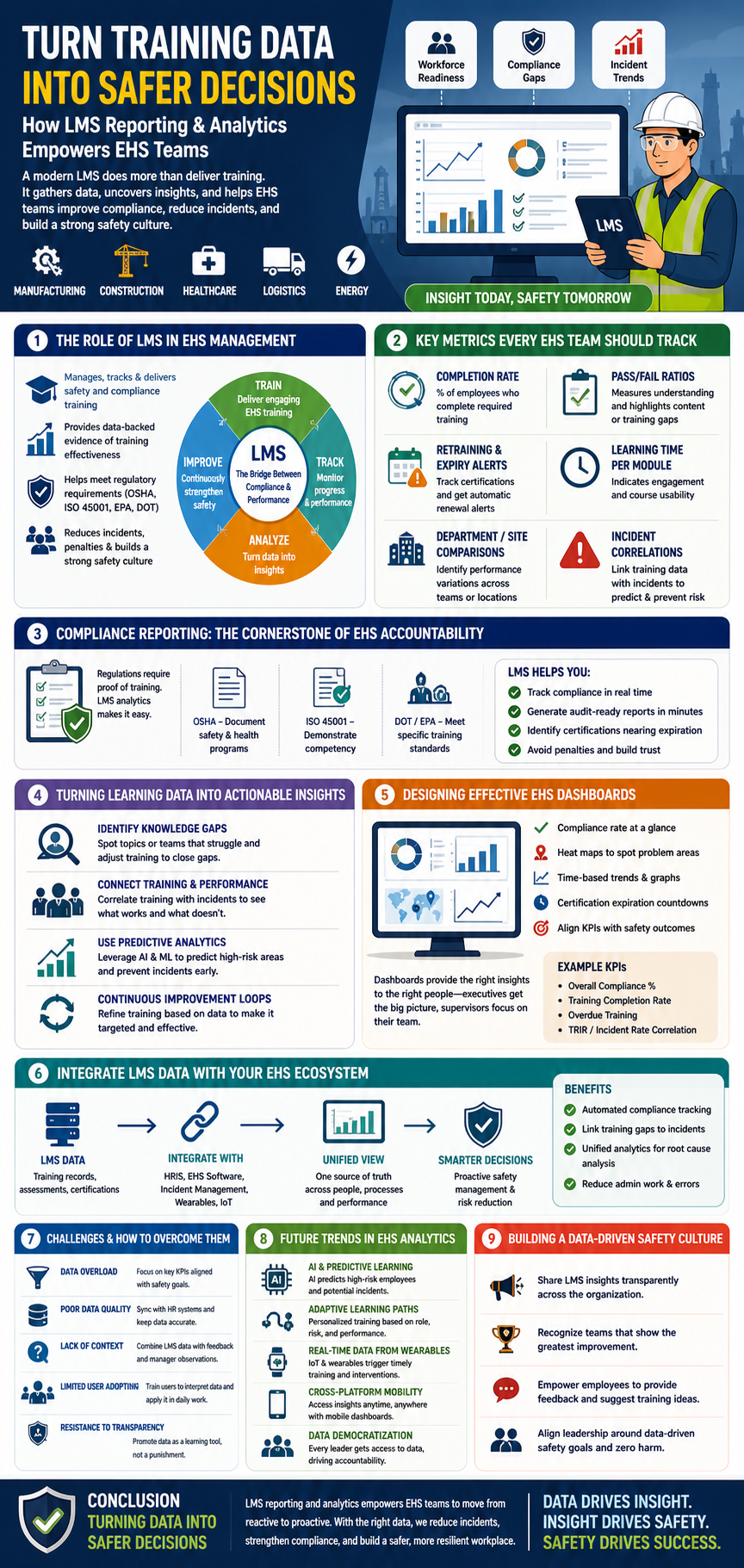
An LMS (Learning Management System) is the backbone of digital training. For EHS teams, it manages, tracks, and delivers courses focused on compliance, safety skills, and emergency preparedness. But beyond course delivery, an LMS provides quantitative evidence that training objectives are being met—or missed.
EHS leaders face dual pressures: regulatory compliance and real-world performance. Compliance requires consistent, auditable training data (e.g., OSHA, ISO 45001, or EPA requirements), while safety culture demands that workers internalize lessons and apply them.
Through reporting and analytics, LMS platforms bridge these two objectives by showing who is trained, how effectively, how recently, and with what results. This visibility helps avoid costly penalties and more importantly reduces workplace incidents.
1. Key Metrics Every EHS Team Should Track
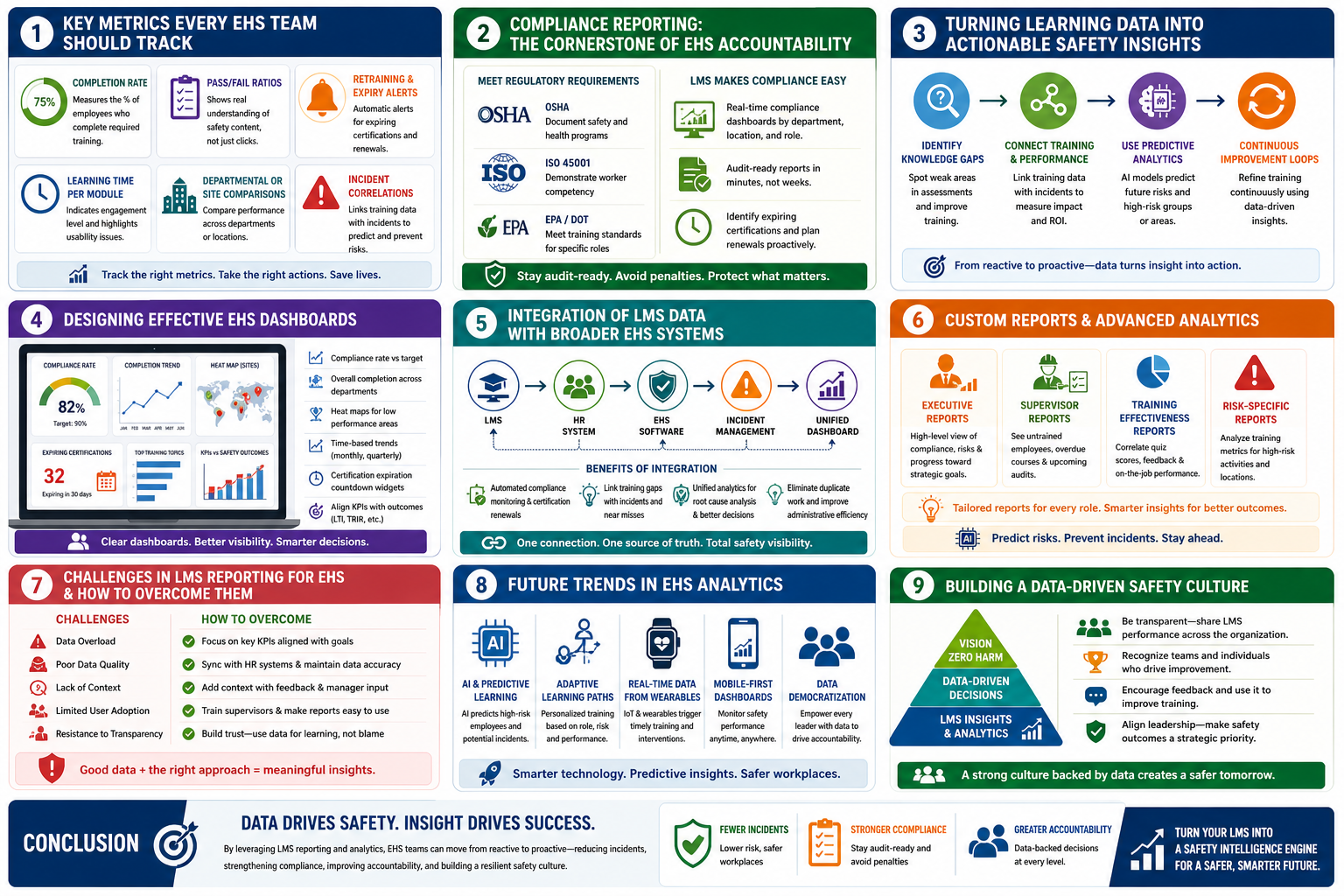
Not all LMS metrics are equally important. In order for EH&S to ensure that their efforts are being put to beneficial use, they must prioritize their KPIs. Here are some examples of metrics used:
a) Completion Rate
This measures the number of employees who have completed safety training courses. A low completion rate may signal scheduling challenges, system usability issues, or lack of supervisory support.
b) Pass/Fail Ratios
Assessment data reveals whether employees genuinely comprehend safety material or are simply clicking through. Low pass rates after multiple attempts may indicate that training materials are unclear or not practical.
c) Retraining Intervals and Expiry Alerts
Certifications for many EHS programs expire (for instance, forklift operations, HAZMAT, confined space entry). It is essential to get automatic notifications regarding the expiration of certification.
d) Learning Time per Module
Time learners take to complete a course can be an indicator of their level of engagement in learning. Very little time could indicate superficial engagement, whereas an outlier could mean usability problems.
e) Departmental or Site Comparisons
Comparisons across departments/sites provide insights into variations in performance.
f) Incident Correlations
Advanced systems can link incident data with training history, identifying whether lack of training contributes to accidents. These turn learning analytics into a tool for predictive safety management.
2. Compliance Reporting: The Cornerstone of EHS Accountability
Regulatory bodies must have proof that training has been completed and maintained, and LMS metrics help tremendously in gathering such proof in an easy way.
They are as follows:
- Regulations laid down by OSHA regarding the need to document safety and health programs.
- Regulations set forth by ISO 45001 regarding demonstrating competency.
- Training standards required by DOT or EPA for some employees.
The EHS teams would be able to leverage automation when doing compliance tasks that include the following:
- Creating dashboards that give real-time reports on compliance rate by department/locations/roles.
- Produce evidence immediately required during an audit within minutes instead of weeks.
- Recognize certifications requiring renewal in the future.
In other words, LMS analytics not only aid in internal monitoring but also prevent penalties for the organization.
3. Turning Learning Data into Actionable Safety Insights
However, the importance of the raw data from the LMS cannot be underestimated; nevertheless, it is in the process of analysis that the benefits brought about by analytics can truly be appreciated. Using the insights gained, EHS experts will be able to shift from a reactive stance in managing safety to a proactive one.
a) Identification of Knowledge Gaps
If certain groups of employees continuously perform poorly in tests concerning lockout/tagout procedures, then they may have gaps in their knowledge regarding the real risks of this procedure. They can modify the training accordingly.
b) Connecting Training and Performance
Comparing training data against incident records will provide valuable information about whether any training investment yields the expected returns. For instance, if employees continue sustaining sprain injuries despite completing ergonomics classes, it is likely time to revamp the curriculum or change the way employees are trained.
c) Using Predictive Analytics
Predictive indicator use makes it possible to employ the LMS system data to accurately predict possible risk factors for future occurrences. Machine learning–enabled LMS systems can detect high-risk areas within a business according to employees’ performance in training programs.
d) Continuous Improvement Loops
Reporting allows for iterative refinement. Instead of offering the same annual refresher, EHS teams can prioritize high-risk topics identified through LMS data, making training more targeted and effective.
4. Designing Effective EHS Dashboards
Dashboards turn reports into easy-to-understand visuals. The most effective dashboards are those that provide clear yet comprehensive information that can help both senior management and line supervisors to see safety education trends instantly.
The key elements are:
- Compliance rate: Measures achievement against target percentage.
- Overall compliance rate: Tracks completion vs. target percentages across departments.
- Heat maps: Visualize areas (plants, divisions, job titles) with lower completion rates or higher failure scores.
- Time-based graphs: Show trends—whether completion rates are improving or declining over months.
- Certification expiration countdown widgets: Display countdowns to retraining requirements.
- Alignment of KPIs: Align LMS KPIs with other company objectives, such as lost-time injuries or TRIR.
With today’s LMS platforms allowing customization, it means that the EHS director may view the overall picture on a dashboard, whereas the site supervisor can focus on compliance issues.
5. Integration of LMS Data with Broader EHS Systems
For holistic safety management, LMS data shouldn’t exist in isolation. Integration with enterprise EHS software, HR systems, and incident management platforms creates a single source of truth.
Benefits of integration include:
- Efficient compliance monitoring: Automatically keeps track of changes made by employees and certification renewals.
- Training gaps and incident investigation: Links training gaps with incidents or near misses.
- Analytics: Integrates metrics on training, safety performance, and the environment into one dashboard for root cause analysis.
- Efficiency in administration: Avoids unnecessary re-entry of information into various systems.
The connection between these factors will help prove how training affects risk management and sustainability.
6. Custom Reports and Advanced Analytics
Different stakeholders need different lenses on the same data. Most LMS platforms allow exporting custom reports tailored to user roles and decision needs.
Examples:
- Executive Summary Reports: Show compliance percentages, key risks, and progress toward strategic objectives.
- Supervisor Reports: Outline untrained staff, overdue courses, and pending audits.
- Training Effectiveness Reports: Correlate quiz results, feedback scores, and on-the-job evaluations.
- Risk-specific Reports: Analyze training metrics in high-risk areas like chemical handling or working at heights.
Advanced LMSs also support predictive analytics—using historical data to forecast future compliance gaps or high-risk periods. For example, data might show that new-hire injuries spike within the first two weeks, prompting immediate onboarding improvements.
7. Challenges in LMS Reporting for EHS and How to Overcome Them
Even the best data systems face pitfalls. EHS teams can avoid common reporting challenges by addressing them proactively.
a) Data Overload
Too much data without direction may result in missing important information. Determine the goals for reporting beforehand, like lowering non-compliance levels by a certain percentage.
b) Poor Data Quality
Data inaccuracies (incorrect job titles, outdated user lists) can skew analysis results. Synchronize with HR systems and keep up with data maintenance.
c) Lack of Context
The pure quantification of the data may lead to misunderstandings without considering context. Combine metrics from the learning management system with employee feedback and managerial assessments.
d) Limited User Adoption
Field supervisors’ inability to use LMS reports may limit analytical benefits. Provide them with training in interpreting the data and applying it practically.
e) Resistance to Transparency
Managers who consider data transparency in an intrusion should be assured that it is a learning tool rather than punishment.
8. Future Trends in EHS Learning Analytics
As digital transformation accelerates, LMS capabilities are rapidly evolving. Trends shaping the future of EHS analytics include:
a) AI and Predictive Learning
Using artificial intelligence, behavioral data such as training completion rates, quiz duration, and roles can be analyzed to forecast employees at high safety risk. Early prevention is made possible.
b) Adaptive Learning Paths
Training pathways will be dynamically adapted using analytics, providing simplified modules for new hires and advanced courses for experienced employees.
c) Real-Time Data from Wearables
The implementation of IoT and wearable devices will enable adaptive response based on field data. For example, the LMS system can deploy relevant ergonomics modules when the sensors report constant alarms regarding unsafe posture.
d) Cross-Platform Mobility
Mobile-first reporting dashboards empower EHS leaders to monitor performance even in remote or highly distributed worksites, improving responsiveness.
e) Data Democratization
Instead of being limited to specialists, analytics dashboards will become accessible to every team leader, fostering organization-wide accountability for safety outcomes.
9. Building a Data-Driven Safety Culture
Reports and analytics will be only as valuable as the culture behind them. In this case, the end game should be creating an environment that fosters continuous learning based on data analysis.
Specific actions to take include:
- Being transparent with performance metrics on the LMS throughout the company.
- Recognizing departments with the greatest improvement in their LMS results.
- Implementing a feedback system for employees to propose changes to the training program based on actual problems encountered.
Making sure that executives understand that LMS results represent strategic success towards zero harm and are not just about checking boxes.
Conclusion: Turning Data into Safer Decisions
Today’s EHS teams no longer view LMS analytics simply as business operations; rather, they are valuable strategies that help accomplish organizational goals. By making close observations and correlations with relevant data being incorporated into the workflow, considerable progress is made regarding safety and resiliency.
Today, EHS has moved from being an enforcement-based activity to becoming one focused on proactive measures. The catalyst behind the change? Data. Once EHS teams start using their LMS system not as a passive database but as a source of predictive intelligence, the benefits become clear—the number of incidents goes down, accountability improves, and an effective safety culture becomes a reality. The future of EHS is all about data-driven decision-making.
Simplify Your SDS Management
CloudSDS gives your team instant access to 23M+ safety data sheets with AI-powered search, automated updates, and full OSHA/GHS compliance — all from one platform.
Leave A Comment