
Last Updated on August 13, 2026
Carbon Monoxide: The Silent Killer—What does the SDS tell you?
Carbon monoxide is one of the few workplace hazards that gives no warning before it hurts someone. It has no color, no smell, and no taste, which is exactly why it has earned the nickname “the silent killer.” A worker can be breathing dangerous levels of it in a warehouse, a boiler room, or a parking garage and have no idea anything is wrong until symptoms set in—and by then, the exposure may already be severe.
That’s what makes the Safety Data Sheet (SDS) for carbon monoxide such a critical document. It’s not paperwork for sale. It’s the reference that tells safety teams how the gas behaves, how much exposure is too much, what equipment can detect it, and what to do in the first sixty seconds of an emergency. This guide walks through everything a safety manager, EHS coordinator, or frontline worker needs to understand about carbon monoxide—its properties, its hazards, exposure limits, detection, PPE, storage, emergency response, and the regulations that govern all of it.
Key takeaways
- Carbon monoxide is a colorless, odorless, toxic gas that can cause oxygen deprivation and death rapidly if inhaled at high concentrations.
- Its danger is compounded by the fact that it’s undetectable by human senses — continuous gas detection is the only reliable early warning.
- Proper ventilation, exposure monitoring, and well-maintained combustion equipment are core engineering and administrative controls.
- Employers carry compliance obligations under OSHA’s Hazard Communication and Confined Space standards, along with applicable EPA and transportation regulations.
- Worker training, a rehearsed emergency response plan, and immediate access to an accurate, current SDS are what actually determine outcomes when something goes wrong.
- Platforms like CloudSDS remove the friction from SDS management — centralized documents, mobile access, inventory integration, and audit-ready reporting — so the right information is available exactly when it’s needed most.
What is carbon monoxide?
Carbon monoxide (CO) is a simple molecule—one carbon atom bonded to one oxygen atom — but its simplicity is deceptive. It's also known as carbonic oxide, and industrially it's sometimes just called "CO gas." Chemically, it carries CAS number 630-08-0 and EC number 211-128-3.
At room temperature, carbon monoxide is a colorless, odorless gas with a molecular weight of about 28 g/mol, which makes it very close to the density of ordinary air—slightly lighter, in fact, at roughly 0.97 times the density of air. That near-equal density matters operationally: unlike a heavier gas that would pool near the floor, CO tends to disperse and mix readily throughout a room or building, which is part of why it can accumulate in unexpected places.
| Property | Value |
| Chemical formula | CO |
| CAS Number | 630-08-0 |
| EC Number | 211-128-3 |
| Molecular weight | ~28.01 g/mol |
| Appearance | Colorless gas |
| Odor | Odorless |
| Density (relative to air) | ~0.97 (slightly lighter than air) |
| Boiling point | -191.5°C (-312.7°F) |
| Melting point | -205°C (-337°F) |
| Solubility in water | Slightly soluble |
Where does carbon monoxide come from?
CO forms whenever a carbon-based fuel burns without enough oxygen to complete the reaction fully. Complete combustion produces carbon dioxide and water; incomplete combustion—a fuel-rich flame, a poorly tuned engine, a blocked flue—leaves carbon monoxide behind instead. Anywhere fuel is burned, there’s potential for CO to form.
Common workplace sources include:
- Gasoline and diesel engines run indoors or in enclosed bays.
- Natural gas or propane heaters and space heaters.
- Boilers and furnaces with degraded combustion efficiency.
- Portable and standby generators.
- Forklifts and other combustion-powered material handling equipment.
- Welding, cutting, and brazing operations.
- Fireplaces and wood stoves.
- Industrial furnaces and kilns.
- Vehicle exhaust in loading docks, garages, and tunnels.
The common thread is combustion in a space where ventilation can’t keep pace with the volume of gas being produced. A gasoline-powered pressure washer used for twenty minutes in an open lot is rarely a problem. The same tool used in a closed garage can raise CO to dangerous levels within minutes.
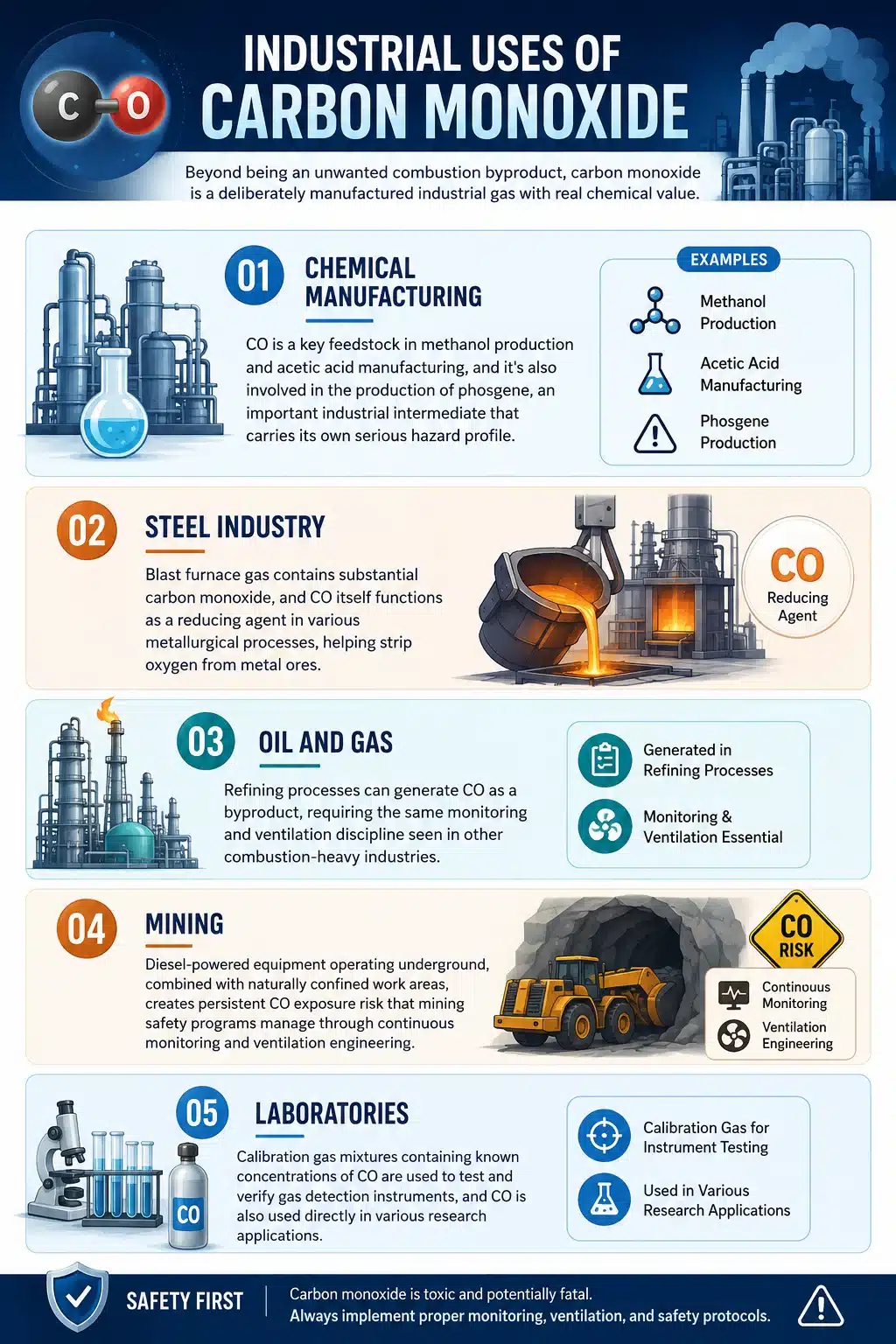
Industrial Uses of Carbon Monoxide
Beyond being an unwanted combustion byproduct, carbon monoxide is also a deliberately manufactured industrial gas with real chemical value.
-
Chemical manufacturing
CO is a key feedstock in methanol production and acetic acid manufacturing, and it's also involved in the production of phosgene, an important industrial intermediate that carries its own serious hazard profile.
-
Steel industry
Blast furnace gas contains substantial carbon monoxide, and CO itself functions as a reducing agent in various metallurgical processes, helping strip oxygen from metal ores.
-
Oil and gas
Refining processes can generate CO as a byproduct, requiring the same monitoring and ventilation discipline seen in other combustion-heavy industries.
-
Mining
Diesel-powered equipment operating underground, combined with naturally confined work areas, creates persistent CO exposure risk that mining safety programs manage through continuous monitoring and ventilation engineering.
-
Laboratories
Calibration gas mixtures containing known concentrations of CO are used to test and verify gas detection instruments, and CO is also used directly in various research applications.
Why does a carbon monoxide SDS matter?
An SDS isn’t a formality—it’s the single document that consolidates everything a worker or safety officer needs in order to make good decisions quickly. For carbon monoxide specifically, the SDS helps people:
- Identify the hazard before it becomes an emergency.
- Understand the exposure limits that define “too much.”
- Select the correct respiratory and other protective equipment.
- Know exactly how to respond if a leak or alarm occurs.
- Administer correct first aid without guessing.
- Meet OSHA’s Hazard Communication Standard obligations.
- Build realistic emergency responses and evacuation plans.
Because CO can’t be detected by the senses, the SDS effectively substitutes for the warning signs a worker would normally rely on with other hazardous materials.
Carbon Monoxide Hazard Classification
Under GHS criteria, carbon monoxide typically carries multiple hazard classifications simultaneously:
| Hazard class | Classification |
| Acute toxicity (inhalation) | Category 3 |
| Flammable gas | Category 1 (where applicable, e.g., compressed CO) |
| Specific target organ toxicity (single exposure) | Category 1 |
| Simple asphyxiant | Relevant in oxygen-displacement scenarios |
What makes CO uniquely dangerous compared to many other regulated gases is the combination of high acute toxicity with total sensory undetectability. A flammable gas with a strong odor gives people a chance to react before concentration becomes lethal. Carbon monoxide gives no such chance — concentration can climb from harmless to fatal without any perceptible change in the environment, which is precisely why continuous instrumental monitoring isn't optional in high-risk settings.
GHS label elements
A compliant label for carbon monoxide generally includes:
Signal Word: Danger
Hazard Statements (representative examples):
- Fatal if inhaled.
- Extremely flammable gas (where the product form applies).
- May cause damage to organs through prolonged or repeated exposure.
Precautionary Statements, organized across four categories:
- Prevention—measures like using only outdoors or in well-ventilated areas, and keeping away from heat and ignition sources
- Response—actions such as removing a victim to fresh air and calling emergency services immediately
- Storage—guidance on cylinder storage location and conditions
- Disposal—proper procedures for returning cylinders or venting residual gas safely
Pictograms typically include the skull-and-crossbones (acute toxicity), the flame (flammability, where applicable), and the health hazard pictogram representing target organ toxicity.
Health Hazards of Carbon Monoxide
1. How does carbon monoxide affect the body?
Oxygen normally travels through the bloodstream attached to hemoglobin in red blood cells. Carbon monoxide competes for that same binding site—and wins. CO binds to hemoglobin roughly 200 to 250 times more readily than oxygen does, forming a compound called carboxyhemoglobin (COHb). Once hemoglobin is occupied by CO, it can no longer carry oxygen effectively, and the tissues throughout the body—starting with the most oxygen-hungry organs, the brain and heart—begin to starve oxygen. This is why carbon monoxide poisoning is fundamentally a form of chemical asphyxiation: the air in the room may still contain plenty of oxygen, but the body loses its ability to use it.
2. Symptoms by exposure level
| Exposure Level | Typical Symptoms |
| Low | Mild headache, slight fatigue |
| Moderate | Throbbing headache, dizziness, nausea, drowsiness |
| High | Severe headache, confusion, vomiting, rapid heartbeat, chest pain |
| Severe | Loss of consciousness, seizures, coma, death |
3. Acute vs. chronic effects
Acute exposure can produce the symptoms of progression within minutes to hours, depending on concentration. Chronic, lower-level exposure—such as working repeatedly near poorly maintained combustion equipment—has been associated with persistent headaches, memory and concentration difficulties, and fatigue that doesn’t resolve with rest.
Pregnant workers face elevated concern because fetal hemoglobin binds carbon monoxide even more readily than adult hemoglobin, meaning a fetus can experience oxygen deprivation at exposure levels a pregnant worker herself might tolerate without severe symptoms.
Cardiovascular risk is significant because the heart is highly sensitive to reduced oxygen delivery; workers with existing heart conditions face amplified risk even at moderate CO levels.
Neurological effects from significant exposure can include delayed-onset symptoms—cognitive or movement difficulties that appear days to weeks after an acute exposure, even after apparent recovery.
4. Routes of exposure
Inhalation is essentially the only route of concern for carbon monoxide. Skin contact isn’t a meaningful hazard pathway because CO doesn’t absorb through intact skin in any toxicologically significant way, and ingestion isn’t applicable since CO is a gas under normal conditions and isn’t handled as a liquid or solid that could be swallowed.
5. OSHA and occupational exposure limits
| Standard | Limit |
| OSHA PEL | 50 ppm (8-hour TWA) |
| NIOSH REL | 35 ppm (TWA); 200 ppm ceiling |
| ACGIH TLV | 25 ppm (TWA) |
| IDLH | 1,200 ppm |
Carbon monoxide detection and monitoring
Because human senses are useless against this gas, detection technology carries the entire burden of early warning.
Fixed gas detection systems are wall- or ceiling-mounted sensors wired into a building's safety system, typically covering garages, boiler rooms, and other permanent combustion-risk areas. Portable CO monitors let technicians check specific locations or pieces of equipment on demand. Personal gas detectors, clipped to a worker's clothing, provide an individual layer of protection in unpredictable environments like confined spaces. Area monitoring stations supplement these tools in larger zones where a single-point sensor wouldn't capture the full picture.
Alarm set points are usually staged—a lower "caution" threshold that prompts investigation and a higher "evacuate now" threshold tied to IDLH-relevant concentrations. None of this works without discipline around calibration and maintenance; a detector that hasn't been calibrated on schedule can give a false sense of security that's arguably worse than having no detector at all. Robust detection programs are also the backbone of OSHA confined space entry procedures, since atmospheric testing is a required step before anyone enters a permit-required confined space with combustion-related CO risk.
Required personal protective equipment (PPE)
Respiratory protection is the centerpiece of CO-related PPE. Supplied-air respirators deliver breathing air from an independent source and are appropriate for planned work in elevated-CO environments. Self-contained breathing apparatus (SCBA) is the standard for emergency response and any situation where CO concentration or oxygen level is unknown or could be immediately dangerous. Air-purifying respirators are a poor fit for CO — standard cartridges are not designed to remove carbon monoxide, so relying on one in a CO-hazard environment can create a false sense of protection.
Eye protection is typically only relevant in secondary scenarios, such as leak investigation near pressurized cylinders where physical debris or extreme cold from a rapid gas release could be a concern, rather than from the gas itself. Protective clothing and hand protection follow similar logic — situational, generally tied to handling pressurized cylinders or cold-temperature exposure from a rapid release, rather than to the gas's toxicity directly, since CO doesn't threaten the skin.
Safe handling practices
A practical, step-by-step safe work approach for any CO-risk task looks like this:
- Confirm adequate ventilation before starting combustion-related work, and verify local exhaust systems are operating correctly.
- Test the atmosphere with a calibrated monitor before and during work in enclosed or confined areas.
- Never operate fuel-powered generators, equipment generators, or pressure washers in an enclosed space without direct outdoor exhaust routing.
- Apply extra caution during hot work (welding, cutting, brazing), since these activities are common, underappreciated CO sources.
- Manage vehicle exhaust deliberately in garages and loading docks—idling engines indoors should be treated as an active hazard, not background noise.
- Position generators well away from doors, windows, and air intakes, and never inside a structure.
- Maintain combustion equipment on a preventive schedule; a poorly tuned burner or engine produces dramatically more CO than a well-maintained one.
- Leak-test connections and fittings on any system carrying CO gas before and during use.
Storage and cylinder safety
When carbon monoxide is supplied in compressed gas cylinders, several practices are non-negotiable:
- Store cylinders upright and secured with chains or straps to prevent tipping
- Keep valve protection caps in place whenever a cylinder isn’t connected to equipment
- Store within manufacturer-specified temperature limits, away from heat sources
- Ensure the storage area has adequate ventilation to prevent accumulation from a slow leak
- Separate CO cylinders from oxidizers, given the flammability of carbon monoxide gas
- Conduct routine leak inspections using soap solution or a calibrated detector, particularly around valves and fittings.
Fire and explosion hazards
Carbon monoxide is flammable, burning with a characteristic blue flame, and it has a relatively high autoignition temperature compared to many other flammable gases—but it still presents a real explosion hazard within its flammable range in air, roughly 12.5% to 74% by volume, one of the widest explosive ranges of any common industrial gas.
Suitable extinguishing media typically include carbon dioxide, dry chemical, or water spray to cool surrounding containers, though the preferred approach for a CO fire fed by a leak is to stop the flow of gas first if it’s safe to do so, since extinguishing the flame without stopping the leak can allow gas to accumulate and reignite or explode. Firefighters and emergency responders addressing a CO fire or leak should use full SCBA and structural firefighting PPE, and special precautions apply around any pressurized cylinder involved in a fire, since heat can cause a cylinder to rupture violently.
Spill or leak response
When a CO leak or alarm occurs, the response should follow a clear sequence:
- Evacuate the affected area immediately and account for all personnel.
- Establish isolation distances appropriate to the release size and location.
- Increase ventilation if it can be done safely from outside the affected zone.
- Shut down the source equipment or gas supply through emergency shutdown procedures if accessible without entering the hazard zone.
- Notify facility safety personnel and, depending on severity, external emergency responders.
- Briefly responding to emergency personnel on suspected sources, cylinder locations, and any known concentrations before they enter.
First aid measures
Inhalation is by far the most critical exposure route to address:
- Move the affected person to fresh air immediately
- Administer oxygen if trained personnel and equipment are available
- Begin CPR if the person isn't breathing or has no pulse, and continue until emergency medical help arrives
- Seek immediate medical attention regardless of how quickly symptoms seem to improve, since some neurological effects can be delayed
Eye contact and skin contact are not typically applicable to gaseous CO exposure itself, though general eye and skin care protocols apply if a worker is also exposed to a pressurized release capable of causing physical or cold-related injury.
Reactivity and chemical incompatibilities
| Incompatible material | Concern |
| Strong oxidizers | Increased fire/explosion risk |
| Oxygen-enriched atmospheres | Dramatically expands the flammable range |
| Halogens (where applicable) | Potential for hazardous reaction products |
Carbon monoxide is generally stable under normal storage conditions, but combustion or reaction with strong oxidizers can generate carbon dioxide as a decomposition product, along with the release of significant heat.
Regulatory compliance
Multiple regulatory frameworks intersect around carbon monoxide in the workplace:
- OSHA Hazard Communication Standard (29 CFR 1910.1200) requires SDS accessibility, proper labeling, and worker training
- OSHA Confined Space Standard (29 CFR 1910.146) requires atmospheric testing, including for CO, before confined space entry
- EPA requirements apply to CO as an outdoor air pollutant and may govern emissions reporting for larger sources
- TSCA Inventory listing applies to CO as a chemical substance
- SARA reporting requirements may apply depending on quantities stored or released
- GHS classification underpins label and SDS content
- NFPA 704 ratings communicate flammability, health, and reactivity hazards on fixed facility placards
- HMIS ratings provide a similar at-a-glance hazard communication system for internal facility use
Employee training checklist
☑︎ Understand carbon monoxide hazards and why it’s undetectable without instruments.
☑︎ Recognize the symptoms of exposure at different levels of severity.
☑︎ Use gas monitors correctly, including pre-use function checks.
☑︎ Know evacuation procedures and assembly points.
☑︎ Perform basic emergency response, including when administering first aid.
☑︎ Read and understand the current SDS for any CO-related product or process.
☑︎ Inspect combustion equipment for signs of poor tuning or venting problems.
☑︎ Conduct atmospheric testing before confining space entry.
☑︎ Report suspected leaks or alarms immediately, without delay, for “double-checking” informally.
Best practices for employers
Employers managing CO risk should aim to build layered protection rather than relying on any single control:
- Install fixed CO detection systems in all combustion-risk and confined areas
- Perform preventive maintenance on boilers, furnaces, and other combustion equipment on a fixed schedule
- Inspect equipment for venting or exhaust problems as part of routine maintenance, not just after complaints
- Calibrate all gas detectors on the manufacturer-recommended schedule, and document it
- Conduct periodic exposure monitoring to verify real-world conditions match assumptions
- Keep SDSs current and genuinely
- accessible—not
- Train workers annually, with refreshers after any near-miss or incident
- Maintain a written emergency response plan specific to CO scenarios
- Keep ventilation systems in good working order and verified through periodic testing
- Move toward digital, centralized chemical safety documentation so information isn't tied to a single physical binder in a single location
How CloudSDS simplifies Carbon Monoxide SDS management
Managing SDS documentation manually—binders, shared drives, scattered PDFs—creates exactly the kind of access delay that's dangerous with a hazard like carbon monoxide, where response speed matters. CloudSDS is built to close that gap.
-
Centralized SDS library
Every current carbon monoxide SDS lives in one managed system with version control, so there's no risk of a worker referencing an outdated sheet with stale exposure limits or first aid guidance.
-
Instant SDS access
QR codes placed near cylinders, equipment, or storage areas let workers and responders pull up the exact SDS on a mobile device in seconds — critical during an actual leak or exposure event, not just during a scheduled review.
-
Chemical inventory integration
Carbon monoxide cylinders and related combustion-risk chemicals can be tied directly to inventory records, giving safety teams a real-time picture of what's on site and where.
-
Compliance management
The platform is built around supporting OSHA HazCom obligations, GHS-compliant labeling, and the kind of documentation trail that makes audits far less stressful.
-
Employee training support
New hires and existing staff get straightforward access to the SDSs they need for onboarding and refresher training, rather than hunting through shared folders.
-
Reporting and audit readiness
Generate documentation and reporting on demand, so inspection days don't turn into a scramble to reconstruct records.
Frequently asked questions
1. What is carbon monoxide?
A colorless, odorless, highly toxic gas produced by incomplete combustion of fuels like gasoline, natural gas, propane, wood, and diesel.
2. Why is carbon monoxide called the silent killer?
Because it can’t be seen, smelled, or tasted, people can be exposed to dangerous or lethal concentrations with no sensory warning at all.
3. What are the symptoms of carbon monoxide poisoning?
Symptoms range from headache, dizziness, and fatigue at lower exposures to confusion, chest pain, loss of consciousness, and death at high concentrations.
4. What is the OSHA permissible exposure limit for carbon monoxide?
OSHA’s PEL is 50 ppm as an 8-hour time-weighted average, though NIOSH (35 ppm TWA) and ACGIH (25 ppm TWA) recommend more conservative limits.
5. How is carbon monoxide detected?
Through fixed gas detection systems, portable monitors, and personal gas detectors — never through smell or visual cues, since there are none.
6. What PPE is required when working around carbon monoxide?
Primarily respiratory protection—supplied-air respirators for planned elevated-exposure work, and SCBA for emergency response. Standard air-purifying respirator cartridges are not effective against CO.
7. Can carbon monoxide explode?
Yes. It’s flammable with a wide explosive range in air, roughly 12.5% to 74% by volume.
8. What industries commonly use or generate carbon monoxide?
Chemical manufacturing, steel production, oil and gas refining, mining, and laboratories, along with any industry running combustion equipment indoors or in confined areas.
9. How should carbon monoxide cylinders be stored?
Upright, secured, with valve protection caps in place, away from heat sources and oxidizers, in a well-ventilated area with routine leak inspections.
10. Where can I find a carbon monoxide SDS?
From the chemical or gas supplier directly, or through a centralized SDS management platform like CloudSDS, which keeps the current version accessible at the point of use.

Simplify Your SDS Management
CloudSDS gives your team instant access to 23M+ safety data sheets with AI-powered search, automated updates, and full OSHA/GHS compliance — all from one platform.
Leave A Comment