
- Why HazCom Audit Readiness Matters in 2026
- Step 1: Define the Scope and Audit Methodology
- Step 2: Line Up the Core HazCom Elements
- Step 3: Audit the Written HazCom Program
- Step 4: Audit the Chemical Inventory and SDS Management
- Step 5: Audit Labels and In-House Labeling Systems
- Step 6: Audit HazCom Training and Employee Understanding
- Step 7: Evaluate Digital and ‑Management Systems
- Step 8: Conduct the Field Walkthrough and Risk‐Based Sampling
- Example Audit Snapshot Table
- Step 9: Prepare the Audit Report and Corrective Actions
- Step 10: Turn Audit Results into Preventive Improvement
- Step 11: Sustain Compliance through Ongoing Audits and Monitoring
- Conclusion: Making HazCom Audits a Strategic Asset
Last Updated on April 30, 2026
Introduction
For EHS professionals overseeing multi‑site operations, the Hazard Communication Standard (HazCom, 29 CFR 1910.1200) remains one of OSHA’s most frequently cited standards—and also one of the most audit‑sensitive. In 2026, new GHS-aligned revisions, updated SDS templates, and stricter labeling expectations mean that a “template-only” HazCom audit no longer cuts it.
Conducting a robust HazCom compliance audit this year requires you to treat it as a living process review, not just a desktop-style checklist sprint. This article walks you through a structured 2026-ready HazCom audit framework, including practical checklists, example tables, and action steps tailored to the technical EHS management audience that juggles chemical inventories, SDS management systems, and multi‑location training programs.
Why HazCom Audit Readiness Matters in 2026
OSHA’s updated HazCom standard continues to align with GHS Revision 7, tightening hazard classifications, label elements, and SDS content expectations. By 2026, OSHA will increasingly scrutinize whether employers have:
- Updated SDSs that reflect current GHS‑based hazard classifications for substances and mixtures.
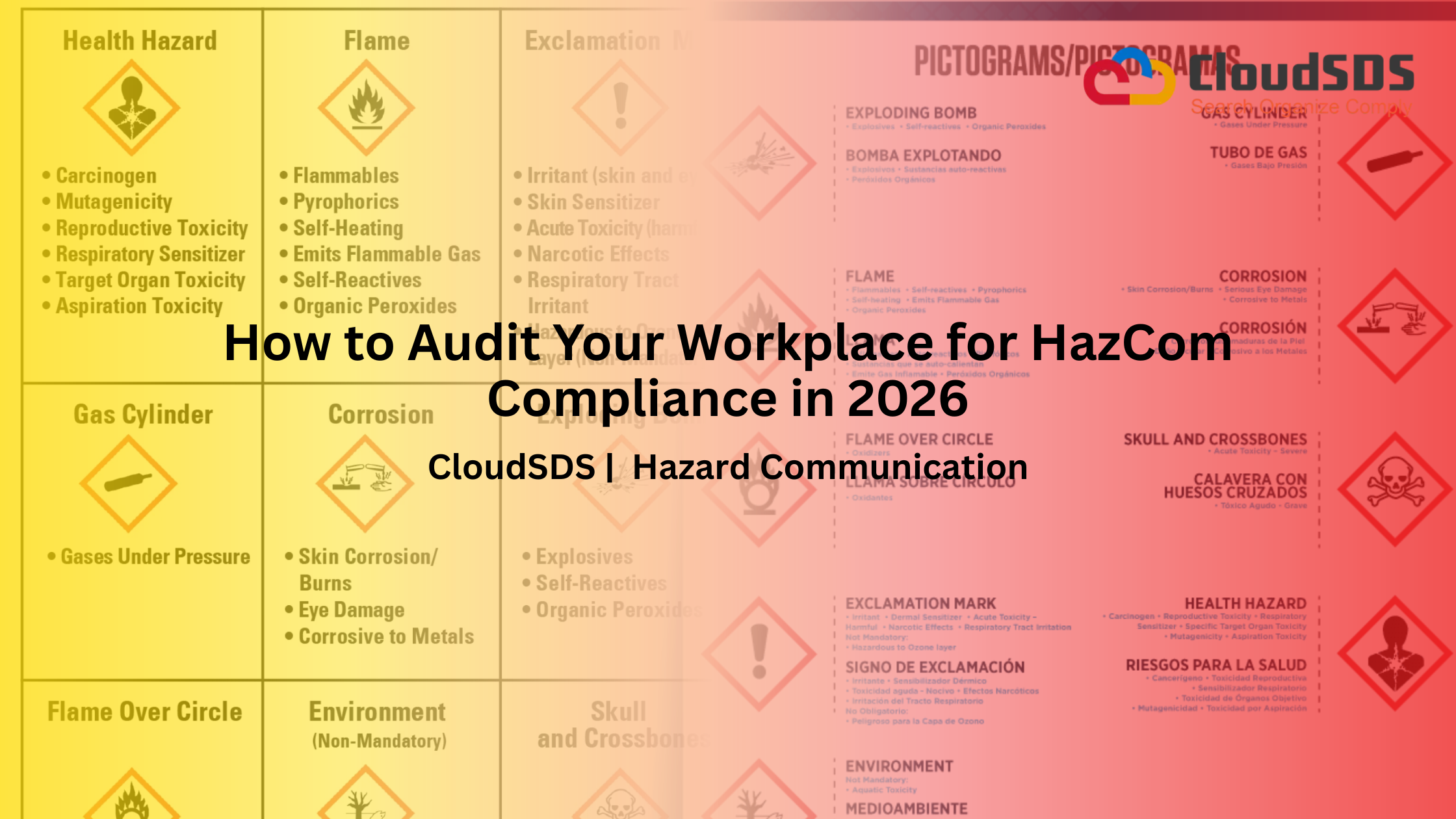
- Labels that match the latest pictograms, signal words, and precautionary statements.
- Training that addresses the revised labels and SDS format, not just legacy “old‑style” HCS content.
HazCom-related violations remain among OSHA’s top ten most cited standards, so a proactive internal audit is not a compliance luxury—it is a risk-reduction lever.
From a multi‑site EHS manager perspective, a 2026-ready HazCom audit also sets the foundation for the following:
- Aligning SDS management systems across facilities.
- Standardizing labeling schemes and training modules.
- Demonstrating “reasonable diligence” if an OSHA inspector shows up.
Step 1: Define the Scope and Audit Methodology
Before you walk the floor, decide what you are auditing and how strictly you will measure against 29 CFR 1910.1200.
Types of HazCom Audits
| Audit Type | What It Focuses On | When to Use It |
| Compliance audit | OSHA 1910.1200 requirements (written program, SDSs, labels, training, etc.) | Quarterly or pre‑inspection |
| Program‑effectiveness audit | Whether training and labeling actually change behavior and reduce exposure risk | Annually or after incidents |
| Management system audit | How HazCom integrates into broader EHS/quality systems and leadership oversight | During EHS‑system assessments |
For a 2026-focused audit, combine all three: verify regulatory compliance, test effectiveness, and place HazCom within your broader EHS management system (e.g., ISO 45001, AIIMS-style platforms, or SDS management software workflows).
For a 2026-focused audit, combine all three: verify regulatory compliance, test effectiveness, and place HazCom within your broader EHS management system (e.g., ISO 45001, AIIMS-style platforms, or SDS management software workflows).
Practical Scope Questions
Ask internally before kicking off the audit:
- Which sites, departments, or processes will be covered?
- Will the audit cover only OSHA‑covered operations, or will it extend to lab use, R&D, and warehouse storage?
- Will you audit SDS management systems (cloud-based, on-prem, or hybrid) and digital access points (QR codes, tablets, kiosks)?
Document answers in a one-page audit plan that links back to your corporate EHS audit schedule.
Step 2: Line Up the Core HazCom Elements
OSHA’s HazCom standard requires five core components: a written program, a chemical inventory, SDSs, container labeling, and employee training. Your 2026 audit should verify each of these, then layer on updated GHS-driven expectations.
Core HazCom Elements (2026 Lens)
| Element | What OSHA Expects (29 CFR 1910.1200) | 2026 Specific Audit Check |
| Written HazCom program | Written, site-specific, assigns responsibilities, and describes SDS and label management. | Confirm it references GHS Revision 7, updated SDS deadlines, and contractor communication for 2026. |
| Chemical inventory | A current list of all hazardous chemicals in the workplace. | Cross‑check against SDSs and verify no “orphan” chemicals are missing. |
| Safety Data Sheets (SDSs) | Complete, GHS-aligned SDSs accessible during each shift. | Verify revision dates match supplier-provided 2026 updated SDSs. |
| Container labeling | Labels with product identifiers, pictograms, signal words, hazard, and precautionary statements. | Confirm no outdated NFPA‑style or “internal” labels without GHS elements. |
| Employee training | Training on hazards, labels, SDSs, and protective measures. | Confirm training includes handling of 2026‑updated labels and SDS‑format changes. |
Treat this document as your “HazCom spine.” For each element, build a short checklist (digital or paper) you can walk with, then expand into a formal audit report.
Step 3: Audit the Written HazCom Program
Your written HazCom program is the audit foundation. In 2026, a compliant program must be tailored to your sites, not a generic template.
Key Program Audit Points
Coverage and specificity
- Does the program explicitly list all covered sites and departments?
- Does it describe how SDSs are stored (cloud, shared drives, binders) and how labels are checked?
Roles and responsibilities
- Does it name the HazCom program owner, SDS coordinator, and responsible trainer(s)?
- Does it outline how nonroutine tasks (e.g., cleaning up chemical spills, tank entries) are communicated?
Contractor and multisite coordination
- Does the program describe how contractors receive SDSs and training on site-specific hazards?
- For multi-site operations, does it specify whether SDSs are centralized or locally maintained, and how updates are pushed?
2026‑specific updates
- Does the program reference OSHA’s 2026 deadlines for updated SDSs and labels?
- Does it mention use of GHS‑aligned hazard classifications and updated SDS Section 2 (hazard identification) and Section 11 (toxicological information)?
Use a simple pass/fail checklist.
- Written program exists and is accessible.
- The program is site-specific and not generic.
- Roles and responsibilities are defined.
- Training and SDS update procedures are documented.
- Contractor communication procedures are described.
- Programs were reviewed and updated within the last 12 months.
If any item fails, please document it as a nonconformance and assign a corrective action owner along with a due date.
Step 4: Audit the Chemical Inventory and SDS Management
The inventory–SDS nexus is where most HazCom citations cluster. In 2026, inspectors will expect:
- An up-to-date chemical inventory.
- SDSs that match the latest GHS-aligned versions from suppliers.
Inventory–SDS Audit Checklist
Walk through operating areas, storage rooms, and labs, and for each hazardous chemical:
- Is the chemical present on the master inventory list?
- Is there a current SDS for that product (not an expired version)?
- Does the SDS revision date fall within the last 3 years or align with the 2026 updated SDS cycle?
- Is the SDS stored in the correct location (e.g., SDS binder, cloud system, or local drive) and accessible during each shift?
Common Gaps to Watch For
- “Shadow inventories”: chemicals used in labs or maintenance areas that are not in the central SDS system.
- Outdated SDSs: old-style SDSs that lack GHS-aligned Section 2 or inconsistent hazard statements.
- Missing SDSs for contractor-supplied materials (e.g., cleaning agents brought in by third-party vendors).
Use a short table during your walkthrough:
| Location | Chemical Name | Product ID | SDS Exists? | SDS Revision Date | Issue/Remark |
| Line 1 Solvent | X‑200 | 123‑456 | Yes | 2026‑02‑15 | Compliant |
| Lab Area | Acetone 500 | 789‑012 | No | — | SDS missing |
After the audit, generate a master list of missing or outdated SDSs and tie each to a corrective action ticket.
Step 5: Audit Labels and In-House Labeling Systems
By 2026, OSHA’s HazCom focus includes whether labels match the updated SDSs and GHS rules. This means scrutinizing both supplier-provided labels and any internal labeling (e.g., “in‑house” or “secondary” container labels).
Label Audit Criteria
Primary containers
- Do they display:
- Product identifier
- GHS pictogram(s)
- Signal word (“Danger” or “Warning”)
- Hazard statement(s)
- Precautionary statement(s)?
- Are there any illegible, peeling, or damaged labels that obscure GHS elements?
Secondary/in‑house containers
- Do painted can, tote‑box, or drum transfer labels follow an internal GHS-aligned system?
- Is there a written policy explaining how secondary labels are created and maintained?
Non‑routine tasks and mobile containers
Do shop-made containers used for temporary transfers (e.g., buckets, sprayers) have at least a product identifier and basic hazard information?
Build a quick field checklist:
- All primary containers show full GHS-aligned labels.
- No outdated NFPA-only or HMIS-only labels are used as the sole hazard identifier.
- Secondary containers follow an internal labeling system described in the HazCom program.
- Damaged or missing labels have been identified and tagged for relabeling.
Photograph examples of non‑compliant labels (e.g., “red label with no pictogram” or “eraser mark-marked container with no hazard info”) and reference them in your audit report.
Step 6: Audit HazCom Training and Employee Understanding
Training is the “effectiveness” lever of HazCom. In 2026, OSHA will expect that workers can recognize updated labels and SDSs, not just recite generic hazard categories.
What to Review in the Audit
Training records
- Are all affected employees trained?
- Are dates, content, and trainers documented?
- Has training been updated to cover the 2026‑aligned label and SDS format?
Training content
Does training cover:
- How to read GHS-aligned labels (pictograms, signal words, hazard/precautionary statements)?
- How to interpret SDS Section 2 and Section 9 (physical and chemical properties)?
- How to access SDSs in your EMS or LMS platform?
Behavioral effectiveness
Can employees:
- Can you point to the SDS location for a random chemical?
- Explain the primary hazard of a container they use regularly.
- Describe the PPE and controls they should use.
Classroom-to-Floor Walkthrough
During the audit, pair a brief document review with a minister.
- Pull a training roster for a line or shop floor.
- Randomly select 2–3 workers and ask:
- “Show me where to find the SDS for Chemical X.”
- “What does the flame pictogram on this drum mean?”
- “How often do you see updated SDSs?”
Use a simple table for each interview:
| Worker Name | Shift | Trained? | Can I locate SDS? | Understand Label? | Training Gap? |
| A. Smith | 1st | Yes | Yes | Partial | Needs refresh |
| B. Jones | 2nd | Yes | No | Yes | Needs access |
This ground truth data helps you distinguish “paper compliant” training from meaningful comprehension.
Step 7: Evaluate Digital and ‑Management Systems
For EHS managers running multi‑site operations, SDS‑management platforms and digital access points are part of the audit. In 2026, OSHA will expect that:
- SDSs are not only available but reliably accessible during each shift.
- Systems are updated to reflect the latest GHS‑aligned SDSs.
The System Audit Points Are:
Access and uptime
- Are there offline SDS binders or backup options if the digital system goes down?
- Can workers access SDSs from production areas, not just the safety office?
Update workflows
- How quickly are new SDSs uploaded after supplier updates?
- Is there a documented process for validating SDS revisions and notifying affected personnel?
Search and filtering
- Can users search by product name, CAS number, or location?
- Are SDSs organized by site or department to avoid cross‑site confusion?
Integration with other systems
Is your SDS platform integrated with your LMS for training records or with your permit-to-work/LOTO system for non‑routine tasks? Also, note any reliance on “PDF‑dump” systems where workers must manually download or print SDSs; this is a red flag for inspectors looking for “practical” accessibility.
Step 8: Conduct the Field Walkthrough and Risk‐Based Sampling
A successful 2026 HazCom audit balances documentation review with a thorough facility walkthrough.
Recommended Audit Walkthrough Flow
Start with high-hazard areas
- Reactor or mixing areas.
- Paint booths, solvent storage, and degreasers.
- Labs handling concentrated acids, bases, or organics.
Sample types of locations
- Main storage racks.
- Point‑of‑use containers on lines.
- Mobile carts and maintenance‑shop chemicals.
- Contractor work zones.
Use a risk‑based sampling approach
- Focus on chemicals with high acute toxicity, flammability, or reactivity.
- Prioritize areas with frequent turnover or contract labor.
Document findings in real time
- Use a tablet, mobile app, or structured form to log:
- Location.
- Chemical name and container ID.
- SDS status (missing/obsolete).
- Label condition.
- Any worker comments or observations.
Example Audit Snapshot Table
| Area | Chemical | Hazard Class | SDS Status | Label Status | Workers Interviewed | Notes |
| Paint Booth | X‑200 Solvent | Flammable liquid | Updated (2026) | GHS label intact | 2 | Good example |
| Maintenance | Y‑50 Acid | Corrosive | Missing | Hand‑written label | 1 | SDS overdue, relabel needed |
This snapshot helps you quickly identify patterns (e.g., “maintenance shop has multiple SDS gaps”) and prioritize corrective actions.
Step 9: Prepare the Audit Report and Corrective Actions
A 2026 HazCom audit is only as valuable as the report and action plan it generates. For an EHS management audience, the report should be concise, data-driven, and aligned with your internal non‑conformance and CAPA workflows.
The key sections of the HazCom audit report are:
Executive summary
- State the audit scope (sites, departments, dates) and overall compliance status (e.g., “85% compliant, 15% minor non‑conformances”).
- Highlight critical findings such as missing SDSs, recurring label issues, or training gaps identified during worker interviews.
Detailed findings by element
Structure this by the core HazCom components: written program, inventory and SDSs, labels, training, and digital system effectiveness. For each, include:
- Number of observations.
- Severity rating (e.g., Major/Minor/Observation).
- Location(s) and examples of chemicals involved.
Corrective and preventive actions (CAPA)
Convert each finding into a time‑bound, ownership-defined action. For example:
- “Upload all missing SDSs for maintenance shop chemicals by May 15, 2026; owner: Site SDS Coordinator.”
- “Revise the HazCom training module to reflect the 2026 GHS label and SDS updates by June 1, 2026; owner: LMS Administrator.”
Follow‑up and verification plan
- Schedule a 30- or 60-day follow-up to verify that corrective actions are closed.
- Indicate whether a re‑audit of high-risk areas will occur after implementation.
Use a simple CAPA table format inside the report:
| Finding ID | Finding Description | Area/Location | Severity | Owner | Target Date | Status (Open/Closed) |
| HC‑01 | SDS missing for Y‑50 Acid in maintenance | Maintenance | Major | SDS Coordinator | 2026‑05‑15 | Open |
| HC‑02 | Label missing GHS pictogram on Line 3 drum | Production | Minor | Line Supervisor | 2026‑04‑30 | Open |
| HC‑03 | Training not updated for 2026 SDS format | All sites | Major | Training Manager | 2026‑06‑01 | Open |
This table makes it easy to track progress across your EHS‑software or Excel‑based tracking system.
Step 10: Turn Audit Results into Preventive Improvement
Beyond fixing the “tickets,” use the audit data to drive preventive improvements. For an EHS‑management audience, this means integrating HazCom into your continuous‑improvement cycle.
Preventive Improvement Actions
Standardize across sites
If some locations have clearer labeling schemes, better SDS access workflows, or stronger training modules, document those as best practices and roll them out enterprise‑wide.
Update your written HazCom program
After the audit, please revise the program to:
- Reflect the 2026 GHS-aligned SDS and label expectations.
- Clarify how contractor-supplied chemicals are captured in the inventory and SDS system.
- Specify how mobile or secondary containers are labeled in your type of operations.
Improve training and communication
- Refresh HazCom training content to include:
- How to read the updated SDS layout (Section 2, Section 9, Section 11).
- How label elements map to SDS information.
- Where to locate SDSs in your digital platform (e.g., via QR codes, tablets, or kiosks).
- Integrate a short “HazCom refresher” into monthly safety meetings or toolbox talks.
Enhance SDS and ‑management workflows
- Tighten SDS‑update SLAs (e.g., “new SDSs uploaded within 7 days of receipt”).
- Implement automated alerts when SDSs are approaching 3-year expiration or when suppliers issue major revisions.
Example Improvement Table
| Existing Weakness | Preventive Action | Target Outcome |
| SDS updates delayed by weeks | Define a 7-day upload SLA and assign SDS coordinator | Faster availability of current SDSs during each shift |
| Inconsistent labeling in maintenance | Issue site-specific labeling standard and train mechanics | Uniform, GHS-aligned labels across all work areas |
| Training not updated for 2026 SDSs | Revise training module and require re‑training by Q3 2026 | Workers understand new SDS and label formats |
Step 11: Sustain Compliance through Ongoing Audits and Monitoring
HazCom compliance is not a one‑time event. In 2026, sustainability means institutionalizing regular audits, spot checks, and automated reminders.
The Recommended Ongoing Practices Are:
Frequency of audits
- Full HazCom audit: Annually or prior to scheduled OSHA inspections.
- Mini‑audits: Quarterly for high-risk areas (labs, paint booths, storage rooms).
Integration with other EHS activities
Combine HazCom checks with:
- PPE audits.
- Process safety inspections.
- Contractor orientation programs.
Digital reminders and dashboards
Use your EHS software or cloud SDS platform to:
- Flag overdue SDS revisions.
- Track training completion for HazCom-related courses.
Management review
Include HazCom audit results in your quarterly EHS committee or leadership reviews.
Discuss trends (e.g., “label quality scores improved 20% year-on-year”) and assign strategic improvements.
Conclusion: Making HazCom Audits a Strategic Asset
By 2026, auditing your workplace for HazCom compliance is no longer just about ticking OSHA boxes; it is a strategic lever for reducing chemical-related incidents, strengthening SDS management systems, and building a culture of safety awareness. For an EHS management audience, the key is to treat each HazCom audit as a repeatable process: define scope, verify the five core elements, combine documentation review with field walkthroughs, and convert findings into clear, measurable actions.
When done right, a 2026-ready HazCom audit helps you move from “compliance as a checklist” to “compliance as a continuous improvement loop.” That lowers citation risk and makes your chemical safety programs more resilient, consistent, and aligned with global GHS expectations.
Simplify Your SDS Management
CloudSDS gives your team instant access to 23M+ safety data sheets with AI-powered search, automated updates, and full OSHA/GHS compliance — all from one platform.
Leave A Comment