
Last Updated on April 22, 2026
You will see colorful labels, warning symbols, directing arrows, and emergency instructions in any factory, lab, warehouse, or industrial building. These are not merely things that are there to look aesthetically pleasing. They are important signs that alert employees about dangers at work, make sure the company is following the rules, and help with audits.
But a lot of companies don’t give them enough credit. If warning signs are missing, out of date, or in the wrong place, they can cause major safety problems, compliance failures, and expensive fines.
As safety rules are becoming harsher, workplace warning signs are more important than most businesses think. They aren’t only about safety; they’re also about being responsible, being seen, and following the rules.
In short, warning signs are necessary to keep your workplace safe and compliant. To learn in detail, continue exploring.
What are workplace warning signs?
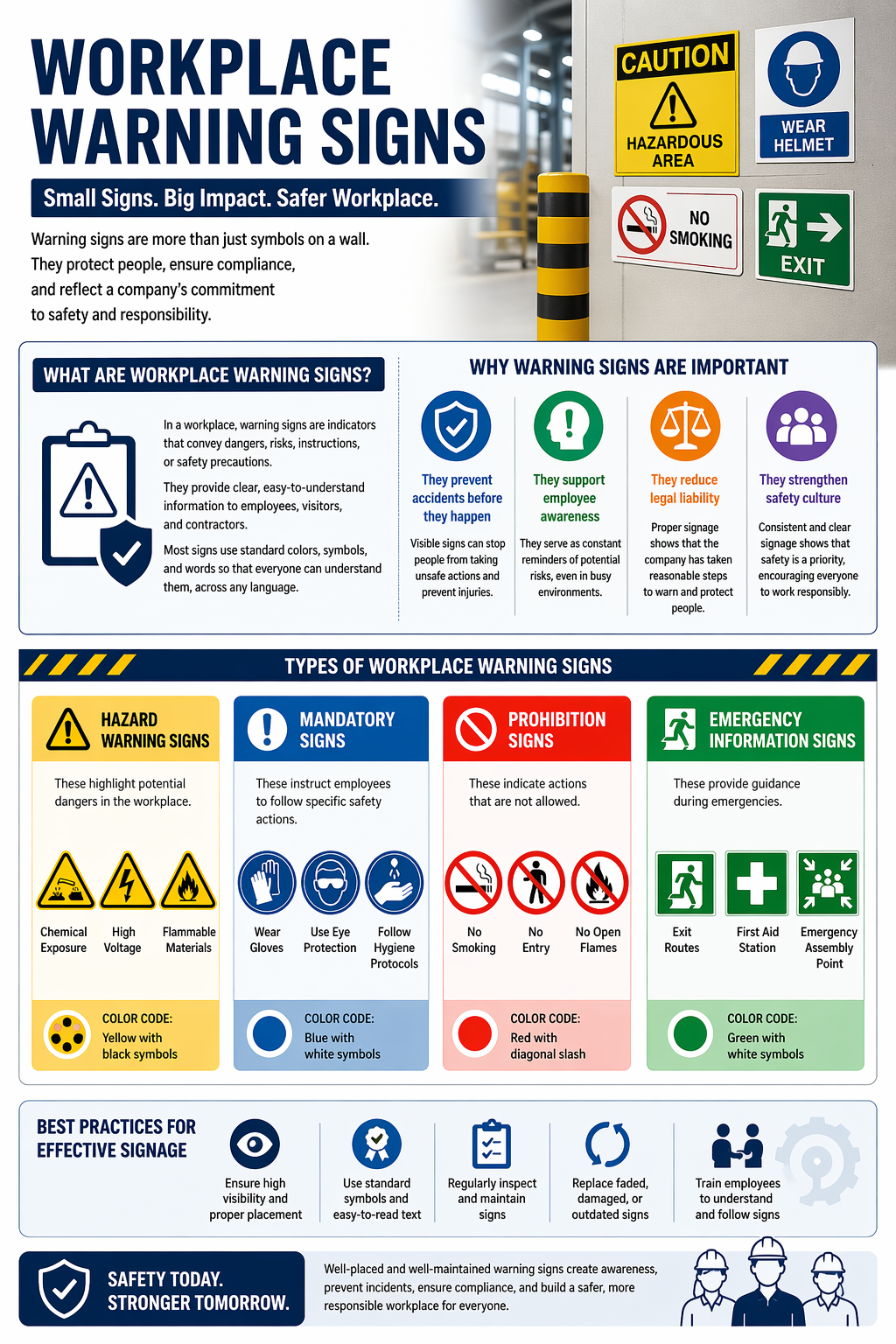
In a workplace, warning signs are indicators that convey dangers, risks, instructions, or safety precautions. These signs are aimed at giving employees, visitors, and contractors information that is easy to read and understand.
Most of the time, they feature warnings about dangers, instructions that must be followed, emergency instructions, and notifications that alert people to what they can’t do. Most warning signs use the same colors, symbols, and phrases so that everyone can understand them, even if they speak different languages.
Why warning signs are important
It’s easy to assume that warning signs are just a regulatory requirement. But their impact goes far beyond compliance.
-
They prevent accidents before they happen
When there are dangers at work, the first thing you should do is check for warning signs. An easy-to-see sign can stop people from touching chemicals, lower the number of slip-and-fall accidents, or stop individuals from going into restricted areas without permission.
-
They support employee awareness
Even workers who have been trained effectively occasionally forget about risks in fast-paced environments. There are always warning signs to advise people to be safe.
-
They reduce legal liability
If something goes wrong, displaying the correct signs shows that the company has done everything it could to warn and protect its employees.
-
They strengthen safety culture
Signs that are always there and easy to read show that a company cares about safety, which makes workers more inclined to take hazards seriously.
Types of workplace warning signs
Understanding different types of signs is essential for proper implementation.
-
Hazard warning signs
These highlight potential dangers such as the following:
- Chemical exposure
- High voltage
- Flammable materials
They are typically yellow with black symbols.
-
Mandatory signs
These instruct employees to follow specific safety actions:
- Wear gloves
- Use eye protection
- Follow hygiene protocols
They are usually blue with white symbols.
-
Prohibition signs
These indicate actions that are not allowed:
- No smoking
- No entry
- No open flames
These signs are red with a diagonal slash.
-
Emergency information signs
These provide guidance during emergencies:
- Exit routes
- First aid stations
- Emergency assembly points
They are green with white symbols.
Types of workplace warning signs
Understanding different types of signs is essential for proper implementation.
-
Hazard warning signs
These highlight potential dangers such as the following:
- Chemical exposure
- High voltage
- Flammable materials
They are typically yellow with black symbols.
-
Mandatory signs
These instruct employees to follow specific safety actions:
- Wear gloves
- Use eye protection
- Follow hygiene protocols
They are usually blue with white symbols.
-
Prohibition signs
These indicate actions that are not allowed:
- No smoking
- No entry
- No open flames
These signs are red with a diagonal slash.
-
Emergency information signs
These provide guidance during emergencies:
- Exit routes
- First aid stations
- Emergency assembly points
They are green with white symbols.
Role of warning signs in regulatory compliance
Regulatory bodies across industries require organizations to maintain proper workplace signage. While the specifics vary by region and industry, the core expectations remain consistent.
1. Hazard communication compliance
Companies that deal with chemicals must adequately label hazards so that workers know what they are. Warning signs help people follow danger communication guidelines by:
- Finding dangerous areas
- Strengthening the information on the Safety Data Sheet (SDS)
- Giving rapid visual signals for action right away
2. Occupational safety requirements
According to workplace safety rules, signs must be used to:
- Point out dangerous places
- Give directions for how to do handle the operation
- Lead responses to emergencies
If you don’t follow the rules, you could get fined, shut down, or sued.
3. Standardization and global alignment
A lot of businesses operate across multiple locations. Standardized warning indicators guarantee the following:
- Regular safety communication
- Training and onboarding are easier
- Following international safety standards
Warning signs and workplace audits
You already know this if you’ve ever had a compliance audit: auditors pay close attention to signs.
Here’s why:
-
Immediate visibility
Warning signals are easy to see right away, unlike documentation. Auditors can easily see if safety measures are being put into place.
-
Proof risk communication
Auditors search for proof that risks are clearly explained. Warning signals are indications that employees are getting the information they need.
-
Indicator system maturity
Well-kept, accurate signs show the following:
- Strong mechanisms for managing safety
- Paying attention to the little things
- Risk management that is proactive
-
Easy non-compliance detection
One of the easiest things to uncover during an audit is missing or wrong signs. Some common problems are:
- Signs that have faded or been damaged
- Wrong symbols
- Old information about hazards
- Not well placed or visible
Common challenges organizations face
Despite their importance, many companies struggle with effective signage management.
-
Outdated information
As chemicals, processes, or regulations change, signs often remain unchanged, leading to misinformation.
-
Lack standardization
Different departments may use inconsistent formats, creating confusion.
-
Poor visibility and placement
Signs placed in the wrong location or obstructed by equipment fail their purpose.
-
Manual management
Tracking hundreds or thousands of signs manually is inefficient and error-prone.
-
Disconnect from SDS data
Warning signs are often not aligned with the latest Safety Data Sheets, leading to compliance gaps.
How digital SDS management supports warning sign compliance
This is where modern solutions like SDS management platforms become highly valuable.
A centralized SDS system helps organizations:
-
Keep hazard information updated
Check that all warning signs provide the most recent information about chemical safety. This alignment helps get rid of inconsistencies between the specified hazards and how people talk about them on site. This makes it less likely that people will not obey the regulations.
-
Make updates easy
Changes can be made instantly everywhere at all places when rules or formulas change. This makes sure that every facility gets the most up-to-date safety information right away, without any delays or need for people to get involved.
-
Get ready for checks
Auditors can easily make sure that hazard communication is up to date and consistent. It’s also easy for firms to show that they are following the rules during inspections when all of their documents are in one place.
-
Make it easier access
With a digital system, there is more safety information available to employees than what is shown on signs. This lets people make good decisions right away, especially when things are going wrong or are harmful.
-
Help people make fewer mistakes
Automation makes it less likely that you’ll use signs that are old or wrong. It also makes people less dependent on manual processes, which makes safety communication more accurate and trustworthy.
Conclusion
If your organization uses chemical products, it must display workplace warning signs, regardless of the industry it belongs to. Choosing the right size is necessary, and most importantly, your employees must be able to read them. Yes, that’s why merely posting the signs won’t help. Plan training sessions that are effective enough to help your employees understand the signs better. Moreover, take the help of EHS platforms like CloudSDS to avoid noncompliance risks.
Simplify Your SDS Management
CloudSDS gives your team instant access to 23M+ safety data sheets with AI-powered search, automated updates, and full OSHA/GHS compliance — all from one platform.
Leave A Comment