
By 2026, electronic Safety Data Sheet (SDS) management software has evolved from a supportive tool into a critical operational necessity due to stricter global chemical regulations, the need for instant access to safety information, and growing demands for efficiency. Paper-based manual solutions are simply not sustainable in an environment that requires real-time data quality and comprehensive compliance. They are cumbersome, error-prone, and intrinsically slow.
Modern e-SDS solutions make the complex process of regulatory compliance easy and provide instant access to the latest safety information to all employees, greatly reducing risks and the heavy administrative burden of managing large inventories of hazardous materials. At the end of the day, good electronic SDS management software isn't just a technology improvement; it's an important part of creating a safer, more compliance and operationally resilient workplace.
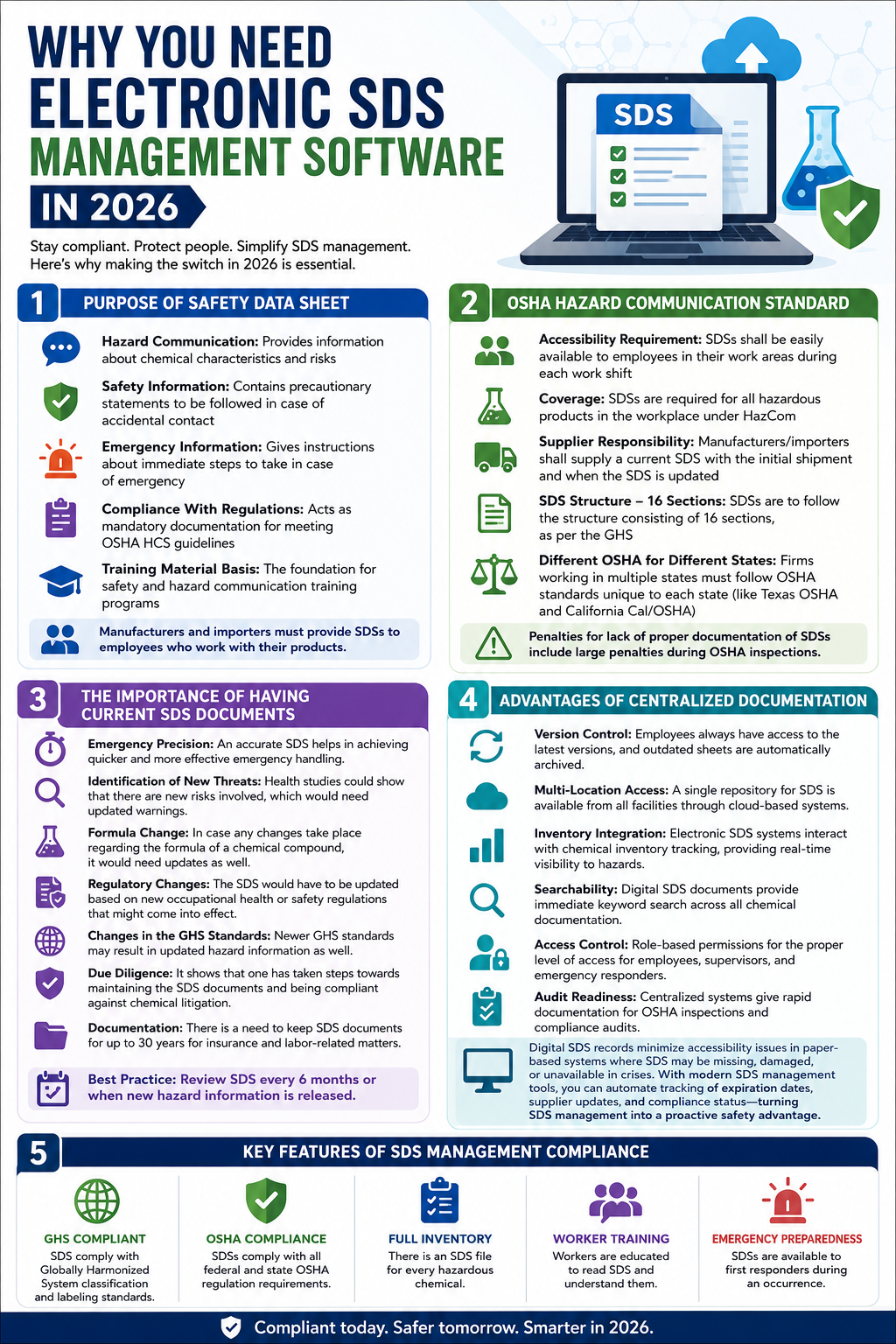
Why You Need Electronic SDS Management Software in 2026
What Is SDS Management?
SDS (Safety Data Sheet) management is the continual, systematic process of organizing, updating, storing, tracking, and disseminating safety data sheets for all hazardous compounds in a company. It covers the whole life cycle of chemical safety documents from the first receipt from manufacturers/importers to ongoing maintenance, version control, enforcement of accessibility, and archiving.
In essence, SDS management enables the workforce, along with the emergency responders, regulatory authorities, and others, to find the exact, up-to-date information on hazards associated with every chemical found in the workplace, resulting in a reduction in risk and compliance with regulations. Good SDS management systems involve scanning, updating, arranging, and linking the SDSs to the chemicals' tracking, among others.
1. Purpose of Safety Data Sheet
Safety Data Sheets are important reference documents aimed at protecting workers, patients, and the environment from chemical risks. Its main aims are:
- Hazard Communication: Provides information about chemical characteristics and risks
- Safety Information: Contains precautionary statements to be followed in case of accidental contact
- Emergency Information: Gives instructions about immediate steps to take in case of emergency
- Compliance With Regulations: Acts as mandatory documentation for meeting OSHA HCS guidelines
- Training Material Basis: The foundation for safety and hazard communication training programs
Manufacturers and importers of chemical substances should be responsible for providing SDSs to employees who work with their products. Safety data sheets are an essential source of information on dangerous substances.
2. OSHA Hazard Communication Standard
OSHA's Hazard Communication Standard (29 CFR 1910.1200) has some SDS management responsibilities:
- Accessibility Requirement: SDSs shall be easily available to employees in their work areas during each work shift
- Coverage: SDSs are required for all hazardous products in the workplace under HazCom
- Supplier Responsibility: Chemical manufacturers/importers shall supply a current SDS with the initial shipment and when the SDS is updated
- SDS Structure – 16 Sections: SDSs are to follow the structure consisting of 16 sections, as per the Globally Harmonized System (GHS)
- Different OSHA for Different States: Firms working in multiple states must follow OSHA standards unique to each state (like Texas OSHA and California Cal/OSHA)
Penalties for lack of proper documentation of SDSs include large penalties during OSHA inspections.
3. The Importance of Having Current SDS Documents
It's vital to keep SDS documentation up-to-date for safety, compliance, and legal protection:
- Emergency Precision: An accurate SDS helps in achieving quicker and more effective emergency handling because time is very essential during an emergency situation
- Identification of New Threats: Health studies could show that there are new risks involved, which would need updated warnings
- Formula Change: In case any changes take place regarding the formula of a chemical compound, it would need updates as well
- Regulatory Changes: The SDS would have to be updated based on new occupational health or safety regulations that might come into effect
- Changes in the GHS Standards: Newer GHS standards may result in updated hazard information as well
- Due Diligence: It shows that one has taken steps towards maintaining the SDS documents and being compliant against chemical litigation
- Documentation: There is a need to keep SDS documents for up to 30 years for insurance and labor-related matters
Best Practice: Review SDS every 6 months or when new hazard information is released.
4. Advantages of Centralized Documentation
Electronic technologies for centralized SDS administration have many advantages to paper-based systems:
- Version Control: Employees always have access to the latest versions, and outdated sheets are automatically archived.
- Multi-Location Access: A single repository for SDS is available from all facilities through cloud-based systems.
- Inventory Integration: Electronic SDS systems interact with chemical inventory tracking, providing real-time visibility to hazards.
- Searchability: Digital SDS documents provide immediate keyword search across all chemical documentation.
- Access Control: Role-based permissions for the proper level of access for employees, supervisors, and emergency responders
- Audit Readiness: Centralized systems give rapid documentation for OSHA inspections and compliance audits.
Digital SDS records minimize accessibility issues in paper-based systems where SDS may be missing, damaged, or unavailable in crises. Workplace SDS management is no longer a reactive burden, and with modern chemical SDS management tools that automate tracking of expiration dates, supplier updates, and compliance status, it is now a proactive safety advantage.
5. Key Features of SDS Management Compliance
The outcome of a good SDS compliance management program is:
- GHS Compliant: SDS comply with Globally Harmonized System classification and labeling standards
- OSHA Compliance: SDSs comply with all federal and state OSHA regulation requirements.
- Full Inventory: There is an SDS file for every hazardous chemical.
- Worker Training: Workers are educated to read SDS and understand them.
- Emergency Preparedness: SDSs are available to first responders during an occurrence.
Good SDS management is not optional. It is a legal necessity and a key part of workplace safety, protecting individuals, organizations, and the environment from chemical risks.
What Does SDS Management Software Mean?
Safety Data Sheet (SDS) management software is a digital application that organizes, maintains, and offers rapid access to safety data sheets so personnel may comprehend chemical risks, comply with right-to-know legislation (including OSHA's HazCom standard), and properly handle products. It replaces manual paper-based systems with an automated centralized platform for managing chemical safety documentation.
1. How Software Automates SDS Management
The SDS management software automates the complete safety data sheet lifecycle by performing a few critical functions:
- Automatic Updates: Looks for the most recent SDS versions in manufacturers' databases or Internet searches and informs the user of updates
- Keyword Search: Facilitates searching for SDS using the chemical name, CAS number, or product number
- Bulk Uploads: Helps in uploading large numbers of SDS files without manual data entry
- Source Control: Keeps track of all SDS updates and makes sure that the latest version of SDS is available
- Label Generation: Creates GHS-compliant and transportation labels in one step
- SDS Access via QR Codes: Access to SDS through QR codes with the help of mobile phone
This automation means no more lost documents, no binders, and no risk of citations from the regulatory agencies.
2. Cloud-based SDS Platforms
Keep your safety data sheets on a secure and centralized server that is also easily accessible from anywhere; the key benefits include the following:
- Centralization: SDSs can be saved, read, and printed from a single local or cloud server.
- Remote Access: Mobile-friendly access means staff can reach critical papers from anywhere without having to chase around hard-copy binders.
- Security role-based access restricts who can view, edit, or download SDS files.
- Full audit trails: Records of all access and changes to enable regulatory compliance audits
- Multi-location support: For single facilities or worldwide networks
3. Digital Document Management
The digital SDS platform reorganizes chemical safety documents into a structured searchable database, which allows you to:
- Centralized SDS database: All sheets in one secure spot instead of binders or email attachments.
- Classification: Chemicals by department, location, danger class, or product line.
- Instant sharing: Share vital safety information promptly during employee training or crises.
- Multilingual support translates papers into many languages for a broad workforce.
- Lower operational expenses: Increased efficiency reduces the likelihood of costly fines and workers' compensation claims.
An online SDS management solution enables firms to stay compliant with changing requirements and saves invaluable time that was once spent rummaging through physical files.
Why Electronic SDS Management Software Matters in 2026
In 2026, electronic SDS management software is mission-critical as it shifts chemical safety from a reactive, paper burden to an automated, intelligence-driven system that prevents mishaps, maintains regulatory compliance, and protects workers in distant workforces. With increased OSHA enforcement, chemical hazards are increasing, and AI is changing EHS compliance; firms relying on manual SDS binders are at substantial regulatory, operational, and safety risk.
1. Increasing OSHA Compliance Standards
Under OSHA’s Hazard Communication Standard (HazCom), employers must keep current Safety Data Sheets for every hazardous chemical on the worksite and must make those sheets readily available to workers throughout each work shift. They have ratcheted up the compliance obligations by 2026:
|
Compliance Obstacle |
How Electronic SDS Software Corrects It |
|
Missing or Outdated MSDS/SDS Sheets |
Automated updates ensure only the latest manufacturer SDS versions are stored |
|
Missing Paper Binders |
Centralized digital storage eliminates lost or missing sheets and reduces citation risks |
|
Audit Preparation |
Audit trails track all SDS access and modifications for regulatory inspections |
|
Right-to-Know Violations |
Employees receive immediate access to critical hazard information |
|
GHS Labeling Standards |
Built-in label generation creates compliant labels in a single click |
SDS compliance software helps firms avoid costly fines, worker compensation claims, and operational disruptions resulting from regulatory infractions.
2. Easier access to Safety Data Sheets
In cases of emergencies, timing is everything. The electronic management system allows immediate retrieval of information that would be necessary in case of a life-threatening chemical situation.
- Immediate search: Find SDS instantly using the name of the chemical substance, CAS Number, or Product Code
- Emergency Response: Get crucial information on how to deal with the hazard and what to do in case of an emergency
- No manual search involved: Timesaving by eliminating the need for browsing through manuals or searching for documents
- Multiple documents access: Allows you to open multiple SDS documents for incident investigation or training
Time equals Severity in the emergency management world.
3. Chemical Safety Risks on the Rise
The workplace in 2026 is becoming more and more chemically complex:
- Emerging Chemicals: Thousands of new chemicals appear on the market each year and all of these must be classified appropriately
- Disrupted supply chain: The frequency of updating SDS has risen dramatically because of the changing suppliers
- Regulatory changes: Changes to the GHS standard or state requirements (CA Prop 65, Texas OSHA) complicate compliance issues
- High risk industries: Greater exposure risk in manufacturing, labs, healthcare, and construction environments
Workplace safety software tackles these hazards by keeping hazard documentation correct and up-to-date and making sure chemical handling procedures are easily accessible.
4. Workforce Management at Multiple Sites
Modern enterprises have many locations, shifts, and distant sites. Centralized SDS management is a must:
Whether you manage one site or a network of sites around the globe, electronic SDS management software assures constant chemical safety compliance wherever you are.
|
Multi-Site Challenge |
Electronic SDS Solution |
|
Miscellaneous Documentation |
All SDSs are stored on one secure platform accessible across all sites |
|
Different Versions |
Version control ensures that every site uses the latest SDS |
|
Remote Workforce Access |
Cloud-based access allows employees to retrieve SDSs from anywhere without physical binders |
|
Inconsistent Training |
Centralized training materials support consistent hazard communication across locations |
|
International Operations |
Multi-language SDS conversion supports facilities and workers worldwide |
Whether you manage one site or a network of sites around the globe, electronic SDS management software assures constant chemical safety compliance wherever you are.
5. Real-Time SDS Updates Needed
SDS documents are often updated by chemical producers as new hazard data, regulatory requirements, or formulation changes occur. Real-time SDS Updates are important because:
- Expired SDS = OSHA violation: OSHA can cite organizations for employing expired versions of SDS.
- Unknown dangers: New hazard classifications may develop after the original SDS is prepared.
- Manufacturer recalls: Some chemicals are recalled or reformulated without warning.
- Compliance deadlines: GHS revision adoption dates define obligatory updating periods.
Automated monitoring in electronic SDS software looks for new versions and promptly alerts safety personnel to changes. This automation removes the weeks-or-month lag time that accompanies human update methods.
6. AI & Automation for EHS Compliance
2026 is a tipping moment for AI-powered EHS software to switch from reactive to predictive safety management:
|
AI Capability for SDS Management |
Business Implications |
|
AI Co-Pilots |
Conversational interfaces let safety teams query SDS data, generate reports, and receive guided regulatory insights. |
|
Classification Automation |
AI automatically assigns GHS hazard categories and routes SDSs to the correct reviewers, reducing classification errors. |
|
Predictive Risk Modeling |
Machine learning evaluates chemical risks by facility or department, helping prioritize resources where issues are most likely |
|
Regulatory Oversight |
AI monitors new regulations and determines whether they apply to specific operations. |
|
Natural Language Generation |
AI assists in drafting investigation narratives, reports, and compliance documentation. |
"AI is becoming more and more embedded in all safety technologies," he said. "It powers computer vision, predictive risk modeling and AI assistants that detect hazards in real time. In 2026, you'll see incident prediction technologies, automated inspections, risk score platforms, and AI SDS authoring software becoming mainstream.
7. Mobile Accessibility for Employees
Modern workplace safety software must be mobile-enabled because employees are accessing SDS in the field, not at desks:
- Mobile access: Employees access SDS on their cellphones or tablets, eliminating the need to search for hardcopy binders.
- QR code scanning Scan QR codes on chemical containers to instantaneously access SDS.
- Offline download: Some systems offer SDS download for places with poor connectivity.
- Hands-free operation: Incident reporting using voice enables you to document while you work.
- Mobile learning modules let you complete SDS training during shift changes or breaks.
With mobile access, critical danger information is constantly at the employees' fingertips, resulting in a safer, more informed workplace.
Main Advantages of SDS Software Management:
SDS management software changes the face of chemical safety from a piecemeal, labor-intensive burden to an efficient, intelligence-driven system that provides verifiable ROI through compliance protection, operational efficiency and incident prevention. Electronic SDS management software can cut the time spent managing safety data sheets by 60–80% while avoiding regulatory infractions and enhancing emergency response capabilities.
SDS Management (Centralized)
Centralized SDS management puts safety data sheets into one secure, searchable database, ending the mess of scattered paper binders, email attachments, and network drives. This centralization gives the following:
- Source of truth: all SDS documents are located in one place and accessible from anywhere
- No duplicates: no previous versions of manufacturer's SDS are saved; only current SDS are provided through version control
- Organization: chemicals classified according to their department, physical location, type of hazard, product lines, etc.
- Access control: administrators specify who has rights to access, edit, download, or remove SDS documents depending on their role
- Audit trail: every action (access, download, edit, and delete) documented and timestamped
For firms with several locations, centralization helps guarantee that chemical safety documentation is standardized across all facilities, and that no SDS is out of date or missing at remote sites.
OSHA Audit Preparation Quick Guide
OSHA inspections often come with little notice, so preparing an OSHA audit quickly is important to avoid costly citations. SDS management software speeds up audit readiness by:
- Instant Search: Provides SDS for substances/department in a few seconds, as compared to spending several hours sorting out SDS
- Compliance Tracker: Helps monitor the process of compliance at different locations by evaluating the availability of the SDS
- Auto Reporting: Creates pre-formatted reports containing information regarding SDS coverage, version details, and log-in activities
- Auto Gap Detection: Helps detect SDS gap, out-of-date SDSs, and non-conformable labels even before the audit is conducted
- Documentation: Records all changes and maintains documentation according to OSHA norms
SDS compliance software often allows organizations to save 70-90% of the time they spend preparing for an audit, a task that used to take days and now can be completed in minutes.
SDS Updates Automatic
Chemical producers routinely update SDS as new hazard data becomes available, as regulations change or as formulations are revised: Automated SDS updates mean businesses always have the latest versions without manual effort:
- Continuous monitoring: Software monitors manufacturer databases and regulatory sources for SDS updates 24/7
- Automatic alerts: Safety teams are notified immediately when new SDS versions are published
- One-click update: old versions instantly replaced by approved changes, with previous versions saved for history
- Change tracking: Review the differences between versions of SDSs (new hazards, revised PPE requirements, etc.)
- Version control enforcement: Employees cannot access outdated SDSs that could lead to regulatory violations
This automation eliminates the weeks-or-month lag time of human update operations and guarantees real-time compliance with evolving GHS and OSHA rules.
Safer Workplaces
The most significant advantage of SDS management software is improving safety at the worksite. When personnel have immediate access to correct hazard information, occurrences drop dramatically:
- Reduced Chemical Exposure: Helps to ensure that SDSs are checked before use, thus ensuring proper personal protective equipment and handling practices
- Decreased Burn Cases: Gives quick access to first-aid information during emergencies arising from chemical exposure
- Better Training: Ensures all shifts have the same and latest SDSs for proper hazard communication training
- Proper Decision Making: Helps supervisors to check SDSs before purchasing or using any new chemicals
- Hazard Alertness: Gives real-time alerts regarding any new hazards concerning already used chemicals
Organizations that have used electronic SDS systems report greater operational efficiency and reduced risk of costly fines and workers compensation claims.
Improved Chemical Inventory Visibility
Many organizations may not know what chemicals they have, where they are housed, or how much they use them. Enhanced chemical inventory visibility for complete transparency:
- Real-time inventory tracking: Know exactly what chemicals are in use at each facility, department, or storage site
- Chemical use of analytics: Monitor use trends to optimize purchases and identify high-use hazardous materials
- Hazard summaries: Instant reporting of total hazardous substances by classification (flammable, corrosive, poisonous, etc.)
- Supply chain transparency: Automatically link chemical purchases to SDS, so new chemicals are documented before usage
- Disposal planning: Identify compounds that need particular disposal processes based on hazard classifications
That visibility is critical for risk assessment, regulatory reporting (like Tier II reports), and strategic decisions concerning chemical management.
Emergency SDS Sheet Retrieval
Having immediate access to SDS sheets during chemical spills, fires, or exposures can save lives. Critical information must be immediately available to first responders and workers:
- Instant retrieval: Access SDS in seconds by chemical name, CAS number, or product code—no search required
- Mobile Access: Emergency responders can access SDS on a smartphone or tablet at the scene of the emergency
- QR code scanning: Scan QR codes to instantly open SDS for chemical containers
- Critical information at a glance: Key facts. Emergency parts (first aid, firefighting, and spill response) are underlined for rapid reading
- 24/7 Access: SDS accessible 24/7, even when safety supervisors are not in the building or absent
This immediate access decreases the severity of the crisis and increases the effectiveness of first responders during high stress conditions.
Reduced Administrative Work
It takes a lot of admin time to handle SDS manually. Less administrative work enables safety professionals to concentrate on strategic initiatives:
|
Job |
Guidance Process |
Software Automated |
|
Where to Get SDS |
15–30 minutes spent searching binders or files |
SDS search completed in 5–10 seconds |
|
SDS Updates |
Hours or weeks spent locating new versions |
Automatic updates completed within minutes |
|
Worker Training |
Paper copy distribution and manual signature tracking |
Digital training with automatic access logging |
|
Audit Preparedness |
Days required to gather documentation |
One-click reporting completed in minutes |
|
New Chemical Introduction |
Manual cataloging and filing |
Bulk upload with automated SDS matching |
Organizations usually spend 60-80% less time on SDS management, which means hundreds of hours saved yearly for EHS personnel.
Enterprise-Wide Compliance Monitoring
For firms with many facilities, enterprise-wide compliance monitoring helps ensure that all locations are meeting standards:
- Centralized compliance dashboard: Real-time compliance status across all sites, departments and facilities
- Automated compliance scoring: The software determines the percentage of compliance for each location, identifying those needing attention
- Cross-site comparison: Find sites with high frequencies of missing SDS, old versions, or access violations
- Standardized policies: identical SDS management policies throughout worldwide operations
- Executive reporting: Create board-level reports that illustrate enterprise-wide chemical safety performance
This visibility is crucial for multi-site labor management to ensure no location is excluded from compliance requirements.
Mobile SDS Access
Today's workers consume information on mobile devices, not desktops. Always have safety knowledge at your fingertips with mobile-friendly SDS:
- Responsive design: SDS looks good on cellphones, tablets, and PCs without formatting problems.
- Offline access: Download SDS for regions with low connectivity (warehouses, distant installations).
- Mobile training: Hazard communication training on shift phones during breaks.
- Incident Reporting: Hands-free voice-enabled incident documentation on the job.
- Push notifications: get immediate alerts for SDS updates, new dangers, or recall announcements.
Mobile access means critical danger of information is always at employees' fingertips, creating a safer, well-informed workplace wherever they are.
SDS Search with AI Enhancement
AI-powered SDS searching that understands natural language queries and provides accurate results is replacing traditional keyword searching:
|
AI Search Functionality |
Legacy Search |
AI Search |
|
Type of Query |
Exact keyword matching only |
Understands natural language queries such as “What PPE do I need for acetone?” |
|
Results |
Returns a list of documents to review |
Provides direct answers extracted from SDS content |
|
Context Awareness |
No understanding of user intent |
Interprets hazard type, exposure route, and regulatory context |
|
Speed |
Users must manually scan documents. |
AI instantly extracts and summarizes critical information. |
|
Multi-SDS Queries |
Requires manual comparison between SDSs |
Compares data across SDSs automatically, e.g., flash points of flammable solvents |
AI copilots enable safety teams to query SDS information using conversational language, generate compliance reports, and get help with regulatory interpretation without sophisticated navigation. Machine learning also becomes better at searching over time, learning from user queries and comments.
Final Thoughts
The advantages of using workplace safety software to handle SDS are extensive:
- Regulatory compliance: Maintain all facilities in compliance and avoid OSHA citations
- Operational Efficiency: Reduce SDS management time by 60-80% and improve accuracy
- Risk reduction: Better hazard knowledge and emergency access to prevent chemical mishaps
- Cost savings: Reduce administrative costs, workers' compensation claims and avoid regulatory fines
- Strategic advantage: Free up EHS personnel to focus on proactive safety initiatives, not administrative burden
The benefits make SDS management software more than a compliance tool. It is a strategic business asset that protects workers, minimizes costs and enhances organizational resilience in 2026.
Frequently Asked Questions
What is SDS management software?
SDS management software is a digital program that organizes, maintains, and provides rapid access to Safety Data Sheets (SDS) for all hazardous compounds in a workplace. It replaces manual paper binders with a centralized, searchable database that automates SDS handling, assures OSHA compliance, and provides staff with rapid access to important chemical hazard information.
What is the importance of electronic SDS management?
By 2026, electronic SDS management will be essential to provide immediate access to the latest danger information, automate compliance with increasingly stringent OSHA standards, and prevent expensive regulatory infractions. Organizations that utilize electronic SDS management software realize a 60-80% decrease in time spent on SDS management and eliminate missing sheets, outdated versions, and audit failures.
Does OSHA mandate an SDS management program?
OSHA's Hazard Communication Standard (HazCom) requires employers to retain SDS for all hazardous substances and to make them accessible to employees during each work shift; however, OSHA does not specifically require electronic software to be used. However, SDS compliance software is the most dependable solution to meet these criteria, as it ensures fast access, automatic updates, and extensive audit trails that paper systems can't reliably give.
What is the role of SDS management software in enhancing safety?
SDS management software enhances safety by:
- Immediate access to emergency first-aid and spill response information during events
- Train personnel to verify current SDS before working with chemicals and verify adequate PPE and procedures
- Automatically notifying teams of new dangers identified or changes in handling requirements
- Discontinuation of obsolete SDS that could cause mishandling of chemicals
- Mobile and QR code access so hazard information is always available at the point of usage
Which industries utilize SDS management software?
SDS management workplace safety software is used in the following industries:
- Manufacturing (chemicals, metals, plastics, food processing)
- Research laboratories (pharmaceutical, clinical, academic)
- Health care (hospitals, clinics, and dentistry offices using disinfectants and chemicals)
- Building (paints, solvents, adhesives, cleaning chemicals)
- Oil and gas (refineries, drilling, petrochemical plants, etc.)
- Education (schools, universities with chemistry laboratories and maintenance chemicals)
- Transportation (Fleet maintenance, Hazardous materials handling)
- Agricultural inputs (pesticides, fertilizers, agrochemicals)
SDS management must be done for all work sites containing hazardous chemicals as defined by OSHA.
Does SDS software keep track of chemical inventory?
Yes, SDS software is capable of tracking chemical inventories. Modern electronic SDS management software offers:
- real-time visibility of which chemicals are stored in each facility, department or storage location
- Analytics on chemical usage, demonstrating trends in consumption and dangerous products with heavy usage
- Hazard summary by chemical categorization (flammable, corrosive, poisonous)
- New chemicals are documented before usage due to automatic linkage of chemical purchases to the SDS
- Disposal planning based on danger classes needing specific handling
This inventory visibility is critical for Tier II reporting, risk assessments, and sound chemical management.
Simplify Your SDS Management
CloudSDS gives your team instant access to 23M+ safety data sheets with AI-powered search, automated updates, and full OSHA/GHS compliance — all from one platform.
Leave A Comment