
- The PFAS Compliance Patchwork: Why One SDS Update Isn't Enough in 2026
- Introduction
- What an SDS does—and what it doesn't
- The four PFAS regimes briefly
- Federal—TSCA Section 8(a)(7)
- Minnesota—Amara's Law
- Minnesota's PFAS reporting requirement
- Maine — 38 M.R.S. § 1614
- California—two tracks, not one
- Where the definitions diverge—and why that breaks single-source compliance
- The stacking problem in practice
- What your compliance data layer actually needs
- A practical sequence for the next 12 months
- Frequently asked questions
- Conclusion—PFAS compliance is a data problem, not an SDS update.
Last Updated on September 15, 2026
The PFAS Compliance Patchwork: Why One SDS Update Isn't Enough in 2026
Introduction
Safety Data Sheet compliance and PFAS compliance are two different legal obligations, even though they often get treated as one project inside the same EHS department. An SDS exists to communicate chemical hazards under OSHA's Hazard Communication Standard (29 CFR 1910.1200). PFAS obligations, by contrast, can be triggered by an entirely different set of facts: whether a substance was intentionally added to a product, whether it fits a structural chemical definition, what category of product it's in, or whether it exposes a consumer above a regulatory threshold. Four regimes currently drive most of the compliance burden for companies selling into the U.S. market: federal TSCA Section 8(a)(7) reporting, Minnesota's Amara's Law, Maine's phased PFAS product bans, and California's Proposition 65. Updating your SDS library does not, on its own, satisfy any reporting, notification, sales-restriction, or warning obligation under these laws. Each regime asks its own question, and each requires its own answer.
What an SDS does—and what it doesn't
Before getting into any individual PFAS law, it's worth being precise about what a Safety Data Sheet is actually for, because a surprising amount of confusion in this space starts from treating the SDS as a general-purpose chemical compliance document rather than the narrower instrument it is.
SDS obligations under OSHA HazCom are hazard-based.
Under 29 CFR 1910.1200, an SDS exists to communicate the hazards of a chemical to workers who handle it. The obligation is triggered by hazard classification—does the substance meet the criteria for a physical hazard, a health hazard, or an environmental hazard as defined by the standard—not by whether the substance happens to belong to a particular chemical family such as PFAS. The 16-section format prescribed by HazCom requires identification, hazard classification, composition information, first-aid measures, handling and storage guidance, exposure controls, and related data. That format was built to answer one question: what do people working with or around this substance need to know to stay safe? It was not built to answer, "Does this product trigger a state reporting law?" or "Is this product banned from sale in a given jurisdiction?. " Downstream, the SDS flows through distributors and employers so that anyone handling the substance in a workplace setting has access to that hazard information—a role that is important but fundamentally occupational rather than regulatory-market-access in nature.
PFAS obligations are often content- and jurisdiction-based.
PFAS laws don't run on the same logic. Several of the regimes discussed below care about intentional addition—did the manufacturer deliberately put a PFAS into the formulation or a component, regardless of whether that substance is hazardous under HazCom criteria? Others care about a substance's chemical identity and structure rather than its hazard classification: a compound can be squarely within the scope of a PFAS reporting rule while carrying no HazCom hazard classification at all, because the two systems are answering different questions. Some obligations attach to the product being sold, not to any single SDS. Some require a direct filing to a state agency on a fee-and-deadline schedule that has nothing to do with hazard communication. Some are about restricting what can be sold in a jurisdiction in the first place. And some—California's Proposition 65 being the clearest example—are about whether a consumer's exposure crosses a numeric threshold, which is a question an SDS was never designed to answer.
Why "we updated our SDSs" is not a PFAS compliance answer
This is worth stating plainly, because it's the single most common gap we see in PFAS compliance programs: an updated, accurate, fully HazCom-compliant SDS can exist for a product that is simultaneously out of compliance with a state PFAS reporting deadline, in violation of a state sales prohibition, or subject to an unresolved Proposition 65 warning obligation. The SDS update satisfies the SDS' obligation. It does nothing, by itself, to satisfy the separate PFAS-specific obligation sitting next to it.
Key takeaway: A current SDS tells you the document is compliant with hazard communication rules. It tells you nothing about whether the product itself is compliant with PFAS reporting, notification, sales-restriction, or warning laws—those are answered by different data, filed with different agencies, and on different timelines.
The four PFAS regimes briefly
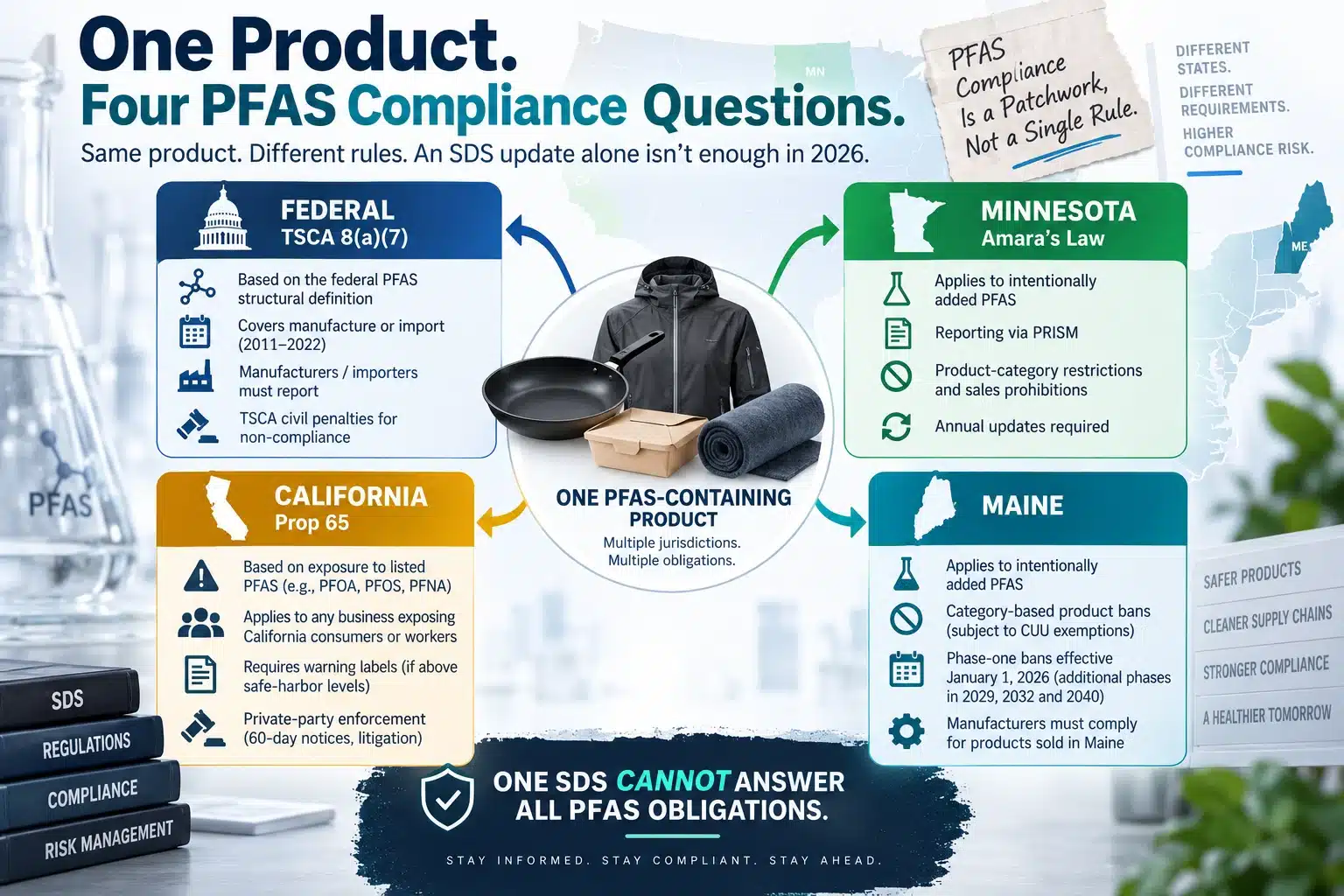
The same physical product can face four different legal questions depending on what triggers each law, who bears the compliance duty, and where the product ends up being sold or distributed. A product can clear up one regime entirely and still be non-compliant under another, because “PFAS compliance” isn’t a single finish line—it’s four separate finish lines that happen to be running through the same warehouse.
| Regime | Legal basis | What triggers it? | Who files/complies? | Timing (as of September 2026) | Primary exposure |
|---|---|---|---|---|---|
| TSCA 8(a)(7) | 40 CFR Part 705 | Manufacture or import of a PFAS meeting the federal structural definition, any year 2011–2022 | Manufacturers/importers | Submission period deferred to 60 days after EPA's pending substantive revision, or January 31, 2027, whichever is earlier | TSCA civil penalties |
| Minnesota (Amara's Law) | Minn. Stat. § 116.943 | Intentionally added PFAS in a covered product sold, offered for sale, or distributed in Minnesota | Manufacturers, via PRISM | Initial reports due September 15, 2026 (extension available to December 14, 2026 if requested by August 16, 2026); annual updates each February 1 | Enforcement plus category sales prohibitions |
| Maine | 38 M.R.S. § 1614 | Intentionally added PFAS in a product falling into a banned category, subject to CUU exemptions | Manufacturers | Phase-one category bans effective since January 1, 2026; further phases in 2029, 2032, and 2040 | Sales prohibition |
| California Prop 65 | Cal. Health & Safety Code § 25249.6 et seq. | Exposure above the applicable safe-harbor level to a listed PFAS (e.g., PFOA, PFOS, PFNA) | Any business exposing California consumers or workers | Ongoing, no filing deadline | Private-party enforcement (60-day notices, litigation) |
Because EPA's TSCA timeline in particular has moved four separate times since the rule was first finalized, and because the Minnesota deadline shown above sits right at the date of this article's publication, treat this table as a pre-publication verification point rather than a fact you draft once and leave untouched. Regulatory dates in this space have a short shelf life.
Federal—TSCA Section 8(a)(7)
For manufacturers and importers, the practical meaning of TSCA 8(a)(7) is this: if your company manufactured or imported a PFAS-containing substance or article at any point between 2011 and 2022, you likely owe EPA a one-time historical report, and the window to file that report has already been delayed multiple times — most recently in April 2026.
Status of the TSCA reporting requirement
TSCA Section 8(a)(7) was added by the FY2020 National Defense Authorization Act and implemented through a final rule EPA issued in October 2023, codified at 40 CFR Part 705. The rule directs anyone who manufactured or imported PFAS—including PFAS contained in imported articles—in any year from 2011 through 2022 to report chemical identity, uses, production volumes, byproducts, environmental and health effects data, worker exposure information, and disposal practices to EPA.
The submission window itself has been a moving target. It was originally set to open in November 2024, then delayed to July 2025 for budgetary reasons, then pushed further via an interim final rule to April 13, 2026. On April 13, 2026, EPA published another final rule that deferred the start of the submission period again — this time to whichever comes first: 60 days after the effective date of a forthcoming substantive revision to the rule, or January 31, 2027 as a fixed backstop. EPA has indicated it intends to issue that substantive revision well before the January 2027 backstop date, which means the realistic start date is tied to the pending rulemaking rather than to a fixed date on the calendar. Because the agency has moved this deadline repeatedly, this is exactly the kind of date that needs to be verified against EPA's TSCA 8(a)(7) program page immediately before this article is published or republished, rather than trusted at face value from any single source, including this one.
The 2011 look-back changes the scope
The most operationally significant feature of this rule is that it is backward-looking. It doesn't just ask what PFAS-containing products a company sells today — it asks what the company manufactured or imported at any point across an eleven-year window. That means companies need to investigate discontinued product lines, prior formulations, historical imports, and even PFAS that arrived as an unintentional component of a raw material or article, not just current catalog items. A product line that was PFAS-free as of last quarter's SDS review can still trigger a reporting obligation because of what it contained in 2014.
Structural definition vs. PFAS lists
One of the more consequential technical points in this rule is that its scope is defined structurally, not by reference to a fixed list of named chemicals. EPA has identified over a thousand substances that may fall within the rule’s structural definition, and a substantial share of those do not appear on the PFAS reference lists that many companies already use for screening. Practically, this means a company that only checks its formulations against a familiar PFAS list—the kind commonly used for state reporting or marketing claims—can still miss substances that are squarely in scope under the federal structural test. A structural determination requires actually looking at molecular structure (in particular, fully fluorinated carbon atoms within the molecule) rather than matching names against an inventory.
What the proposed modifications could change
In November 2025, the EPA proposed amendments to narrow the rule’s scope—among other things, floating potential exemptions for certain importers of finished goods and a small-quantity exemption. The comment period on that proposal closed at the end of December 2025, and EPA has said it is still working through a large volume of public comments. Nothing in that proposal is final. Until EPA issues a substantive final rule, the original, broader version of the requirement remains under the operative law, even though the timeline for actually submitting reports has been pushed out. Companies should track the proposal but shouldn’t treat a pending exemption as a compliance position they can rely on today.
Callout: Don’t confuse a PFAS inventory screen against a familiar chemical list with an actual structural-scope of determination—under TSCA 8(a)(7), those are two different exercises with two different answers.
Minnesota—Amara's Law
For companies selling into Minnesota, Amara's Law (Minn. Stat. § 116.943) creates two separate obligations that are easy to conflate: a reporting requirement administered through the state's PRISM system, and a set of phased sales prohibitions that operate independently of the reporting deadline.
Minnesota's PFAS reporting requirement
Amara's Law requires manufacturers of products containing intentionally added PFAS that are sold, offered for sale, or distributed in Minnesota to file a report through the PFAS Reporting and Information System for Manufacturers (PRISM) and pay a reporting fee. The Minnesota Pollution Control Agency finalized its reporting rules in December 2025, spelling out what must be reported: a product description (including identifiers such as UPC or SKU), the PFAS chemicals present by CAS registry number, the concentration of each, the function PFAS serves in the product, and manufacturer contact information. The initial reporting deadline has moved twice—from an original January 1, 2026 date, to July 1, 2026, and most recently to September 15, 2026, after MPCA said it was responding to manufacturers' difficulties collecting supply-chain data and using the PRISM system. Manufacturers who need more time can apply for a one-time 90-day extension, but the request had to be postmarked by August 16, 2026, pushing an extended deadline out to December 14, 2026. The initial filing carries an $800 fee, and products manufactured before July 1, 2023, are excluded from the initial reporting scope. Ongoing, annual updates are due every February 1 thereafter.
Minnesota's phased sales prohibitions
Separate from the reporting mechanism, Amara's Law also restricts what can actually be sold. As of January 1, 2025, eleven specific categories of products became subject to a sales ban in Minnesota if they contain intentionally added PFAS. The law is structured to expand from there: by January 1, 2032, the prohibition extends to essentially any product containing intentionally added PFAS, absent an applicable exemption. That means the reporting deadline sitting in front of most companies right now is only one part of the compliance picture—the sales restriction clock is already running independently and has been since 2025.
Why year-two compliance is harder than year-one compliance
It's tempting to treat the initial PRISM filing as the finish line, but the structure of the law suggests the opposite. Year one is a single, large data-collection exercise: get the initial report filed, even if MPCA's relaxed due-diligence standard for this first cycle allows submission based on best-available information while gaps with unresponsive suppliers are documented. Year two and beyond require companies to maintain and update that data annually, track formulation and supplier changes that affect what was previously reported, and keep evidence of ongoing due diligence rather than a one-time supplier email. A supplier who doesn't respond to a PFAS questionnaire in year one may be tolerable, if documented, for an initial filing made on a best-efforts basis; the same non-response sitting unresolved in year three is a materially different risk posture.
PRISM and the possibility of multi-state implications
Minnesota's PRISM system is also notable because the reporting infrastructure it represents—a public-facing product-and-substance database, populated through structured manufacturer questionnaires—is the kind of model other states are watching as they draft their own PFAS reporting statutes. That doesn't mean a Minnesota filing satisfies any other state's law; it doesn't, and there's no reciprocity provision that makes it do so. But companies building internal data pipelines to answer Minnesota's PRISM questions are, in effect, building the same kind of substance-level dataset that other states are likely to ask for as their own reporting programs come online.
Maine — 38 M.R.S. § 1614
Maine’s framework has changed enough since its original 2021 enactment that any article discussing it needs to be explicit about which version of the law is currently in force.
The original notification and phaseout framework
Maine’s original 2021 law set an ambitious target: notification of PFAS in virtually all products sold in the state, moving toward a comprehensive 2030 sales ban, with an early prohibition on carpets, rugs, and fabric treatments containing intentionally added PFAS. That original structure proved difficult to implement at the scale intended, and it was substantially revised before most of it took effect.
The amended framework and currently unavoidable uses
In 2024, Maine enacted LD 1537, which restructured the law in two major ways. First, it eliminated the broad product-notification reporting requirement that had been set to take effect for essentially all products—the piece of the original law that most closely resembled Minnesota’s PRISM-style reporting. Second, it replaced the single 2030 cutoff with a staged set of category-specific bans running through 2026, 2029, 2032, and 2040, while introducing a Currently Unavoidable Use (CUU) exemption process. Under the CUU framework, a manufacturer can seek a determination that PFAS use in a specific product or component is essential for health, safety, or the functioning of society, that no feasible alternative currently exists, and that the product can’t reasonably be reformulated. Maine’s Department of Environmental Protection has run this process narrowly in practice—of eleven CUU proposals submitted ahead of the January 2026 phase, only two were approved, both covering highly specific internal components rather than entire product categories.
January 2026 category bans
The first phase of Maine’s amended ban took effect January 1, 2026, prohibiting the sale, offer for sale, or distribution of products in the following categories if they contain intentionally added PFAS:
- Cleaning products
- Cookware
- Cosmetic products
- Dental floss
- Juvenile products
- Menstrual products
- Ski wax
- Upholstered furniture
- Certain textile articles (with defined carve-outs, including a longer runway for some outdoor apparel uses)
Fluorinated containers associated with any of these product categories are captured as well. Subsequent phases are scheduled for 2029 and 2032, when the ban broadens toward essentially all remaining consumer products containing intentionally added PFAS, with a narrower carve-out for cooling and heating equipment and refrigerants, which isn’t banned until 2040.
Maine vs. Minnesota: similar terminology, different obligations
Maine and Minnesota both hinge their bans on “intentionally added” PFAS, which makes it easy to assume the two laws can be handled with a single compliance workflow. They can’t. Minnesota still requires an affirmative reporting filing through PRISM, with a fee and an annual update cycle; Maine’s 2024 amendment eliminated that kind of broad reporting obligation in favor of category-specific sales restrictions and a CUU exemption process. The product categories captured, the exemption mechanics, the effective dates, and the enforcement approach all diverge, even where the underlying “intentional addition” trigger sounds the same on paper.
California—two tracks, not one
California is where the “one PFAS law” assumption breaks down most visibly, because the state actually runs two structurally different tracks that happen to apply to the same products at the same time.
Proposition 65 is a warning regime, not a PFAS ban.
Proposition 65 — the Safe Drinking Water and Toxic Enforcement Act of 1986 — is a right-to-know statute, not a prohibition. It requires a “clear and reasonable” warning when a consumer’s or worker’s exposure to a listed chemical exceeds an applicable safe-harbor level. California’s Prop 65 list currently includes specific PFAS compounds such as PFOA, PFOS (including relevant salts and transformation products), and PFNA — the trigger is exposure to one of these individually listed substances, not membership in the broader PFAS chemical class. Compliance under Prop 65 requires identifying whether a specific listed substance is present, assessing likely exposure, and comparing that exposure against the relevant safe-harbor number — an entirely different exercise from asking whether PFAS was “intentionally added,” and one that doesn’t produce, or require, the kind of state filing Minnesota’s law does.
Separate category-specific PFAS product laws
Running alongside Prop 65, California has enacted its own set of product-specific PFAS restrictions independent of the warning statute: a ban on intentionally added PFAS in textile articles, with a later compliance date carved out for certain outdoor apparel; a ban covering juvenile products; and restrictions on PFAS in food packaging paired with cookware disclosure requirements. In 2024, California consolidated enforcement of these product-specific restrictions under its Department of Toxic Substances Control (DTSC) and added a manufacturer registration and compliance-certification requirement, with registration due by mid-2029 and DTSC enforcement beginning after that. These laws operate on their own triggers and deadlines, entirely apart from whether a Prop 65 warning is required for the same product.
Why “PFAS-free” claims can create another compliance risk
Because California runs an exposure-based warning regime alongside intentional-addition-based product bans, a company can satisfy one track and still be exposed on the other—and marketing claims tend to be where that gap becomes a legal liability rather than a technical footnote. A “PFAS-free” claim made because a product passed a targeted screen against a handful of named compounds isn’t necessarily substantiated against the full range of structural PFAS that could still be present through raw materials, coatings, or trace contamination. Treating a single regulatory screen—done for Prop 65 purposes, or for a state reporting filing—as sufficient evidence for a broad, unqualified “PFAS-free” marketing claim is a common way companies create a new compliance exposure while trying to resolve an old one.
Where the definitions diverge—and why that breaks single-source compliance
The core problem underlying everything above is that "PFAS" does not function as a single, unified regulatory category. It's a chemistry-based umbrella term that different laws operationalize in different, and sometimes incompatible, ways. That divergence shows up along four dimensions.
Intentional addition: Minnesota and Maine both center their obligations on whether PFAS was deliberately added to a product or component. TSCA 8(a)(7) does not require intentionality at all—unintentional presence from manufacturing byproducts or contaminated raw materials can still be reportable.
Structural definition: Federal scope under TSCA is set by a chemical structure test, independent of any published list. State product laws generally define PFAS by structure too but apply that structure only to the specific product categories the statute names, which is a narrower application than TSCA's substance-level reporting mandate.
Exposure threshold: Proposition 65 is the outlier here—it doesn't care whether PFAS was intentionally added or what the product category is; it cares whether exposure to a specific listed substance crosses a numeric safe-harbor level. That's a fundamentally different analytical question from the intentional-addition regimes.
Product and article treatment: Some obligations attach at the substance level (TSCA), some at the finished-product level (Minnesota's PRISM filings, Maine's category bans), and some depend on how a component or imported article is treated relative to the larger product it's part of. A PFAS-containing component sourced from a third party can trigger obligations differently depending on whether the regulator in question looks through to the component or only at the finished good.
De minimis thresholds and exemptions: Some regimes recognize concentration thresholds or de minimis exemptions; others—particularly the intentional-addition-based state bans—largely don't, treating any intentionally added PFAS as sufficient to trigger the restriction regardless of concentration. CUU determinations in Maine and comparable carve-outs elsewhere add another layer of exemption logic that has no real counterpart in Minnesota's reporting statute or in Prop 65.
Put together, a single product can be exempt from federal TSCA reporting, reportable under Minnesota's PRISM system, banned from sale in Maine, and subject to a Proposition 65 warning obligation in California—all at the same time, and all correctly. That's not a contradiction. Each jurisdiction is asking a different legal question about the same physical item, using a different trigger, and there's no requirement that the four answers line up.
The stacking problem in practice
Consider a fictional SKU: a PFAS-treated industrial textile, manufactured overseas, imported into the United States, and sold in multiple states, including Minnesota, Maine, and California.
Step 1 — Federal screening
Was the substance manufactured or imported at any point since 2011? Does the specific PFAS used meet TSCA’s structural definition, regardless of whether it appears on a familiar reference list? Does the company’s import history need to be checked as far back as 2011, even if the current product formulation is different from what was imported a decade ago?
Step 2—Minnesota
Was the PFAS intentionally added to the textile treatment? Does the product fall into a category covered by Amara’s Law’s sales restrictions? What substance-level data—CAS numbers, concentrations, function—needs to go into the PRISM filing, and does the product’s manufacture date fall before or after the July 1, 2023, cutoff for initial reporting?
Step 3—Maine
Does the textile fall within the category of textile articles covered by the January 2026 ban, or does it qualify for one of the law’s narrower carve-outs? Has a CUU determination been sought or granted for this specific use, or is the product simply prohibited from sale in the state?
Step 4—California
Does the finished textile expose California consumers to a listed Prop 65 substance such as PFOA or PFOS above the applicable safe-harbor level, independent of the intentional-addition question? Separately, does the textile also fall under California’s own product-specific PFAS restrictions on textile articles, which operate apart from Prop 65 entirely?
| Question | Federal | Minnesota | Maine | California |
|---|---|---|---|---|
| PFAS identity needed? | Yes | Yes | Yes | Yes |
| Intentional addition relevant? | Not necessarily | Yes | Yes | Depends on which California rule applies |
| Structural definition relevant? | Yes | No/limited | No/limited | No |
| Exposure threshold? | No | No | No | Yes, for Prop 65 |
| Filing required? | Potentially | Yes | Framework-dependent | No Prop 65 filing; registration under separate product law |
| Sales restriction possible? | — | Yes | Yes | Yes, under separate product-specific laws |
| SDS update alone sufficient? | No | No | No | No |
This is the part of PFAS compliance that a single-department, single-document approach can't handle. A hazard communication team armed only with SDS revision authority can't answer the Minnesota, Maine, or California questions above, because none of those questions are hazard-classification questions.
What your compliance data layer actually needs
If an SDS isn't the right instrument, the natural next question is what is. In practice, it comes down to four components.
Substance-level records, not just product-level records
Companies need records that go below the finished product to the substance level: chemical identity, CAS or other structural identifiers where available, whether the substance meets a relevant structural PFAS definition, whether it was intentionally added or present incidentally, and its concentration where a regime cares about concentration. That substance-level record then needs to be tied back to every product it appears in—not the other way around, since a single PFAS substance can show up across dozens of otherwise unrelated SKUs.
Supplier attestations with change-control triggers
Because most companies don't manufacture every raw material or component themselves, supplier attestations are the backbone of a defensible PFAS record. That means standardized questionnaires sent to every relevant supplier, documented responses (or documented non-response, where that's the honest answer), and—critically—a trigger that re-opens the question whenever a formulation, raw material, or coating/finish changes. An attestation collected two formulation cycles ago isn't evidence of anything current.
Jurisdiction mapping for every SKU
Each SKU needs a clear chain running from substance to formulation to the finished product to the markets it's actually sold or distributed into, to the specific obligations that attach in each of those markets. Without that mapping, companies end up either over-complying everywhere (expensive and often impractical) or under-complying somewhere (a genuine legal and enforcement risk), because nobody has connected "we sell this SKU in Minnesota and Maine" to "here's what each of those facts actually requires of us."
Audit trails for every determination
Every PFAS determination—in scope or out of scope, exempt or not exempt, reportable or not reportable—needs a record of what was reviewed, who made the call, what source was relied on, when the determination was made, what supplier evidence backed it up, and what regulatory basis it rests on. Given how often the underlying laws have changed in the last two years, that record also needs to capture when a prior determination was revisited because the law itself moved.
This is where centralized SDS and product-compliance data platforms genuinely earn their place—not because an SDS satisfies a PFAS obligation, but because a system built to hold substance-level data, supplier evidence, and jurisdiction mapping in one place, with a real audit trail, is what actually lets a company answer these four regimes' questions on demand rather than reconstructing the analysis from scratch every time a regulator or customer asks.
A practical sequence for the next 12 months
- Inventory manufacturing and import history back to 2011: Don't limit the review to the current product catalog—TSCA's look-back period means historical formulations and imports matter.
- Screen substances against the applicable structural definitions, not just published PFAS lists: A list-only screen will miss substances that are in scope under TSCA's structural test.
- Send standardized PFAS questionnaires to suppliers: This builds in a process for following up on non-responses rather than treating silence as a closed question.
- Map every SKU to the jurisdictions where it's sold, offered for sale, or distributed: To tie that map to the specific obligation each jurisdiction imposes.
- Identify formulation, raw-material, and finish or coating changes: That could alter a product's PFAS status, and route those changes back through the screening process.
- Centralize supporting evidence and audit trails for every scope of determination, exemption claim, and filing.
- Monitor EPA, MPCA, Maine DEP, and California OEHHA/DTSC updates: Before finalizing any reporting or compliance decision—this is an area where "we checked six months ago" is not the same as "we checked."
Don't wait for the next SDS revision cycle to do any of this. SDS updates run on their own hazard-communication timeline, which has no relationship to Minnesota's September filing deadline, Maine's phased category bans, or a Prop 65 warning obligation that can attach the moment an exposure threshold is crossed.
Frequently asked questions
-
Does updating our SDSs satisfy PFAS reporting requirements?
No. An SDS update satisfies OSHA’s hazard communication obligation. PFAS reporting laws like Minnesota’s Amara’s Law require a separate, substance-level filing to a state agency, built around intentional addition and product category rather than hazard classification.
-
Is the federal TSCA PFAS deadline still active?
The underlying reporting obligation under TSCA Section 8(a)(7) is still in force, but the start of the actual submission window has been delayed multiple times, most recently to 60 days after a pending EPA rule revision or January 31, 2027, whichever comes first. Confirm the current date against EPA’s TSCA 8(a)(7) program page immediately before relying on it.
-
Does a Minnesota PFAS filing cover other states?
No. Minnesota’s PRISM filing satisfies Minnesota’s own statute. Other states with PFAS reporting or sales-restriction laws operate independently unless a specific law says otherwise, and none currently offers automatic reciprocity with Minnesota’s filing.
-
What if suppliers won’t disclose PFAS content?
Document the outreach, the questions asked, and the supplier’s response or non-response. Regulators, including Minnesota’s MPCA, have acknowledged that initial filings can be made on a best-available-information basis when supplier data is incomplete, but that due-diligence documentation needs to exist and needs to be followed up on—a non-response is a data gap to keep working, not proof that PFAS is absent.
-
Are articles and components in scope?
It depends on which law. TSCA 8(a)(7) explicitly reaches PFAS contained in imported articles. State product bans generally look at the finished product category rather than each internal component, though Maine’s CUU process has specifically addressed PFAS embedded in internal components (like an O-ring or a container liner) as distinct from PFAS in the product itself. There’s no single answer that applies across all four regimes.
Conclusion—PFAS compliance is a data problem, not an SDS update.
SDSs remain essential—they're a legal requirement, and nothing in this article suggests otherwise. But an SDS is only one document in a much larger compliance record, and it was never designed to answer the questions that federal and state PFAS laws are actually asking. TSCA 8(a)(7), Minnesota's Amara's Law, Maine's phased product bans, and California's two-track Prop 65 and product-specific framework each define PFAS, trigger obligations, and assign compliance duties differently—which means the same product can be compliant under one regime and non-compliant under another, simultaneously, without any contradiction.
For companies operating across state lines, that reality points toward a different kind of infrastructure than a periodic SDS refresh: substance-level records tied to every product they appear in, supplier evidence that gets revisited when formulations change, a live map of which SKUs are sold into which jurisdictions, and an audit trail for every scope and exemption determination made along the way. The practical goal isn't "update the SDS"—it's maintaining a defensible, current record of what PFAS is present in, in which products, under which legal definition, and what each jurisdiction where those products are sold actually requires as a result.

Simplify Your SDS Management
CloudSDS gives your team instant access to 23M+ safety data sheets with AI-powered search, automated updates, and full OSHA/GHS compliance — all from one platform.
Leave A Comment