
Last Updated on September 23, 2026
Chemical Inventory and SDS Library: How to Close the Gap
Summary
Most facilities maintain a chemical inventory and an SDS library but rarely verify that the two actually match. This article breaks down what true alignment looks like—a 1:1 link between every active chemical and its correct, current SDS—and why that link breaks down: separate ownership across procurement, warehouse, and EHS; manual spreadsheet drift; SDS revisions that outpace inventory updates; and chemicals entering the facility outside normal purchasing channels. It covers the compliance exposure this creates under OSHA’s Hazard Communication standard and EPCRA Tier II reporting, walks through a five-step audit process (including an alignment-rate formula), and lays out what an ongoing reconciliation process needs to look like to keep the gap from reopening.
Introduction
Walk into almost any EHS office, and you’ll find two systems running in parallel: a chemical inventory that tracks what’s on site and an SDS library that stores the hazard of documentation for those chemicals. Both usually exist. Both are usually considered “maintained.” And yet, in a large share of facilities, nobody can answer a simple question with confidence: does every chemical physically present in the building have a current, correctly matched SDS sitting behind it?
That gap—between having an inventory, having an SDS library, and actually being able to connect with the two — is where most HazCom programs quietly fail. It’s rarely a case of an EHS manager ignoring the requirement. It’s a case of two systems that were built, staffed, and updated independently, drifting apart one purchase order at a time.
The practical consequences show up in predictable places. An auditor pulls a random drum off the shelf, and the SDS file is for a different supplier formulation. A new hire asks where the SDS for a solvent is kept and gets pointed to a binder that hasn’t been updated since a reformulation two years ago. A Tier II report gets filed based on inventory counts that don’t match what’s actually stored in the flammable cabinet. None of these are catastrophic on their own, but each one is evidence of the same underlying problem: the inventory and the SDS library were never actually reconciled against each other.
This article walks through what alignment actually means, why it breaks down even in well-run EHS programs, what it costs you when it does, and how to run both a one-time audit and an ongoing process that keeps the two systems in sync. The goal isn’t just “have SDSs somewhere.” It’s a reliable, verifiable connection between every chemical in the workplace and its corresponding, current SDS.
Understand the basics of chemical inventory
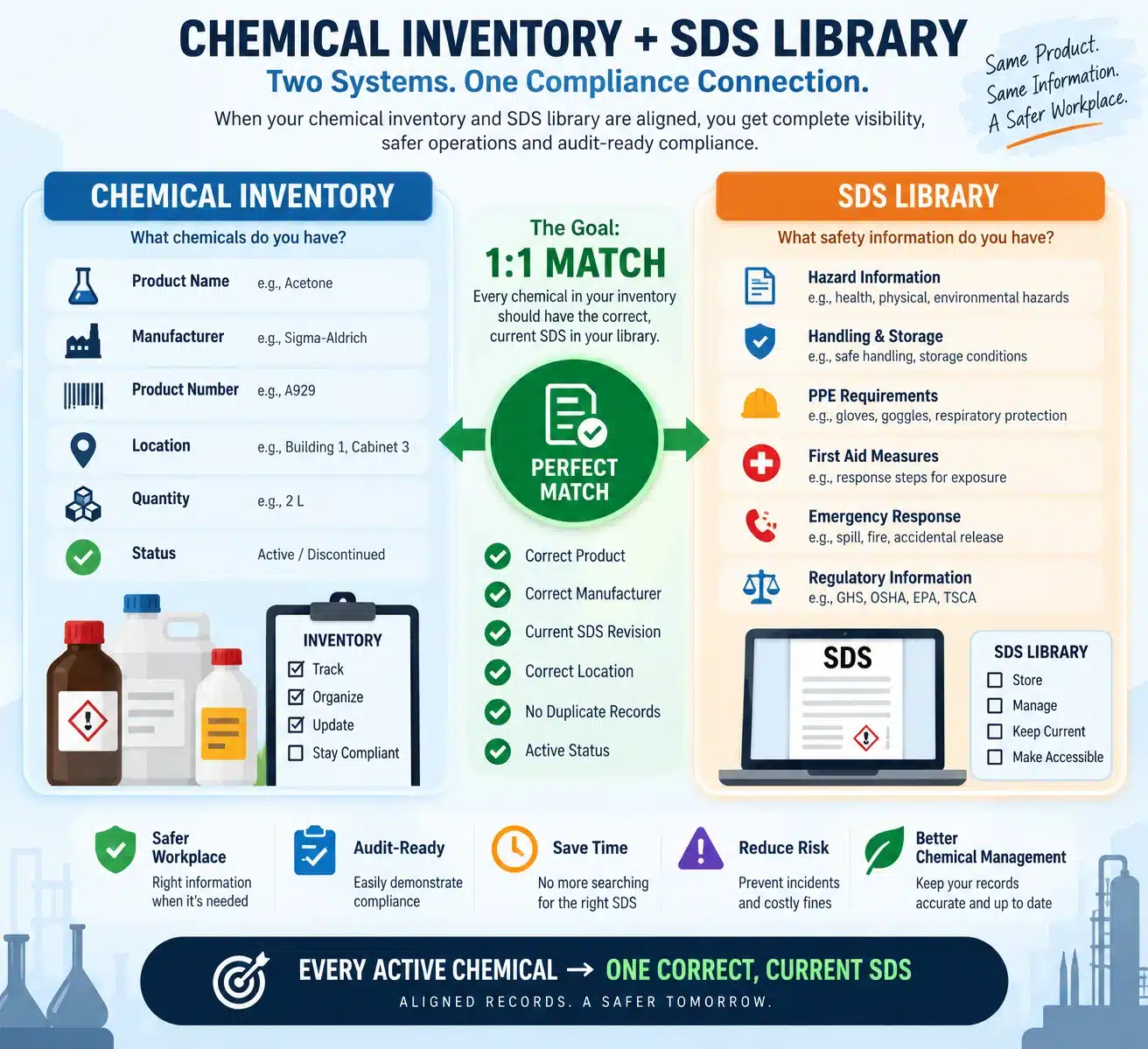
Chemical inventory—SDS alignment means every chemical physically present and actively used at a facility has a matching, current Safety Data Sheet on file—and, just as important, every SDS in the library corresponds to a chemical the facility actually has. It's a two-way check, not a one-way lookup.
In an aligned system, an EHS professional can pull up any inventory item and immediately confirm the SDS on record is for the correct product and manufacturer, reflects the current revision, and is tied to a specific storage location and use. Conversely, nothing sits in the SDS library as an orphaned document with no active chemical behind it.
Alignment breaks down for a handful of recurring reasons: inventory and SDS data live in separate systems maintained by separate people, updates happen manually and inconsistently, chemicals enter the facility outside the normal purchasing workflow, and manufacturers issue SDS revisions that never make it back to the inventory record. None of these causes are exotic—they're the ordinary friction of running two systems that were never designed to talk to each other.
The fix isn't complicated in concept, even if it takes real work to execute: connect inventory and SDS management so a chemical record and its SDS are treated as one linked object rather than two separate filing tasks, assign clear ownership for that connection specifically, and run reconciliation on a schedule rather than only when an audit forces the issue.
Chemical inventory—SDS alignment = knowing that every chemical currently present at your facility has the correct SDS available, while every active SDS in your library corresponds to a chemical you actually manage.
What chemical inventory–SDS alignment means
Two systems, one compliance obligation
A chemical inventory and an SDS library answer different questions, and it’s worth being precise about the split because the confusion between them is where alignment problems start.
The chemical inventory tells you:
- What chemicals are present, by product name, and, ideally, by manufacturer and product number
- Where they’re physically located—building, room, cabinet, or storage area
- How much is on hand, typically tracked by container count or volume
- Which department or facility uses each chemical
- Whether a given item is active, discontinued, or has been removed from stock
The SDS library, by contrast, tells you:
- The hazards associated with the chemical—health, physical, and environmental
- Required handling and storage precautions
- Personal protective equipment requirements
- First-aid measures
- Firefighting and accidental-release response information
- Regulatory and transport information, where applicable (DOT, IATA, IMDG classifications, for example)
These aren’t redundant systems—they’re complementary ones, and that’s exactly why keeping them separate creates a reconciliation problem instead of a duplication problem. The inventory can be perfectly accurate about what’s on the shelf while the SDS library is perfectly accurate about the hazards of products the facility no longer stocks. Both records can be individually “correct” and still be functionally useless together, because nothing forces them to reference each other.
Key takeaway: Having a complete inventory and having a complete SDS library are two different accomplishments. Compliance and operational readiness depend on the ability to connect the two—not on either one being comprehensive in isolation.
What "aligned" looks like
Alignment is a specific, testable condition, not a vague sense that "we have our SDSs." In a genuinely aligned system, an EHS professional should be able to:
- Search for any chemical in the inventory and pull up its corresponding SDS without a secondary lookup
- Confirm the SDS matches the correct product and manufacturer—not just a generically similar chemical
- See the SDS revision or effective date at a glance
- Identify where that chemical is used or stored
- Determine whether the chemical is still active in the inventory or has been phased out
The distinction between "not aligned" and "aligned" comes down to specificity and traceability:
Not aligned: A chemical appears in the inventory. An SDS for something with a similar name exists somewhere on a shared drive. Whether it's the right one, the right revision, or even the right manufacturer is a matter of assumption.
Aligned: A chemical/product in the inventory links to a specific SDS, confirmed against the correct manufacturer and product, showing the current revision, tied to an identifiable location and use.
The mismatch cases are usually more instructive than the clean ones:
| Inventory record | SDS record | Alignment status |
| Acetone—Supplier A | Acetone—Supplier A, current revision | Aligned |
| Xylene — Supplier B | Xylene — Supplier A | Mismatch |
| Cleaning solvent X | No SDS on file | Missing |
| Old adhesive | SDS exists; the chemical is discontinued. | Archive |
The xylene example is the one that catches people off guard. Both records reference "xylene," so a cursory check pass. But xylene formulations differ by supplier — flash point, stabilizer packages, and impurity profiles aren't identical across manufacturers — and an SDS from the wrong supplier can understate or misstate the actual hazard profile of the product in the building. A 1:1 mapping means matching the product, not just the chemical name.
Why most companies haven’t aligned them
It’s tempting to assume misalignment is a symptom of an under-resourced EHS function that simply hasn’t gotten around to collecting SDSs. In practice, that’s rarely the root cause. Most facilities have plenty of SDSs. The problem is structural—it’s about process design, not effort.
Separate ownership and systems
In most organizations, responsibility for chemicals in the workplace is split across functions that don’t report to each other and don’t share a system of record:
- Procurement manages purchasing and vendor relationships
- Warehouse or operations manages physical stock, receiving, and storage
- EHS manages SDS collection and the written HazCom program
- Individual departments—maintenance, R&D, and a production line—often purchase chemicals independently, sometimes through a corporate card rather than a PO
- Each of these groups may keep its own spreadsheet, shared drive folder, binder, or standalone database
The core problem isn’t that any one group is doing their job poorly. It’s that no one owns the relationship between the inventory record and the SDS record. Procurement’s job is to buy things and track spend. The warehouse’s job is to know what’s on the shelf. EHS’s job is to have hazard documentation. None of those job descriptions include “verify that today’s inventory count still matches the SDS revision on file,” and so that task falls into a gap between roles.
Manual tracking and spreadsheet drift
Even in EHS programs that do have a defined process, manual tracking degrades over time in a fairly predictable sequence: a chemical is purchased, the inventory spreadsheet gets updated, the SDS arrives by email or gets pulled from a supplier portal, it gets saved somewhere—a shared drive, a binder, an email folder—and then, as inventory changes happen afterward (reorders, relocations, discontinuations), the SDS record sits untouched.
The drift compounds through familiar failure modes: manual data entry errors, duplicate records created because someone didn't check whether an entry already existed, product names that get typed differently each time ("Isopropyl Alcohol 70%" vs. "IPA 70%" vs. "Iso Alcohol"), inconsistent naming conventions between departments, missing manufacturer or product-number fields that make matching ambiguous, old spreadsheet versions still circulating on someone's desktop, and updates that lag weeks or months behind the actual physical change.
None of these are dramatic failures individually. Collectively, across a facility with a few hundred SKUs and multiple people touching the records, they're enough to make the inventory and SDS library diverge steadily, even when everyone involved believes they're keeping things current.
SDS revisions outpacing inventory updates
A subtler version of the same problem: the inventory can still correctly identify the chemical while the SDS linked to it is no longer the applicable revision. This happens because SDS currency is driven by the manufacturer’s schedule, not the facilities.
Manufacturers reissue SDSs for reasons that don’t always trigger any visible change on the shelf—a reformulation, a supplier or manufacturing-site change, an update to hazard classification under a revised GHS interpretation, or new precautionary or first-aid language based on updated toxicology data. The container on the shelf may look identical to the one from two years ago. The SDS governing that product may not be.
This is why simply confirming “we have an SDS on file” doesn’t establish alignment. The relevant question is whether it’s the SDS—current, matched to what’s actually being used—not merely a document with the right product name at the top.
New chemicals entering without a corresponding SDS pull
Every facility has purchasing paths that route around the normal SDS-intake workflow, even when that workflow exists on paper. Common examples include one-off purchases for a specific job, small-quantity buys that don't go through a formal PO process, department-level purchasing where a supervisor orders directly, free samples from a vendor rep, maintenance supplies bought at a local hardware or industrial supply store, emergency purchases made to address an immediate operational need, and chemicals ordered directly from a supplier's website without going through central purchasing at all.
Each of these is a chemical entering the facility without triggering whatever process is supposed to capture its SDS. The question worth sitting with: what actually happens, procedurally, when a chemical shows up at the loading dock or gets carried in from a supply run, and nothing in the process forces an SDS check before it goes into use?
The compliance and risk consequences of misalignment
Misalignment isn’t merely a data-hygiene issue that makes audits mildly annoying. It creates real gaps in hazard communication, regulatory reporting accuracy, emergency response readiness, and audit defensibility—the areas where OSHA, state regulators, and internal risk management focus.
1. HazCom violations under OSHA 1910.1200
The Hazard Communication Standard requires employers to maintain a written HazCom program, ensure SDSs are readily accessible to employees for every hazardous chemical in the workplace during their work shift, and train employees on the hazards of the chemicals they work with. All three of those obligations depend on the employer actually knowing which chemicals are present and having the corresponding SDS available—which is precisely the connection that breaks down when inventory and SDS records aren’t reconciled.
Hazard communication has been a fixture near the top of OSHA’s most-frequently-cited list for years, and FY2025 was no exception: it ranked second overall, behind only fall protection, with 2,546 citations nationally. Citations under 1910.1200 cluster around a few recurring findings—no written hazard communication program, missing or incomplete employee training, and SDSs that aren’t accessible or aren’t maintained for the chemicals actually in use. That last category is exactly the failure mode this article is about: a chemical present in the workplace with no corresponding, accessible SDS to back it up.
2. EPCRA tier II reporting errors
Tier II reporting under EPCRA depends on an accurate picture of what hazardous chemicals are on site and in what quantities, at or above the applicable thresholds. That picture comes directly from physical inventory. If the inventory itself is unreliable—items that are logged but no longer present, items present but never logged, or quantities that don’t reflect current stock—the Tier II report inherits those errors.
An inventory that hasn’t been reconciled against actual SDS-backed chemical identities also creates a subtler reporting risk: chemicals get miscategorized, or their EHS (extremely hazardous substance) status under threshold planning quantities gets missed, because the underlying hazard classification wasn’t verified against a current SDS. Reconciling inventory and SDS records is, in effect, a prerequisite for a defensible Tier II filing, not a separate exercise.
For a deeper look at Tier II thresholds and filing mechanics, see CloudSDS’s EPCRA Tier II reporting resource.
3. Emergency response failures
First responders—internal emergency teams and external fire or hazmat units—depend on being able to quickly and correctly identify what they’re dealing with: the hazards, exposure risks, appropriate firefighting approach, spill or release precautions, PPE requirements, and first-aid measures for the specific product involved.
An SDS that exists somewhere in the library but can’t be confidently matched to the product actually being handled in an incident is not functionally different from not having an SDS at all at that moment. Responders don’t have time to guess whether the SDS on file is for the correct supplier version of a product or whether it reflects the formulation currently in the tank. Alignment is what makes an SDS library actually useful in an emergency, rather than merely present in an audit.
4. Audit and inspection exposure
Reconciliation gaps tend to surface at the worst possible moments—during an OSHA inspection, an internal EHS audit, a customer or vendor compliance audit, a corporate-level compliance review, or a multi-site assessment comparing facilities against each other. In each of these contexts, the practical question an auditor or inspector is testing is straightforward: can you prove that the chemicals physically present at your facility correspond to the SDSs in your system?
“Prove” is an operative word. A facility that can pull a chemical and immediately produce the matched, current SDS demonstrates a functioning program. A facility that has to search, cross-reference names manually, or admit uncertainty about which SDS applies is demonstrating the opposite—even if every individual document in the library is technically legitimate.
How to audit your current inventory—SDS alignment
This is where the concept turns into a repeatable process. The audit below works as a one-time baseline exercise and, at reduced scope, as the template for ongoing reconciliation.
Step 1—conduct a physical inventory walkthrough
Start by comparing what’s physically on the shelf against what the records say should be there—inventory records, department-level lists, warehouse logs, and purchasing records, since these often diverge from each other before you even get to the SDS question.
During the walkthrough, look specifically for chemicals that aren’t listed anywhere, products that were formally discontinued but are still physically present, duplicate entries for what’s actually the same product, quantities that don’t match what’s recorded, containers stored somewhere other than their listed location, and product-name discrepancies between what’s on the label and what’s in the system.
Step 2—Cross-reference every inventory item against its SDS.
For every active inventory record, verify chemical or product name, manufacturer, product number, whether an SDS exists at all, the SDS revision or effective date, the recorded location, and active/inactive status.
A practical checklist for each item: does it have a corresponding SDS, is that SDS for the correct manufacturer and product, is the revision current, is the location clearly identifiable, and is the active status accurate?
Step 3—Identify orphaned records
Two categories of orphan show up in every audit, and they point to different problems.
Inventory orphan: A chemical exists in the inventory with no corresponding SDS. This is the more urgent finding—it’s a direct hazard-communication gap, and it’s the exact condition that produces a 1910.1200 citation.
SDS orphan: An SDS exists in the library with no active inventory record behind it. This is lower urgency but still worth investigating—it can indicate a discontinued chemical that was never removed from the library, a duplicate SDS entered under two different names, an outdated document left over from a past formulation, or a chemical that was pulled from inventory without a corresponding library cleanup.
Step 4—Flag discontinued chemicals for archiving
Removing a chemical from the active inventory doesn’t mean its SDS should be deleted outright. There’s value in retaining discontinued-product SDSs as historical documentation—for exposure-history questions, for medical surveillance records tied to past chemical use, and for maintaining an audit trail that shows what was on site during a given period.
The practical move is distinguishing active from archived status clearly in the system so archived records don’t get mistaken for current guidance but also aren’t simply deleted and lost.
Step 5—Quantify the alignment gap
Numbers make this exercise defensible and trackable over time, rather than a one-time qualitative impression. Useful metrics include the inventory-to-SDS match rate, the count of inventory records without SDSs, the count of SDS records without active inventory matches, the count of outdated SDS revisions still linked as current, and the count of unverified or ambiguous product matches.
A simple formula for the headline metric:
SDS alignment rate = matched active inventory records ÷ total active inventory records × 100
Tracking this number quarter over quarter turns “we think we’re mostly aligned” into an actual, auditable trend line—and gives EHS leadership something concrete to report up the chain.
Building an ongoing inventory–SDS alignment process
A one-time cleanup gets you to zero. It doesn't keep you there. The audit above needs to become a standing process, not an annual fire drill.
Establish a single source of truth.
The instinct to keep a spreadsheet "as backup" alongside a shared drive, a paper binder, the procurement system, and a dedicated SDS database is understandable—and it's exactly what recreates the drift problem. Every additional independent record is another place for the inventory and the SDS to disagree.
The goal is a connected record: one system where the chemical and its SDS are treated as a single linked object, not two separate entries that happen to reference the same product name.
Automate SDS updates at receiving.
The strongest version of this process starts before the chemical is fully in the building, not months later during an audit. A workable sequence: purchase, receive, identify the chemical against the system, verify the SDS is current, add or update the inventory record, link the SDS to that record, and make it available to employees—all as part of receiving, not as a follow-up task.
Catching gaps at the point of receiving is categorically stronger than discovering them a year later during an annual audit, because it prevents the gap from ever existing in the first place rather than finding it after the fact.
Create a scheduled reconciliation cadence.
An annual reconciliation is a reasonable baseline for a stable facility with low chemical turnover. It's not sufficient for every environment—facilities with frequent purchasing, high SKU turnover, multiple departments buying independently, or multi-site operations generally need a tighter cadence, sometimes quarterly or even monthly for high-activity sites. There isn't a single OSHA-mandated frequency for this reconciliation specifically; the right cadence is a function of your actual chemical turnover and risk profile, not a fixed regulatory number.
Maintain multi-site consistency.
Multi-site organizations layer a second problem on top of the first: each facility may have its own procurement habits, its own naming conventions, its own local spreadsheet, and its own SDS library, none of which necessarily match how the facility down the road does it. A centralized system can enforce consistent naming, matching logic, and reconciliation cadence across sites while still preserving the facility-specific detail—location, quantity, local ownership—that each site actually needs day to day.
What EHS teams need in place
1. Defined ownership
Someone needs to own each piece of this explicitly: inventory accuracy, SDS accuracy, new-chemical onboarding, SDS revision monitoring, reconciliation itself, archiving of discontinued records, and audit documentation. The critical point is that ownership needs to cover the connection between the two systems specifically—not just “EHS owns SDSs” and “the warehouse owns inventory” as two separate assignments that never intersect.
2. Audit trail and version control
A defensible program needs visibility into when an SDS was added, when it was revised and what changed, which revision is currently marked active, when a chemical entered or left the inventory, who made each change, and what happened to records once they were archived. This is what turns “we believe our records are accurate” into something you can demonstrate to an auditor or inspector on request.
3. Integration between procurement and SDS management
The ideal workflow runs in one continuous chain: procurement triggers the chemical inventory update, which triggers SDS management, which makes the document available to employees, which feeds audit and reporting. Each handoff in that chain is a place where a connected system prevents drift that independent spreadsheets can’t.
This is where a platform like CloudSDS fits—not as a replacement for the process described above, but as the connective layer that makes it sustainable. Linking SDS Management and Chemical Inventory Management in one system reduces duplicate data entry, keeps chemicals and their SDSs connected by design rather than by manual cross-referencing, surfaces gaps automatically instead of waiting for an annual audit to find them, centralizes records across departments and sites, maintains version history without relying on someone remembering to update a spreadsheet, and gives EHS visibility across multiple facilities from one place.
See CloudSDS’s SDS Management and Chemical Inventory Management pages for more on how the two modules work together, along with related HazCom program resources.
A practical inventory–SDS alignment checklist
Before declaring your systems aligned, verify:
- Every active chemical appears in the inventory
- Every active chemical has a corresponding SDS
- The SDS matches the correct product and manufacturer
- SDS revision information has been verified as current
- Chemical locations in the inventory are accurate
- Duplicate records have been identified and resolved
- Inventory-only orphan records have been investigated
- SDS-only orphan records have been investigated
- Discontinued chemicals have been appropriately archived, not deleted
- New chemical purchases trigger an SDS verification workflow
- Responsibility for reconciliation is clearly assigned to a specific role
- Changes to both systems are captured in an audit trail
- Multi-site records follow a consistent naming and matching process
Frequently asked questions
How often should I reconcile chemical inventory with my SDS library?
There's no single OSHA-mandated frequency for this specific reconciliation, so the right cadence depends on your operational risk and chemical turnover rather than a fixed regulatory number. A stable facility with a small, slow-changing chemical list can reasonably reconcile annually. A facility with frequent purchasing, multiple departments buying independently, or high SKU turnover should reconcile quarterly at minimum, and some high-activity sites benefit from a rolling monthly check tied to receiving activity rather than a single annual event.
What happens if OSHA finds a chemical with no corresponding SDS?
Under 1910.1200, employers are required to maintain SDSs for hazardous chemicals in the workplace and make them readily accessible to employees. A chemical found on site without a corresponding SDS is a direct gap against that requirement and can result in a citation, independent of whether the facility's written HazCom program is otherwise in good shape. Hazard Communication has consistently ranked among OSHA's most frequently cited standards — it placed second nationally in FY2025—and missing or unmatched SDSs are a recurring finding within those citations, alongside written-program and training gaps.
Can I automate SDS-to-inventory matching?
Automation can reliably handle a meaningful share of this work—flagging inventory items with no linked SDS, catching duplicate entries, checking SDS revision dates against what's currently marked active, and surfacing orphaned records on both sides. What automation generally can't do on its own is resolve ambiguous matches with full confidence—cases like the xylene example above, where two records reference the same chemical name but different suppliers or formulations. Those still benefit from a human check, particularly for products where supplier-specific formulation differences actually change the hazard profile.
What's the difference between chemical inventory management and SDS management?
| Chemical inventory management | SDS management |
| What chemicals are present | Hazard information |
| Where they’re located | Handling and storage requirements |
| Quantities on hand | PPE and first-aid information |
| Active/discontinued status | SDS revision history |
Each system answers a real, distinct question on its own. The value—and the compliance obligation—comes from connecting them so that knowing what's on-site and knowing how to handle it safely aren't two separate lookups but one linked record.
Conclusion
Chemical inventory—SDS alignment isn't a paperwork nicety—it's the difference between a HazCom program that looks complete on paper and one that actually holds up when an auditor, inspector, or emergency responder needs it to. The companies that get this right don't necessarily have fewer chemicals or simpler operations; they've just stopped treating inventory and SDS management as two separate filing tasks maintained by two separate teams. They've assigned clear ownership for the connection itself, built SDS verification into receiving rather than into an annual scramble, and put a number—an alignment rate—on something that used to be a gut feeling.

Simplify Your SDS Management
CloudSDS gives your team instant access to 23M+ safety data sheets with AI-powered search, automated updates, and full OSHA/GHS compliance — all from one platform.
Leave A Comment