 Skip to content
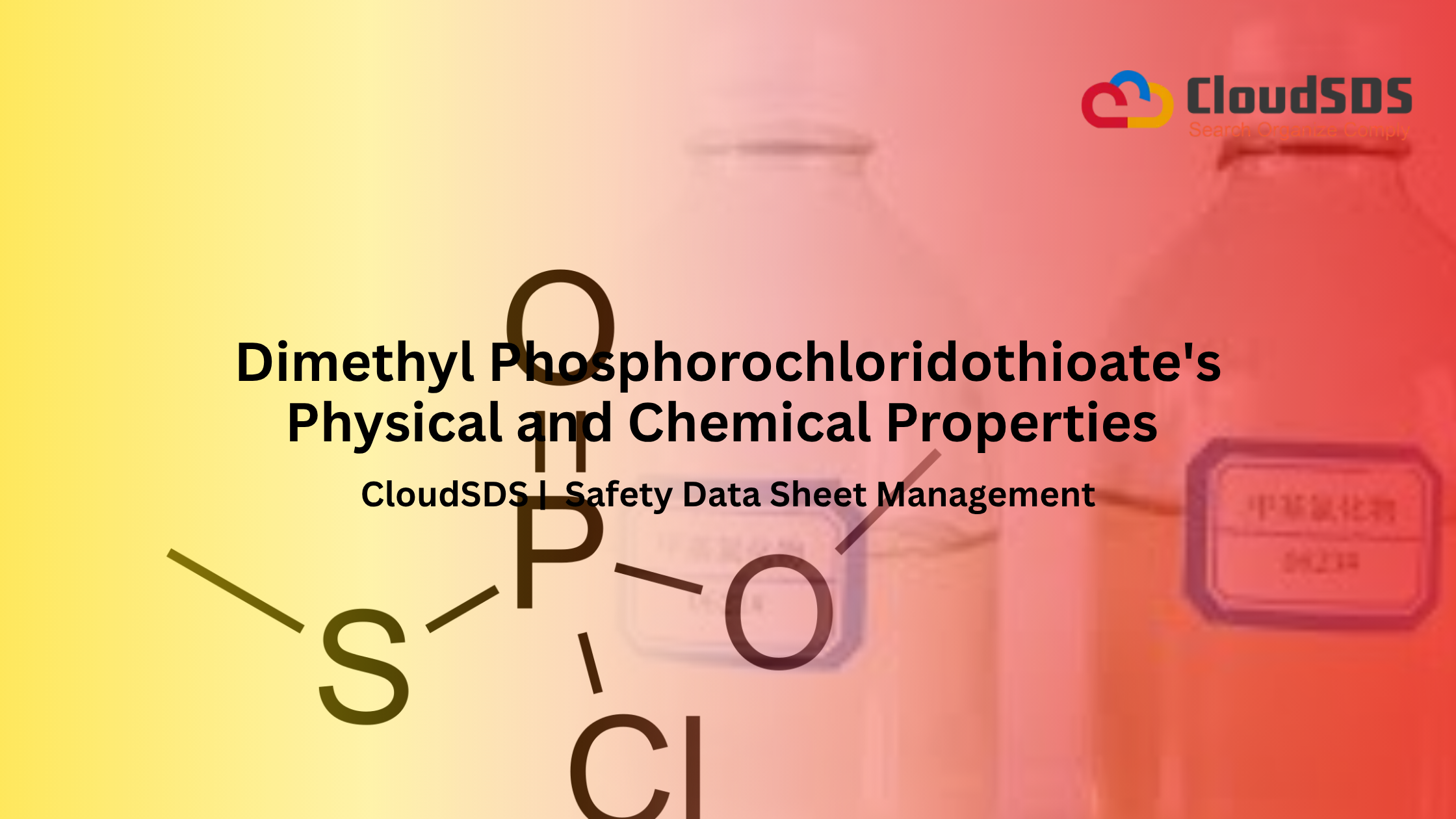
One of the most important organophosphorus compounds utilized in the chemical industry today is dimethyl phosphorochloridothioate, which is also known as O-dimethyl phosphorochloridothioate or dimethyl chlorothiophosphate. Thiophosphoryl chloride derivative is an important step in making a lot of different insecticides, herbicides, and other industrial additives.
The chemical has a phosphorus atom that is connected to a sulfur atom, chlorine, and methoxy groups. This property means that the chemical reacts quickly, which is good but also makes it difficult to handle. To make sure you follow OSHA or GHS rules when handling EHS, you need to know what the chemical is made of.
Learning About the Physical and Chemical Properties of Dimethyl Phosphorochloridothioate
Agriculture and materials research have made organophosphorus compounds like this one essential since the mid-20th century. The research team discovered dimethyl phosphorochloridothioate as part of their research into phosphate esters. Since then, it has been an integral part of the production of phosphorothioate insecticides, which are quite effective in controlling pests because of their natural biochemical pathways.
It does, however, need special handling, adhering to safety regulations outlined by agencies such as the EPA, because it easily dissolves in water and is also corrosive. This article goes into detail about its chemical identity, physical and chemical properties, reactivity, uses, and risks, making it a valuable resource for EHS professionals, chemists, and compliance officers.
Chemical structure and identity
The chemical formula for dimethyl phosphorochloridothioate is C₂H₆ClO₂PS. In this small structure, a phosphorus (V) atom is double-bonded to sulfur (P=S), single-bonded to chlorine, and linked to two methyl groups (–O–CH₃) by oxygen bridges. This arrangement puts it in the thiophosphoryl chloride family. The thio substitution makes it more lipophilic and reactive toward nucleophiles than simpler phosphoryl chlorides.
CAS number 2524-03-0, EINECS number 219-754-9, and RTECS TD1830000 are important identifiers used by regulators for the management of these compounds, which are generally included in Safety Data Sheets (SDS) and other global databases. The IUPAC nomenclature for this compound is O-dimethyl phosphorochloridothioate, which indicates that this molecule has functional methoxy groups as well as a functional chlorine group. Other names for this compound are dimethyl chlorothiophosphate. This molecule is similar in structure to the core structure of other pesticides, which are based on organophosphorus compounds, for example, malathion, where the P-Cl bond is a reactive site. This type of phosphorus-based structure can form tetrahedral structures, which are reactive and versatile.
In the actual world, commercial samples frequently have purity levels around 95%, and contaminants like dimethyl phosphorothioate occur from incomplete hydrolysis. It is important to use NMR (³¹P around 50–60 ppm) or IR (strong P=S stretch at ~700 cm⁻¹) to determine the identity of a substance for quality control in EHS-managed facilities.
A quick look at physical properties
Dimethyl phosphorochloridothioate is a clear pale amber liquid at room temperature. It smells strong and sharp, like thiols and chlorides. This smell is the first sign of danger in the workplace. Its physical shape as an oil shows that it has a low viscosity, which makes it easier to flow during processing but harder to contain.
Quantitative properties show that it has a boiling point of 66–67°C at a lower pressure (16 mm Hg). This means that it is moderately volatile, which makes it suitable for distillation under vacuum to keep it from breaking down. The density at 25°C is between 1.322 and 1.341 g/mL, which is more than water. This helps spills settle and makes it easier to separate things. A common approach to determining purity is to look at the refractive index (n²⁰/D), which is between 1.4776 and 1.4822. At 20°C, the vapor pressure is about 4 mm Hg (0.67 psi), and the vapor density is 5.54, which is more than five times that of air. This means that when there are leaks, the vapor will be collected in low-lying regions.
| Property | Value | Conditions |
|---|---|---|
| Boiling Point | 66–67 °C | 16 mm Hg |
| Density | 1.322–1.341 g/mL | 25 °C |
| Refractive Index | 1.4776–1.482 | n20/D |
| Vapor Pressure | 0.67 psi (4 mm Hg) | 20 °C |
| Vapor Density | 5.54 | Air = 1 |
| Flash Point | 105–221 °F (41–105 °C) | Closed cup |
| Physical Form | Colorless to amber oil | Room temperature |
It is stated that the material is combustible, with a flash point that suggests it could catch fire near open flames. However, it does not catch fire on its own below 120°C. If the temperature and pressure rise above this level, autocatalytic breakdown happens, which is a problem for sealed storage.
Chemical properties and how they react
Dimethyl phosphorochloridothioate is very electrophilic because it has chlorine and sulfur atoms that pull electrons away from the phosphorus atom. In water, hydrolysis happens, although it takes a long time. It doesn't make a stable solution; instead, it breaks down into dimethyl phosphorothioate, HCl, and phosphoric acids. It reacts violently with damp air, creating hydrogen, which is particularly combustible, and HCl gas, which is corrosive. This makes fires more likely.
Strong oxidizers, phosphonate bases, and ester-making alcohols don't mix. When something burns, it breaks down and releases phosphorus oxides (P₄O₁₀), sulfur oxides (SO₂), carbon monoxide, and chlorinated chemicals. Dimethyl phosphorochloridothioate is not very soluble in chloroform and dichloromethane.
Key points about reactivity:
Hydrolytic Instability: The molecule has a P-Cl bond that breaks down when nucleophiles are around. Moisture or amines speed up the process.
- Redox Sensitivity: When the molecule touches active metals, it changes into phosphines. It also turns into phosphates as it oxidizes.
- Ignition Potential: The chemical can start flames through exothermic processes, especially when it touches things that can burn.
- Conditions for Stability: The compound stays stable while it is in dry nitrogen and away from light and temperatures above 50°C.
Industrial usage
The main thing this molecule does is make phosphorothioate insecticides like parathion and coumaphos, where nucleophilic substitution replaces Cl with thiolates. In addition to agrochemicals, it is used to make flame retardants (via phosphonate esters), plasticizers, corrosion inhibitors for fuels, and flotation agents for mining. Sulfur in oil and gasoline additives makes them more slippery. Its scalability makes it suitable for mass production, and worldwide demand is linked to agriculture, which is expected to expand because of concerns about food security.
Safety issues and risks
There are three types of hazards: Acute Tox 3 (H301+H311+H331), Skin Corrosion 1B (H314), and Eye Damage 1 (H318). Burns, respiratory failure, and CNS depression (tremors and convulsions) are some of the symptoms. The UN classification 2267 (Class 6.1+8, PG II) says that the item needs specific packaging.
To reduce risk, wear PPE (PVC gloves and respirators), create an inert atmosphere, and make sure the ventilation rate is more than 10 air changes per hour. Soda ash is used to neutralize spills, and subsequently they are burned, according to SDS. Cholinesterase monitoring should be included in EHS training because organophosphate chemicals can also be neurotoxic.
In summary, dimethyl phosphorochloridothioate shows the dual nature of organophosphorus chemistry: it may be used to make things, but it also needs careful EHS management. Knowing its properties well makes the workplace safe, obeys the rules, and lets you employ chemicals in new ways.
Leave A Comment