
Last Updated on September 25, 2026
GHS Classification of Sodium Bicarbonate: What You Need to Know
Summary:
Sodium bicarbonate (CAS 144-55-8) is generally not classified as hazardous under GHS, but supplier SDSs can differ—some list no classification at all, while others flag fine dust as a mild eye irritant. This article gives the direct classification answer, breaks down each GHS hazard class for the substance, explains why supplier grade, particle size, and jurisdiction drive that variation, and covers labeling requirements, key SDS sections to check, safe handling, and spill response—so EHS teams can interpret any sodium bicarbonate SDS with confidence rather than treating classification differences as a red flag.
Introduction
Sodium bicarbonate—commonly known as baking soda and identified by CAS number 144-55-8—is one of the most widely handled chemicals in industrial, laboratory, food-processing, and cleaning applications. Because it shows so many chemical inventories, EHS teams frequently ask a deceptively simple question: is it actually classified as hazardous under the Globally Harmonized System (GHS)?
The short answer is that sodium bicarbonate is generally not classified as hazardous under GHS. But that answer isn’t the whole story. Anyone who has pulled SDSs from three different suppliers for the same product knows that classifications aren’t always identical—one SDS might list no hazard classification at all, while another flags dust as an eye irritant. Neither is necessarily wrong. The difference usually comes down to particle size, formulation, impurities, and how conservatively a given supplier’s hazard assessment was written, rather than any real disagreement about the chemistry of sodium bicarbonate itself. This article separates the substance’s inherent hazard profile from supplier-specific classification decisions, so EHS professionals can interpret an SDS correctly rather than treating every classification variation as a red flag.
Is sodium bicarbonate GHS classified as hazardous?
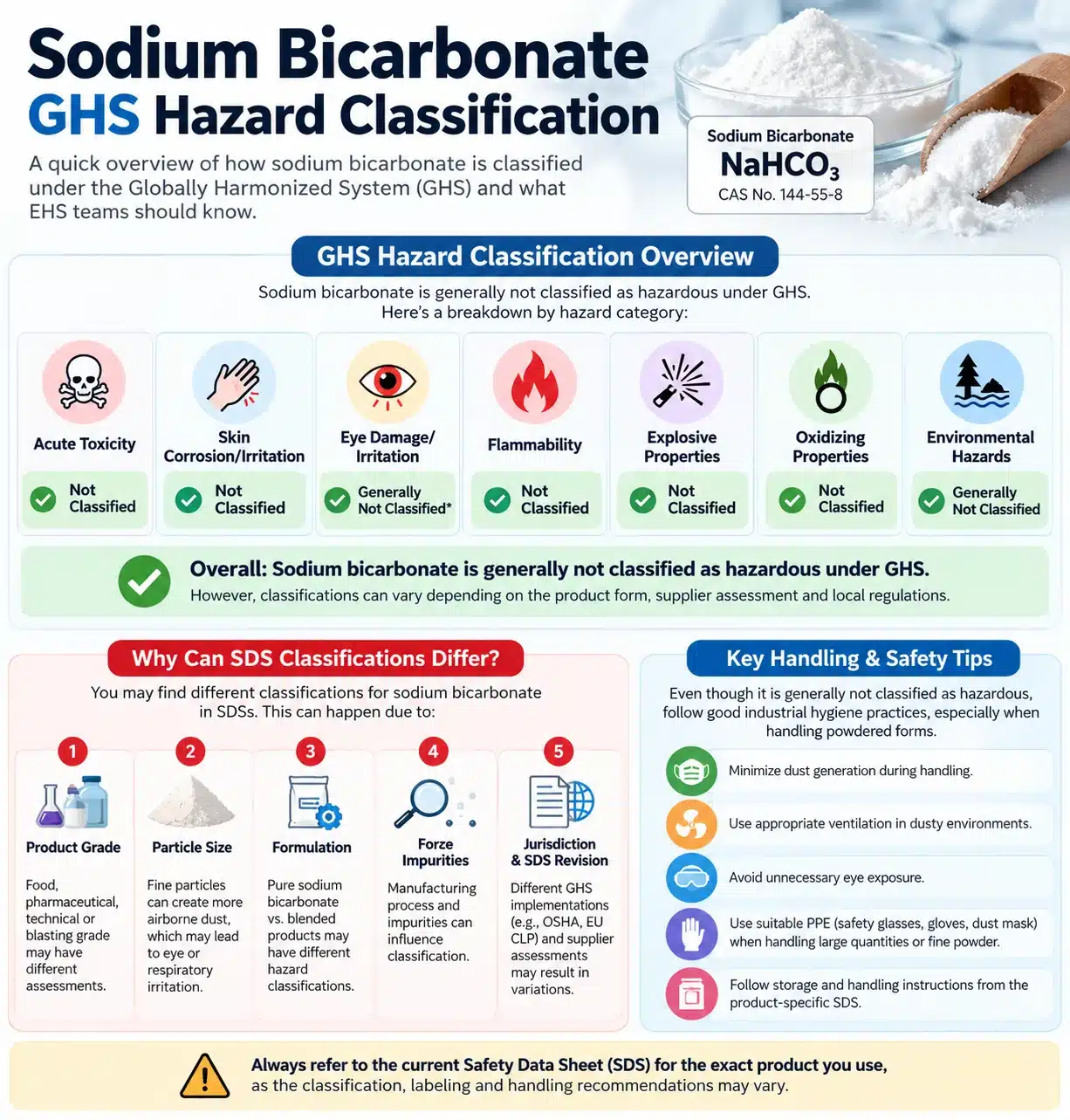
Short answer: Sodium bicarbonate is generally not classified as a hazardous substance under GHS when supplied and used under normal conditions. Classification can vary by supplier, formulation, physical form, and applicable jurisdiction. Some SDSs identify sodium bicarbonate dust as a potential eye irritant or include precautionary language for airborne exposure, even though the substance does not meet formal GHS classification thresholds in most assessments.
- GHS classification: Generally, not classified as hazardous
- CAS number: 144-55-8
- Potential concern: Fine dust may cause mechanical irritation to the eyes or upper respiratory tract
- SDS check: Always confirm classification against the current supplier SDS for the specific product handled at your facility
What is sodium bicarbonate?
Chemical identity and basic properties
Sodium bicarbonate is an inorganic salt with the molecular formula NaHCO₃, also known by its common names baking soda, bicarbonate of soda, and sodium hydrogen carbonate. It appears as a white, odorless crystalline powder that is readily soluble in water, forming a mildly alkaline solution (a saturated solution typically registers as a pH in the 8–9 range). It is stable at room temperature but decomposes gradually above roughly 50°C, releasing carbon dioxide, water vapor, and sodium carbonate—a property that underlies many of its industrial uses.
Common applications include food production and leavening, pharmaceutical formulations, water treatment, flue-gas and acid-gas scrubbing, fire suppression (as the active agent in some dry-chemical extinguishers), abrasive blasting media, and general-purpose cleaning and deodorizing products. This article focuses specifically on GHS hazard classification rather than a general chemistry profile—readers looking for broader physical and chemical property data should consult the substance's current SDS Section 9.
Why physical form matters
Sodium bicarbonate is sold and handled in several physical forms, and exposure potential differs meaningfully between them:
- Powder or fine dust: The form most likely to become airborne during transfer, mixing, or blasting operations
- Granular or coarse crystalline material: Lower dusting potential, reduced inhalation and eye-contact risk during routine handling
- Solutions or aqueous mixtures: Different handling considerations entirely, generally lower airborne-exposure risk but potential for splash contact
- Formulated blends: Sodium bicarbonate combined with other ingredients (abrasive media, cleaning formulations, food-grade blends), where the classification of the mixture may differ from that of sodium bicarbonate alone
A classification that appears on one supplier's SDS—particularly one written for a fine-particle or abrasive-blasting grade—should not be assumed to apply automatically to every sodium bicarbonate product an EHS professional encounters. The product-specific SDS, not general chemical knowledge, governs the classification that applies to material on site.
GHS hazard classification of sodium bicarbonate
Is sodium bicarbonate a hazardous chemical under GHS?
Under the criteria set out in the UN GHS framework and as implemented in the OSHA Hazard Communication Standard (29 CFR 1910.1200), sodium bicarbonate does not typically meet the classification thresholds for any GHS hazard class. This is the position reflected in most manufacturer and distributor SDSs, and it’s consistent with sodium bicarbonate’s long history of use in food, pharmaceutical, and consumer applications.
That said, two things can both be true at once:
- Sodium bicarbonate itself does not normally meet GHS hazard-classification criteria: The substance is not classified as an acute toxicant, skin or eye corrosive/irritant, respiratory or skin sensitizer, carcinogen, flammable solid, oxidizer, or environmental hazard under standard GHS test criteria.
- Supplier-specific classifications can still appear on an SDS: A supplier may classify a particular grade—often a fine-particle or dust-generating product—as a mild eye irritant or may include precautionary statements around dust exposure even without a formal hazard classification. This reflects the supplier’s own hazard assessment of their specific product, not a change in the underlying chemistry of sodium bicarbonate.
GHS hazard classes and sodium bicarbonate
| GHS Hazard Category | Sodium Bicarbonate | Explanation |
| Acute toxicity | Generally not classified | Oral, dermal, and inhalation toxicity data do not meet GHS classification thresholds; sodium bicarbonate has a long history of use in food and pharmaceutical products at low toxicity. |
| Skin corrosion/irritation | Generally not classified | Standard dermal contact does not produce corrosive or irritant effects meeting GHS criteria under normal handling. |
| Serious eye damage/eye irritation | Generally not classified, though supplier classification may vary | Bulk material is not typically classified; some SDSs flag fine dust as a mild/transient irritant based on mechanical particle contact rather than chemical corrosivity. |
| Respiratory sensitization / STOT | Not generally classified as a GHS hazard | Nuisance-level dust irritation is a recognized physical effect but does not, by itself, meet formal GHS classification criteria for respiratory hazard or specific target organ toxicity. |
| Flammability | Not classified as flammable | Sodium bicarbonate is a non-combustible inorganic salt; it does not support combustion and is used as a fire-suppression agent in some applications. |
| Explosive properties | Not classified | Does not meet GHS explosive-substance criteria; no self-reactive or explosive decomposition pathway under normal conditions |
| Oxidizing properties | Not classified | Sodium bicarbonate is not an oxidizer under GHS test methods. |
| Environmental hazards | Generally not classified | Available aquatic toxicity and environmental fate data do not support classification as hazardous to the aquatic environment |
This table reflects the general classification pattern seen across representative current SDSs and is not an independent regulatory determination. The applicable supplier of SDS — and any jurisdiction-specific classification requirements that apply where the product is manufactured, sold, or used — controls the classification for a particular product. Where a table of entry and a product's actual SDS disagree, the SDS governs.
Why some SDSs may classify sodium bicarbonate differently
This is one of the more common points of confusion EHS professionals run into when comparing sodium bicarbonate SDSs across suppliers, and it’s worth addressing directly rather than glossing over.
Dust exposure
Fine sodium bicarbonate particles can become airborne during pouring, mixing, blasting, or bulk-bag handling. Airborne dust can:
- Cause mechanical irritation on contact with the eyes—a physical effect from particulate contact rather than chemical corrosivity
- Cause temporary irritation of the nose, throat, or upper respiratory tract if inhaled in significant quantity, particularly in enclosed or poorly ventilated spaces
It’s important to distinguish irritation potential from formal GHS classification. Nuisance dust can produce a transient irritant response without the substance meeting the specific concentration, severity, or reversibility criteria that GHS requires for a formal skin, eye, or respiratory hazard classification. This is why a product can generate handling precautions on an SDS—appropriate ventilation, avoiding dust generation, eye protection during bulk transfer — without carrying a formal GHS hazard classification.
Why supplier SDSs can differ
Several factors legitimately produce different classification outcomes across suppliers for what is chemically the same substance:
- Product grade: Food-grade, pharmaceutical-grade, technical-grade, and blasting-media-grade sodium bicarbonate can carry different particle-size specifications and purity levels
- Particle size and physical form: A micronized or fine-milled product generates more airborne dust than a coarse granular product, which can lead a supplier to add precautionary dust-related language that a coarser product’s SDS omits
- Mixtures and formulations: Many commercial products are sodium bicarbonate blended with other ingredients; the SDS classification reflects the mixture, not pure NaHCO₃
- Trace impurities: Depending on the source and refining process, trace-level impurities can differ between suppliers and, in some cases, influence a conservative hazard assessment
- Supplier hazard-assessment methodology: Different manufacturers may apply differing levels of conservatism when classifying substances near a classification threshold, particularly for eye irritation
- Jurisdictional requirements: Classification and labeling obligations differ between OSHA HazCom, the EU CLP Regulation, and other national GHS implementations, and a globally distributed supplier’s SDS may reflect the most conservative applicable jurisdiction
- SDS revision currency: Regulatory guidance and classification criteria are periodically updated, and not every SDS in circulation reflects the most recent revision
None of this means that the SDSs are in conflict. It means classification is product-specific, and the correct practice is to rely on the current SDS for the exact product on site rather than assuming a classification based on general familiarity with sodium bicarbonate.
Sodium bicarbonate GHS labeling requirements
When no GHS hazard classification applies
When a supplier’s hazard assessment concludes that sodium bicarbonate does not meet GHS classification criteria, the product is not required to carry GHS hazard pictograms, a signal word (“Danger” or “Warning”), or GHS hazard statements, because none of the classification triggers that generate those label elements have been met. This does not mean the product is exempt from labeling altogether—supplier and workplace labels still typically identify the product, and many labels include general handling guidance as a matter of good practice even where it isn’t a GHS-mandated hazard statement. It simply means the label will not carry the pictogram/signal-word/hazard-statement combination that GHS reserves for classified hazards.
It’s a common misconception that every chemical on an inventory must display a GHS pictogram. Classification—not the mere presence of a chemical in the workplace—is what triggers pictograms, signal words, and hazard statements under HazCom.
When a supplier classification applies
Where a supplier has determined that a specific product (or a specific grade or particle size) meets classification criteria — for example, an eye-irritation classification tied to a fine-dust product — the SDS and label should reflect that classification, including the applicable pictogram, signal word, hazard statement, and precautionary statements. In that case, the workplace label and any secondary container labeling should match what the current SDS specifies for that product, not a generic assumption about sodium bicarbonate as a substance.
Sodium bicarbonate SDS: What should workers check?
Given how much classification depends on the specific product, the SDS itself—not general knowledge about sodium bicarbonate—is the authoritative source. Workers and EHS staff reviewing a sodium bicarbonate SDS should prioritize:
- Section 1—Identification: Confirms the exact product, supplier, and intended use match what’s on site
- Section 2—Hazard identification: The primary place to verify whether this specific product carries a GHS classification, and if so, which one
- Section 4 — First-aid measures: Relevant guidance for eye contact, dust inhalation, or ingestion
- Section 7—Handling and storage: Dust-control and storage recommendations specific to the product’s physical form
- Section 8 — Exposure controls/personal protection: Any recommended engineering controls or PPE, particularly for dust-generating tasks
- Section 10—Stability and reactivity: Relevant for storage compatibility and understanding decomposition behavior at elevated temperature
- Section 11 — Toxicological information: Supporting data behind the Section 2 classification decision
Section 2 is the single most important section for answering the classification question directly—it’s where the supplier’s actual GHS determination is stated, rather than inferred.
Sodium bicarbonate hazards and safe handling
Potential exposure routes
- Inhalation of airborne dust during bulk transfer, mixing, or blasting operations
- Eye contact from airborne particulate or splash during handling
- Skin contact, generally low concern under normal handling
- Accidental ingestion, primarily a concern in food-handling or laboratory settings with poor hygiene practices
Basic handling precautions
- Minimize dust generation during transfer, scooping, and bagging operations
- Use local exhaust ventilation or other engineering controls where airborne dust is generated, particularly in blasting or bulk-handling operations
- Avoid unnecessary eye contact with airborne dust; use safety glasses or goggles during dusty tasks
- Follow the specific supplier’s SDS recommendations for the product grade in use, rather than generic sodium bicarbonate handling assumptions
- Select PPE based on an actual task-level exposure assessment rather than a blanket assumption that no classification means no precautions are needed
Storage
- Store in a dry location; sodium bicarbonate is hygroscopic to a degree and can cake or degrade in humid conditions
- Use appropriate, well-sealed containers to prevent moisture ingress and contamination
- Prevent cross-contamination with incompatible materials, particularly acids, which will react with sodium bicarbonate to release carbon dioxide
- Follow supplier-specific storage guidance found in SDS Section 7, especially for bulk storage silos or large-volume containers
What should you do if sodium bicarbonate is spilled?
Sodium bicarbonate spills are generally low-severity events, but proper cleanup still matters, primarily to control dust:
- Avoid dry sweeping methods that generate unnecessary airborne dust; consider vacuum collection with appropriate filtration or lightly dampening the material before sweeping
- Use appropriate collection methods and containers for the spilled quantity
- Ventilate the area if airborne dust is generated during cleanup
- Follow the specific product SDS for any additional spill-response guidance
- Dispose of collected material according to applicable local, state, and federal waste-disposal requirements
Sodium bicarbonate should not be treated as a major chemical emergency simply because it appears in a chemical-safety article alongside more hazardous substances — its spill response is comparatively straightforward, and the main practical concern is dust management rather than acute toxicity or reactivity.
Sodium bicarbonate vs. other commonly Used chemicals
| Chemical | Typical GHS Classification Status | Main Consideration |
| Sodium bicarbonate | Generally not classified as hazardous | Dust/mechanical irritation considerations |
| Sodium hydroxide | Classified—skin/eye corrosive (Category 1) | Severe corrosivity requiring dedicated PPE and handling controls |
| Sodium carbonate (soda ash) | Often classified — eye irritant (Category 2) | More consistently classified for eye irritation than sodium bicarbonate |
This comparison is included to contextualize where sodium bicarbonate sits relative to chemically related substances that EHS teams often store or use alongside it — it isn't meant to expand into a full comparative hazard review.
Regulatory and authoritative sources
This article's classification statements are based on the following categories of authoritative sources:
- OSHA Hazard Communication Standard, 29 CFR 1910.1200, which adopts GHS classification and labeling requirements for the U.S. workplace
- UN Globally Harmonized System (GHS) of Classification and Labelling of Chemicals, the underlying international framework for hazard classification criteria
- Applicable OSHA/GHS classification guidance for substances near classification thresholds, including guidance on nuisance dust and mechanical irritation versus formal hazard classification
- A representative current supplier SDS for sodium bicarbonate—readers should identify the specific manufacturer or distributor, product name, SDS revision date, and jurisdiction when citing or relying on a particular SDS, since classification statements are product- and revision-specific
- Other applicable regulatory sources, including jurisdiction-specific GHS implementations (e.g., the EU CLP Regulation) where products are distributed internationally
Because classification is product-specific, and SDSs are periodically revised, this article should be treated as general guidance on how to interpret sodium bicarbonate classification—not a substitute for the current SDS of the specific product in use.
Frequently asked questions
Is sodium bicarbonate classified as hazardous under GHS?
Generally, no. Most current SDSs do not assign sodium bicarbonate a GHS hazard classification. However, classification is supplier- and product-specific, so the current SDS for the exact product in use should always be checked before assuming no hazard applies.
What is the GHS classification of sodium bicarbonate?
Sodium bicarbonate is generally not classified under any GHS hazard class—acute toxicity, skin/eye irritation, flammability, and environmental hazard criteria are typically not met. Some supplier SDSs classify specific products, often fine-particle grades, as mild eye irritants; this reflects a supplier-specific hazard assessment rather than a universal classification of the substance.
Does sodium bicarbonate require a GHS label?
Only if the specific product has been classified under GHS criteria by its supplier. An unclassified product is not required to carry GHS pictograms, a signal word, or hazard statements. Labeling requirements always depend on the actual classification outcome for that product and the applicable regulatory jurisdiction.
Can sodium bicarbonate dust be hazardous?
Airborne sodium bicarbonate dust can cause mechanical eye irritation and transient respiratory or throat irritation, particularly during dust-generating tasks like blasting or bulk transfer. This physical irritation potential is a real handling consideration, but it does not automatically mean the substance meets formal GHS hazard-classification criteria.
What is the CAS number for sodium bicarbonate?
144-55-8.
Where can I find the GHS classification for my sodium bicarbonate product?
Section 2 (Hazard Identification) of the current supplier for SDS for your specific product is the first and most reliable place to check.
Conclusion
Sodium bicarbonate is generally not classified as hazardous under GHS, and that position is well supported across the substance's toxicological and physical-hazard data. But an unclassified status is not the same as "no precautions needed." Airborne dust from handling, mixing, or blasting operations can still cause real, if generally mild and transient, eye and respiratory irritation — and some supplier SDSs reflect that reality through product-specific classifications or precautionary statements even without a formal GHS hazard class.
The practical takeaway for EHS teams is straightforward: don't rely on general familiarity with sodium bicarbonate as a substitute for checking the actual SDS of the product on site. Classification varies by grade, particle size, formulation, and supplier methodology, and workplace controls should be based on the specific task, exposure potential, and the current SDS — not on assumptions carried over from a different product or a different supplier's paperwork.
This is exactly the kind of variability that makes centralized SDS management valuable. When every sodium bicarbonate product across a facility — different grades, different suppliers, different revision dates — is tracked and accessible in one place, EHS teams and frontline workers can confirm the classification that actually applies, rather than relying on memory or an outdated printed copy. CloudSDS helps organizations keep current, product-specific SDSs centralized and accessible, so classification questions like this one can be answered in seconds rather than by searching through a binder or contacting a supplier.
References
- https://www.osha.gov/laws-regs/regulations/standardnumber/1910/1910.1200
- https://www.osha.gov/hazcom/standards
- https://unece.org/about-ghs
- https://ls-fts.unog.ch/sites/default/files/2024-04/GHS%20Rev10e.pdf
- https://pubchem.ncbi.nlm.nih.gov/compound/516892
- https://crawler.dep.state.pa.us/OilGas/BOGM/BOGMPortalFiles/IndustryResources/InformationalResources/HDD_Saftey_Data_Sheets/Sodium_Bicarbonate_SDS.pdf
- https://cityofhouston.ehsinsight.com/attachment/fetch/04d5ae8e-80b8-4b55-a029-486bd4e5a6d4
- https://cdn.schoolspecialty.com/804da3e3-0975-41bb-a6cc-b0f10009cddd/580029_Original%20file.pdf

Simplify Your SDS Management
CloudSDS gives your team instant access to 23M+ safety data sheets with AI-powered search, automated updates, and full OSHA/GHS compliance — all from one platform.
Leave A Comment