
Last Updated on September 24, 2026
Chemical Inventory Management: The Foundation of EHS Compliance
Quick Answer
A chemical inventory is a facility's current record of every hazardous chemical on site—what it is, how much is present, and where it's stored. It's more than a HazCom list: a complete inventory tracks product identity, CAS numbers, quantities, container details, storage locations, and ownership, and it feeds directly into OSHA Hazard Communication, EPCRA Tier II reporting, emergency response planning, and RCRA waste determinations. This article explains what belongs in a chemical inventory, the regulations that depend on it, common failure points, and a practical process for building and maintaining one—whether on a spreadsheet or in dedicated software.
What is a chemical inventory?
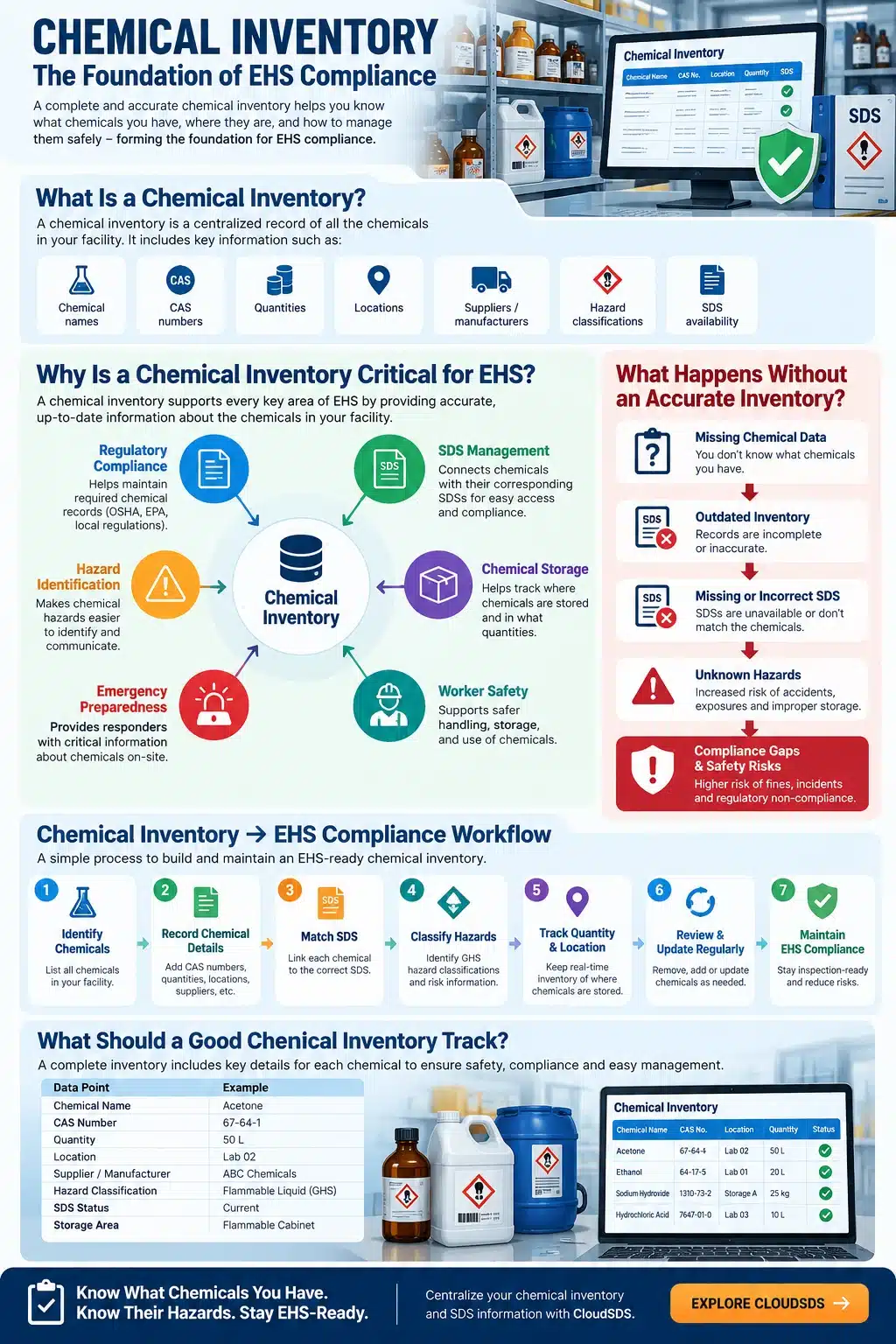
A chemical inventory is a current, facility-level record of every hazardous chemical on site: what it is, how much you have, and where it’s kept. Most chemical-related compliance duties start from that list:
- OSHA Hazard Communication (HazCom): the list determines which SDSs, labels, and training you owe.
- EPCRA Tier II reporting: the annual filing is built from your inventory quantities.
- Emergency response: fire departments and LEPCs use it to decide how to approach an incident.
- RCRA waste tracking: it’s where waste determinations begin.
If the inventory is wrong, every program built on it inherits the error.
Core definition
No regulation defines "chemical inventory" as a single document with fixed contents. OSHA requires a list of hazardous chemicals. EPA requires quantity reporting above thresholds. The fire code requires a hazardous materials inventory statement. Those are three separate obligations with different fields and audiences.
In practice, well-run facilities keep one master record detailed enough to answer all three. That record is what this article means by chemical inventory. It covers what is on site right now, in what quantity, in what container, and in which room.
What a complete inventory includes
Name, CAS number, quantity, container type, location, date received, and owner are the baseline. Here is why each one earns its place, plus a few fields that experienced EHS managers add.
| Field | Why it matters |
| Product name and manufacturer | Must match the label and SDS exactly. Trade-name mismatches are the most common reason a list and an SDS binder don’t reconcile. |
| CAS number(s) | Identifies components, not just the product. Mixtures have no CAS number of their own, so record the reportable components from SDS Section 3. |
| Physical state and hazard classes | Drives Tier II hazard categories and fire-code classification. Note that EPA replaced the 24 Tier II hazard categories with 118 categories aligned to OSHA’s 2024 HazCom classifications, effective 21 August 2026. The expanded categories first apply to reporting year 2027, in reports due 1 March 2028. |
| Quantity (maximum and typical) | Tier II asks for maximum and average daily amounts, in pounds. Convert from gallons using the specific gravity in SDS Section 9. |
| Container type and size | Tier II asks for storage type. Fire codes limit quantities by container. |
| Storage location | Responders need it. Fire code maximum allowable quantities are applied per control area. |
| Date received / expiration | Flags aging stock, and expired reagents are a common source of unplanned hazardous waste. |
| Responsible owner | Someone has to be accountable for each area. |
| SDS revision date | Shows which sheets predate the 2024 HazCom update. |
Chemical inventory vs. the TSCA inventory
Search results for this phrase are muddied by a second meaning. The TSCA Chemical Substance Inventory is EPA’s national list of chemical substances manufactured, imported, or processed in the United States. It holds tens of thousands of substances, and its main function is telling manufacturers and importers whether a substance is permitted in commerce. It says nothing about what is in your building.
The facility-level inventory in this article is a record of your own chemicals and quantities. The two connect only at the margins, for example, when you import a substance and need to confirm it is TSCA-listed. If you land here looking for the national list, EPA maintains it directly.
Why it’s the foundation of EHS compliance
Hazard communication (OSHA 1910.1200)
The written program required by OSHA’s Hazard Communication Standard must include a list of hazardous chemicals known to be present, using an identity that can be traced to the SDS. The list can cover the whole workplace or be broken out by work area. Every entry then triggers three duties: a current SDS that employees can reach, labels on containers, and training on the hazards.
The standard doesn’t ask for quantities or locations. That is why many facilities keep a bare-bones HazCom list that can’t support anything else. A useful inventory goes further, and it should link to the SDS for each product.
Two scoping traps cause under-inventorying. The consumer product exemption applies only when the product is used the way a consumer would use it, in a similar duration and frequency. A janitorial crew using a household cleaner all shift doesn’t qualify. And the “article” exemption is narrower than most people assume.
EPCRA Tier II reporting
Under EPCRA Section 312, facilities that hold hazardous chemicals at or above threshold quantities report them each year to the state emergency response commission, the LEPC, and the local fire department. The general threshold is 10,000 pounds for chemicals with an OSHA SDS requirement. Extremely hazardous substances are reportable at 500 pounds or their threshold planning quantity, whichever is lower. The report covers the prior calendar year and is due March 1.
Notice what the filing asks for: maximum and average daily amounts, storage types, and locations. You can’t produce those from a list of names. A Tier II filing built from memory or from purchasing records is the most common way facilities end up with errors.
The form itself is also changing. EPA’s June 2026 final rule (FR Doc. 2026-12426) aligns Tier II hazard categories with the 2024 HazCom classifications, replacing 24 categories with 118. It takes effect on 21 August 2026 and first applies to reporting year 2027—the report due on 1 March 2028. Facilities filing for reporting year 2026 in March 2027 still use the existing categories. An inventory that already records HazCom hazard classes per product will map across cleanly; one that records only names and quantities will not.
Emergency response and right-to-know
When a fire is reported at your site, the first question from the incident commander is what's inside. The Tier II submission is one source of that answer, and the fire department's pre-incident plan is another. Both are only as good as the inventory behind them.
Right-to-know also runs the other way. Employees, and in many states the public, can request chemical information. An inventory that is current and organized by location makes those requests routine. One that lives in three spreadsheets makes them a scramble.
RCRA hazardous waste tracking
RCRA doesn't require a chemical inventory. But it does require generators to determine whether their waste is hazardous and to keep the records supporting that determination. The inventory is where that work starts.
A waste stream is usually a chemical you already know about. The inventory tells you what it was, what it contained, and how old it is. It also catches the situation many facilities discover only at cleanout time: unused commercial chemical products that become listed hazardous waste when discarded. Your monthly generation total, which sets your generator category, is easier to defend when you can trace it back to inventory records.
Process safety management (where applicable)
For some facilities, quantities decide whether a whole regulatory program applies. OSHA's PSM standard covers processes with specified toxic or reactive chemicals at or above the threshold quantities in Appendix A and flammable liquids or gases of 10,000 pounds or more in a process. EPA's Risk Management Program under 40 CFR Part 68 has its own list and thresholds.
The key phrase is "in a process," which includes interconnected vessels and nearby vessels that could be involved in a release. A container-by-container list isn't enough. The inventory needs to show how much of a chemical can be aggregated at one point.
Regulatory requirements for maintaining a chemical inventory
OSHA requirements
The core obligation is the HazCom list described above, kept as part of the written program. Records of retention is the requirement people miss. If you discard an old SDS, 29 CFR 1910.1020 lets you do so only if you keep a record of the chemical identity, where it was used, and when for 30 years. Your inventory history can serve as that record, but only if you retain past versions.
Laboratories operating under the OSHA Laboratory Standard (1910.1450) have somewhat different HazCom obligations. EPCRA reporting still applies to them.
State and local requirements
State programs vary a lot. Some states run their own reporting portals and charge fees. Some set lower thresholds or add chemicals to the federal lists. California’s Hazardous Materials Business Plan requires reporting at 55 gallons of liquid, 500 pounds of solid, or 200 cubic feet of compressed gas, far below the federal 10,000-pound threshold.
Local fire codes matter just as much. The International Fire Code, adopted with local amendments, requires a hazardous materials inventory statement and caps quantities per control area. Check with your state emergency response commission and your local fire marshal, since the federal minimum is often not the binding one.
Update frequency expectations
An annual review is the floor, and it lines up with the Tier II cycle. But an annual-only approach fails in practice. A new chemical, a discontinued product, a process of change, or a move to another building should each trigger an update when it happens, so the record never drifts more than a few weeks from reality.
One timely trigger: OSHA moved the HazCom 2024 compliance dates back by four months in a final rule published 15 January 2026 (FR Doc. 2026-00653). Four separate deadlines shifted, and they apply to different parties.
| Who | What they must do | Original date | New date |
| Manufacturers, importers, distributors—substances | Comply with all modified provisions of 1910. 1200 | 19 Jan 2026 | 19 May 2026 |
| Employers—substances | Update workplace labeling, the HazCom program, and training. | 20 Jul 2026 | 20 Nov 2026 |
| Manufacturers, importers, distributors—mixtures | Comply with all modified provisions of 1910. 1200 | 19 Jul 2027 | 19 Nov 2027 |
| Employers—mixtures | Update workplace labeling, the HazCom program, and training. | 19 Jan 2028 | 19 May 2028 |
Until each deadline passes, employers may follow either the 2012 or the 2024 version of the standard. For an inventory, the practical step is knowing which products have received revised SDSs — and the live deadline for most US employers is 20 November 2026 for substances.
What goes wrong without an accurate inventory
HazCom citations
HazCom is one of the most-cited standards OSHA has. Hazard Communication (29 CFR 1910.1200) ranked second, behind fall protection, on OSHA's Top 10 most frequently cited standards for fiscal year 2025—the most recent list OSHA has published—and held the same position in fiscal year 2024. The paragraphs cited most often tend to be the written program, employee training, SDS access, and workplace labeling. An inventory doesn't fix all of those, but a missing or stale one makes each of them harder to defend.
Tier II filing errors
The mistakes are usually mundane:
- Reporting in gallons when the form calls for pounds.
- Confusing maximum daily amount with average.
- Missing extremely hazardous substances hiding in mixtures.
- Failing to notice that a single large purchase pushed the facility over a threshold.
- Carrying forward last year's hazard categories without checking whether the 118-category structure applies to the reporting year being filed.
EPCRA civil penalties are assessed per violation and adjusted for inflation each year, so check EPA's current figures rather than relying on an old number.
Emergency response gaps
The gap that hurts most is between the record and the building. Chemicals get moved, staging areas appear, and a compressed gas cylinder rack ends up somewhere no one wrote down. If responders trust a location that is out of date, they may enter the wrong area or, worse, not know a hazard is behind a door.
Audit failures
Auditors, whether insurers, customers, or ISO certification bodies, tend to test the inventory in two ways. They pick up a container off the shelf and look for it on the list, then pick an entry off the list and look for it on the shelf. Facilities that fail in one direction usually fail the other.
How to build and maintain a chemical inventory
Initial walkthrough and baseline capture
Start with a physical walkthrough, and don't treat purchasing records as a substitute. Records show what was bought, not what's still there, and they miss samples, donated stock, and contractor-supplied products. Go room by room: production areas, maintenance shops, labs, loading docks, outdoor storage, tanks, and the back of the janitor's closet. Record each product as it appears on the container, and photograph labels as you go.
Then reconcile against your SDS collection. Every product should have a current sheet, and every sheet should map to a product actually on site. The orphans on both sides are your first findings.
Choosing between spreadsheets and dedicated software
A spreadsheet is a legitimate starting point for one small site with a few dozen products and one person maintaining it. It stops working when several people edit it, when quantities need to roll up by location or facility, or when you need to show who changed what and when. Unit conversions for Tier II become manual work, and SDS revision tracking depends on someone remembering to do it.
At that point, evaluate dedicated software against your own list of needs: audit trail, per-location quantity roll-ups, SDS linkage, barcode or QR-based updates, and Tier II export.
Integrating inventory with SDS management
Treat the inventory and the SDS library as one system with two views. Each inventory record should point to a specific SDS version, and each new SDS revision should prompt a check of the inventory entry. That way a new product can't be added without a sheet, and a retired product doesn't leave a stale one behind.
Multi-site and multi-department consistency
Multi-site organizations run into naming drift: one plant calls a solvent by its trade name, another by its generic name, and a third by a part number. Agree on one naming convention and one master product list, then let sites add their own quantities and locations to it. Set one owner per site and one central reviewer and use the same unit of conventions everywhere. Otherwise, corporate-level Tier II and RMP roll-ups turn into a reconciliation project each February.
Frequently asked questions
-
What is required to be included in a chemical inventory?
At minimum, OSHA requires a list of the hazardous chemicals present, identified in a way that matches the SDS. EPCRA reporting adds maximum and average quantities, storage types, and locations. For a working inventory, add CAS numbers for components, container details, dates, and an owner.
-
How often does a chemical inventory need to be updated?
No federal regulation fixes a single interval. Annual review is the common floor, because Tier II is due each March 1. Update the record whenever something significant changes, such as a new chemical, a discontinued one, or a relocation, so the annual review is a check and not a rebuild.
-
Is a chemical inventory the same as an SDS library?
No. The SDS library holds the hazard documents. The inventory says which chemicals you have, where they are, and how much. You need both, and each entry in one should connect to the other.
-
Do small businesses need a chemical inventory?
If a small business has hazardous chemicals in the workplace, HazCom applies regardless of size, and that includes keeping the list. EPCRA Tier II reporting depends on thresholds, so many small operations fall below it, but state and local rules may still apply. The scale is smaller; the obligation is the same.
-
When do the 2024 HazCom changes affect my inventory?
Chemical manufacturers, importers, and distributors had to comply with substances by 19 May 2026 and must comply with mixtures by 19 November 2027. Employers must update workplace labeling, their written HazCom program, and training by 20 November 2026 for substances and 19 May 2028 for mixtures. Practically, that means revised SDSs are arriving now, so track SDS revision dates in the inventory.
-
Are the EPCRA Tier II hazard categories changing?
Yes. EPA replaced the 24 hazard categories with 118 categories aligned to the 2024 HazCom classifications. The rule took effect on 21 August 2026 and first applies to reporting year 2027, filed by 1 March 2028. Reports filed in March 2027 covering 2026 use the existing categories.
Conclusion
A chemical inventory isn't a single form required by a single regulation—it's the shared record that HazCom, Tier II, emergency responders, and RCRA all draw from. Get it wrong, and every program built on top of it inherits that error, from missed SDSs to misfiled Tier II reports to responders walking into a building blind. Get it right—accurate, current, and reconciled against your SDS library—and the rest of your chemical compliance program has something solid to stand on. Treat the walkthrough, the reconciliation, and the update triggers as ongoing work rather than an annual scramble, and the inventory will do its job when it matters most.
Sources
Primary regulatory sources used in this article. Links in the body text go directly to the relevant standard.
- OSHA, 29 CFR 1910.1200, Hazard Communication.
https://www.osha.gov/laws-regs/regulations/standardnumber/1910/1910.1200
- OSHA, 29 CFR 1910.1020, Access to Employee Exposure and Medical Records.
https://www.osha.gov/laws-regs/regulations/standardnumber/1910/1910.1020
- OSHA, 29 CFR 1910.119, Process Safety Management of Highly Hazardous Chemicals.
https://www.osha.gov/laws-regs/regulations/standardnumber/1910/1910.119
- OSHA, 29 CFR 1910.1450, Occupational Exposure to Hazardous Chemicals in Laboratories.
https://www.osha.gov/laws-regs/regulations/standardnumber/1910/1910.1450
- 40 CFR Part 370, Hazardous Chemical Reporting: Community Right-to-Know.

Automate Your Tier II Reports
CloudSDS auto-generates Tier II and EPCRA reports from your chemical inventory — no spreadsheets, no missed deadlines.
Leave A Comment