 Skip to content

When it comes to handling hazardous materials, dropping the ball on Safety Data Sheet (SDS) management isn’t just a minor oversight; it’s a direct threat to your entire operational flow. Without accurate and accessible SDS, your team might misidentify chemicals, leading to serious safety incidents, costly spills, and even worker injuries that can bring production to a screeching halt. Beyond the immediate dangers, a shoddy SDS system invites hefty regulatory fines from agencies like OSHA, tarnishes your brand’s reputation, and can even trigger supply chain disruptions if you can’t properly manage incoming or outgoing materials. In short, neglecting your SDS responsibilities is a surefire way to invite a whole heap of operational headaches and financial pain.
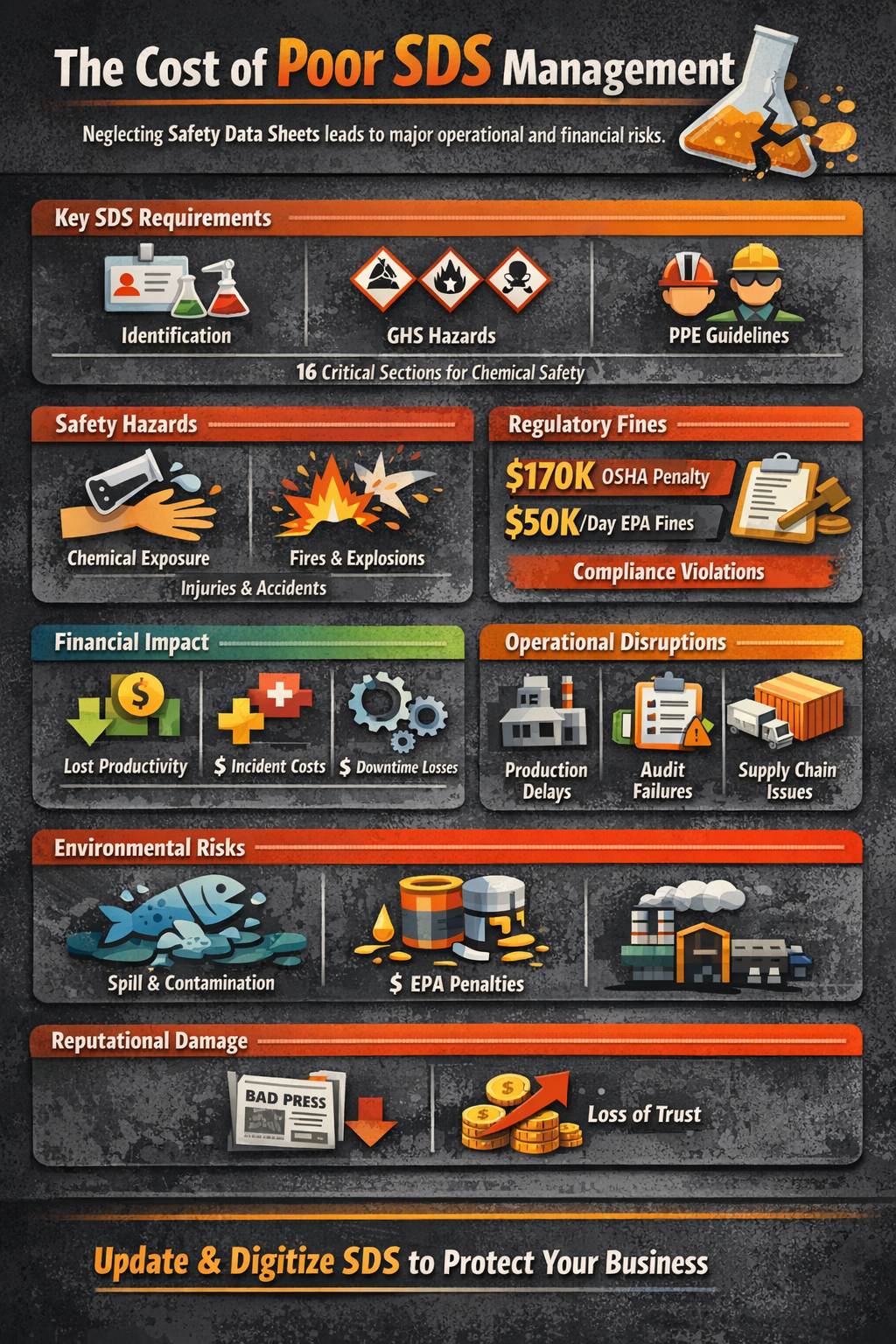
Guide to Identifying Operational Risks in SDS
Poor SDS management creates cascading operational vulnerabilities across safety, compliance, regulatory adherence, finances, and productivity in chemical-handling environments. Expanding core hazards like inaccessible or outdated Safety Data Sheets (SDSs), organizations face heightened accident risks, multimillion-dollar penalties, and workflow breakdowns that undermine long-term viability.
SDS Core Requirements
Safety Data Sheets standardize hazard communication via 16 mandatory sections, covering:
- Identification
- Hazards (GHS pictograms/signal words)
- Composition
- First-aid
- Firefighting
- Accidental release
- Handling/storage
- Exposure controls/PPE
- Physical/chemical properties
- Stability/reactivity
- Toxicological
- Ecological
- Disposal
- Transport
- Regulatory
- Supplier details
OSHA’s Hazard Communication Standard (29 CFR 1910.1200, aligned with GHS Revision 9 as of 2025) mandates SDSs for every hazardous chemical in workplaces, with immediate worker access in work areas. In short, there should be no excuses for binders in distant offices.
Updates trigger within three months of new data; multilingual versions apply diverse workforces, and electronic SDSs must function offline without IT dependency. Poor management skips revisions for formula tweaks or supplier changes, fostering “zombie SDSs” or outdated docs masquerading as current, priming disasters.
Expanded Safety Hazards
Workers exposed to chemicals without SDS guidance face acute risks: corrosive splashes erode skin without specified neutralization, inhalants trigger pulmonary edema sans respiratory limits, and flammables ignite from overlooked incompatibilities like acids near bases. Chronic effects compound silently; carcinogens evade detection without toxicological thresholds, leading to elevated cancer clusters in underinformed plants.
-
PPE mismatches amplify
SDS Section 8 details respirators (e.g., NIOSH-approved P100 for particulates), gloves (Viton for solvents), but absent docs default to generic gear, failing in real exposures. Emergency voids prove deadliest—spill response lacks absorbents or diking methods, turning drips into facility floods; one analog case saw hydrofluoric acid spread unchecked, dissolving concrete and injuring responders.
-
Fire/explosion chains
Section 10 (stability) flags peroxides or self-reactive; neglect invites runaway reactions, as in organic peroxide storage failures causing blasts. BLS logs 27.2 MSD cases per 10,000 in chemical manufacturing, but chemical burns/poisonings underreport due to misattribution—true SDS-linked incidents likely double via poor root-cause analysis.
Regulatory Violations Deep Dive
-
OSHA’s HCS violations top citations
“No SDS” or “inaccessible” nets $16,550 serious fines, but willful repeats hit $165,514 maximums, adjusted annually for inflation (2026: ~$170,000). EPCRA Section 311/312 demands SDS lists to Local Emergency Planning Committees (LEPCs); omissions add $37,500 daily EPA penalties.
-
Global layers intensify
EU REACH Annex II enforces exposure scenarios in extended SDSs (eSDS), with ECHA fines to €1M; Canada’s WHMIS mirrors GHS but mandates bilingual access. DOT hazmat transport rules (49 CFR) cross-reference SDS Section 14, fining $91,585+ for mismatches causing carrier incidents.
-
State amps
California’s Prop 65 requires SDS cancer/ reproductive warnings, with $2,500 daily bounties for NGOs. Audits expose chains—e.g., a 2025 manufacturing inspection cited 47 SDS gaps, totaling $450K plus abatement orders halting lines.
| Violation Category
| Max Fine (2026 USD)
| Common Triggers
| Abatement Period
|
| Hazard Communication (Serious)
| $17,000/instance
| Outdated/incomplete SDS folders
| 30 days
|
| Willful SDS Failure
| $170,000/instance
| Ignoring citations, no access
| Immediate
|
| EPCRA Reporting Gap
| $50,000/day
| No Tier II SDS submissions
| 7 days
|
| Repeat multi-site
| $1M+ corporate
| Systemic SDS mgmt. flaws
| Court-ordered
|
Financial Toll Breakdown
-
Direct fines pale against indirect
A mid-sized plant’s SDS lapse simulation hit $2.5M yearly—$380K labor (spreadsheet jockeys), $250K penalties, $500K incident medicals, $1.4M downtime (40 hours/line at $35K/hour). Workers comp surges 20-50% post-exposure claims, with experience mod ratings spiking premiums $300K+.
-
Litigation snowballs
Product liability from “failure to warn” (Restatement (Third) Torts) awards $10M+ juries, as plaintiffs cite missing SDS reactivity data. Inventory waste: obsolete SDSs hoard expired stock, losing $100K/quarter; overbuys from misread purities add 15% costs.
-
Lost productivity
A 30-second access rule broken means 2-5 hours/week per shift of hunting docs, equaling $750K annually for 500 workers. Digital shifts reclaim this—ROI hit 300% in year one via automation.
Operational Disruptions Expanded
-
Decentralized binders spawn chaos
Shifts end hunting multilingual SDSs, violating OSHA’s “immediately available” clause and slowing startups 15-30 minutes/day. Siloed systems—SDS divorced from CMMS or ERP—duplicate entries, with 20% data errors inflating cycle counts.
-
Supply chain ripples
Vendor SDS delays halt receipts, idling $50K batches; customs snags on non-GHS formats reject imports. Maintenance stalls sans disposal specs, accruing Haz waste fees.
-
Audits paralyze
Prep devours 1,000+ man-hours, diverting from production; post-citation shutdowns cost $200K/day in high-volume ops. Turnover climbs 12% from frustration, rehiring at $20K/head.
Environmental and Spill Risks
SDS Section 12/13 details ecotoxicity (LC50 fish values) and disposal (RCRA codes); skips invite illicit dumps, fining $70K/ton under CERCLA. Storage mismatches—e.g., oxidizers near flammables—breach SPCC plans, triggering $50K EPA notices.
Stormwater pollution: Runoff from unlabeled drums hits NPDES limits, mandating $1M bioremediation. Bioaccumulation warnings ignored bio-magnify toxins in food chains, drawing Superfund liability.
Reputational and Strategic Fallout
Incidents headline ESG reports, slashing stock 5-10% and voiding contracts with safety clauses (e.g., Walmart, Boeing). C-suite scrutiny mounts—boards demand KPIs like “SDS compliance rate >99%” amid shareholder suits.
Talent flight: Gen Z shuns risky firms, hiking wages 18% for certified-safe sites. Partnerships fray—suppliers withhold from non-compliant buyers.
Real-World Case Studies
-
Hydrogen Sulfide Tragedy (2024 Oilfield)
Superficial SDS risk phrases (“avoid inhalation”) omitted NFPA 704 indices and reaction products: workers mixed H2S precursors, poisoning three. The root cause was unmanaged SDS revisions, and it costs $15M for settlements and shutdowns.
-
Manufacturing Spill Cascade (2025)
Missing Section 6 containment led to a 500-gal solvent flood, contaminating drains. No PPE specs injured 12; fines $300K, cleanup $2M, production loss $4M.
Comprehensive Mitigation Framework
Digitize via cloud platforms: QR-linked mobile access, AI flagging expiries, auto-imports from PubChem. Annual refresh cycles sync with GHS/OSHA portals.
Training ladders: New hires master SDS hunts (quiz 100%), refreshers yearly on scenarios.
- Audit Protocol: Monthly spot-checks (10% inventory), quarterly fills with mock spills.
- Integration Hubs: SDS feeds ERP for auto-orders, EHS for incident linking.
- Vendor Vetting: Contracts mandate compliant SDSs within 48 hours.
- Metrics Dashboard: Track access logs, update lags, and violation zeros.
| Mitigation Tier | Tactics | Projected ROI | Implementation Time |
| Tech Stack | Cloud SDS + Mobile | 300% Year 1 (saves $265K) | 4-6 weeks |
| Training | Role-Based LMS Modules | 50% Accident Drop | Ongoing |
| Process | Audits + Workflows | Avoids $500K Fines | Quarterly |
| Culture | Safety KPIs in Reviews | 20% Turnover Cut | 6 months |
Layered defenses transform SDS from liability to asset, fortifying ops in volatile chemical landscapes.
Conclusion
Layered defenses through digital SDS platforms, rigorous training, and proactive audits transform SDS management from a compliance burden into a strategic asset that safeguards operations amid 2026’s HCS updates and GHS alignments. Prioritizing immediate access and automated updates mitigates risks of fines exceeding thousands of dollars per willful violation, accidents, and disruptions while delivering 300% ROI via reduced downtime and enhanced safety culture. EHS leaders can future-proof their facilities by integrating cloud-based tools with ERP and LMS systems today.
Leave A Comment