 Skip to content

Forget the headaches and possible fines; learning the training requirements under OSHA is your company’s roadmap to a safer, more compliant, and ultimately more productive work environment. These essential requirements are not a one-size-fits-all solution; instead, they cover a range of programs specific to certain industries, job types, and hazards—from general industry 10-hour and 30-hour training programs to specialized certifications such as HAZWOPER or lockout/tagout.
Employers are required by law to identify which of these standards apply and provide timely, effective, and documented training to their entire staff, protecting against fall, chemical, and other workplace hazards. At the end of the day, it is not just about avoiding fines for non-compliance; it is about creating a culture of safety that protects your most valuable assets and secures your company’s future success.
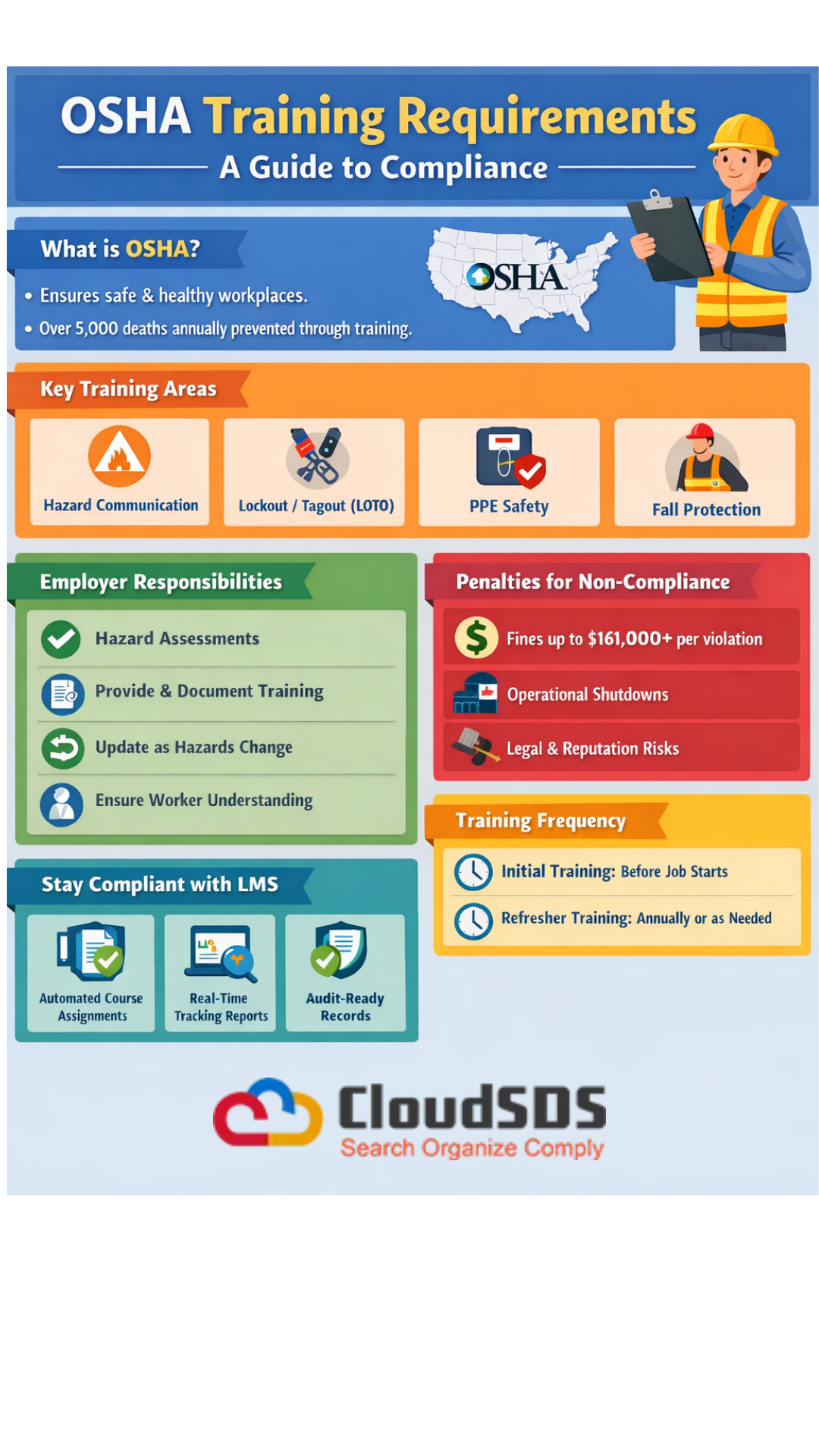
What Is OSHA, and Why Training Matters
The Occupational Safety and Health Administration (OSHA), created through the Occupational Safety and Health Act of 1970, is the United States’ regulatory agency for workplace safety and health. OSHA’s mission is simple: “Ensure every working American returns home safely from their job.” Training is at the center of this, turning abstract regulations into concrete skills that prevent injuries, reduce accidents, and promote a culture of safety.
Why is training vital? The numbers tell a grim story—OSHA estimates more than 5,000 fatal occupational injuries each year, and many of these could have been prevented by avoiding known hazards such as falls, electrocution, and chemical exposure. Training empowers workers to avoid hazards, wear protective gear, and act in emergencies, directly reducing injury rates by as much as 60%, as measured by OSHA studies. For the employer, it is not a choice—it is a safety net and a necessity.
Employer Responsibilities Under OSHA
The employer’s first responsibility for a safe working environment is mandated by OSHA’s General Duty Clause (Section 5(a)(1)). This includes mandatory training on recognized hazards, free of charge during work hours, in a language workers understand. Key responsibilities include:
- Assessing workplace hazards via job safety analyses (JSAs).
- Providing training prior to exposing workers to hazards.
- Documenting training completion with worker signatures.
- Modifying training as hazards change or incidents happen.
A failure to comply can trigger an OSHA review during inspections, which happen 30,000 times a year.
Consequences of Non-Compliance
A failure to comply is not simply a punishment but also expensive. OSHA penalties are issued in six levels of severity, ranging from “other than serious” ($16,131 maximum penalty in 2026) to “willful/repeat” violations exceeding $161,323 per offense. Repeat offenders can be prosecuted, leading to imprisonment for willful violations that result in deaths.
The effects of non-compliance extend to:
| Type of Consequence | Examples | Possible Effects |
| Money | Fines of up to $161,000 or more for each infraction; higher insurance rates | Big firms lost millions of dollars. |
| Operational | Stopping or closing down operations during abatement | Shutdowns of production and loss of income |
| Lawful | Criminal charges; lawsuits from hurt workers | Settlements and CEO liability |
| Reputation | Lists that are open to the public on osha.gov | Lost customers and talent |
Mandatory OSHA Training Categories
OSHA provides industry-specific training through 29 CFR regulations. Employers must identify training for operations, ranging from hazard communication to machine guarding.
General Industry Training
General industry (manufacturing, warehousing, and healthcare) demands comprehensive training based on regulations such as 29 CFR 1910. Key areas of training include:
- Hazard Communication (HazCom): GHS-compliant SDS training, labeling, and spill response—required for chemical handlers.
- Bloodborne Pathogens: Annual training for healthcare and laboratory personnel (29 CFR 1910.1030).
- Lockout/Tagout (LOTO): Energy control procedures to avoid unexpected startups.
- Personal Protective Equipment (PPE): Fitting, use, and maintenance.
| Standard | Topic | Who Needs It | Key Elements |
| 1910.1200 | HazCom | Chemical users | SDS review, pictograms |
| 1910.1030 | Bloodborne | Healthcare workers | Exposure control plans |
| 1910.147 | LOTO | Maintenance staff | Authorized/qualified levels |
| 1910.132 | PPE | All exposed employees | Hazard assessment |
Over 100 million U.S. workers fall under these, per OSHA data.
Construction and High-Risk Roles
Because construction has a high death rate (about 20% of all occupational deaths), it needs a lot of training under 29 CFR 1926. OSHA-10 and OSHA-30 cards show that you have completed 10 or 30 hours of training. High-risk roles make requirements stronger:
- Training for heights over 6 feet (1926.501) is necessary to prevent falls.
- Scaffolding: Training for competent people to set up and use.
- Excavations: Daily checks to stop cave-ins.
- Cranes and derricks: Operators must have NCCCO or a similar certification.
Lists for high-risk people:
- Cranes: rigging, signals, and load charts.
- Electrical: Being a qualified person for live work.
- Silica: Ensure your lungs are protected and monitor your exposure (1926.1153).
Within 30 days of hiring, construction companies must train all their staff.
Frequency and Documentation Requirements
Training isn't a one-off—it's ongoing to match evolving risks.
Initial vs. Refresher Training
Before being exposed to hazards, first training covers all the basics. Refreshers help you keep your talents sharp:
| Type of Training | How often | Things that set off |
| First | Before the assignment | New hiring and job changes |
| Refresher | Every year (like HazCom and Bloodborne) or every three years (like Forklifts) | Incidents, audits, and adjustments to processes |
| Specialized | When needed (for example, every year when the crane needs to be recertified) | Changes to the rules |
For example, forklift drivers need to take a refresher course every three years and pass an evaluation.
Record Retention Rules
OSHA mandates records proving training adequacy. Retain:
- Records must include names, training dates, and content outlines.
- Qualifications of trainers.
- Proof of comprehension is demonstrated through quizzes and signatures.
Retention periods vary:
- HazCom/LOTO: Duration of employment + 30 years? No—3 years post-training suffices for most.
- Bloodborne: 3 years after the employee leaves.
- Fit-for-duty medicals: Employment duration.
Digital records make this easier and eliminate problems with paper.
Employer Responsibilities in OSHA Training
Employers drive compliance through proactive steps.
Identifying Training Needs
Start with hazard assessments:
- Conduct walkthroughs and JSAs.
- Review incident reports and near misses.
- Consult SDS and equipment manuals.
- Prioritize via risk matrices (likelihood x severity).
Tailor roles include warehouse pickers who operate forklifts and chemists who require HazCom.
Ensuring Comprehension, Not Just Attendance
Attendance logs aren't enough. Verify via:
- Hands-on demos and simulations.
- Quizzes (80% pass rate typical).
- Verbal questioning in workers' languages.
- Post-training observations.
OSHA inspectors' probe: "Can you explain LOTO?" Failure here voids records.
Common OSHA Training Mistakes
Pitfalls abound, amplifying risks.
One-Size-Fits-All Training
Generic videos ignore site-specific hazards, leading to 40% knowledge gaps per studies. Solution: Customize with real SDS, local risks.
Poor Documentation Practices
Incomplete logs or lost papers doom audits. Common errors:
- No trainer credentials.
- Missing signatures/quizzes.
- Inconsistent formats across shifts.
Audits reveal 25% of citations stem from documentation flaws.
Simplifying OSHA Compliance with LMS
Learning Management Systems (LMS) like CloudSDS revolutionize training, automating drudgery for EHS teams.
Automated Training Assignment and Tracking
LMS assigns courses by role/hazard—new hires auto-get HazCom. Real-time dashboards track completion, flagging delinquents via alerts.
Benefits in a table:
| Feature | Manual Process Issue | LMS Advantage |
| Assignment | Manual rosters | Role-based auto-enroll |
| Tracking | Spreadsheets | Dashboards, mobile access |
| Reminders | Forgotten refreshers | Automated emails/SMS |
Audit-Ready OSHA Reports
Generate compliant reports instantly—certs, quizzes, timestamps. Cloud-based storage ensures 99.9% uptime, beating paper’s fragility.
Frequently Asked Questions
-
Q1. Why is safety training documentation legally required?
Safety training documentation is legally required because employers are mandated to provide evidence of adequate training of employees on safe working practices.
-
Q2. What happens if training records are missing during an audit?
Organizations may receive penalties, fines, shutdowns, or lawsuits.
-
Q3. Are paper-based training records risky?
Yes, paper-based training records are susceptible to loss, damage, and inaccuracies.
-
Q4. How does an LMS reduce documentation risks?
An LMS minimizes risks associated with documentation by providing a central location for documentation, tracking, and integrity.
-
Q5. Can LMS records be used as legal evidence?
Yes, LMS records containing date and time stamps and audit trails are generally accepted in legal proceedings.
Leave A Comment