

Last Updated on January 27, 2026
When it comes to workplace chemical safety, OSHA makes it crystal clear: a robust Safety Data Sheet (SDS) management process isn’t just smart—it’s legally required. Employers must ensure that every hazardous chemical on site has an accurate, up-to-date SDS readily available to all employees during their work shift, whether in print or electronically. This isn’t just about having a binder; it involves the followings to ensure workers understand how to read and utilize these vital documents:
- A comprehensive written hazard communication program
- Diligent tracking of new chemicals, and
- Mandatory training
From understanding first aid measures to proper spill cleanup and personal protective equipment, SDSs are the ultimate guide to mitigating risks and ensuring a safe working environment. Ultimately, a well-executed SDS management process under OSHA isn’t just about avoiding fines; it’s about safeguarding lives and fostering a truly secure workplace culture.
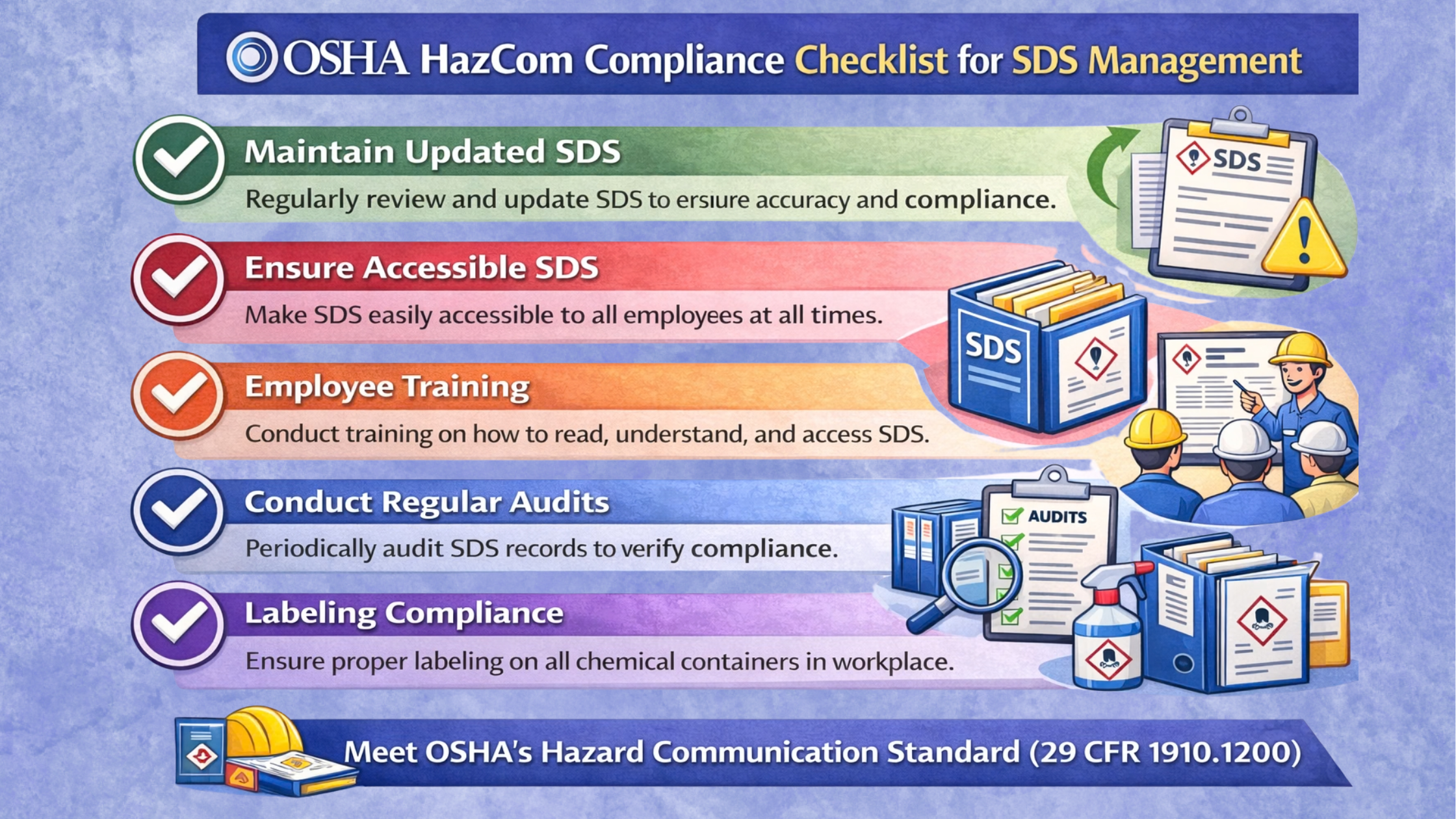
Implement Effective SDS Management Processes in Compliance with OSHA
Safety Data Sheets provide critical information on chemical properties, hazards, and safe handling practices, enabling workers to protect themselves from exposure risks. OSHA defines an SDS as a document containing properties of each chemical, physical health and environmental hazards, protective measures, and safety precautions for handling, use, storage, and transportation. The purpose extends to empowering employees with the “right-to-know” about workplace chemicals, reducing incidents through informed decision-making.
The OSHA Hazard Communication Standard (29 CFR 1910.1200), or HCS, mandates SDSs as a key element of chemical safety programs, requiring chemical manufacturers, importers, distributors, and employers to communicate hazards consistently. It aligns with the Globally Harmonized System (GHS), standardizing labels, SDSs, and training globally to enhance comprehension and protection.
Historically, Material Safety Data Sheets (MSDSs) varied in format and content until OSHA’s 2012 HCS revision adopted the GHS 16-section SDS format, fully effective by June 1, 2015, replacing inconsistent MSDS practices for uniformity. This shift improved accessibility and reduced confusion in multinational operations.
Purpose of This Section: This section lays the foundation of SDS requirements under OSHA, emphasizing a structured management process to ensure safety, prevent accidents, and avoid citations, as non-compliance can lead to penalties up to $15,625 per serious violation.
OSHA Regulatory Framework for SDS Management
OSHA’s HCS (29 CFR 1910.1200) governs SDS management, integrating it into a comprehensive hazard communication program that includes labeling, SDSs, and training. Employers must obtain and maintain SDSs for every hazardous chemical in the workplace, provided by manufacturers or importers.
A “hazardous chemical” under OSHA is any chemical posing a physical or health hazard, such as flammables, corrosives, carcinogens, or those causing acute toxicity, skin irritation, or aspiration hazards. This broad definition covers substances or mixtures capable of harming health or safety via inhalation, ingestion, skin absorption, or environmental release.
These requirements uphold employee “right-to-know” protections, ensuring access to hazard information without barriers, fostering a culture of safety, and enabling informed PPE and handling choices.
Purpose of This Section: This establishes the legal basis for SDS management, clarifying OSHA mandates to prevent exposures and support enforcement during inspections.
|
OSHA HCS Key Provisions for SDS
|
Description |
|
29 CFR 1910.1200(d)(1)
|
Manufacturers/importers classify hazards and develop SDSs
|
|
29 CFR 1910.1200(g)
|
Employers maintain SDSs for hazardous chemicals in workplace
|
|
Appendix D
|
Minimum content for 16-section format
|
|
Employee Access
|
Readily available during each shift
|
OSHA Requirements for SDS Accessibility and Availability
Employers must maintain SDSs for all hazardous chemicals used, stored, or handled, ensuring coverage matches the workplace’s inventory. SDSs require ready accessibility during each work shift for exposed employees, without leaving work areas or facing barriers like passwords or downtime.
Both paper and electronic formats are acceptable if immediate access is guaranteed, with backups for power failures; electronic systems must allow printing or viewing without delay. Multi-language SDSs supplement English versions for diverse workforces, though English remains mandatory.
SDSs must also be available to designated representatives (e.g., unions), OSHA officials, and authorized personnel upon request, often within minutes.
Purpose of This Section: This details practical SDS management for compliance, prioritizing worker access to enable real-time hazard mitigation.
- Paper Binders: Centralized in work areas, color-coded by department.
- Electronic Systems: Cloud-based platforms such as CloudSDS, with mobile access and audit trails.
- Hybrid: Digital primary with printed backups for high-risk zones.
Required SDS Content and Format Under OSHA
OSHA aligns SDSs with the GHS 16-section standardized format per Appendix D of 29 CFR 1910.1200, ensuring consistent hazard communication. Sections 1-11 and 16 are mandatory; 12-15 (ecological, disposal, transport, regulatory) are non-mandatory but recommended for GHS consistency.
Uniform structure covers identification (Section 1), hazard identification (Section 2 with pictograms/signal words), composition (Section 3), first-aid/fire-fighting/release measures (4-6), handling/storage/exposure controls (7-8), and properties/stability/toxicology (9-11).
SDSs must be in English, with additional languages allowed; content must be comprehensive, noting “no information available” where data lacks.
Purpose of This Section: Standardized content ensures effective, quick hazard communication, critical for training and emergency response.
| GHS 16-Section SDS Format | Key Content |
| 1. Identification | Product name, supplier, recommended use |
| 2. Hazard(s) Identification | GHS classification, pictograms, precautions |
| 3. Composition/Ingredients | Hazardous components, CAS numbers |
| 4. First-Aid Measures | Exposure routes, symptoms, medical advice |
| 5. Fire-Fighting Measures | Extinguishers, hazards during fire |
| 6. Accidental Release Measures | Containment, cleanup, PPE |
| 7. Handling and Storage | Safe practices, incompatibilities |
| 8. Exposure Controls/PPE | Limits (PELs/TLVs), engineering controls |
| 9. Physical/Chemical Properties | Appearance, flash point, pH, etc |
| 10. Stability/Reactivity | Conditions to avoid, decomposition products |
| 11. Toxicological Information | Routes, LD50, carcinogenicity |
| 12. Ecological Information | (Non-mandatory) Toxicity to environment |
| 13. Disposal Considerations | (Non-mandatory) Waste handling |
| 14. Transport Information | (Non-mandatory) UN number, class |
| 15. Regulatory Information | (Non-mandatory) OSHA/EPA rules |
| 16. Other Information | Revision date, changes |
SDS Management Requirements in Practice
Effective SDS management starts with a master hazardous chemical inventory, cross-referenced to SDSs via product ID, location, and quantity for traceability. Documentation includes labeling links, version control (track revisions), and annual reviews or upon new info receipt.
Employers must update SDSs promptly when new hazards emerge, chemicals change, or manufacturer revisions arrive—ideally within 30 days. Integrate SDSs into the HazCom program, linking to labels, training, and emergency plans.
Digital tools like SDS management software automate updates, searches, and audits, ensuring compliance in large facilities.
Purpose of This Section: This offers actionable steps for implementing SDS processes, turning regulatory requirements into operational safety systems.
- Inventory: Quarterly audits to match chemicals to SDSs.
- Organization: Centralized database with search by name/CAS.
- Updates: Auto-alerts for revisions; archive old versions.
- Recordkeeping: Retain SDSs for 30 years per OSHA 1910.1020.
Employee Training and SDS Utilization
OSHA mandates training on chemical hazards, SDS location/use, pictograms, and safe practices before exposure and changes (29 CFR 1910.1200(h)). Training connects SDSs to hazard recognition, handling, PPE selection (e.g., Section 8), and emergencies (Sections 4-6).
Best practices include hands-on SDS drills, annual refreshers, and multilingual sessions; verify comprehension via quizzes.
Purpose of This Section: Training transforms SDSs from documents to tools, empowering workers to mitigate risks proactively. Here’s a brief training checklist:
- SDS format and sections.
- Hazard interpretation (GHS elements).
- Access methods (electronic/paper).
- Integration with PPE/emergency response.
Compliance Monitoring and Audits
Self-inspections involve quarterly inventory-SDS matches, access tests, and completeness checks against Appendix D. OSHA inspectors review during site visits: verify SDS presence, currency, accessibility, and training records; cite gaps as serious violations.
Common pitfalls: missing SDSs (40% audits), outdated docs, poor access, incomplete sections (e.g., missing PPE in Section 8). Robust management prevents $14,502 average fines.
Purpose of This Section: This equips readers for audits, highlighting proactive strategies for sustained compliance.
| Common SDS Violations | Fixes |
| Missing SDSs for hazards | Automated inventory sync |
| Inaccessible during shifts | Backup power/mobile apps |
| Outdated versions | Revision tracking protocols |
| Incomplete content (e.g., no TLVs) | Use pro software for validation |
Integration with Broader Regulatory Requirements
SDSs support OSHA standards like PPE (1910.132, using Section 8), emergency action (1910.38, Sections 5-6), and lab safety (1910.1450). They align with state right-to-know laws (e.g., California’s HCS equivalent) and EPCRA for emergency planning.
In spills, SDSs guide response under HAZWOPER (1910.120); ecologically, Section 12 aids EPA compliance.
Purpose of This Section: SDS management bolsters multi-regulatory compliance, amplifying safety across frameworks.
- OSHA Cross-Links: PPE selection from SDS Section 8.
- State Laws: Enhanced access in NJ/NY right-to-know acts.
- Federal: Supports DOT transport (Section 14), EPA disposal.
Conclusion
Key OSHA SDS requirements include HCS-mandated 16-section formats, ready accessibility, updates, and training integration for all hazardous chemicals. Structured processes safeguard workers, ensure legal compliance, and maintain operational efficiency. So, audit your SDS program by following these steps:
Inventory chemicals
- Test access
- Review training, and
- Digitize for updates
Such proactive steps are essential to prevent violations and enhance safety.
Simplify Your SDS Management
CloudSDS gives your team instant access to 23M+ safety data sheets with AI-powered search, automated updates, and full OSHA/GHS compliance — all from one platform.
Leave A Comment