 Skip to content

In regulated industries, Safety Data Sheets (SDS) are only valuable when they are accurate, up-to-date, and properly validated. An effective SDS review and approval workflow ensures that chemical hazard information is verified before being distributed across operations, training systems, and compliance programs. As organizations manage growing chemical inventories, manual SDS validation processes pose risks, including outdated hazard classifications, missing regulatory data, and audit gaps. Modern digital workflows introduce structured review stages, automated version control, and role-based approvals to maintain data integrity. For EHS leaders, compliance teams, and operations managers, a standardized SDS review process strengthens regulatory readiness, improves hazard communication, and supports safer chemical handling across facilities. This guide explains how SDS approval workflows function and why they are critical for compliance and risk reduction.
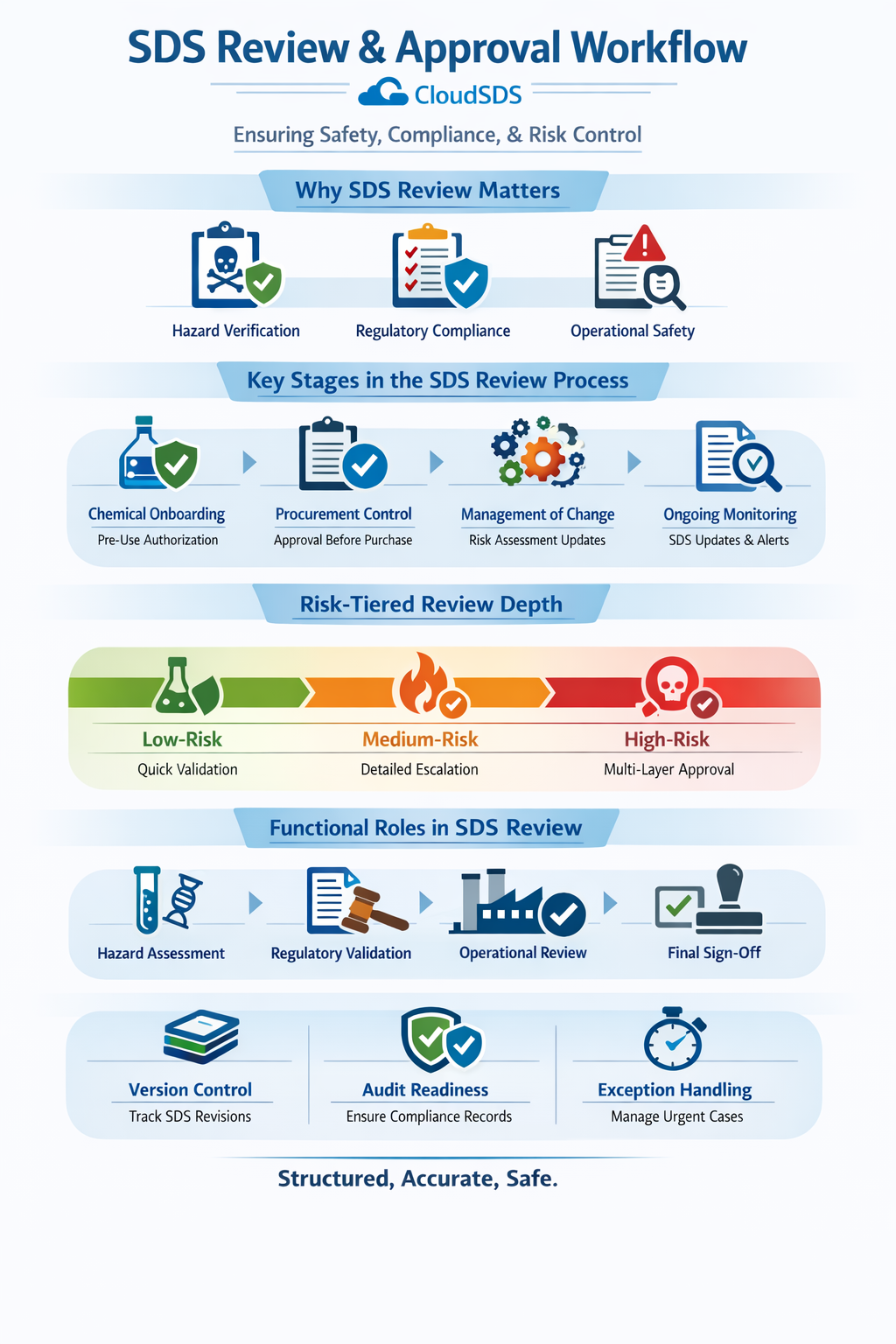
Why SDS Review Is a Control Process, not a Document Task
SDS review is fundamentally a risk control process, not just a document management task, because it determines whether chemical hazard information is verified, compliant, and safe to operationalize. Treating SDS approval as a risk-control gate ensures that hazard classifications, exposure limits, PPE requirements, and storage rules are validated before chemicals enter procurement, production, or distribution of workflows. There is a critical distinction between document availability and operational authorization—simply storing an SDS in a repository does not confirm regulatory accuracy, site applicability, or alignment with safe use.
When review workflows are weak or informal, errors such as outdated GHS classifications, missing toxicology data, or incorrect handling guidance can move downstream into training, labeling, and operations. These gaps frequently lead to workplace incidents, failed audits, regulatory citations, and increased liability, making structured SDS review a core component of enterprise risk governance.
Where SDS Review Fits in the Chemical Lifecycle
1. Chemical Onboarding and Pre-Use Authorization
SDS review plays a critical role during chemical onboarding by acting as a pre-use authorization checkpoint before a substance enters a facility. During this stage, EHS and compliance teams verify hazard classifications, exposure controls, storage compatibility, and regulatory applicability. This ensures that chemicals are not only documented but also safe and legally approved for operational use. Without SDS validation at onboarding, organizations risk introducing substances that conflict with existing controls, storage systems, or worker protection programs.
2. SDS Approval and Procurement Control Alignment
SDS approval is closely tied to procurement governance because purchasing decisions should be contingent on verified hazard and compliance data. When SDS approval is embedded into procurement workflows, it prevents unauthorized chemical purchases, ensures supplier-compliant SDS, and supports audit traceability. This integration helps organizations avoid situations in which chemicals arrive on-site without validated hazard documentation, which can disrupt operations and delay production.
3. Integration with Management of Change (MOC) Processes
SDS review is a core data input for management of change processes whenever new chemicals, formulations, or suppliers are introduced. Approved SDS data informs risk assessments, training updates, labeling revisions, and emergency response planning. Integrating SDS workflows with MOC ensures that chemical changes are evaluated systematically rather than reactively, reducing operational and regulatory risk.
4. Operational and Compliance Failures When SDS Review Is Skipped
When SDS review is delayed or bypassed, multiple systems begin to fail simultaneously, including training accuracy, labeling compliance, storage safety, and exposure control programs. This often leads to misclassified hazards, incomplete worker training, and audit findings. Over time, these gaps increase incident probability, regulatory penalties, and liability exposure, making timely SDS review essential for lifecycle chemical safety management.
Decision Logic Behind SDS Approval
1. Site-Specific Chemical Authorization Decisions
The SDS approval process includes evaluating whether a chemical is permitted for use at a specific site based on operational activities, local regulations, and facility risk thresholds. Even if a chemical is legally allowed in a country, site-level factors such as process type, workforce exposure risk, and emergency response capability determine whether it can be safely introduced.
2. Inventory Compatibility and Co-Existence Risk Assessment
Approval workflows assess how a new chemical interacts with existing inventory, including storage compatibility, reactive hazards, and segregation requirements. This step helps prevent incompatible storage scenarios, cross-contamination risks, and unintended chemical reactions that could lead to fires, toxic releases, or facility damage.
3. Validation of Real-World Control Effectiveness
SDS data is evaluated against actual workplace conditions to confirm that recommended controls are practical and sufficient. This includes verifying ventilation capability, PPE availability, handling procedures, and exposure monitoring programs. The goal is to ensure controls work in real operating environments, not just in theoretical guidance.
4. Multi-Jurisdiction Regulatory Compliance Validation
For organizations operating across regions, SDS approval requires confirming regulatory acceptability in applicable jurisdictions, such as OSHA, REACH, WHMIS, or local chemical safety laws. This ensures chemicals can be transported, stored, and used legally without creating cross-border compliance gaps.
5. Residual Risk Evaluation and Final Acceptance Decision
The final stage of SDS approval involves determining whether the remaining risk, after controls are applied, falls within the organization’s acceptable risk tolerance. If residual risk exceeds thresholds, the chemical may be rejected, restricted, or substituted, reinforcing SDS approval as a formal risk governance decision rather than a documentation step.
Risk-Tiered SDS Review Depth
Risk-tiered SDS review depth is a structured methodology that calibrates the intensity, expertise level, and approval layers of SDS evaluation based on a chemical’s inherent hazard profile and intended operational use. Instead of applying a uniform review process to all chemicals. Organizations categorize substances into risk tiers using factors such as GHS hazard classification, toxicity, reactivity, environmental impact, exposure potential, and volume of use. This approach allows EHS teams to allocate resources efficiently, ensuring that high-hazard chemicals receive detailed technical scrutiny while low-risk materials move through faster validation of workflows. Risk-tiered review models also support audit defensibility by demonstrating that review rigor is systematically aligned with real-world risk, regulatory exposure, and worker safety priorities.
-
Low-Risk Chemical Review Pathways
Low-risk chemical review pathways are designed to accelerate approval for substances with minimal hazard potential and well-understood use cases. These typically include non-hazardous or low-hazard materials, widely used industrial chemicals with stable regulatory status, or substances used in closed systems with negligible exposure risk. The review process generally focuses on verifying SDS completeness, confirming supplier credibility, validating labeling and classification accuracy, and ensuring compatibility with existing storage and handling procedures. Automation often plays a major role at this tier, with systems performing hazard classification checks, revision date validation, and regulatory list screening. By standardizing low-risk reviews, organizations reduce administrative workload while maintaining baseline compliance and ensuring that safety controls remain consistent across facilities.
-
Medium-Risk Chemical Escalation Logic
The medium-risk chemical review introduces conditional escalation mechanisms that trigger additional scrutiny when specific risk indicators are present. These chemicals may have moderate toxicity, flammability, corrosivity, or environmental hazards, or pose risks due to operational contexts such as high-volume storage, elevated-temperature processes, aerosolization, or manual handling. Escalation logic often incorporates exposure modeling, task-based risk assessment, and evaluation of existing engineering controls. Cross-functional review may be required, involving EHS specialists, industrial hygienists, and operations leadership. Digital SDS systems frequently support this tier through configurable workflows that automatically route chemicals for secondary review when predefined thresholds—such as quantity limits or hazard class combinations—are exceeded. This ensures risk-sensitive decision-making without unnecessarily slowing routine approvals.
-
High-Risk Chemical Multi-Layer Approval Requirements
High-risk chemicals require rigorous, multi-layered review frameworks due to their potential to cause severe worker injury, catastrophic process incidents, or major environmental harm. These typically include carcinogens, highly toxic inhalation hazards, reactive chemicals, explosive precursors, or substances regulated under stringent global frameworks. The review process often includes toxicological analysis, process hazard assessment (PHA), exposure monitoring strategy, emergency response planning, and verification of regulatory jurisdiction. Approval typically requires sign-off from multiple stakeholders, including EHS leadership, plant management, occupational health, and sometimes corporate compliance or legal teams. Additional controls—such as substitution analysis, restricted access protocols, and specialized training requirements—are often mandated before chemical introduction. This layered approach ensures that residual risk is formally evaluated and accepted at the appropriate organizational level.
-
Preventing Review Bottlenecks Without Lowering Safety Thresholds
Preventing SDS review bottlenecks requires designing workflows that balance speed with risk sensitivity. Modern SDS management platforms use rule-based automation, AI-assisted hazard extraction, and risk-scoring algorithms to route chemicals to the appropriate review pathway automatically. Standardized templates, pre-approved control libraries, and automated regulatory screening reduce manual review time without compromising safety rigor. Parallel review structures allow multiple stakeholders to evaluate high-risk chemicals simultaneously rather than sequentially. Organizations also set service-level targets tied to risk tiers—for example, 24-hour review for low-risk chemicals and extended timelines for high-risk materials that require technical analysis. By combining automation with clear governance frameworks, companies can maintain operational agility while preserving strict safety and compliance standards.
Functional Roles in an SDS Approval Workflow
An effective SDS approval workflow is not a single-person task—it is a coordinated, role-based process that ensures hazards are correctly understood, regulations are satisfied, operational realities are validated, and organizational accountability is clearly defined. Clearly assigning functional responsibilities prevents gaps, reduces approval delays, and strengthens audit defensibility. Modern SDS management systems typically formalize these roles through workflow routing, digital signoffs, and role-based access control, ensuring that every chemical introduction decision is supported by both technical expertise and governance oversight.
1. Hazard Interpretation Role (Toxicology & Exposure)
This role focuses on converting raw SDS hazard data into practical risk understanding for the workplace. Professionals in this function—often industrial hygienists, toxicologists, or senior EHS specialists—evaluate toxicity endpoints, exposure routes, permissible exposure limits (PELs), and acute versus chronic health effects. They assess how hazard classifications translate into real-world exposure scenarios, accounting for task, duration, frequency, and control measures. This role also evaluates whether existing engineering controls, PPE programs, and monitoring strategies are adequate. Their output typically includes exposure risk summaries, recommended control measures, and escalation recommendations when hazards exceed acceptable thresholds. This function ensures decisions are science-based rather than purely classification-based.
2. Regulatory Validation Role
The regulatory validation function ensures the chemical is legally permitted for procurement, storage, transport, use, and disposal in all applicable jurisdictions. This includes verification against regulatory inventories, restricted substance lists, and reporting obligations. Typical evaluations include alignment with OSHA Hazard Communication requirements, EPA chemical regulations, TSCA inventory status, REACH obligations (if applicable globally), and transport classifications under DOT, IATA, or IMDG frameworks. This role also checks labeling compliance, GHS classification consistency, and SDS format requirements. Regulatory specialists ensure that introducing the chemical does not trigger unexpected reporting thresholds, permit requirements, or restricted-use conditions.
3. Operational Reality Check Role
Even when hazards and regulations are understood, chemicals must still be evaluated against actual operational conditions. This role is typically performed by operations managers, process engineers, or site safety leaders. They validate whether proposed controls are realistic in production environments, considering workflow speed, equipment design, worker behavior patterns, maintenance access, and storage limitations. They also evaluate potential unintended risks, such as cross-chemical compatibility issues, complex waste handling, or transport within the facility. This role ensures that safety measures are not only technically correct but also executable without creating new operational risks or production inefficiencies.
4. Risk Ownership and Sign-Off Authority
This function establishes accountability by ensuring that final approval authority sits with leaders who have both operational responsibility and risk acceptance authority. Typically, this includes plant managers, EHS directors, or corporate risk leaders, depending on the chemical risk tier. Their responsibility is not to perform a technical review but to confirm that hazards are understood, controls are funded and implemented, and residual risk aligns with the company’s risk tolerance. Formal sign-off creates traceable documentation that demonstrates due diligence during audits, regulatory inspections, or incident investigations. It also ensures high-risk decisions receive executive-level visibility when necessary.
5. System Authority for Publishing and Access Control
System authority roles are responsible for final SDS publishing, version control, and access governance within the SDS management platform. This typically includes EHS system administrators or compliance with data managers. They ensure that only approved SDS versions are visible to employees, that archived versions remain accessible for audit history, and that access permissions align with job roles and site needs. This function also manages automated notifications, revision tracking, and integration with training or chemical inventory systems. By controlling the digital release process, organizations prevent unauthorized chemical use and ensure that workers always have access to current, approved safety information.
SDS Review as a Change Detection Mechanism
SDS review is not only about initial approval—it is a continuous surveillance function. Each new SDS revision must be evaluated for material changes such as updated hazard classifications, modified exposure limits, revised PPE recommendations, new incompatibilities, or transport reclassification. Automated SDS comparison tools can highlight structured data differences across sections, allowing reviewers to focus on risk-relevant deltas rather than re-reading entire documents. This ensures that safety programs evolve with supplier knowledge, toxicology updates, and regulatory changes, rather than relying on static historical assumptions.
1. Detecting Silent Risk Escalations (Toxicity, Reclassification, Limits)
Silent risk escalation occurs when hazard severity increases without obvious operational visibility. Examples include reclassification from irritant to sensitizer, reduced exposure limits, or newly identified chronic toxicity endpoints. These changes can significantly alter safe handling requirements without changing product names or suppliers. SDS review functions as an early-warning intelligence layer, ensuring organizations detect and respond to evolving scientific and regulatory understanding before incidents occur.
2. Comparing Historical and Current SDS Data
Longitudinal SDS comparison enables trend analysis across chemical lifecycle stages. Organizations can track how hazard understanding evolves over time and identify patterns such as repeated supplier data corrections or recurring classification upgrades. This historical perspective supports procurement decisions, supplier performance evaluation, and substitution strategy development. It also strengthens legal defensibility by demonstrating continuous risk monitoring.
3. Triggering Downstream Safety Actions from SDS Changes
SDS changes should automatically trigger downstream workflows. These may include retraining workers, updating job hazard analyses, modifying PPE programs, revising storage compatibility charts, or updating emergency response procedures. Mature organizations integrate SDS change alerts directly into operational safety systems to ensure hazard knowledge is translated into action, not just documentation updates.
Approval vs Publication Control
Approval and publication are distinct control points. A chemical may be technically approved but not yet operationally ready for deployment. Staged release ensures SDSs are published only after training, labeling, inventory updates, and engineering controls are verified. This prevents premature chemical use and ensures safety readiness aligns with documentation availability.
-
Site-Specific vs Enterprise-Wide Approvals
Enterprise approvals establish baseline acceptability, while site approvals confirm local readiness. Site-level factors such as ventilation design, workforce training maturity, climate conditions, and storage infrastructure can significantly alter risk. Dual-layer approval models balance corporate governance with operational reality.
-
Preventing Premature Worker Access to Unapproved SDSs
Role-based system controls prevent employees from accessing SDSs for chemicals that are not yet authorized for use. This reduces the risk of unauthorized procurement, experimental use, or the creation of shadow inventory. It also ensures that workers rely only on validated, approved hazard information.
-
Managing Conditional and Temporary Approvals
Sometimes chemicals are approved with conditions such as restricted volume, limited process use, or temporary evaluation periods. Systems must track expiry dates, usage thresholds, and re-review triggers. Conditional approvals allow operational flexibility while maintaining risk governance.
Exception Handling and Escalation Paths
Emergency scenarios may require immediate chemical use to maintain safety or business continuity. Exception workflows must allow rapid authorization while ensuring retrospective review, documentation, and risk assessment occur within defined timelines.
-
Supplier Delays and Incomplete SDS Submissions
Organizations often face pressure to approve chemicals before full documentation is available. Exception frameworks should define minimum acceptable data thresholds and require formal risk acceptance when gaps exist.
-
Conflicting Regulatory Interpretations
Different jurisdictions or agencies may classify hazards differently. Escalation pathways should route such conflicts to regulatory specialists or legal teams to prevent non-compliant approvals.
-
Documenting and Controlling Temporary Risk Acceptance
Temporary acceptance decisions must include a defined duration, justification, mitigation controls, and re-evaluation triggers. This prevents temporary exceptions from becoming permanent, uncontrolled risks.
-
Creating Audit-Defensible Exception Records
Exception documentation must clearly show decision rationale, risk evaluation, approver authority, and mitigation measures. This is critical during regulatory audits or post-incident investigations.
Failure Modes in SDS Approval Workflows
Informal approvals via email, messaging, or verbal authorization create audit blind spots and introduce uncontrolled risk.
-
Rubber-Stamp Approvals and Reviewer Fatigue
High approval volumes can cause reviewers to approve without deep evaluation. Risk-tier routing and workload balancing reduce fatigue-driven errors.
-
Over-Centralized Approval Authority
Excessive centralization creates bottlenecks and delays critical operational decisions, increasing pressure for workaround behavior.
-
Missing Re-Review Triggers
Without automated triggers tied to SDS revisions or regulatory updates, previously approved chemicals may become unmanaged risks.
-
Workflow Degradation at Scale
As organizations grow, manual workflows become unsustainable, leading to inconsistent review quality and approval delays.
Measuring SDS Workflow Health
Monitoring cycle time variability helps identify bottlenecks, resource gaps, or process instability.
-
Risk-Tier Distribution of Approved Chemicals
Analyzing approval patterns across risk tiers reveals whether high-risk chemicals receive adequate review depth.
-
Rejection and Rework Trend Analysis
High rework rates may indicate poor supplier SDS quality or unclear internal review criteria.
-
Linking SDS Workflow Data to Incident Patterns
Correlating approvals with incident data provides predictive safety intelligence and identifies hidden systemic weaknesses.
SDS Approval in Multi-Site and Global Operations
In global chemical safety governance, fully centralized or fully decentralized approval models rarely perform optimally. Hybrid approval structures typically provide the best balance by combining corporate-level hazard acceptance criteria with site-level operational validation. Corporate EHS functions usually define global chemical risk thresholds, restricted substance lists, and baseline control expectations. Local sites then validate operational feasibility, including storage design, workforce competency, emergency response capability, and environmental discharge controls. Hybrid models reduce duplicate technical reviews while ensuring that chemicals are not approved in environments that cannot safely support them. They also improve audit performance consistency while maintaining operational agility.
-
Handling Jurisdiction-Specific Regulatory Requirements
Global organizations must manage complex regulatory variability across countries and regions. Chemical restrictions, reporting thresholds, occupational exposure limits, and labeling requirements often differ significantly between jurisdictions. SDS approval workflows must dynamically evaluate chemical acceptability based on site location and applicable regulatory frameworks. This includes screening against regional restricted-substance lists, verifying country-specific differences in GHS adoption, and confirming local reporting triggers. Mature systems use jurisdiction mapping logic to automatically apply the correct regulatory rule set during approval review, preventing compliance gaps caused by applying a single global standard.
-
Language and Format Challenges
Multi-language SDS management introduces challenges related to both translation accuracy and structural consistency. Direct translation alone is insufficient—hazard terminology must be technically validated to ensure meaning is preserved across languages. In addition, SDS formats may vary between suppliers and regions, complicating data comparison and automation. Structured data extraction normalizes hazard classifications, exposure limits, and regulatory indicators into standardized fields regardless of source format. Organizations often implement translation verification workflows and maintain standardized terminology libraries to reduce the risk of misinterpretation.
-
Preventing Lowest-Common-Denominator Approvals
Global SDS approvals should not default to the least restrictive regulatory or operational environment. Approving chemicals based on minimal compliance criteria can create hidden risk when chemicals are later transferred between sites with stricter requirements. Instead, organizations should define global baseline risk acceptance criteria that reflect the most protective regulatory or safety standard applicable across operations. This approach reduces cross-site transfer risk and supports a consistent corporate safety philosophy.
-
Site-Level Override Governance
While global governance sets baseline standards, site-level overrides may be necessary due to unique operational conditions or local regulatory allowances. Override processes must require documented justification, risk evaluation, and defined expiration timelines. Corporate EHS visibility into override decisions ensures consistency and prevents the gradual erosion of safety standards. Mature governance models treat overrides as controlled exceptions rather than alternative approval pathways.
Digital Workflow Design Principles
1. Enforced Sequence vs Optional Steps
Critical hazard evaluation steps should be system-mandated and non-bypassable. Optional workflows create opportunities for incomplete hazard evaluation, especially under operational pressure. An enforced sequence of workflows ensures that hazard interpretation, regulatory validation, operational review, and risk sign-off occur in the correct order before approval can proceed. This guarantees consistent application of safety governance regardless of workload or urgency.
2. Separation of Duties and Conflict-of-Interest Controls
Effective SDS governance requires role separation to prevent conflicts of interest and reduce decision bias. The same individual should not interpret hazard data, approve chemical use, and authorize system publication. Segregated responsibilities strengthen audit defensibility and reduce the risk of approval of shortcuts driven by production pressure or cost considerations. Digital workflow systems can automatically enforce role separation.
3. Immutable Audit Trails and Time-Bound Approvals
Immutable audit logs ensure every review action, comment, decision, and timestamp is permanently recorded. Time-bound approvals ensure chemicals are periodically re-evaluated to account for regulatory changes, new toxicological data, or operational changes. This prevents legacy approvals from persisting indefinitely without revalidation.
4. System-Enforced Stopgaps for Non-Approved Chemicals
Integration between SDS approval of workflows and operational systems prevents unauthorized introduction of chemicals. Procurement systems can block purchase orders for unapproved chemicals. Inventory systems can prevent receiving or barcode registration. Training systems can block work authorization if required chemical training is incomplete. These stopgaps convert SDS approval from documentation control into active operational risk control.
How Auditors and Regulators Evaluate SDS Approval
1. Evidence Auditors Look for Beyond Approval Status
Auditors rarely focus only on whether a chemical was approved. They evaluate the quality of the decision-making process, including the depth of hazard evaluation, the completeness of regulatory verification, the exposure assessment methodology, and the risk acceptance justification. They also evaluate whether approval decisions align with actual site controls and worker practices.
2. Demonstrating Reviewer Competence
Organizations must demonstrate that individuals performing SDS reviews have appropriate training, experience, and technical qualifications. This often includes documented competency frameworks, refresher training records, and role-based authorization. Competence validation is especially important for high-hazard chemical approvals.
3. Using Approval Records in Legal Defense
Detailed SDS approval documentation can be critical during litigation or regulatory enforcement actions. Records showing systematic hazard evaluation, documented control selection, and executive-level risk acceptance demonstrate due diligence. Conversely, incomplete or inconsistent approval documentation can increase liability exposure.
4. Aligning Workflows with Enforcement Expectations
Regulators evaluate whether internal workflows align with real-world enforcement priorities, such as preventing worker exposure, ensuring effective hazard communication, and controlling chemical lifecycles. Organizations that design SDS workflows around real enforcement patterns rather than minimum regulatory text requirements typically perform better during inspections and investigations.
Workflow Evolution: From Compliance to Risk Intelligence
-
Moving from PDF Review to Structured Risk Validation
Traditional SDS workflows were document-centric—focused on reading PDFs, checking completeness, and verifying regulatory formatting. Modern programs are shifting toward structured data extraction and risk modeling. Structured SDS data allows hazard classifications, exposure limits, toxicological endpoints, and regulatory flags to be machine-readable and comparable across chemicals. This enables automated risk scoring, control verification, and predictive analytics that identify high-risk trends before incidents occur. Instead of reviewing documents in isolation, organizations validate chemicals against defined risk models tied to exposure scenarios, operational conditions, and regulatory obligations. This transition transforms SDS management from a documentation exercise into an active risk intelligence function that continuously evaluates chemical safety in real-world operating contexts.
-
Using Approval Outcomes to Improve Chemical Strategy
SDS approval decisions generate valuable strategic data. By analyzing approval trends, organizations can identify patterns such as repeated high-risk approvals in certain processes, frequent rejections from specific suppliers, or recurring exposure control challenges. Procurement teams can use this data to prioritize safer vendors or pre-approved chemical lists. EHS leadership can use approval data to identify areas where substitution or process redesign may reduce long-term risk. Over time, approval outcomes evolve from isolated decisions into enterprise-level chemical strategy intelligence, helping companies reduce hazard inventory while maintaining operational performance.
-
Identifying Substitution and Elimination Candidates
Rejected chemicals are often treated as administrative outcomes, but they are valuable indicators of substitution opportunity. When chemicals are consistently rejected due to toxicity, regulatory complexity, or control costs, organizations can proactively seek safer alternatives. Even approved chemicals can become substitution candidates if risk management costs are high relative to alternatives. SDS workflow analytics can highlight chemicals with high PPE dependency, high training burden, or complex emergency response requirements. This supports long-term hazard elimination strategies aligned with hierarchy-of-controls principles and sustainability goals.
-
SDS Workflows as Organizational Learning Systems
Mature SDS workflows capture and reuse knowledge. Over time, approval rationales, risk assessments, exposure modeling results, and control effectiveness data become institutional memory. This reduces the effort required for repeated analysis and improves decision consistency across sites. Organizations can build knowledge libraries tied to chemical classes, process types, and exposure scenarios. Machine learning models can eventually use historical approval decisions to recommend risk tiers or highlight unusual hazard profiles. This transforms SDS workflows into continuous learning systems that strengthen safety culture and decision quality.
When an SDS Approval Workflow Needs Redesign
-
Growth, Acquisitions, and New Hazard Profiles
Business expansion often introduces unfamiliar chemical classes, new suppliers, or new industrial processes. Legacy workflows designed for smaller or less complex chemical inventories often cannot scale to handle increased review volume or new hazard categories. Acquisitions can also introduce inconsistent safety standards and approval practices. A workflow redesign is necessary to standardize governance, harmonize risk criteria, and support larger data volumes.
-
Regulatory Change Pressure
Regulatory frameworks evolve continuously. Changes to hazard classification criteria, reporting thresholds, or restricted substance lists can require workflow updates. Organizations must ensure that the approval logic reflects current regulatory requirements, including jurisdiction-specific variations. Failure to adapt to workflows quickly can create compliance gaps even if individual SDS reviews appear technically correct.
-
Incident-Driven Redesign Triggers
Major incidents often reveal hidden workflow failures, such as incomplete hazard review, weak escalation triggers, or poor communication between approval functions. Post-incident root cause analysis frequently shows that hazard information existed but was not effectively translated into operational controls. Redesign after incidents typically focuses on strengthening risk validation steps, enforcing cross-functional review, and improving documentation requirements.
-
Signs Your Workflow No Longer Scales
Scaling issues typically manifest as longer approval cycles, inconsistent decisions across sites, heavy reliance on manual tracking, or frequent exception approvals. Another key indicator is reviewer overload, which increases the risk of superficial approvals. When organizations begin creating parallel informal approval pathways to maintain operational speed, it is a strong signal that the formal workflow requires redesign.
SDS Approval as a Core Safety Governance Layer
Individual expertise is critical, but human decision-making is vulnerable to bias, fatigue, and inconsistent risk perception. Structured workflows enforce standardized review criteria, ensure required expertise is applied at each stage, and provide documented decision logic. Systems also maintain institutional continuity when experienced personnel leave. By embedding risk evaluation into structured workflows, organizations reduce reliance on memory-based or relationship-based decision-making and improve consistency across facilities.
Conclusion
An effective SDS review and approval workflow is no longer just a compliance checkpoint—it is a core safety governance mechanism that directly influences chemical risk control, regulatory performance, and operational resilience. By combining risk-tiered review depth, clearly defined functional roles, digital workflow enforcement, and global regulatory intelligence, organizations can move from reactive document review to proactive chemical risk management. Modern SDS workflows enable faster, defensible decision-making while preventing unauthorized chemical introduction and ensuring that hazard knowledge translates into real-world safety controls. As chemical complexity, regulatory expectations, and operational scale continue to grow, organizations that treat SDS approval as a strategic, data-driven process will be best positioned to protect workers, maintain compliance, and drive long-term safety performance.
Leave A Comment