
The Globally Harmonized System of Classification and Labelling of Chemicals (GHS) revolutionized hazard communication by standardizing Safety Data Sheets (SDS) and chemical labels across international borders. In the United States, the Occupational Safety and Health Administration (OSHA) implemented these changes through updates to the Hazard Communication Standard (HCS), mandating the use of nine specific pictograms to convey chemical hazards efficiently. These pictograms—visual symbols framed by red borders—serve as immediate warnings for workers handling hazardous substances, ranging from flammable materials to acute toxins. This report examines the regulatory framework, technical specifications, and practical applications of SDS pictograms, providing a detailed analysis of their role in modern workplace safety protocols.
Understanding Safety Data Sheet (SDS) Pictograms and Harmonized System
Origins of the Globally Harmonized System
The GHS emerged from a United Nations initiative in 1992 to address inconsistencies in chemical classification systems worldwide. Prior to its adoption, countries maintained disparate labeling standards, creating confusion for multinational industries and increasing risks of chemical mishandling. OSHA’s 2012 revision of the HCS aligned U.S. regulations with GHS principles, phasing out Material Safety Data Sheets (MSDS) in favor of the 16-section SDS format. This transition mandated the use of pictograms, signal words (“Danger” or “Warning”), and standardized hazard statements to improve clarity.
OSHA’s Implementation Timeline
Compliance with the updated HCS occurred in stages:
- December 1, 2013: Employers required to train workers on new label elements and SDS formats.
- June 1, 2015: Chemical manufacturers and importers obligated to use GHS-aligned labels and SDS.
- December 1, 2015: Distributors prohibited from shipping containers without updated labels.
These deadlines ensured a systematic transition, though OSHA permitted early adoption of GHS elements to facilitate compliance.
Structural and Design Specifications of Pictograms
Visual Composition
OSHA mandates that pictograms adhere to strict design criteria to ensure recognizability:
- Shape: A square set on one of its points (diamond shape).
- Color Scheme: Black hazard symbol on a white background, enclosed by a red border at least 1.5 mm wide.
- Prohibited Variations: A red border without a symbol is invalid, and pictograms cannot be duplicated on a single label even if multiple hazards fall under the same category.
Hierarchical Hazard Classification
Pictograms correspond to three broad hazard classes:
- Physical Hazards: Explosives, flammables, gases under pressure.
- Health Hazards: Carcinogens, respiratory sensitizers, acute toxicity.
- Environmental Hazards (non-mandatory under OSHA): Aquatic toxicity, ozone depletion.
Detailed Analysis of OSHA-Required Pictograms
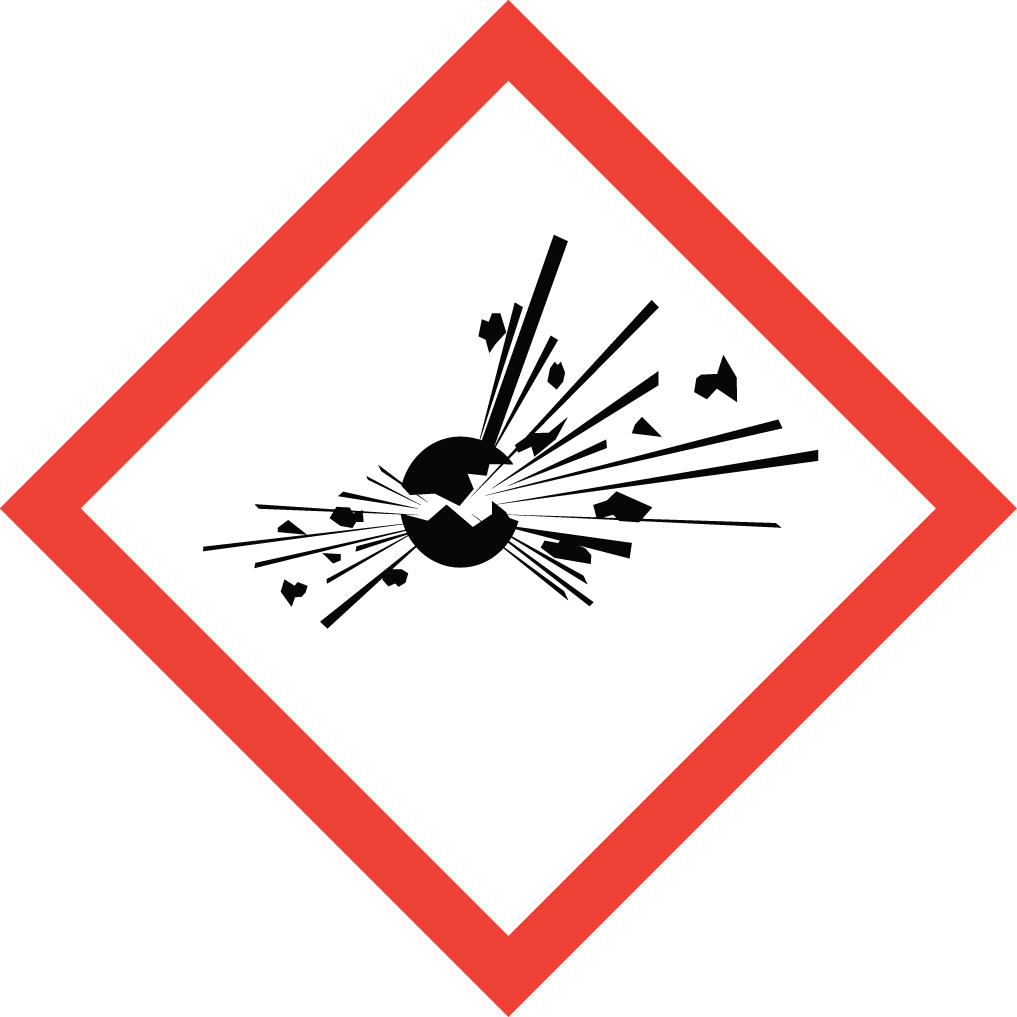
Exploding Bomb
Symbol: A stylized explosion emanating from a circle.
Associated Hazards:
- Unstable explosives (e.g., trinitrotoluene).
- Self-reactive substances prone to exothermic decomposition.
- Organic peroxides that may detonate under thermal or mechanical stress.
- Regulatory Notes: This pictogram takes precedence over others when multiple hazards coexist, as explosions pose immediate lethal risks.

Flame
Symbol: A flame.
Hazard Classes:
- Flammable gases, aerosols, liquids, and solids (e.g., acetone, propane).
- Pyrophoric materials igniting spontaneously in air (e.g., white phosphorus).
- Self-heating substances (e.g., activated carbon).
- Workplace Considerations: Storage areas displaying this pictogram require intrinsically safe electrical systems to prevent ignition.

Flame Over Circle
Symbol: A flame atop a circle.
- Primary Use: Identifies oxidizers that intensify combustion (e.g., potassium permanganate, hydrogen peroxide).
- Mechanism: Oxidizers release oxygen or react with combustibles to initiate fire without an external ignition source.

Gas Cylinder
Symbol: A gas cylinder.
Hazards:
- Compressed gases (e.g., nitrogen, helium)
- Liquefied gases (e.g., propane)
- Dissolved gases (e.g., acetylene)
- Risks: Cylinder rupture due to heat or damage can project fragments at high velocity, necessitating secure storage.

Corrosion
Symbol: Test tubes dripping liquid onto a surface and a hand.
Health Impacts:
- Skin corrosion (e.g., sulfuric acid causing third-degree burns).
- Eye damage (e.g., sodium hydroxide solutions).
- Material Hazards: Corrosion to metals (e.g., hydrochloric acid degrading steel).
- Labeling Conflict: If this pictogram appears, the Exclamation Mark symbol cannot denote skin/eye irritation for the same chemical.

Skull and Crossbones
Symbol: A human skull over crossed bones.
Toxicity Levels:
- Acute Toxicity (Fatal): Oral, dermal, or inhalation exposure (e.g., cyanide, strychnine).
- Category 1: LD50 ≤5 mg/kg (oral).
- Usage Restrictions: Prohibited for chemicals causing only narcotic effects or respiratory irritation
 Health Hazard

Symbol: A silhouette with a starburst chest.
Chronic Health Risks:
- Carcinogenicity (e.g., benzene, asbestos).
- Reproductive toxicity (e.g., lead compounds).
- Mutagenicity (e.g., ethidium bromide).
- Aspiration Hazards: Chemicals like petroleum distillates that can enter lungs via ingestion.

Exclamation Mark
Symbol: An exclamation point.
Scope:
- Irritants (e.g., sodium hypochlorite causing reversible eye damage).
- Skin sensitizers (e.g., epoxy resins triggering allergic dermatitis).
- Acute toxicity (Category 4): LD50 >300 mg/kg (oral).
- Exclusions: Cannot appear alongside skull and crossbones or corrosion pictograms for overlapping hazards.

Environment (Non-Mandatory)
- Symbol: A dead tree and fish.
Regulatory Status: OSHA does not enforce this pictogram, but the Environmental Protection Agency (EPA) may require it for chemicals with:
- Acute aquatic toxicity (e.g., pesticides).
- Chronic marine pollution potential (e.g., plastic microbeads).
Integration of Pictograms into Safety Data Sheets
Section 2: Hazard Identification
SDS Section 2 must list all applicable pictograms, alongside signal words and hazard statements. For example, a methanol SDS includes the following:
- Pictograms: Flame, Health Hazard.
- Signal Word: Danger.
- Hazard Statements: “Highly flammable liquid and vapor; causes damage to organs through prolonged exposure.”
Labeling Requirements
OSHA-compliant labels must include the following:
- Product Identifier: Chemical name (e.g., “Ammonia, anhydrous”).
- Supplier Information: Manufacturer’s name, address, and emergency phone number.
- Precautionary Statements: Mitigation measures (e.g., “Use explosion-proof equipment”).
Compliance Challenges and Best Practices
Common Labeling Errors
- Pictogram Omission: Failing to include the Gas Cylinder symbol for argon gas cylinders.
- Incorrect Borders: Using black borders instead of red, reducing visibility.
- Overlabeling: Adding non-OSHA pictograms (e.g., EU’s “Serious Health Hazard”) without justification.
Training and Workforce Education
OSHA mandates that employees receive training on:
- Pictogram recognition and associated hazards.
- Location and interpretation of SDS.
- Proper use of personal protective equipment (PPE) specified in SDS Section 8.
Digital SDS Management
Many organizations now use cloud-based systems to:
- Centralize SDS access via QR codes on labels.
- Automate hazard notifications based on pictograms.
- Future Directions in Hazard Communication
Adoption of Digital Pictograms
Emerging technologies enable dynamic labels with:
- RFID Chips: Updating hazards in real-time as chemical mixtures change.
- Augmented Reality (AR): Overlaying hazard data via smart glasses during handling.
Harmonization with International Standards
Ongoing efforts to align OSHA’s HCS with updates to the GHS, particularly in areas like:
- Nanomaterials: Classifying ultrafine particles with unique pictograms.
- Endocrine Disruptors: New symbols for chemicals interfering with hormonal systems.
Fundamental Design and Functional Differences
Visual vs. Text-Based Communication
Pictograms leverage universal graphic symbols to convey hazards instantaneously, whereas text-based systems rely on written descriptions:
- Pictograms: Standardized red-bordered diamonds with black symbols (e.g., flame for flammables) designed for rapid recognition.
- Shipping Papers: Text documents detailing chemical identities, quantities, and emergency response information, mandated by the Pipeline and Hazardous Materials Safety Administration (PHMSA) for transportation.
The exclamation mark pictogram, for instance, communicates irritant hazards in <2 seconds, while shipping papers require literacy and time to interpret.
Regulatory Scope and Applicability
- Workplace Focus (OSHA): Pictograms are mandatory under OSHA’s Hazard Communication Standard (HCS) for fixed facilities, appearing on labels and SDS.
- Transportation Focus (DOT): Placards and hazmat labels dominate chemical shipments, using distinct symbols (e.g., DOT’s flame logo differs from OSHA’s flame pictogram).
For example, a tanker truck carrying gasoline displays a DOT placard with a flame symbol during transit but switches to OSHA-compliant pictograms upon reaching a storage facility.
Comparative Analysis of Communication Channels
Pictograms vs. Safety Data Sheets
| Criteria | Pictograms | Safety Data Sheets (SDS) |
| Content | Single hazard per symbol | 16-section technical dossier |
| Accessibility | Language-independent | Requires literacy in host country’s language |
| Response Time | Immediate visual processing (<3 seconds) | Minutes to hours for full comprehension |
| Regulatory Anchor | OSHA HCS 1910.1200 | OSHA HCS 1910.1200 Section 4 |
While Section 2 of an SDS lists applicable pictograms, Sections 4–8 provide toxicological data and exposure controls unavailable through symbols alone.
Pictograms vs. DOT Placards
Design:
- OSHA pictograms: Red border, white background, black symbol.
- DOT placards: Color-coded diamonds (e.g., red for flammables) with numeric hazard classes.
Usage Context:
- Pictograms guide daily handling in labs/factories.
- Placards warn emergency responders during transportation accidents.
A chlorine cylinder moving through a supply chain might bear a DOT corrosive placard (UN 1017) during transit and switch to an OSHA corrosion pictogram at a water treatment plant.
Synergy with Training and Labeling Systems
Complementarity with Workforce Education
Pictograms serve as mnemonics for training content:
Workers taught to associate the skull and crossbones with acute toxicity can quickly identify lethal chemicals without rereading SDS Section 11.
Conversely, training programs explain pictogram limitations (e.g., environmental hazard symbol’s non-mandatory status under OSHA).
Integration into Hierarchical Labeling
OSHA mandates a layered approach:
- Primary Containers: Pictograms + signal words (“Danger”/“Warning”).
- Secondary Containers: Text labels with hazard statements.
- Storage Areas: Supplemental signage (e.g., “Flammables Zone” posters).
This hierarchy ensures pictograms anchor rapid hazard identification, while text provides granular details.
Limitations and Contextual Challenges
Overreliance Risks
- Misinterpretation: The health hazard pictogram (starburst chest) ambiguously represents 10+ chronic risks, from carcinogenicity to reproductive toxicity. Without SDS cross-referencing, workers might not distinguish between cancer risks and less immediate hazards.
- Cross-Regulatory Conflicts: A chemical labeled with OSHA’s flame pictogram might require a different DOT placard during transport, creating compliance complexities.
Technological Disruption
Digital systems now augment traditional methods:
- Smart Labels: RFID tags encoding both pictograms and SDS data reduce reliance on physical documents.
- Augmented Reality (AR): Overlaying interactive hazard maps onto pictogram-equipped containers.
Conclusion
OSHA’s pictogram system provides a universal language for chemical hazards, transcending literacy and language barriers in diverse workplaces. By standardizing labels and SDS, the HCS reduces occupational illnesses, prevents accidents, and fosters a culture of proactive risk management. Future advancements in digital labeling and international collaboration promise to further enhance chemical safety, ensuring that pictograms remain a cornerstone of hazard communication for decades to come.

Simplify Your SDS Management
CloudSDS gives your team instant access to 23M+ safety data sheets with AI-powered search, automated updates, and full OSHA/GHS compliance — all from one platform.
Leave A Comment