

- SDS vs. Chemical Labels: What to Check Before Handling Chemicals
- Summary
- introduction
- Label first or SDS first? Use the question you're trying to answer.
- What should workers check on a chemical label?
- Why the label on the container may look different from a shipped label
- What workers should check on the SDS
- Why an SDS and label can legitimately disagree
- What about small chemical containers?
- A simple two-step SDS and label check workers can follow
- What is changing under the 2024 Hazard Communication Standard?
- Frequently asked questions
- Conclusion
- References
Last Updated on September 30, 2026
SDS vs. Chemical Labels: What to Check Before Handling Chemicals
Summary
Workers should check the chemical label first for the product identifier, signal word, hazard statements, pictograms, and basic precautions. Before starting a task, they should check out the SDS, mainly Sections 4, 7, 8, 10, 11, and 16, for PPE, storage, reactivity, first aid, and health effects. This article explains what workplace and small-container labels can legitimately leave out, why an SDS and label can disagree, what to do when they do, and what employers must update by November 20, 2026, under the 2024 Hazard Communication Standard.
introduction
Check the label first. It tells you what is in the container and what the immediate hazards are. Check the SDS before you start any task where the details matter: what PPE to wear, how to control exposure, where to store the chemical, what it can't be mixed with, what to do after exposure, and what to do in an emergency.
The two documents do different jobs:
- Label = immediate, point-of-use hazard communication
- SDS = detailed safety and exposure information
OSHA's Hazard Communication Standard (29 CFR 1910.1200) requires both, and each assumes the other exists. The label is short because the SDS carries the detail. The SDS is long because you can't read it while holding a container in one hand.
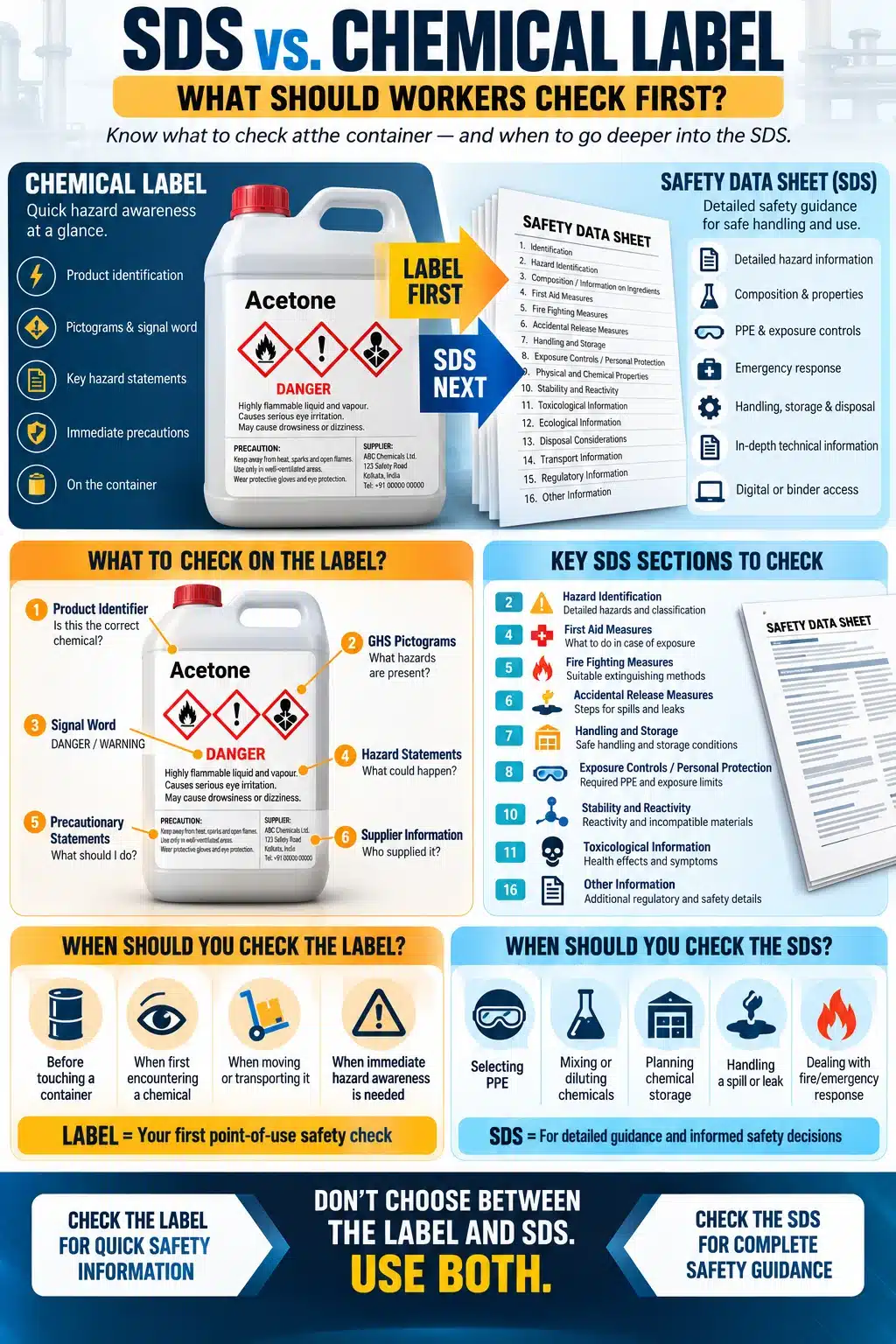
Label first or SDS first? Use the question you're trying to answer.
Which document to open depends on the question you have at that moment.
| If you need to know | Check |
| What chemical is in this container? | Label |
| What are the immediate hazards? | Label |
| What does the pictogram mean? | Label |
| What basic precautions are required? | Label |
| Which gloves should I use? | SDS Section 8 |
| Can I store it next to another chemical? | SDS Sections 7 and 10 |
| What should I do after exposure? | SDS Section 4 |
| What happens with prolonged exposure? | SDS Section 11 |
| What conditions should I avoid? | SDS Section 10 |
The pattern is simple. Anything you need to know at a glance, before you touch the container, is on the label. Anything that decides how you do the job, or what happens if the job goes wrong, is in the SDS.
What should workers check on a chemical label?
A label on a shipped container has six required elements. Together they’re meant to be read in about ten seconds.
1. Product identifier
This is the chemical or product name or a code number. It has to match the identifier on the SDS. That makes it your first check: if the name or code on the container doesn’t appear on the SDS you’re holding, you may have the wrong sheet.
2. Signal word
There are only two: Danger and Warning. Danger is used for the more severe hazard categories, and warning for the less severe ones. A label carries one signal word at most. If a product has hazards that trigger both, only Danger appears. “Warning” on a label therefore means none of the classified hazards reached the danger level. It doesn’t mean the product is mild.
3. Hazard statements
These say what the chemical can do, in standardized wording. Acetone is a typical example. Its label reads “Highly flammable liquid and vapor” and “Causes serious eye irritation,” and it usually adds “May cause drowsiness or dizziness.” Each statement corresponds to a classified hazard, so the list of statements is effectively the list of things the supplier classified the product for.
4. Pictograms
These are red-bordered diamonds with black symbols on a white background. Under HazCom, OSHA mandates eight of the nine GHS pictograms. The environmental pictogram is allowed but not required, because environmental hazards are outside OSHA’s jurisdiction. A flame, a skull and crossbones, and a corrosion symbol each point to a specific category of hazard, so you can recognize the type of risk before you read any text.
5. Precautionary statements
These are short, standardized recommendations for preventing or reducing harm. They come in four types: prevention, response, storage, and disposal. Examples are “Keep away from heat, sparks, and open flames,” “Wear eye protection,” and “Store in a well-ventilated place.”
One point causes trouble. The response statements, such as “IF IN EYES: Rinse cautiously with water for several minutes,” are first-response prompts, not first-aid instructions. Full first-aid guidance, broken out by route of exposure, is in SDS Section 4. Don’t treat the label as a substitute for it.
6. Supplier information
The label gives the name, address, and telephone number of the manufacturer, importer, or other responsible party. This is the contact you use to request a current SDS, ask a question about a product, or report a labeling problem.
Why the label on the container may look different from a shipped label
Many of the containers' workers handle isn't in their original packaging. Someone has filled a wash bottle, decanted a drum into a day tank, or set up a dispensing station. OSHA allows for different labeling in those cases, and this is where workers most often don't know what they're looking at. The rules are 1910.1200(f)(6), (f)(7), and (f)(8).
1. Workplace containers can use alternative labeling.
For workplace containers, an employer can use one of two approaches:
- The full shipped-container label, with all six elements, or
- A workplace label with the product identifier plus words, pictures, or symbols that give at least general hazard information. That label has to work together with other information the employer makes immediately available so employees can get the specific physical and health hazards.
A workplace label that shows only a product name and a flame symbol is compliant, as long as the rest of the HazCom program backs it up. If you see one, that's the reason. The SDS is where you'll find the rest.
2. Stationary process containers may use alternative warnings.
Reactors, mixing tanks, and similar fixed vessels don't need an individual label if the employer uses signs, placards, process sheets, batch tickets, operating procedures, or similar written materials instead. Two conditions apply. The alternative has to identify the containers it covers, and it must be readily accessible to employees in their work area throughout the shift. A binder in the supervisor's office doesn't meet that standard.
3. Portable containers for immediate use
You don't have to label a portable container when you transfer a chemical into it from a labeled container if the container is for your own immediate use. OSHA's definition of immediate use is specific. The chemical is under the control of, and used only by, the person who transferred it, and only within the work shift in which it was transferred.
Exemption is narrower than people assume. A spray bottle filled at 7 a.m. and used by one person that shift qualifies. The same bottle left on a shelf overnight, or handed to a coworker, no longer does. An unlabeled portable container isn't safe just because someone poured the chemical into it from a labeled one. Many employers require a label on every secondary container anyway, because it's easier to enforce than a rule with a time limit.
4. Never remove or deface an incoming label.
Employers can't remove or deface the label on an incoming container unless the container is immediately re-marked with the required information. If a label is damaged, peeling, or missing, stop and tell your supervisor. Don't identify the contents by smell, color, or where the container was stored. Someone should trace the product through the purchase records, the supplier, or the lot number and then apply a proper label. Until then, don't use it. A container with no readable label should be treated as an unknown hazard.
What workers should check on the SDS
An SDS has 16 sections, and few workers need all of them for a given task. These are the sections that answer the questions people actually ask.
Section 2—Hazard identification
This section repeats the classification and the label elements: hazard classes and categories, the signal word, hazard statements, pictograms, and precautionary statements. It also lists any hazards not otherwise classified. Compare it with the label on your container. They should agree, and when they don’t, see the section below on why they can legitimately differ.
Section 3 — Composition
This section lists the ingredients and their concentrations. Read it if you need to know what’s actually in a mixture, for example, when an exposure has occurred or a coworker has an ingredient-specific sensitivity.
You may see a concentration range, such as “10–30%,” where you expected an exact percentage. A range doesn’t mean the SDS is incomplete. It can reflect a valid trade-secret claim, and the SDS has to say when a chemical identity or percentage has been withheld for that reason. Ranges can also appear when the composition varies from batch to batch. In a medical emergency, a treating health professional can get the withheld information from the supplier.
Section 4 — First-aid measures
This is where the label’s response statements are expanded into instructions. The section is organized by route of exposure:
- Inhalation
- Skin contact
- Eye contact
- Ingestion
It also describes the most important symptoms, both immediate and delayed, and says whether immediate medical attention or special treatment is needed. Read it before you work with a product, not after exposure. If eye contact means 15 minutes at an eyewash station, you want to know that in advance.
Section 7—Handling and storage
This section covers precautions for safe handling and conditions for safe storage, including incompatibilities. It's the section to check when you're deciding where a chemical goes on a shelf or whether it can share a cabinet with something else.
Section 8—Exposure controls/PPE
This is the section that answers the question most workers care about: "What protection do I actually need for this task?" It covers:
- Occupational exposure limits (OSHA PELs, ACGIH TLVs, and any others the supplier lists)
- Engineering controls such as local exhaust ventilation
- Gloves
- Respiratory protection
- Eye and face protection
- Protective clothing
One caution about gloves. Many SDSs recommend "chemical-resistant gloves" without naming a material, and even when they do, the recommendation is general. The correct glove for a particular task depends on the glove material, thickness, and the chemical's breakthrough time. Your employer's PPE hazard assessment under 1910.132 and the glove manufacturer's permeation data are what settle it, and Section 8 is the starting point. Respirator selection follows the same logic and falls under the respiratory protection standard, 1910.134.
Section 10—Stability and reactivity
This section lists incompatible materials, conditions to avoid (heat, light, moisture, shock), hazardous reactions, and hazardous decomposition products. If you're about to combine two products or heat something, check here first.
Section 11—Toxicological information
Section 11 covers the routes of exposure, the symptoms, and the acute effects, along with the effects of chronic or repeated exposure. It's where you find out what happens if you work with a chemical every day for years, which the label never says. You'll also find numerical toxicity data and carcinogenicity listings here.
Section 16—Other information
Section 16 includes the date the SDS was prepared or last revised. Check it. HazCom doesn't set an expiry date for an SDS, but a sheet that's several years old, or that predates the 2024 update to the standard, should prompt a request to the supplier for the current version.
Why an SDS and label can legitimately disagree
SDS updates and label updates follow different timelines.
Suppliers have three months to add newly learned, significant hazard information to the SDS. They have six months to revise the label. The gap is deliberate. A label has to be redesigned and reprinted, and a product already in the supply chain has to be worked through.
The result is that for a few months, the SDS can describe a hazard the label doesn't yet show. Other differences are less dramatic. The SDS includes hazard information that didn't meet the threshold for a classification, and the label doesn't carry it.
What should a worker do if they disagree?
- Don't assume the label is more current. It often isn't. The SDS is updated first.
- Check the SDS revision date (Section 16) and compare it with the date on the container, if there is one.
- Don't decide for yourself which source to ignore. Neither document outranks the other by default.
- Escalate the difference to your supervisor or the EHS team.
- Get clarification before you proceed if the difference affects how you'd handle the material safely. Until you have an answer, the stricter precaution is the safe default, never the looser one.
Neither document is wrong in most of these cases. Handling it as a question for EHS, not something to resolve on the shop floor, is what keeps the problem from being repeated the next time.
What about small chemical containers?
The 2024 update to HazCom added provisions for small containers at 1910.1200(f)(12). These apply to the supplier, and only when the supplier can show that pull-out labels, fold-back labels, and tags aren't feasible. Workers still need to understand them, because reagent vials, sample bottles, and ampoules are where a reduced label appears.
-
Containers of 100 mL or less
A container of 100 mL or less can carry a reduced label with the product identifier, pictograms, signal word, the manufacturer's name and phone number, and a statement that the full label is on the immediate outer package. Hazard statements and precautionary statements aren't on the container itself in this case.
-
Containers of 3 mL or less
For a container of 3 mL or less, where any label would interfere with normal use, no label is required. The container must still bear the product identifier. The supplier has to be able to show that a label interferes with use before relying on this.
-
The outer package still matters.
This is the practical point. For all small containers covered by these provisions, the immediate outer package must carry the full label information. The outer package must also state that the small containers should be stored in it when not in use.
If a lab or stockroom throws away the box and racks the bare vials, the full hazard of information goes in the bin with it. Keep the outer package and keep the small containers in it.
A simple two-step SDS and label check workers can follow
Step 1—Check the container label.
- Confirm that the product identifier is what you expect.
- Scan the pictograms.
- Read the signal word.
- Read the hazard statements.
- Check out the precautionary statements.
- Confirm that the labeling situation is appropriate. Is it the supplier's label, a workplace label, or a container that should have one and doesn't?
Step 2—Check the SDS before the task.
- Section 8 for PPE and exposure controls
- Section 10 for incompatibilities and reactivity
- Section 7 for storage and handling
- Section 4 for first aid
- Section 11 for health effects
- Section 16 for the revision date
If the label and SDS don't agree, or something is missing, stop and ask before starting the task.
What is changing under the 2024 Hazard Communication Standard?
OSHA published the revised standard on May 20, 2024, aligning HazCom with the seventh revision of the GHS. The changes include new and revised hazard classes and categories, such as flammable gases, aerosols, desensitized explosives, and chemicals under pressure, along with the small-container labeling provisions above. On January 15, 2026, OSHA extended the compliance dates by four months. During the transition period, employers may follow the 2012 standard, the 2024 standard, or both.
Employer deadline for substances—November 20, 2026
Employers have until November 20, 2026, for substances to update their hazard communication program, workplace labels, and training as necessary. In practice that means:
- Alternative workplace labels. Any in-house label system has to reflect the updated classifications and hazard information. If your secondary-container labels are generated from SDS data, they need regenerating as suppliers issue updated sheets.
- Written HazCom program. It should describe the current labeling, SDS, and training practices.
- Employee training. Workers need training on any newly identified physical or health hazards for the chemicals in their area.
Mixture deadline—May 19, 2028
The employer deadline for mixtures is May 19, 2028. The steps are the same as for substances: update workplace labels, revise the written program, and train employees on the new hazard information. Suppliers have an earlier deadline of November 19, 2027, for mixtures, so updated SDSs and labels for mixtures will arrive during 2027 ahead of the employer date.
Frequently asked questions
Should workers check the SDS or label first?
Check the label first. It identifies the chemical and gives the immediate hazards and basic precautions. Check the SDS before you start a task for PPE, exposure controls, storage, incompatibilities, and first aid. The label tells you what you're holding. The SDS tells you how to work with it safely.
Can a chemical label replace an SDS?
No. A label is a summary and is limited by space. HazCom requires an SDS for each hazardous chemical, and employers must keep it accessible to employees in their work area during every shift. A label is not accepted in place of the SDS.
Why does my workplace container have no pictogram?
Workplace containers can carry a label with the product identifier plus words, pictures, or symbols giving general hazard information, and that label doesn't have to include the full set of pictograms. Stationary process vessels can use signs or process sheets, and portable containers for immediate use are exempt. A missing pictogram doesn't mean the contents are safe. Check the SDS or ask your supervisor.
Does a small chemical container need a full label?
Not always. A supplier may use a reduced label on containers of 100 mL or less, or just the product identifier on 3 mL or less, when a full label isn't feasible. The complete label information must then be on the immediate outer package, and the small containers should be stored in it when not in use.
Why does the SDS show a hazard that the label doesn't?
The most common reason is timing. Suppliers have three months to update the SDS with significant new hazard information and six months to update the label. The SDS may also include information that didn't meet a classification threshold, so no hazard statement appears on the label. If the difference affects how you'd handle the chemical, ask your supervisor or EHS team before you proceed.
Conclusion
Start with the label. It tells you what the chemical is and what could go wrong right now. Then open the SDS before the task for PPE, storage, reactivity, first aid, and health effects. When a workplace label looks sparse, or the label and SDS seem to disagree, treat that as a question for your supervisor or EHS team, not something to settle yourself. With employer deadlines under the 2024 HazCom update starting November 20, 2026, now is a good time to check that your labels, SDSs, and training all say the same thing.

Simplify Your SDS Management
CloudSDS gives your team instant access to 23M+ safety data sheets with AI-powered search, automated updates, and full OSHA/GHS compliance — all from one platform.
Leave A Comment