
Last Updated on March 25, 2026
Managing Safety Data Sheets (SDSs) is no longer just about retaining a binder in the safety office. In today's highly regulated environments, SDSs sit at the intersection of hazard communication, emergency response, and regulatory compliance. Yet many organizations still treat SDS management as a manual, paper‑driven task, which exposes them to avoidable compliance risks and operational inefficiencies.
Digital (or cloud‑based) SDS management systems change this dynamic by turning SDSs into a structured, auditable, and continuously updated component of the EHS program. When implemented correctly, these platforms don't just make SDSs easier to find—they actively strengthen an organization's ability to meet OSHA, WHMIS, REACH, GHS, and other local obligations.
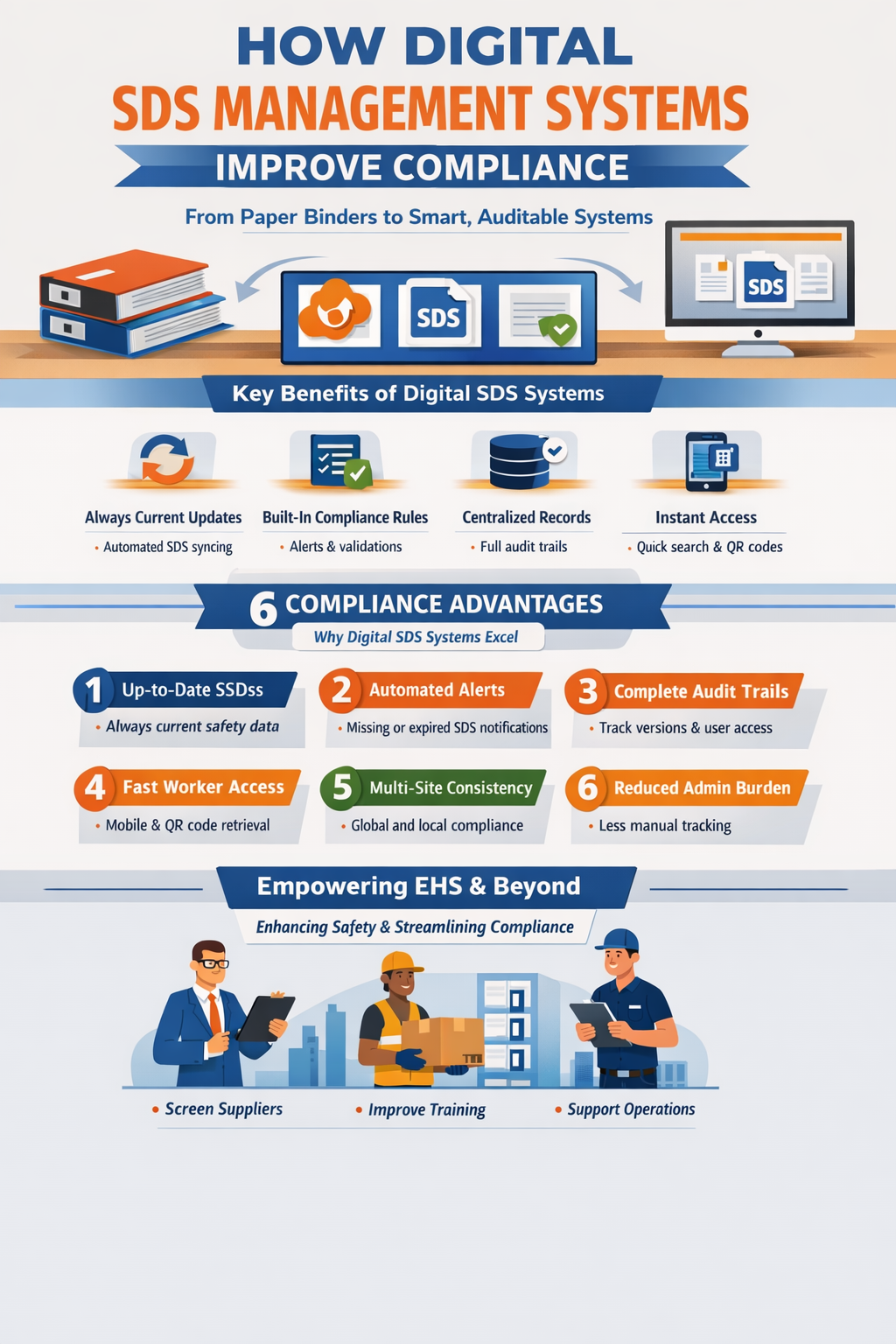
Effective Ways to Improve Digital SDS Management Systems Compliance
Why Traditional SDS Management Struggles with Compliance
Most legacy SDS approaches rely on physical binders, shared drives, or collections of scanned PDFs. At first glance, these methods seem "good enough," but they quickly reveal four critical weaknesses when regulatory scrutiny comes into play.
- Outdated content: SDSs evolve as classifications, exposure limits, and precautionary statements change. Paper or poorly managed electronic libraries often fall behind, which means that sites are using old hazard information.
- Version confusion: Different departments or locations may end up with different versions of the same SDS, creating gaps between what is documented and what is used.
- Delays in access: Workers in an emergency or inspection response might not be able to access the required SDS in a timely manner, which defeats the "right to know" concept.
- Lack of audit trails: It is challenging to track when an SDS was updated, who reviewed it, and who was informed of updates, which poses a risk to an organization during an audit.
The above-mentioned issues pose a tangible risk to an organization in the form of citations, fines, enforcement orders, and reputational risks if a regulator finds that an organization's hazard of communication is lacking or out of date.
What a Digital SDS Management System Actually Does
A digital SDS management system is not just a "digital binder." It is a centralized, configurable platform that:
- Stores all SDSs in a searchable, version‑controlled vault.
- Automatically ingest and update SDSs from regulatory and supplier sources.
- Integrates with chemical inventory, training, and EHS/PSC systems.
Instead of chasing down PDFs or chasing down binders, EHS teams configure rules, workflows, and access controls that keep compliance "on by default." The system becomes a compliance engine, not just an archive.
1. Always‑current Libraries
Regulators expect SDSs to reflect the latest hazard classifications, exposure limits, and precautionary statements. Outdated SDSs are one of the most common non-compliances observed during inspections.
Digital systems address this issue by:
- Monitoring new versions of SDS documents from global sources and identifying expired or obsolete documents.
- Automated ingestion of new SDS documents and archiving of obsolete documents with clear timestamps.
In terms of compliance, there are fewer chances for an organization to be cited for non-compliance due to the use of obsolete SDS documents. The system also enables the dissemination of new information regarding hazards in a timely manner, which fits in with the dynamic nature of the requirements for hazard communication.
2. Built‑in Compliance Guardrails
In current SDS management platforms, compliance logic is integrated directly into the system, rather than in a spreadsheet or tribal knowledge system. Some of the most common features of this include:
- Automated notifications for missing SDSs, expired SDSs, or missing information in an SDS.
- Validation of GHS elements, label pictograms, signal words, and hazard statements.
- Review and communicate SDSs and their linkage to processes using a checklist or workflow.
In an audit, this means that teams don't have to scramble to show auditors binders and documentation but rather can point to processes and show that they're constantly monitoring and reviewing and that they're using automated processes to trigger actions, which is a hallmark of a mature compliance program.
3. Centralized, auditable record-keeping
A digital SDS system creates a single source of truth for all SDS‑related activity. This is one of the most powerful compliance advantages it offers.
Key record-keeping benefits include:
- The complete version history shows when an SDS was added, revised, or replaced.
- Audit logs that track who accessed or downloaded an SDS, especially during an incident or audit.
- Structured archival of retired SDSs and discontinued products, often aligned with long‑term retention expectations (e.g., 10–30 years).
This traceability makes it easier to demonstrate due diligence. When regulators ask, "How do you know this SDS was current at the time of the incident?" a digital system can show a clear chain of versions, dates, and review notes.
4. Faster & More Reliable Access for Workers
OSHA's Hazard Communication Standard and similar frameworks in other jurisdictions require that SDSs be "readily accessible" to exposed employees. Paper‑based systems often fail this test in practice, even if they look acceptable on paper.
Digital platforms help by:
- This allows workers to access SDSs via mobile devices or web browsers and search for them by product name, CAS number, etc., directly from the workplace.
- Facilitating the use of QR codes that provide direct access to the latest SDSs in case of spills, exposures, etc. This minimizes response time in emergency situations.
From a compliance standpoint, this process shows that the organization has implemented accessibility, not simply claimed to have done so. In case of inspections, this can lead to a significant reduction in the number and severity of findings concerning SDS access.
5. Multi‑site compliance with consistency
Global and multi-facility organizations face the unique challenge of aligning SDS content across regions that use different regulatory frameworks. Without a digital system, it is common to see local sites relying on their own improvised libraries, creating uneven compliance postures.
Digital systems help by:
- Maintaining a master SDS library while applying regional rules (OSHA, WHMIS, REACH, CLP, etc.) on a per‑site or per‑jurisdiction basis.
- Supporting role‑based access so that local EHS leads see only the SDSs relevant to their facility and regulatory context.
This consistency also makes it easier to implement global SDS management policies, as it's known that regional requirements are being enforced at the system level.
6. Reduced Administrative Burden and Risk
Manual management not only takes a toll on the team but also increases the likelihood of human error. EHS staff may spend critical hours searching for missing documents, updating spreadsheets, and manually validating completion dates. Technology reduces the administrative burden associated with managing SDSs in many ways:
- It eliminates administrative tasks such as updating SDSs, locating missing documents, and generating compliance reports.
- It reduces the number of administrative steps that are prone to human error, such as missing updates, incorrect printouts, and incorrect versions.
This, in turn, decreases the risk of non-compliance citations. At the same time, EHS staff can focus more on higher-value tasks like exposure assessment, control validation, and risk prioritization.
Key Compliance Benefits Briefly
The table below summarizes how digital SDS management improves different aspects of compliance.
| Aspects of compliance | How digital SDS systems help | Typical impact |
| Regulatory alignment | Automatically sync with GHS, OSHA, WHMIS, REACH, CLP, and local rules. | Fewer violations due to outdated classifications or missing sections. |
| Right‑to‑know / access | Provide instant, electronic access via web, mobile, or QR codes. | Easier to prove that SDSs are "readily accessible" during audits. |
| Version control | Track versions, timestamps, and document history. | Clear mapping indicates which SDS was current at any point in time. |
| Audit readiness | Maintain complete logs, alerts, and retention records. | Faster, less stressful audits with clear evidence trails. |
| Multi-site compliance | Centralize SDSs while applying regional rules per site. | Harmonized compliance across global operations. |
| Incident and emergency response | Enable rapid retrieval of SDSs during spills or exposures. | Improved response safety and stronger regulatory defensibility. |
| Administrative workload | Automate updates, alerts, and reminders. | Less manual labor and fewer human‑error‑related gaps. |
This structured view makes it easier for leadership, EHS teams, and auditors to see that digital SDS management is not just "going paperless" but actively tightening compliance controls.
Empowering EHS and Non‑EHS Teams
Digital SDS platforms are not only for EHS officers; they also help other roles meet their compliance obligations. When multiple functions pull from the same SDS source, compliance becomes a shared responsibility rather than a siloed task.
For example:
- Procurement teams can screen suppliers for valid, GHS‑compliant SDSs before onboarding, ensuring that hazard information is available from the outset.
- Warehouse and logistics staff can access SDSs linked to inventory items, supporting correct segregation, storage, and labeling practices.
- Training and HR teams can integrate SDS data into role‑based training modules, demonstrating that employees understand hazards and controls associated with the chemicals they use.
This cross‑functional alignment strengthens the overall compliance posture of the organization, because SDS‑related expectations are embedded in the workflows of multiple stakeholders.
Practical Next Steps for Implementation
To maximize the compliance benefits of a digital SDS management system, organizations should treat implementation as a structured program rather than a simple software rollout.
- Assess Current SDS Gaps: List all chemicals and identify gaps in SDSs. Determine all regulations that apply to your facilities, such as OSHA, WHMIS, REACH, CLP, and local regulations, to make sure the system is set up to accommodate them all.
- Choose an SDS Solution with Compliance-Centric Capabilities: Consider systems that provide real-time update feeds, version control, and audit history. Consider systems that provide support for multiple languages or regions. Ensure the system can integrate with existing EHS, inventory, and training systems to facilitate data flow.
- Establish SDS-Related Workflows: Determine review processes for SDSs and communication processes for receiving and disseminating new or revised SDSs. Identify potential problems by setting up processes to monitor overdue or missing SDSs.
- Train and socialize the system: Provide role‑based training that shows how to search, access, and interpret SDSs in the digital environment. Emphasize how the system supports both safety and regulatory requirements so that users understand it as part of their everyday responsibilities.
Over time, these steps turn the digital SDS management system from a technical tool into a continuous, automated control that demonstrably reduces regulatory risk. It becomes a living component of the compliance program, evolving as regulations change and as the organization's chemical usage evolves.
Wrapping Up
A digital SDS management system is not just a digital version of a binder but also a system that changes the way organizations manage their hazard information, turning a static, reactive compliance exercise into a dynamic, auditable, and constantly changing process. The addition of compliance rules, automatic updates, and easier access to records help organizations effectively follow GHS, OSHA, WHMIS, REACH, and other regulations.
For EHS leaders, a digital SDS management system is not just a new technology but a smart business decision to drive better compliance, lower regulatory risks, and a stronger safety culture based on facts and data.
FAQ:
Yes, we offer demonstrations to give you firsthand experience with our SDS management solution. During the demo, you can explore the user-friendly interface, assess key features, and understand how our system aligns with your business needs. Additionally, our free trials allow you to test the software’s functionality within your specific workflow, ensuring it meets your requirements before committing. We are confident that our solution’s comprehensive features, ease of use, and dedicated support will showcase its suitability for optimizing your SDS management processes.
Simplify Your SDS Management
CloudSDS gives your team instant access to 23M+ safety data sheets with AI-powered search, automated updates, and full OSHA/GHS compliance — all from one platform.
Managing SDS sheets involves a systematic approach to organizing, accessing, and updating safety data sheets for chemicals in compliance with regulations. Our SDS management system simplifies this process by offering a user-friendly interface for easy navigation, ensuring that businesses can efficiently find and store crucial information. It implies utilizing our online SDS management software to streamline workflows, track changes, and stay up-to-date with the latest regulatory requirements. With features such as cloud accessibility and real-time updates, businesses can optimize their SDS management, enhancing overall efficiency and compliance efforts.
Simplify Your SDS Management
CloudSDS gives your team instant access to 23M+ safety data sheets with AI-powered search, automated updates, and full OSHA/GHS compliance — all from one platform.
MSDS, or Material Safety Data Sheet, was the previous terminology used for safety data sheets. The transition from MSDS to SDS (Safety Data Sheet) occurred to align with the Globally Harmonized System of Classification and Labelling of Chemicals (GHS). While MSDS primarily focused on materials and substances, SDS provides a standardized format globally, ensuring consistency in hazard communication. Our software caters to both MSDS and SDS management needs, offering a seamless transition and comprehensive solution for businesses navigating these regulatory changes.
Simplify Your SDS Management
CloudSDS gives your team instant access to 23M+ safety data sheets with AI-powered search, automated updates, and full OSHA/GHS compliance — all from one platform.
SDS management, or Safety Data Sheet management, involves the organization and accessibility of crucial safety information for chemicals used in various industries. Our online SDS management software is a robust system designed to streamline this process, ensuring easy access, compliance, and efficient handling of safety data sheets. With our feature-rich solution, businesses can experience the benefits of a user-friendly interface, real-time updates, and a cloud-based system that simplifies the entire SDS management process. Enhance your compliance efforts and optimize workflow with our comprehensive online SDS management system.
Simplify Your SDS Management
CloudSDS gives your team instant access to 23M+ safety data sheets with AI-powered search, automated updates, and full OSHA/GHS compliance — all from one platform.
Simplify Your SDS Management
CloudSDS gives your team instant access to 23M+ safety data sheets with AI-powered search, automated updates, and full OSHA/GHS compliance — all from one platform.
Leave A Comment