
Last Updated on March 24, 2026
We often use sodium bicarbonate, commonly known as baking soda, for cooking or cleaning. Apparently, this substance may seem harmless. But the reality is, it’s not. Yes, it can cause serious damage if not handled carefully.
Although toxicity cases are rare, they exist. Mainly because of overconsumption or misuse, the users may experience some discomfort or harmful effects. A documented case reported a patient hospitalized 3 times within 4 months due to excessive baking soda ingestion.
(source link: https://pubmed.ncbi.nlm.nih.gov/8285975/)
While not highly toxic, it still qualifies as a workplace irritant hazard. Occupational exposure to sodium bicarbonate dust can lead to:
- Respiratory irritation (coughing, sneezing)
- Eye irritation (redness, tearing)
- Skin dryness with prolonged contact
It is indeed a toxic item that requires careful handling. This blog is a guide that will help you understand the risks of handling sodium bicarbonate. So, continue reading to find out details that are necessary to know before using sodium bicarbonate daily.
Sodium Bicarbonate: In Brief
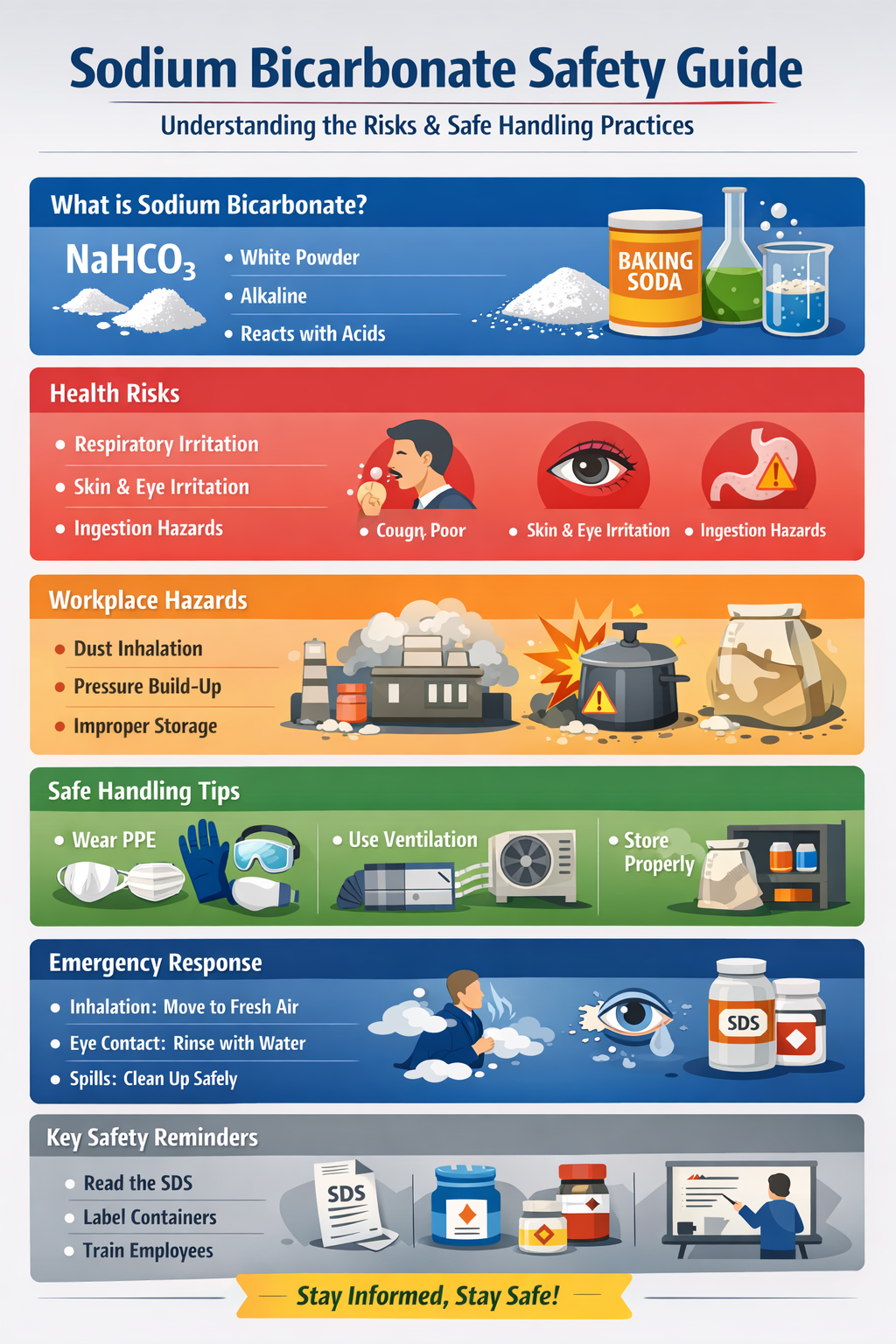
People like to use sodium bicarbonate since it may be used in many ways. If you take a look at it, you’ll find a white, odorless crystalline powder that dissolves easily in water. As it is mildly alkaline in nature, it can neutralize acids effectively. Multiple industries require it because of these properties. For instance, food processing, pharmaceuticals, cleaning, fire safety, and chemical manufacturing.
Despite its reputation as a safe household substance, sodium bicarbonate can present certain risks when handled in large quantities or under industrial conditions. It comes with an ability to release carbon dioxide when heated or mixed with acids, along with its fine powder form. Excess baking soda usage can create hazards such as dust inhalation, pressure build-up, and mild irritation to the skin, eyes, and respiratory system. This makes it important for workplaces to understand their behavior and follow proper safety and handling practices.
Chemical profile of sodium bicarbonate
-
The compounds’ structure and formula
Sodium bicarbonate is represented by the chemical formula NaHCO₃. The following things compose it:
- Sodium (Na⁺)
- H⁺ (hydrogen)
- Carbonate (CO₃²⁻)
This is an ionic molecule, which means that the sodium ions and bicarbonate ions are connected to each other. The bicarbonate ion is made up of one carbon atom, one oxygen atom, and one hydrogen atom. This signifies that it doesn’t change, but it can react.
Sodium bicarbonate can act as a buffer because of how it is made. It can, in other words, balance out acids and bases in a lot of different situations.
-
The physical and traits
Sodium bicarbonate is stable and easy to work with, which is why it is employed in so many different areas.
Physical traits:
- White powder that looks like crystals
- No smell
- A taste that is either plain or a touch salty
- It breaks down in water.
Chemical properties:
- Not flammable and relatively stable in most situations
- When it touches acids, it puts off gas.
- It is a weak base.
- It is stable, but tiny particles can get into the air, which is highly crucial for safety at work.
-
pH level (not too acidic)
When you mix sodium bicarbonate with water, you produce a solution that is somewhat alkaline, with a pH of 8 to 8.5.
This small amount of alkalinity:
- Helps keep acidity under control.
- This is helpful for things like cleaning supplies and antacids.
But at work:
- Your skin could get dry or inflamed if you are exposed to it for a long time.
- If it gets in your eyes, it could hurt or make them red.
Even though it doesn’t eat through objects very quickly, you still need to be careful when you handle it.
-
How it interacts with acids
One of the most essential things about sodium bicarbonate is how it works with acids.
It reacts with acids like hydrochloric acid or even vinegar to make the following:
- Gas CO2
- H₂O, or water
- Salt
This reaction means:
- When something bubbles or fizzes, it is effervescent.
- Rising pressure in closed systems
Workplace relevance:
- If you mix acids by accident, gas could get out quickly.
- This might make small places dangerous.
-
Thermal decomposition (releasing CO₂)
When you heat sodium bicarbonate, it breaks down into smaller pieces. This indicates that it breaks down into smaller parts.
When the temperature rises, it breaks down into the following:
- Sodium carbonate, also known as Na₂CO₃
- Water (H₂O) Water (H₂O)
- Gas that is carbon dioxide (CO₂)
That’s why it’s utilized in:
- Baking (to make the dough rise)
- Fire extinguishers (emitting CO₂ helps put out fires)
Consider the following points for safety:
- When you heat sodium bicarbonate in closed factory equipment, the gas pressure can go up.
- You need to make sure that there is enough airflow so that CO₂ doesn’t build up.
Sodium bicarbonate health hazards
Risks of inhalation
- Dust irritation
Most of the time, people use sodium bicarbonate in powder form. This means that small particles can easily go into the air when they are blended, poured, or transported. If you breathe in this dust, it might make your throat and nose feel scratchy or make you sneeze.
- Uncomfortable lungs
People who work in settings with bad ventilation or who are exposed to it for a long time may suffer mild respiratory discomfort. This can include coughing, having problems breathing, or having a painful throat. These symptoms usually don’t last long, but being around them all the time without protection can make the pain worse over time.
Skin contact
Sodium bicarbonate is usually safe to touch, but if you touch it a lot or for a long time, it can irritate your skin. This can make your skin dry, irritated, or slightly red. In workplaces where workers are often around sodium bicarbonate, its alkaline nature can slowly strip the skin of its natural oils, which might make them feel more uncomfortable.
Eye contact
If you touch sodium bicarbonate dust by accident, it could harm your eyes. A common sign is redness, dampness, and a little burning sensation. Even though it doesn’t normally hurt very badly, even small amounts of it can be annoying and make it hard to see for a short time. Most of the time, washing with clean water straight after is all it takes to make the symptoms go away.
Dangers ingestion
- What happens when you consume too much?
Using or eating little doses of sodium bicarbonate as medicine is safe. But eating a lot of it, intentionally or by mistake, might be bad for your health.
- An imbalance of electrolytes and alkalosis
Taking too much can change the body’s natural pH equilibrium, which can lead to metabolic alkalosis. This can cause signs like:
- Feeling bad and throwing up
- Muscle spasms or twitching
- Feeling weak or confused
Too much salt can also throw off the balance of electrolytes, which can cause sodium levels to rise and potassium levels to fall. This can change how well the heart and muscles perform.
Fire and explosion considerations
Sodium bicarbonate is not flammable and does not burn, which makes it safer than many other compounds used in industry. Because it can release CO₂ and put out fires, it is often used in fire extinguishers.
But there are still some crucial safety things to think about:
-
Not a fuel, but can contribute to pressure hazards
Sodium bicarbonate doesn’t catch fire, but it can break down at high temperatures and release carbon dioxide gas. When this happens in closed or sealed systems, it can cause pressure to build up, which can lead to the following:
- Breakage of containers
- Damage to equipment
-
Concerns about dust
Sodium bicarbonate dust doesn’t catch fire very easily, but too much of it in small areas can still make it hard to see and pose a small explosion risk when mixed with other flammable elements.
-
Thermal decomposition
Sodium bicarbonate breaks down into sodium carbonate, water, and CO₂ when the temperature rises. This method is usually safe when done in a controlled setting; however, it can be dangerous if
- Heating happens by accident.
- There isn’t enough airflow in the equipment.
Sodium bicarbonate risks at workplace
In actual workplaces, the dangers of sodium bicarbonate are usually more about how it is handled, stored, and controlled than about how hazardous it is.
-
Exposure dust while handling bulk
When you handle a lot of baking soda, such as in production, packaging, or shipping, dust can get into the air. If there aren’t enough controls, the following things can happen:
- Irritation of the lungs
- Eye pain
- Worse air quality in the workplace
-
Bad ways to products
If you keep sodium bicarbonate in a place that is too humid or not well sealed, it can
- Absorb the moisture and make lumps.
- Slowly react with pollutants
- Lose their ability to work or stay stable
It is more likely that reactions will happen by accident if you keep it next to things that don’t mix well with it, such as acids.
-
Not being aware of safety
A lot of workers don’t think sodium bicarbonate is dangerous because it’s used a lot in homes. This could cause:
- Not using personal protective equipment (PPE)
- Bad ways of handling
- Not enough instruction on how to handle chemicals safely
-
Problems with spills and cleaning up
Spills may not seem dangerous, but fine powder can spread swiftly and get into the air. Using the wrong cleaning procedures, like dry sweeping, can make exposure worse by putting dust back into the air.
How to handle sodium bicarbonate safely
To securely handle sodium bicarbonate at work, you don’t need complicated controls; you only need to do the same simple steps every time. Even though it is a low-hazard chemical, handling it incorrectly, especially in large amounts, can put people at risk of exposure and make operations less safe.
-
Reduce the amount of dust that is made
When you handle sodium bicarbonate, you should always try to keep dust from getting into the air. When you pour, move, or mix anything, you should do so slowly and, if you can, use enclosed systems or local exhaust ventilation.
-
Use theright containers
Put the chemical in containers that are clearly labeled and tightly sealed. This helps keep things from becoming dirty, being mixed up by accident, and soaking up wet.
-
Make sure there is enough air flow
To keep dust from building up and lower the risk of breathing it in, workspaces should be well-ventilated. Local exhaust systems may make the air much cleaner in factories and other industrial environments.
-
Don’ttouch things that are incompatible with each other
To avoid unwanted reactions and gas emission, keep sodium bicarbonate away from acids and other compounds that react with it.
-
Keep up good hygiene
After touching the substance, workers should wash their hands and not eat or drink in places where chemicals are handled. This lowers the chance of accidentally eating it.
Personal protective gear
Using the correct PPE is an important extra layer of protection, especially in places where you are likely to be exposed to it.
-
Gloves
Wear gloves to keep your skin from coming into contact with the material for too long. This is especially crucial when handling a lot of something or being exposed to it over and over again, which can make your skin dry or irritated.
-
Goggles forsafety
When working with powders, it’s very important to protect your eyes. Safety eyewear keeps you from getting irritated by dust or splashes that happen by accident when mixing.
-
Protection for the lungs
When there is a lot of dust or not enough air flow, a dust mask or respirator should be used to keep tiny particles from getting into the lungs.
-
Clothes that protect you
In factories, wearing the right work clothes or lab coats can keep your clothes from getting dirty and keep your skin from coming into direct contact with chemicals.
Response to spills and emergencies
Even though sodium bicarbonate spills aren’t very dangerous, you should nevertheless be careful with them to minimize unnecessary exposure and keep the workplace clean.
Handlingspills
Here’s how to proceed:
- Don’t sweep the floor dry because it can send dust into the air
- Use measures like vacuuming with the right filters or gently picking up the debris to cut down on particles in the air.
- Put the stuff you’ve collected in the right containers for trash or reuse, if it’s safe.
Airflow during cleanup
Make sure the space is well-ventilated before, during, and after cleaning to keep dust from building up and to make the air better.
Firstaid steps
- Inhalation: If someone has inhaled something, get them outside to breathe. If your symptoms don’t go away, see a doctor.
- Skin contact: Use soap and water to wash the area that was affected.
- Eye exposure: Rinse your eyes with clean water for a few minutes until they stop hurting.
- Ingestion: If you eat a lot of it, rinse your mouth and see a doctor.
Awareness ofemergencies
Workers should know how to handle emergencies and where to find Safety Data Sheets (SDS) so they can quickly look them up in case of an emergency.
Sodium bicarbonate SDS
A Safety Data Sheet (SDS) is one of the most important papers for keeping chemicals safe at work. The SDS gives teams organized, standardized information on risks, how to deal with them, and what to do in an emergency, even for a material that isn’t very dangerous, like sodium bicarbonate.
Why SDSmatters
Many businesses don’t know how significant SDS is for “safe” substances. But regulatory bodies still need SDS evidence since risks can emerge from using too much, being exposed, or utilizing something inappropriately. An SDS makes sure that everyone, from people who work in labs to people who work in warehouses, gets the same vital safety information.
Sectionsthatare important to notice
-
Section 2: Identification of hazards
In most cases, sodium bicarbonate is safe, but it can hurt the eyes, skin, or lungs in specific conditions.
-
Section 4: Steps for first aid
It instructs you what to do immediately if you touch it, including washing your skin, cleaning your eyes, or going outdoors to get some fresh air.
-
Section 7: How to store and handle
It tells you how to securely handle the chemical, such as keeping it away from acids and other things that don’t mix well with it.
-
Section 8: PPE and exposure control
It lists the safety gear that should be worn, such as gloves, goggles, and dust masks, as well as the ventilation required.
-
Section 10: How stable and reactive it is
It talks about how chemicals work, like how they react with acids and break down when they get heated. This is incredibly important to keep things from going wrong.
The best ways to follow safety rules at work
Keeping records is only one part of following chemical safety standards. You also need to make sure that safety is a part of your culture that is always there and always working. Even with a drug that is generally safe, like sodium bicarbonate, following the prescribed steps will minimize the risk over time.
Keep an SDS database that is up to date
Make sure you have the latest recent SDS for sodium bicarbonate:
- Easy for all staff to get to
- Updated on a regular basis
- Stored in a central system, which should be digital if possible
This is highly important for being ready for an audit and for dealing with an emergency.
Conduct safety training courses on a regular basis
Employees should know about:
- Basic hazards of chemicals
- How to do things the right way
- What to do in an emergency
Training helps people stop making assumptions like “this chemical is safe,” which can lead to bad behavior.
Make sure there are clear labeling systems
All containers should have these labels:
- Chemical name
- Details regarding dangers
- How to deal with
This decreases the danger of using it wrong or mixing it with things that don’t function with it.
Store items the right way
You should keep sodium bicarbonate in:
- Places that are cool and dry
- Sealed containers
- Places that aren’t close to acids or water
Consistent ways of storing the chemical products prevent them from getting dirty and triggering unwanted reactions.
Watch out for exposure at work
Check on a regular basis:
- How much dust is in the air
- How well does the air flow
- How often workers are exposed
This helps detect problems early and fix them.
Take advantage of digital safety tools
This is helpful to:
- Get safety information straight away
- Watch out for compliance
- Improve your ability to prepare for audits
These kinds of solutions help get rid of the requirement for paper and make it less likely that you’ll overlook critical information.
Conclusion
Indeed, the usage of sodium bicarbonate can be risky. However, any user or team can easily avoid risks. So, start by sharing all the hazard information about it and train them how to handle the hazards. Most importantly, share how an emergency can be managed. Above all, choose a chemical safety management tool to make the usage of baking soda-like products easier.
Simplify Your SDS Management
CloudSDS gives your team instant access to 23M+ safety data sheets with AI-powered search, automated updates, and full OSHA/GHS compliance — all from one platform.
Leave A Comment