
Chemical safety in the workplace begins with one key piece of information: the Safety Data Sheet (SDS). As global regulations continue to shift in 2026, the expectation of digital-only availability and the advent of AI-assisted tools for creating these documents make a structured process for managing the SDS lifecycle more important than ever for EHS professionals, operations managers, and compliance experts.
This resource will guide you through the entire process of the SDS lifecycle in easy-to-follow steps, specifically geared toward industrial, manufacturing, and laboratory environments where the need to balance compliance with operational efficiency is paramount.
Step‑by‑Step SDS Lifecycle Management Process in 2026: A Detailed Guide
1. Why SDS Lifecycle Management Matters in 2026
The SDS has evolved beyond a mere regulatory compliance exercise. It is the backbone of hazard communication, risk assessment, and emergency response planning. In 2026, organizations are being asked to:
- Prove SDS availability during audits and inspections.
- Keep classifications current in the face of ongoing regulatory updates (REACH, CLP, OSHA/GHS-style schemes, and PFAS-related restrictions).
- Enable digital-first workplaces where workers access SDSs on mobile devices, tablets, or intranets, rather than paper binders.
A lifecycle approach to SDSs, as opposed to a static document-centric approach, ensures SDSs remain current, accessible, and relevant in a changing world.
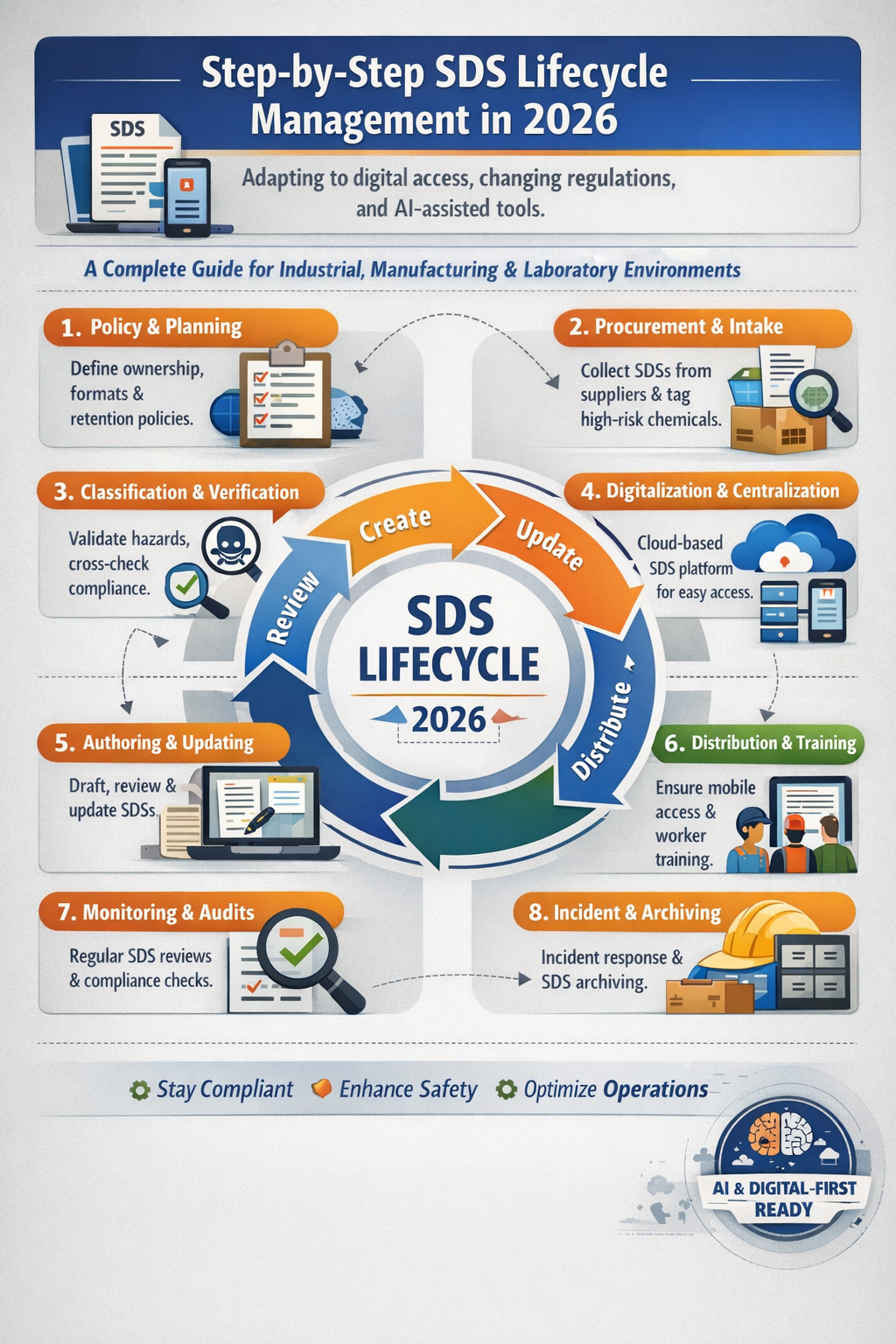
2. Understanding the SDS Lifecycle: Key Stages
Think of SDS lifecycle management as a closed loop rather than a one-off task. At the highest level, the lifecycle includes the following:
- Policy and planning
- Procurement and data intake
- Classification and verification
- Digitalization and centralization
- Authoring and updating
- Distribution, access, and training
- Monitoring, review, and audits
- Incident‑response integration
- Archiving and retirement
- Continuous improvement
Each stage directly feeds into compliance, worker safety, and operational efficiency. In 2026, the degree of digitization and integration at each stage largely determines how resilient your SDS program is under regulatory scrutiny.
3. Pre‑Planning and Policy Setup
Before you touch a single SDS, you need a clear SDS management policy. Ask:
- Who owns the SDS program (EHS, procurement, operations, or a cross‑functional team)?
- What sites, brands, and legal entities are covered?
- What formats are allowed (PDF, XML, web‑native, multi‑language)?
- How will you define “timeliness” for updates and “accessibility” for workers?
In 2026‑ready organizations, policies also specify:
- Minimum retention periods aligned with local labor/OSHA‑style rules and product‑life expectations.
- Requirements for digital access in case of fire, power outage, or network failure (e.g., offline caches or local servers).
This pre‑planning stage should also define KPIs such as SDS completion rate, update‑lag time, and user‑search‑success metrics.
4. Procurement and Initial Data Collection
SDS management begins at the point of purchase. A robust 2026‑style process includes:
- Mandate that suppliers submit SDS before goods are accepted on site.
- Tagging records with product‑specific metadata (CAS numbers, UN numbers, GHS pictograms, and supplier codes).
- Flagging high-risk substances (e.g., carcinogens, PFAS-containing mixtures, explosives) for immediate risk-assessment follow-up.
Centralize this intake in a single source of truth—ideally a cloud‑based SDS management platform—so procurement, warehouse, and EHS see the same information in real time.
5. Classification, Risk Assessment, and SDS Verification
Supplier SDSs are a starting point, not an absolute truth. In 2026, smart organizations:
- Recalculate hazards based on internal usage patterns (concentration in use, ventilation, control measures).
- Cross‑check classifications against updated regulatory lists and in‑house toxicology or exposure data.
- Flag discrepancies (e.g., “SDS says Category 3 skin corrosion, but site‑specific handling is Category 1‑like due to frequency of exposure”).
This step often triggers internal SDS revisions or custom annexes that explain site‑specific conditions, storage requirements, and emergency procedures beyond what the supplier provides.
6. Digitalization and Centralized Management
In 2026, paper‑only SDS binders are an audit risk and a usability nightmare. A modern SDS lifecycle embraces the following:
- Cloud‑based SDS management systems with role‑based access, search, and version control.
- Integration with ERP, inventory, and procurement systems so an SDS is automatically linked to every product code.
- Mobile access and offline modes for areas without reliable Wi‑Fi (e.g., warehouses, loading docks, field sites).
The 2026‑ready organization treats SDSs as dynamic information assets, not static PDFs. That means metadata tagging; smart search (by CAS, UN number, hazard class, or even “which products contain PFAS?”); and robust access logging for compliance reporting.
7. Authoring and Updating SDSs (Internal and Supplier)
A step-by-step authoring workflow improves consistency, whether you are drafting an internal SDS or chasing a supplier-submitted one:
- Collate all raw data (test reports, mix information, toxicological profiles).
- Classify hazards according to current GHS‑style or regional rules (CLP, REACH, etc.).
- Draft each SDS section systematically, ensuring coherence between exposure‑control advice and handled quantities.
- Conduct a technical and legal review (EHS, regulatory, legal, and sometimes finance).
- Publish the final version with the version number, date, and “effective from” date.
In 2026, major triggers for updates include:
- The formula or ingredients change.
- New scientific or regulatory information.
- Supplier‑provided updated SDSs.
- Help‑desk or incident‑related feedback (e.g., “workers didn’t understand Section 8”).
A beneficial practice is to define clear update timelines (e.g., “within 7 days of a formula change” or “by quarter-end after a regulatory update is issued”) and automate reminders where possible.
8. Distribution, Access, and Training
An SDS that sits in a folder is no SDS at all for compliance purposes. In 2026, effective distribution means:
- Embedding SDS links to work permits, SOPs, and batch records.
- Ensuring every worker can access the SDS from their workstation, mobile device, or kiosk in under 15 seconds.
- Providing multilingual options where relevant, especially in global or multi‑site operations.
Training should be tightly linked to access:
- New‑hire orientation includes SDS navigation drills.
- Role‑based training explains which SDS sections workers must consult (usually 4, 8, and 9 for emergency and PPE advice).
- Digital learning platforms can embed quick quizzes or “click‑through” confirmations tied to specific SDSs or product families.
This turns the SDS from a reference document into a living part of the safety culture.
-
Monitoring, Review, and Internal Audits
A lifecycle never stops. In 2026‑style programs, organizations:
- Schedule periodic SDS reviews (e.g., every 12 months, or after each major regulatory change).
- Run automated reports on “missing SDS,” “outdated SDS,” or “products with no matching SDS in inventory.”
- Incorporate SDS checks into internal EHS audits and management‑review meetings.
The SDS audit protocol should include:
- Completeness of sections (especially emergency‑response and exposure‑control details).
- Accuracy of classification and language.
- There is proof that the workers are proficient in locating and utilizing the SDS in both routine and emergency situations.
These checks prevent “silent non‑compliance”—where systems look fine on paper but fail in practice during an incident.
10. Incident Response, Investigations, and Corrective Actions
The SDS serves as the primary defense for responders in the event of an exposure, spill, or near-miss. In a mature 2026‑style program:
- SDS data is front‑loaded into incident‑reporting systems so responders can instantly see toxicity, PPE requirements, and spill‑control measures.
- Root‑cause investigations cross‑check whether the SDS was available, accurate, and clearly understood.
- Corrective actions are documented back into the SDS lifecycle (e.g., clarifying PPE language and adding site‑specific first‑aid instructions).
This feedback loop ensures that each incident Strengthen the SDS system, not just the isolated product.
11. Retirement, Archiving, and Legal Retention
Products and suppliers change over time. A complete SDS lifecycle must also define what happens when:
- A product is discontinued.
- A supplier is no longer active.
- Technology shifts make an older SDS version obsolete.
In 2026, best practice is
- Archiving all historical SDSs with clear version‑history tags and end‑of‑life dates.
- Retaining records for the legally required period (often tied to employee exposure history or product liability timelines).
- Ensuring archived SDSs remain searchable in case of legacy‑exposure or litigation queries.
This step protects the organization legally and supports long‑term occupational‑health analyses.
12. Continuous Improvement and 2026–2027 Readiness
The final stage of the SDS lifecycle is not a conclusion; it is a continuous improvement loop. In 2026‑ready organizations:
- Feedback from users, auditors, and regulators is systematically collected and mapped to SDS content or process gaps.
- Management reviews include SDS‑related KPIs and action items.
- Future‑looking investments are made in AI‑assisted SDS validation, auto‑translation, and dynamic risk dashboards that highlight “high‑exposure” or “poor‑communication” SDSs.
Organizations that treat SDS lifecycle management as a living, evolving system are far better positioned for 2027 and beyond, where regulators will increasingly expect real‑time, data‑driven proof of SDS control.
13. Case‑Style Example: A Production Site in 2026
Consider a medium‑sized chemical manufacturing site. In 2026, they:
- Use a cloud‑based SDS platform synced with their ERP and procurement system.
- Automatically flag any incoming purchase order without an up‑to‑date SDS.
- Link each SDS to relevant SOPs, batch instructions, and training modules.
- Generate quarterly reports that include SDS completion, update lag, and incidents of missing SDS.
When a regulator visits, the site can demonstrate the following:
- Ensure that every product in use has a current SDS.
- SDSs are accessible at the point of use, including on mobile devices.
- That training and incident‑response records show SDS usage in practice, not just on paper.
This case illustrates how a structured lifecycle turns SDS management from a compliance burden into a strategic safety and operational enabler.
14. Building a 2026‑Ready SDS Management Culture
In 2026, SDS lifecycle management is no longer a niche EHS task; it is a cross‑functional capability touching procurement, operations, IT, legal, and training. To do justice to the topic in your pillar blog, position your organization as:
- Proactively embedding SDS governance into broader occupied‑hazard and supply‑chain‑risk programs.
- You are not only storing SDSs in digital tools but also incorporating them into your daily work.
- We are preparing for upcoming regulatory and technological shifts, such as expanded exposure tracking and AI-mediated SDS consumption.
By adopting a step-by-step lifecycle view, you can transform your SDS program from a static document repository into a dynamic, data-driven pillar of workplace safety and compliance.
Frequently Asked Questions (FAQs):
-
What is SDS lifecycle management, and why is it important in 2026?
SDS lifecycle management is the structured process of creating, updating, distributing, reviewing, and retiring Safety Data Sheets throughout a product’s time in use. In 2026, it’s critical because of tightening global regulations, digital‑access expectations, and the need for real‑time hazard information in incident response and audits.
-
How often should SDSs be reviewed and updated in 2026?
It is recommended to review SDSs at least once per year, but also in case there are any changes to the formula, any updates to the regulations, or any significant incidents. Common internal SLAs include “within 7 days of a classification change” and the use of SDS management software.
-
Should we manage SDSs in paper or digitally in 2026?
While paper SDS binders are still allowed in some jurisdictions, 2026‑ready programs strongly favor digital‑first approaches (cloud‑based SDS systems with mobile and offline access). Digital systems improve speed of access, automate version control, and simplify audits and reporting.
-
How do we handle SDSs when a supplier stops providing them ordiscontinuesa product?
If the supplier no longer provides SDSs, the last available SDS should be archived, and the required retention period should be observed. The company records should show that the product is no longer available. For critical legacy products, it might be useful to create an “internal legacy SDS” with basic information on hazards and responses.
-
How are SDS lifecycle management and worker training connected?
SDS lifecycle management and training are closely related. Workers need to know how to find and read the right parts of the SDS, especially those about emergency response, PPE, and exposure control. In 2026‑style programs, training modules are often embedded in digital SDS platforms, with role‑based quizzes and access confirmations tied to specific products or job tasks.
-
Can AI tools be used in SDS lifecycle management in 2026?
Yes. AI-assisted tools are being used more in 2026 to help suggest classifications for SDS, verify for inconsistencies between sections, automatically translate SDS content, and identify “high-risk” or unclear SDSs for review. However, final classification, legal review, and approval should always remain under human oversight.
Simplify Your SDS Management
CloudSDS gives your team instant access to 23M+ safety data sheets with AI-powered search, automated updates, and full OSHA/GHS compliance — all from one platform.
Leave A Comment