
Passing an OSHA audit requires consistent compliance with workplace safety regulations, documentation, employee training, and hazard control. However, many organizations repeatedly fail inspections because they overlook fundamental safety requirements. OSHA audit failures often stem from the same issues that regulators frequently cite as violations.
According to recent data, the most commonly cited OSHA violations include fall protection, hazard communication, ladders, lockout/tagout, respiratory protection, scaffolding, powered industrial trucks, PPE compliance, and machine guarding. These categories consistently appear year after year, highlighting persistent compliance gaps across industries.
This blog explains the top 10 reasons companies fail OSHA audits, based on these recurring violations, and provides practical strategies to prevent them.
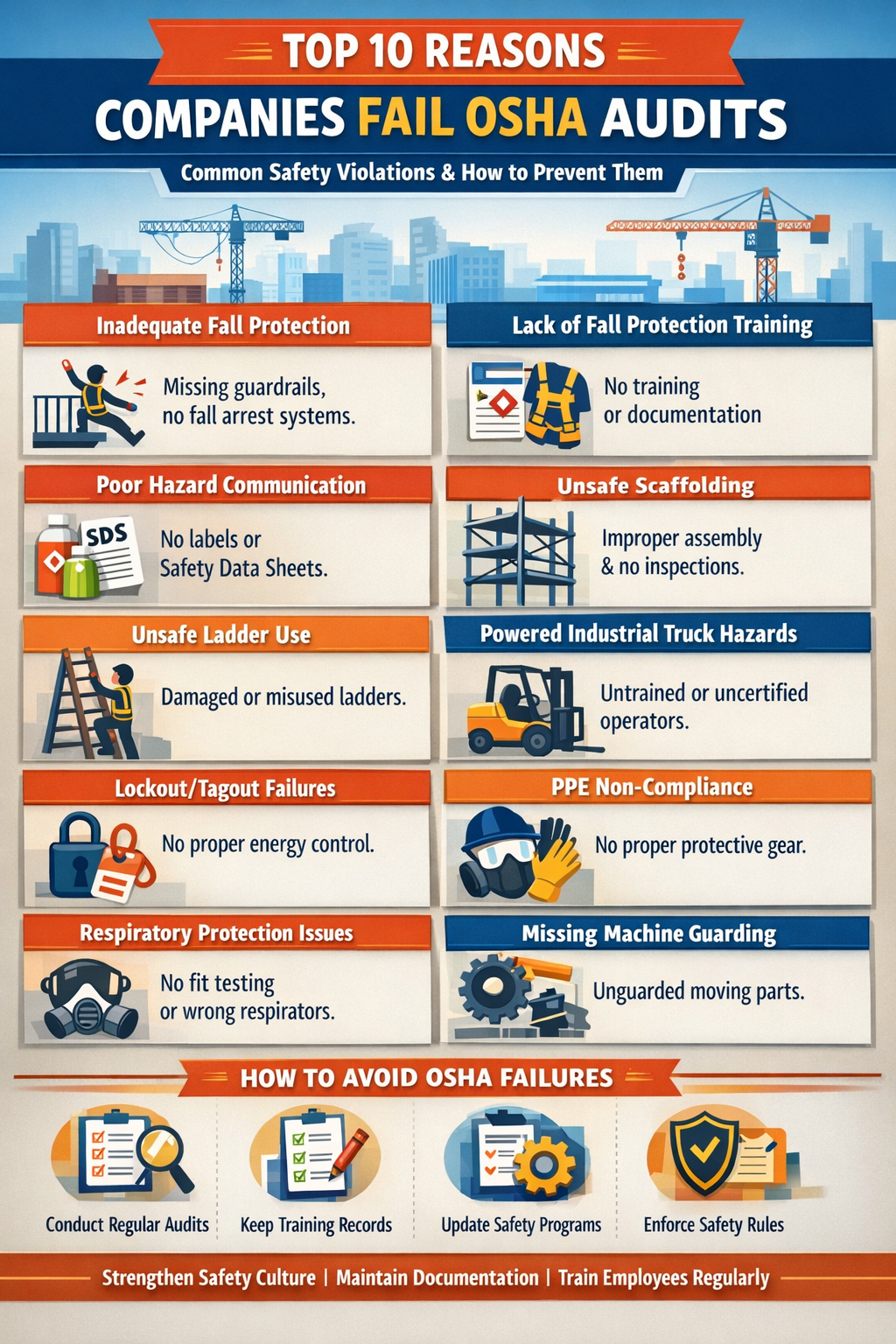
Top 10 Reasons
Inadequate Fall Protection Measures
Not providing workers with the right to fall protection is still the main reason OSHA fines people. This means lacking guardrails, edge protection, fall arrest systems, and correct safety harness use.
Fall protection violations have ranked first for multiple consecutive years, demonstrating that many employers still underestimate fall hazards in construction, maintenance, and industrial environments.
Common mistakes:
- Missing guardrails on elevated surfaces.
- No fall arrest systems.
- Improper ladder usage.
- Inadequate fall hazard assessments.
How to avoid failure:
- Conduct fall hazard risk assessments.
- Install guardrails and fall protection systems.
- Train employees to work at heights.
- Document inspections regularly.
Poor hazard communication program
Missing labels, old Safety Data Sheets (SDS), and not enough training for employees are common reasons why Hazard Communication (HazCom) violations happen.
Hazard communication is one of the most often cited OSHA standards, which shows how important it is for workers to know about chemical safety.
Reasons for audit failure:
- GHS missing labels.
- No access to SDS.
- There is no chemical inventory.
- No paperwork for HazCom training.
Best practices:
- Keep your SDS library up to date.
- Put labels on all chemical containers.
- Provide HazCom training once a year.
- Put a written HazCom program into action.
Unsafe ladder practices
Improper ladder use leads to frequent OSHA citations. This includes damaged ladders, incorrect ladder angles, and a lack of inspection protocols.
Ladder violations consistently appear among the top OSHA citations across industries.
Common issues:
- Using damaged ladders.
- Improper ladder setup.
- No ladder safety training.
Prevention steps:
- Implement ladder inspection checklists.
- Please ensure that damaged ladders are replaced.
- Train employees for ladder safety.
- Enforce the three-point contact rule.
Lockout/Tagout (LOTO) non-compliance
The primary reason for audit failure during maintenance is the failure to control hazardous energy sources. Lockout/tagout violations happen when machines are
worked on
This standard is consistently cited because hazardous energy accidents can lead to severe injuries or fatalities.
Audit gaps:
- No written LOTO plan.
- Lockout devices that aren’t there.
- No training for employees.
- Not checking for isolation.
Corrective actions:
- Develop equipment-specific LOTO procedures.
- Provide lockout kits.
- Conduct annual LOTO audits.
- Train authorized employees.
Inadequate respiratory protection
Organizations break respiratory protection rules if they fail to provide respirators, perform fit testing, or implement written programs.
OSHA’s most frequently mentioned requirements always include respiratory protection.
Common violations:
- No testing of respirator fits.
- No medical checkups.
- Choosing the wrong respirator.
- No written program.
Prevention strategy:
- Do a risk assessment.
- Establish a scheme for respiratory protection.
- Do fit testing once a year.
- Keep records of training.
Lack of fall protection training
Even when fall protection equipment exists, companies fail audits due to a lack of employee training documentation.
Training-related fall protection violations frequently appear in OSHA citation data.
Failure indicators:
- No training records.
- Employees are unaware of fall hazards.
- Improper harness use.
- No refresher training.
Solution:
- Conduct initial and refresher training.
- Maintain attendance records.
- Evaluate competency.
- Document training outcomes.
Unsafe scaffolding practices
Scaffolding violations occur due to improper assembly, missing guardrails, and lack of inspection.
Scaffolding continues to appear at the top of OSHA violations lists, indicating ongoing compliance challenges.
Typical problems:
- No scaffold inspection.
- Missing guardrails.
- Overloading scaffolds.
Prevention:
- Train competent people.
- Inspect scaffolds daily.
- Follow load capacity limits.
- Install guardrails.
Unsafe scaffolding practices
Scaffolding violations occur due to improper assembly, missing guardrails, and lack of inspection.
Scaffolding continues to appear at the top of the OSHA violation list, indicating ongoing compliance challenges.
Typical problems:
- No scaffold inspection.
- Missing guardrails.
- Overloading scaffolds.
Prevention:
- Train competent people.
- Inspect scaffolds daily.
- Follow load capacity limits.
- Install guardrails.
Powered industrial truck safety issues
Forklift-related violations occur due to lack of operator certification, unsafe driving practices, and poor maintenance.
Powered industrial trucks are among the most frequently cited OSHA standards.
Audit failures include the following:
- No training for forklifts.
- Operators without certification.
- No records of maintenance.
- Handling loads in an unsafe way.
Corrective measures:
- Offer training for forklift certification.
- Do daily checks.
- Keep records of service.
- Put the traffic control plan into action.
Personal protective equipment (PPE) non-compliance
OSHA will issue you a ticket if you don’t supply the right PPE or enforce its use, especially for eye and facial protection.
OSHA compliance still has many problems with PPE violations.
Common issues:
- No PPE risk assessment.
- Workers that aren’t wearing PPE.
- Choosing the wrong PPE.
- No training in PPE.
How to fix:
- Do a PPE evaluation.
- Give the right PPE.
- Teach workers.
- Ensure that everyone follows the rules.
Missing machine guarding
Exposed moving parts increase the risk of serious injury, leading to machine guarding violations.
Machine guarding continues to rank among the most cited OSHA violations.
Audit red flags:
- Unguarded rotating parts.
- Missing safety interlocks.
- Bypassed guards.
- Lack of inspection.
Prevention:
- Install machine guards.
- Conduct periodic inspections.
- Train operators.
- Implement lockout during maintenance.
Why these violations keep appearing
The recurring nature of these violations highlights systemic issues such as the following:
- Weaken a safe culture.
- Inadequate training programs.
- Poor documentation.
- Lack of internal audits.
- Failure to update safety procedures.
Regulatory experts note that the consistency in rankings signals that organizations must strengthen training, hazard identification, and leadership accountability to improve workplace safety outcomes.
How organizations can prepare for OSHA audits
To reduce audit risks, organizations should:
- Conduct internal compliance audits.
- Maintain documentation and training records.
- Implement safety management systems.
- Provide continuous employee training.
- Track corrective actions.
- Review OSHA standards regularly.
Conclusion
Companies fail OSHA audits primarily due to recurring safety gaps such as poor fall protection, inadequate hazard communication, missing training, and weak machine guarding. OSHA’s most cited violations consistently highlight these issues, demonstrating that proper planning, documentation, and training can prevent compliance failures. By implementing proactive safety programs, conducting internal audits, and maintaining regulatory awareness, organizations can significantly reduce risks, protect employees, and successfully pass OSHA inspections.
Simplify Your SDS Management
CloudSDS gives your team instant access to 23M+ safety data sheets with AI-powered search, automated updates, and full OSHA/GHS compliance — all from one platform.
Leave A Comment