
Last Updated on April 14, 2026
One of the most essential components of workplace safety is hazard communication. When hazard information is inaccurate, missing, or poorly presented, workers may put themselves in danger without even knowing it. Poor hazard communication can cause chemical exposure, injuries, fines from the government, and lost productivity.
The Occupational Safety and Health Administration (OSHA) says that organizations must ensure that workers know about dangers and are instructed on how to read labels, use Safety Data Sheets (SDS), and handle things safely. Employees can spot dangers and keep themselves safe if they communicate properly.
This comprehensive blog explores poor communication hazards and offers practical alternatives based on OSHA's guidelines for preventing them.
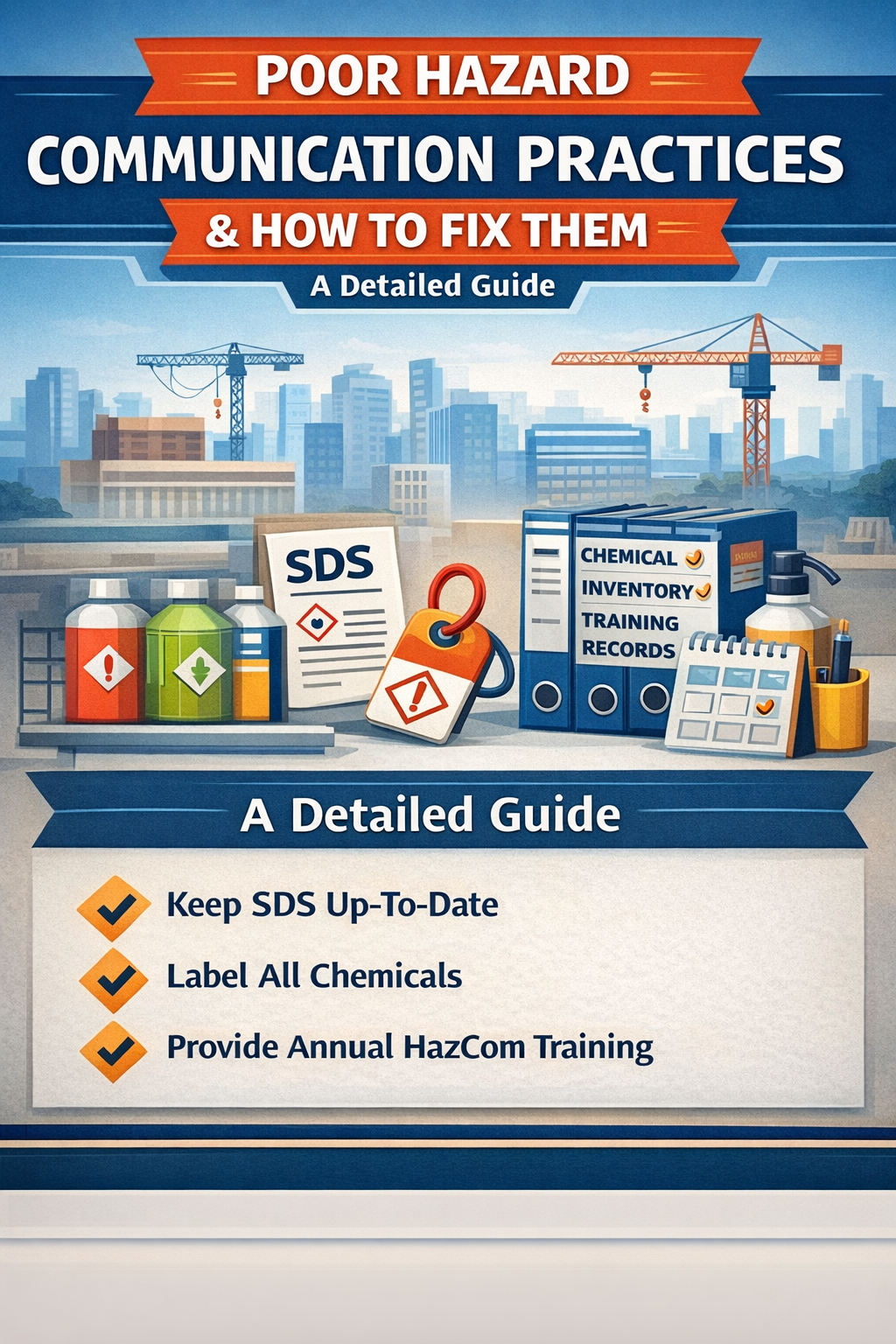
Definition of Hazard Communication?
Hazard communication refers to the process of informing employees about workplace hazards through labels, SDS, signage, and training. The goal is to ensure workers understand risks and know how to protect themselves.
Effective hazard communication includes:
- Clear chemical labeling
- Accessible Safety Data Sheets
- Employee training
- Warning signage
- Emergency communication procedures
When these components are missing or poorly implemented, hazard communication failures occur.
1. Poor hazard communication practices and how to fix them
Lack of hazard identification
One of the most common problems is failing to identify hazards before communicating with them. If hazards are unrecognized, they cannot be solved effectively.
OSHA reports that many injuries occur because people fail to recognize or anticipate hazards. To find dangers, a proactive procedure must gather information, check out workplaces, and look over incidences.
How to Fix It
- Perform periodic inspections of the workplace
- Look over records of incidents and near misses
- Look over the SDS and equipment manuals.
- Get staff involved in finding hazards
- Put dangers in order of how bad they are
Finding threats upfront ensures that communication is clear and useful.
2. Inadequate employee training
Training gaps represent a significant failure in hazard communication. Workers may see warning labels but not understand them.
OSHA requires employers to train workers on chemical hazards, labels, and SDS format so they can recognize risks.
How to fix it
- Provide initial and refresher training
- Use real workplace examples
- Conduct hands-on demonstrations
- Offer multilingual training if needed
- Test employee understanding
Training transforms hazard information into actionable knowledge.
3. Poor labeling of chemicals
Improper or missing labels pose a serious hazard in communication. Employees may use chemicals incorrectly if labels are unclear.
Labels must have signal words, hazard statements, and pictures (as per hazard communication criteria).
How to fix it
- Ensure that all containers have labels.
- Use standard pictograms
- Replace labels that are broken right away
- Put labels on secondary containers
- Examine labeling processes on a regular basis.
Clear labeling reduces confusion and prevents accidents.
4. Safety data sheets are inaccessible.
A major issue in communicating hazards is not having enough training. People who work may see warning labels but not know what they mean.
OSHA states that organizations must instruct their workers on the dangers of chemicals, how to read labels, and how to use the SDS format so they can spot problems.
How to fix it
- Provide new and refresher training.
- Use examples from the real world.
- Do hands-on demos.
- If necessary, provide training in multiple languages.
- Verify to see if employees comprehend.
- Training turns information about hazards into useful knowledge.
Accessible SDS improves emergency response and hazard awareness.
5. Lack of worker involvement
Many organizations fail to involve employees in hazard communication decisions. Workers often understand risks better than management.
OSHA recommends involving workers in identifying hazards and selecting controls because they understand workplace conditions.
How to fix it
- Conduct safety meetings
- Encourage hazard reporting
- Use suggestion systems
- Include employees in risk assessments
- Create safety committees
Worker participation improves communication effectiveness.
6. Overly dependent on PPE instead of communication
Some workplaces only use PPE and don't make the dangers readily clear.
OSHA says that when utilizing a hierarchy of controls, you should put elimination, substitution, and engineering controls ahead of PPE.
How to fix it
- Before giving out PPE, explain the risks.
- Teach workers what PPE can't do.
- Put engineering controls into place.
- Improve administrative tasks.
- Put controls together for better safety.
- Communication should help controls, not take their place.
- There is no plan for communicating hazards.
7. Failure to communicate nonroutine hazards
Temporary tasks, such as maintenance or chemical cleaning, often lack proper communication.
OSHA stresses that hazard control plans must address nonroutine operations and emergencies.
How to fix it
- Conduct job hazard analysis before nonroutine tasks
- Hold pre-task safety briefings
- Communicate emergency procedures
- Provide temporary signage
- Monitor task execution
This reduces risks during unusual operations.
8. Poor follow-up and monitoring
Some organizations communicate hazards once but never evaluate effectiveness.
OSHA recommends tracking controls, inspecting them, and verifying that workers understand and follow procedures.
How to fix it
- Conduct periodic audits
- Observe worker behavior
- Evaluate training effectiveness
- Update procedures
- Improve communication tools
Continuous improvement strengthens hazard communication.
9. Inconsistent safety messaging
Mixed messages from supervisors and management create confusion.
Workers must receive consistent instructions across departments.
How to fix it
- Standardize communication materials
- Train supervisors consistently
- Use uniform signage
- Reinforce policies regularly
- Conduct toolbox talks
Consistency builds trust and compliance.
Best practices for effective hazard communication
To avoid poor practices, implement these strategies:
- Develop a written hazard communication program
- Maintain an updated SDS database
- Provide regular training
- Use clear labeling systems
- Conduct hazard assessments
- Encourage worker participation
- Review communication effectiveness
- Follow the OSHA hierarchy of controls
- Implement emergency communication procedures
Benefits of strong hazard communication
Effective hazard communication provides:
- Reduced workplace injuries.
- Better regulatory compliance.
- Improved employee awareness.
- Faster emergency response.
- Higher productivity.
- Lower liability risk.
Organizations with strong hazard communication programs create safer and more efficient workplaces.
Frequently asked questions
-
What is the hazard of communication?
Labels, SDSs, and training are all methods for informing workers about chemical and workplace risks.
-
Why is hazard communication important?
It enables workers to identify hazards, prevent injuries, and adhere to safety protocols.
-
What are common hazard communication failures?
Missing labels, inadequate training, SDSs that are difficult to access, and the inability to find hazards.
-
Who is responsible for hazard communication?
Employers are responsible for giving employees information and training about hazards, and employees are responsible for following safety rules.
-
How often should hazard communication training be conducted?
Training should be provided initially, and whenever new hazards or chemicals are introduced, training should be provided quickly.
Conclusion
Poor hazard communication practices significantly increase workplace risk. Injuries and violations of safety rules can occur when labels are missing, training is insufficient, safety data sheets are challenging to access, and hazards are not recognized. To solve these problems, organizations can create an effective hazard communication program by using OSHA-recommended tactics to prevent hazards, such as involving workers, using a hierarchy of controls, and maintaining constant oversight. Good communication means ensuring that workers know about risks, follow safety rules, and help make the workplace safer.
Simplify Your SDS Management
CloudSDS gives your team instant access to 23M+ safety data sheets with AI-powered search, automated updates, and full OSHA/GHS compliance — all from one platform.
Leave A Comment