
Most people outside the safety or compliance team think audits are stressful because of the inspectors. That is only half of the story.
The real headache usually begins long before the auditor walks through the door. It starts when someone suddenly asks for training records, certification dates, employee sign-offs, or proof that refresher training was completed six months ago.
And then chaos begins. Someone opens an old spreadsheet that has not been updated properly. Another person starts digging through email folders for certificates. HR has one version of the records, operations has another, and the safety manager is trying to figure out which document is actually correct.
This happens in more companies than people realize.
Whether the organization is preparing for an OSHA inspection, an EPA review, or an ISO 45001 audit, the same problems usually appear:
- Missing paperwork
- Expired certifications
- Incomplete training records
- Last-minute scrambling
- Confusing spreadsheets
- Disconnected systems
The worst part is that traditional methods make the process harder every year. Once a company grows, hires more employees, adds contractors, or expands to multiple locations, manual tracking simply becomes too difficult to manage properly.
That is why many organizations are now using an audit-ready learning management system to simplify compliance management.
Instead of spending weeks preparing for inspections, companies can keep training records organized and accessible throughout the year.
What Is An LMS?
An LMS is a software used to manage employee training, learning activities, certifications, and compliance records. Many companies first adopt an LMS for onboarding or employee development. But over time, they realize it can solve another major problem too: compliance tracking. How? Well, the LMSs do save all your training and activity reports with real-time details.
Why does an LMS matter for compliance?
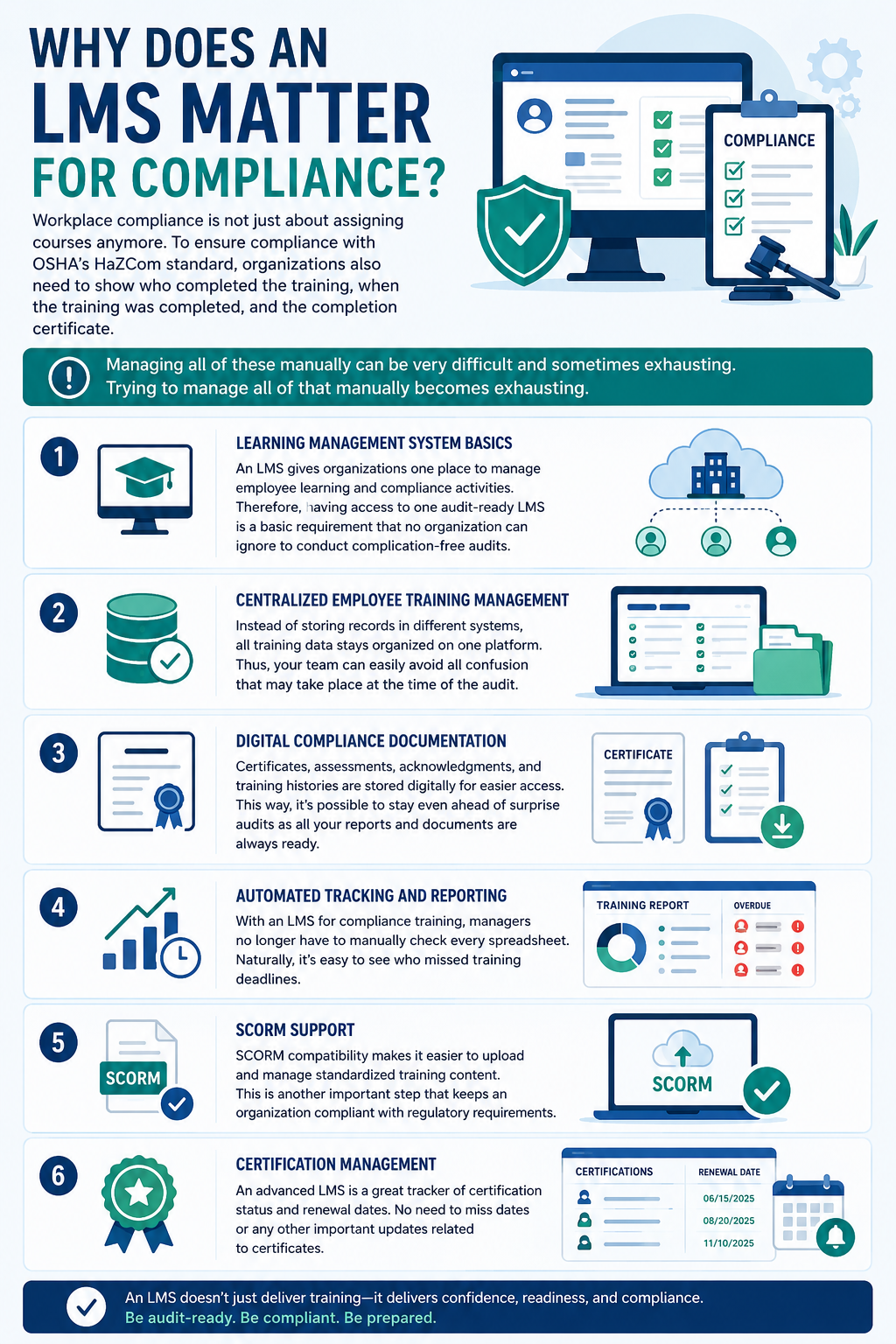
That matters because workplace compliance is not just about assigning courses anymore. To ensure compliance with OSHA’s HaZCom standard, organizations also need to show who completed the training, when training was completed, and also the completion certificate. Managing all of these manually can be very difficult and sometimes exhausting. Trying to manage all of that manually becomes exhausting.
☑️ Learning management system basics
An LMS gives organizations one place to manage employee learning and compliance activities. Therefore, having access to one audit-ready LMS is a basic requirement that no organization can ignore to conduct complication-free audits.
☑️ Centralized employee training management
Instead of storing records in different systems, all training data stays organized on one platform. Thus, your team can easily avoid all confusions that may take place at the time of the audit.
☑️ Digital compliance documentation
Certificates, assessments, acknowledgments, and training histories are stored digitally for easier access. This way, it’s possible to stay even ahead of surprise audits as all your reports and documents always stay ready.
☑️ Automated tracking and reporting
With an LMS for compliance training, managers no longer have to manually check every spreadsheet. Naturally, it’s easy to see who missed training deadlines.
☑️ SCORM support
SCORM compatibility makes it easier to upload and manage standardized training content. This is another important step that keeps an organization compliant with regulatory requirements.
☑️ Certification management
An advanced LMS is a great tracker of certification status and renewal dates. No need to miss dates or any other important updates related to certificates.
The biggest reasons audit prep takes weeks
Many companies assume long audit preparation timelines are normal. Usually, they are not. In most cases, the delays happen because the organization is relying on outdated processes that create unnecessary manual work.
➤ Paper-based records
Paper files create problems the moment somebody needs information quickly. Records go missing, signatures fade, and folders end up in the wrong cabinet.
➤ Spreadsheet dependency
Spreadsheets become difficult to manage once the workforce grows. One missed update can throw off the entire compliance report.
➤ Decentralized training data
Without an audit-ready LMS, training information often sits in multiple places across HR, safety, operations, and supervisors. Nobody has one complete picture.
➤ Inconsistent employee documentation
Some employees may have complete records while others are missing assessments, certificates, or retraining history. Having or storing incomplete documents is one of the biggest compliance risks.
➤ Multi-location compliance chaos
Different facilities often use different systems and processes. Certainly, this creates confusion during audits, and handling such situations without an LMS for compliance training can be difficult.
➤ Operational impact
All of these problems eventually lead to:
- Delays
- Compliance risks
- Audit fatigue
- Increased admin workload
- Stress across teams
- Poor visibility into training status
Over time, the entire process becomes frustrating for everyone involved.
How an LMS centralizes compliance records
One of the biggest reasons organizations move to an LMS is because they are tired of hunting records. With manual systems, information is usually scattered everywhere. An OSHA-compliant LMS changes by creating one centralized system for compliance documentation.
1. Single source of truth
An audit-ready LMS stores the following:
- Employee training records
- Certificates
- Assessment scores
- Audit logs
- Digital signatures
- Training history
This way, everything stays connected and searchable. Moreover, the teams won’t have to prepare for hours for any last-minute audits.
2. Faster retrieval
When auditors ask for documentation, managers can locate records quickly instead of searching through multiple folders. Thus, an advanced LMS is a time saver also.
3. Reduced admin workload
Safety teams spend less time updating spreadsheets and more time focusing on actual safety improvements. Thus, not just the training process, but a team can upgrade their overall chemical safety management process.
4. Better record for accuracy
Since records update automatically, there is less chance of missing or outdated information.
Automated compliance tracking and certification management
Manual compliance tracking works for a while. Then the company grows. Suddenly there are hundreds of employees, dozens of certifications, recurring training schedules, and multiple departments trying to keep everything updated. That is usually when organizations realize they need automation.
1. An automatictracker
An OSHA-compliant LMS can automatically monitor
- Mandatory training
- Refresher schedules
- Certification expiry
- OSHA-required courses
- Role-based compliance
- Employee course completion
This is a single platform to handle all documents that are necessary to ensure effective employee training.
2. Automated reminders
Employees receive reminders about all the courses. The users can easily track which courses are in progress, which are completed, and which have not yet been started.
3. Escalation workflows
Managers can also receive notifications when employees fail to complete required training. Based on the received notification, it becomes easier to make further decisions.
4. Compliance alerts
Instead of finding problems during an audit, organizations can identify them early and fix them sooner. That alone removes a huge amount of stress from the audit process.
Instant audit reporting and documentation
Reporting is usually where audit preparation slows down the most. Some companies spend days manually collecting records and formatting spreadsheets before inspections. An LMS simplifies this process significantly.
Real-time compliance reports
Managers can instantly generate reports showing:
- Training completion
- Certification status
- Department compliance
- Employee learning history
- Overdue training
Certification status dashboards
Dashboards make it easier to spot:
- Expired certifications
- Missing records
- Non-compliant departments
- Training gaps
-
Exportable reports
Most systems allow reports to be exported as the following:
- Excel
- CSV
Reduced manual reporting effort
What once required several days can often be completed within minutes. That is where organizations begin seeing major time savings.
Role-based training for better compliance accuracy
An LMS helps organizations assign training based on job responsibilities. Below are the examples:
1. Forklift operator
Required Training: Equipment safety
Benefits:
- Decreases the chances of equipment-related accidents.
- Improves safe forklift operation practices
- Allows an employee to understand load handling procedures
- Reduces all the chances of workplace injury risks
2. Lab technician
Required Training: Chemical handling
Benefits:
- Improves awareness related chemical safety at workplaces
- Reduces risks related to chemical exposure
- Educates employees about proper storage and handling procedures of chemicals.
- Supports safer laboratory operations
3. Maintenance team
Required Training: Lockout or tagout
Benefits:
- Protects from accidental machine startup when repairing is going on
- Improves worker safety during maintenance activities.
- Removes or decreases all the chances of equipment-related injuries.
- Helps maintain regulatory compliance
4. Warehouse staff
Required Training: Hazard communication
Benefits:
- Educates employees about chemical labels and warnings.
- Improves awareness of workplace hazards
- Supports safe handling of hazardous materials
- Reduces the risk of improper chemical usage or storage
How LMS improves OSHA and regulatory compliance
Many organizations today must comply with multiple regulations at the same time. Managing all of this manually becomes difficult very quickly. An advanced LMS these days helps organizations stay compliant by not just organizing the entire training process but also always staying ahead multiple steps. Here’s how it helps:
-
Training completion:
Tracking the current status of each course is necessary. It proves how sincerely your organization conducts training sessions. As a result, it becomes easier for your organization to prove its commitment to OSHA’s HazCom standard.
-
Employee competency:
According to the HazCom standard, all employees must receive training before their first assignment. Proving that each of your employees is skilled and trained is necessary to ensure compliance. An LMS stores all such documents to prove that your organization offers an effective training program.
-
Retraining history:
An LMS allows your team to record the status of all the previous training. So, your team can show all the details of the previous training program and their status with the inspectors. Yes, during audits, your team may have to show past records of training.
-
Documentation retention:
For a positive outcome of audits, storing all the required documents is a vital step your team can’t skip. With an LMS it becomes easier. This software stores all the documents with real-time data and is also printable.
Essential LMS features that reduce audit prep time
Not every LMS is designed for compliance-heavy environments. Organizations should focus on features that actually reduce administrative workload and improve audit readiness. Here are a few mentioned below:
1. Automated reporting
An LMS offering automatic reporting allows companies to create training records on the go, without the need for human paperwork. During audits, safety supervisors can quickly draw up staff completion data and lists of overdue training and compliance reports. This cuts down on the administrative overhead and saves crucial lead time.
2. Audit monitoring
Certification monitoring allows companies to automatically track employee certifications and renewal dates. It can warn teams to expiring certificates, which helps them prevent compliance failures. This translates into always qualified and ready-to-audit staff.
3. Dashboards for compliance
Compliance dashboards provide you with a real-time view of department training and compliance status. Managers can easily see whether a course has been completed, a certificate is out of date, or there is training that still needs to be done. This visibility enables organizations to solve problems prior to an audit.
4. Mobile-friendly design
Mobile access – Staff can learn on a smartphone or tablet from anywhere. This is great for remote workers, warehouse teams, and field people who may not have access to a desktop. “More accessible training leads to higher completion rates and more consistent compliance.
5. SCORM compatibility
SCORM compatibility Enterprises can simply integrate standardized e-learning content into their LMS with SCORM compliance. It ensures any progress made in training, assessment marks, or completion is correctly logged into the system.
6. Audit logs
The LMS automatically tracks all activity (course completions, document changes, etc.) in audit logs. These logs are a clear record of employee training and compliance. Records with timestamps are readily available to organizations for verification during an audit.
7. Cloud storage
All training data, certificates, and compliance-related documents are stored safely in the cloud on one centralized platform. Authorized people can access important papers anytime, without having to go through physical files or separate systems. It also protects against data loss through automatic backups and secure storage.
8. Multiple language support
Multi-language support means staff can get training materials in the language of their choice. This improves knowledge of safety procedures, compliance requirements, and workplace policies. The more you know, the better training, the better compliance, all around.
Best practices for becoming audit-ready year-round
An LMS works best when organizations also improve their internal compliance processes.
1. Conduct internal audits regularly
Internal audits allow organizations to spot compliance weaknesses before they are subject to outside inspection. They enable teams to go over training records, certificates, and safety procedures in advance. This preemptive strategy will eliminate last-minute stress and increase overall audit readiness.
2. Automate refresher training
Automated refresher training removes the need for manual follow-ups by ensuring staff complete recurring training on schedule. This can be automated through the LMS to distribute courses and reminders based on training schedules or compliance requirements. This ensures firms are always compliant and never miss a training date.
3. Maintain centralized records
Centralized records imply that training materials, certifications, and compliance data are all maintained in one secure area. This gives managers and auditors reliable information when they need it, in a timely manner. And it solves the problem of dispersed spreadsheets or physical papers.
4. Use dashboards proactively.
Compliance dashboards enable firms to see training progress and problems in real-time. Managers can view delayed courses, incomplete training, or compliance gaps at the department level with ease. If you get on top of it early, it can keep compliance issues from becoming large audit findings.
5. Monitor certification expiry trends.
Tracking certification expiration statistics helps firms spot trends and plan renewals more effectively. It also helps avoid several staff certifications from expiring at the same time. This increases staff readiness and reduces operational downtime during audits and inspections.
6. Standardize training workflows.
Standardized training methods help ensure that all employees have the same method for learning and compliance throughout the organization. This is consistency in the delivery, documentation, and reporting of training. Consistency in protocols also assists with audits as papers are categorized and easier to confirm.
Conclusion
Most organizations do not struggle with audits because they lack training programs.
They struggle because their compliance records are disorganized, disconnected, and difficult to manage under pressure.
That is why an LMS has become an important tool for modern compliance management.
Instead of spending weeks preparing for inspections, companies can maintain continuous audit readiness throughout the year.
And honestly, that makes life easier for everyone involved, from safety managers and HR teams to operations leaders and employees on the floor.
Author Bio:

Simplify Your SDS Management
CloudSDS gives your team instant access to 23M+ safety data sheets with AI-powered search, automated updates, and full OSHA/GHS compliance — all from one platform.
Leave A Comment