
Last Updated on August 27, 2026
Everything You Need to Know About Biological Hazard Symbols
Introduction
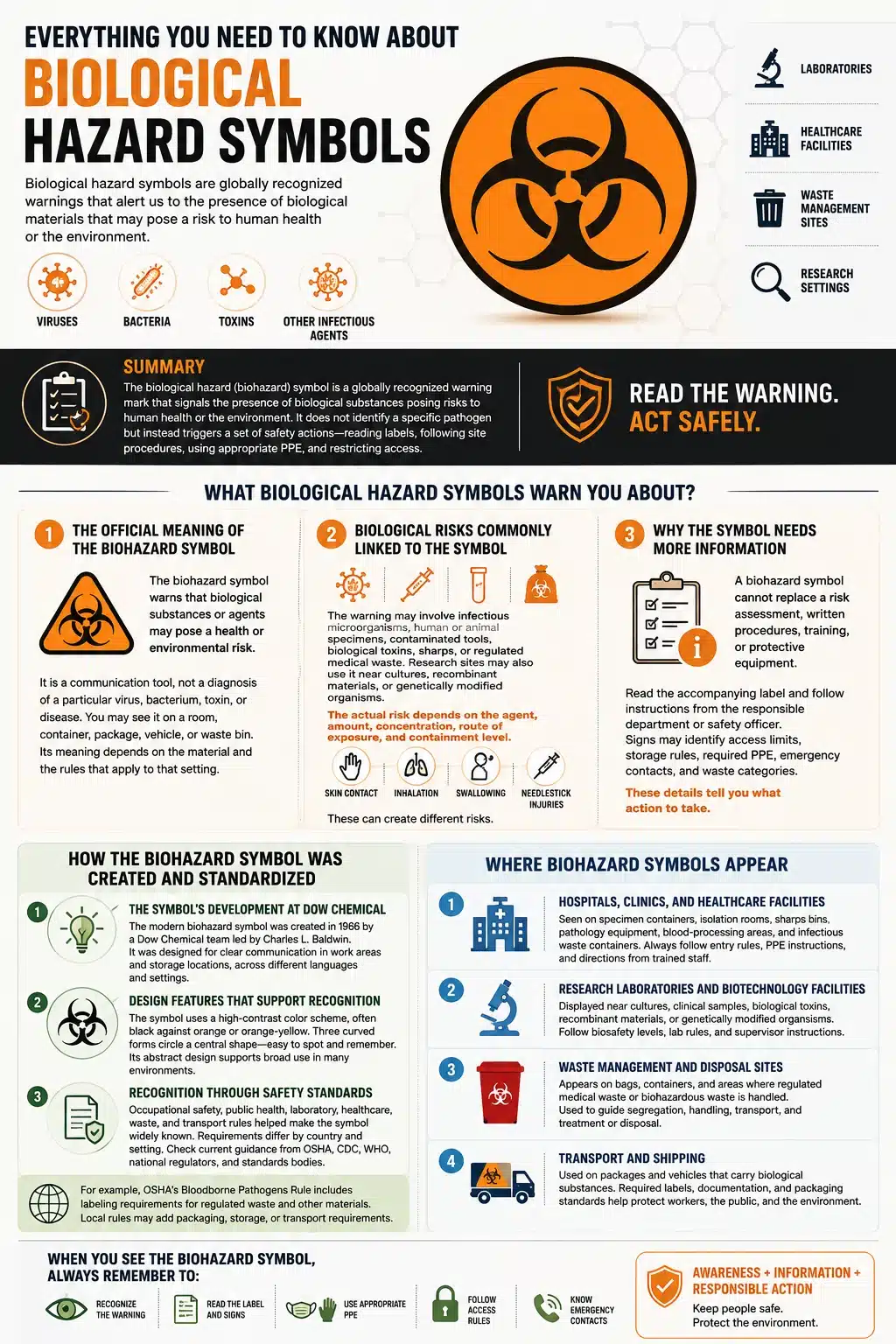
Understanding biological hazard symbols is absolutely critical for anyone working with or around biological materials that are potentially dangerous. These globally recognized pictograms serve as an immediate visual warning, alerting individuals to the presence of biohazards that pose a risk to human health or the environment, including:
- Viruses
- Bacteria
- Toxins, and
- Other infectious agents
These are prominently found in laboratories, healthcare facilities, waste management sites, and research settings. These symbols are indispensable for communicating risks, guiding proper handling and disposal protocols, and ultimately safeguarding workers and the public. Therefore, a comprehensive grasp of what these symbols represent is fundamental to ensuring safety and preventing accidental exposure in a multitude of professional and public contexts.
Summary
The biological hazard (biohazard) symbol is a globally recognized warning mark that signals the presence of biological substances posing risks to human health or the environment. It does not identify a specific pathogen but instead triggers a set of safety actions—reading labels, following site procedures, using appropriate PPE, and restricting access.
Biological hazard symbols: Read the warning and act safely.
The biological hazard symbol can stop you at a laboratory door, a hospital waste bin, or a specimen container. Biological hazard symbols signal possible exposure to agents that may harm people, animals, or the environment. Recognizing the mark matters, but it does not tell you which agent is present or how severe the danger may be. You also need the label, safety procedures, containment details, and emergency instructions.
What biological hazard symbols warn you about?
1. The official meaning of the biohazard symbol
The biohazard symbol warns that biological substances or agents may pose a health or environmental risk. It is a communication tool, not a diagnosis of a particular virus, bacterium, toxin, or disease. A symbol may appear in a room, container, package, vehicle, or waste bin. Its meaning depends on the material and the rules that apply to that setting.
2. Biological risks commonly linked to the symbol
The warning may involve infectious microorganisms, human or animal specimens, contaminated tools, biological toxins, sharps, or regulated medical waste. Research sites may also use it near cultures, recombinant materials, or genetically modified organisms. The actual risk depends on the agent, amount, concentration, route of exposure, and containment level. Skin contact, inhalation, swallowing, and needlestick injuries can create different risks.
3. Why the symbol needs more information
A biohazard symbol cannot replace a risk assessment, written procedures, training, or protective equipment. Read the accompanying label and follow the instructions from the responsible department or safety officer. Signs may also identify access limits, storage rules, required PPE, emergency contacts, and waste categories. These details tell you what action to take.
How the biohazard symbol was created and standardized
1. The symbol's development at Dow Chemical
The modern biohazard symbol was created in 1966 by a Dow Chemical team led by Charles L. Baldwin. The team designed it for clear biological hazard communication in work areas and storage locations. The design needed to work across different languages and settings. A strong visual mark could warn people before they read detailed instructions.
2. Design features that support recognition
The symbol uses a high-contrast color scheme, often black against orange or orange-yellow. Three curved forms circle in a central shape, creating a balanced pattern that is easy to spot and remember. It does not show a germ or a specific organism. Its abstract design supports broad use in laboratories, hospitals, waste facilities, and transport systems.
3. Recognition through safety standards
Occupational safety, public health, laboratory, healthcare, waste, and transport rules helped make the symbol widely known. Requirements differ by country and setting, so organizations should check current guidance from OSHA, CDC, WHO, national regulators, and standards bodies. For example, OSHA's bloodborne pathogens rule includes labeling requirements for regulated waste and other materials. A local rule may add packaging, storage, or transport requirements.
Where biological hazard symbols appear
1. Hospitals, clinics, and healthcare facilities
You may see the mark on specimen containers, isolation rooms, sharps bins, pathology equipment, blood-processing areas, and infectious waste containers. It can also appear near rooms where staff handle potentially infectious materials. The symbol does not mean every person nearby faces the same risk. Follow the room's entry rules, PPE instructions, and directions from trained staff.
2. Research laboratories and biotechnology facilities
Laboratories may display the symbol near cultures, clinical samples, biological toxins, recombinant materials, or genetically modified organisms. Signs often appear with biosafety-level information, access controls, and containment instructions. A restricted door may require authorization and training before entry. Never assume that a familiar lab symbol gives permission to enter or handle materials.
3. Waste collection, transport, and treatment
Regulated medical waste containers, transport packages, temporary storage rooms, autoclave loads, and treatment facilities may carry biohazard labels. Waste must be separated, sealed, labeled, and handled under local rules. Damaged packaging creates a separate hazard. Report it rather than moving it unless your training and written procedures allow that task.
How biological hazards are classified and controlled
1. Risk groups and hazard assessments
Risk groups help classify agents by factors such as disease-causing ability, spread, host range, treatment, prevention, and environmental effects. Terms and group numbers can differ by country or institution. A risk assessment also considers the task. Opening a sealed sample, creating aerosols, handling a sharp object, and transporting waste may require different controls.
2. Biosafety levels and containment practices
The four commonly referenced biosafety levels, BSL-1 through BSL-4, describe increasing containment needs. Each level combines work practices, equipment, facility design, and worker training. A BSL designation is not a symbol and cannot be inferred from the biohazard mark alone. The institution must set the level through formal assessment and approved procedures.
3. The hierarchy of controls
Organizations first consider removing or replacing a hazard where feasible. Engineering controls, such as biological safety cabinets, sealed centrifuge cups, and sharps containers, help prevent exposure at the source. Training, access rules, cleaning procedures, and supervision add administrative controls. Gloves, gowns, eye protection, respirators, and other PPE provide a final barrier, but PPE should not be the only safeguard.
How to read and use biological hazard symbols safely
1. Information beside the symbol
Look for the material name, hazard description, responsible department, date, storage conditions, emergency contact, and waste category. Labels may also state the required PPE and the approved containment method. When information is missing, unclear, or damaged, stop and contact trained personnel. Do not guess based on the symbol alone.
2. Safe behavior around an unfamiliar sign
Stop working and keep your distance. Do not open, smell, touch, move, or inspect an unknown container, spill, package, or discarded item. Keep others away from the area and notify the site safety contact or supervisor. Trained responders should decide whether the material needs isolation, testing, cleanup, or medical follow-up.
3. Choosing personal protective equipment
PPE depends on the task and exposure route. Gloves may protect hands, while gowns, eye protection, face shields, closed footwear, and respiratory protection address other exposure paths. PPE must fit the user and match the material. Workers also need training in putting it on, removing it without contamination, and disposing of or cleaning it safely.
4. Responding to spills and exposures
Stop the task, alert nearby people, and isolate the area. Follow the site's exposure-control or spill-response plan, then report the event and seek medical evaluation when instructed. Only trained personnel should clean a biological spill. They need approved equipment, disinfectants, contact times, and disposal methods for that material.
Biological hazard symbols compared with other warning signs
Biohazard versus chemical hazard symbols
The biohazard symbol signals biological risk. Chemical labels use the Globally Harmonized System pictograms for dangers such as acute toxicity, corrosion, flammability, and serious health effects. A sample can carry both biological and chemical risks. Each hazard needs its own controls, storage rules, PPE, and response plan.
Biohazard versus radiation symbols
Ionizing radiation and radioactive materials use separate radiation warning symbols. They require specialized monitoring, shielding, distance controls, and handling procedures. A laboratory may display both symbols when biological material contains radioactive substances. Read every warning before entering or handling anything.
Why several symbols may appear together
A single area can contain biological, chemical, radiation, sharps, electrical, or compressed-gas hazards. Combined signs give workers and emergency responders a fuller picture of the risks. Follow the written instructions for every symbol. The most familiar warning does not set the complete safety procedure.
Building better biological hazard communication
1. Place signs before exposure can occur.
Put labels at room entrances, containers, equipment, storage points, waste stations, transport packages, and restricted areas. People need the warning before they enter or touch the material.
2. Pair symbols with plain instructions.
A useful sign states the hazard, required PPE, access limits, prohibited actions, emergency contact, and response steps. Symbols support written communication; they do not replace it.
3. Keep labels accurate and visible.
Inspect signs for fading, damage, dirt, missing information, and outdated contacts. Replace labels when room use, materials, waste categories, or procedures change.
4. Train everyone who may encounter the sign.
Training should include laboratory workers, healthcare staff, cleaners, maintenance teams, waste handlers, students, contractors, delivery workers, and emergency responders. Refresher training, competency checks, and written records help keep procedures current.
Conclusion
Biological hazard symbols warn of possible infectious agents, biological toxins, contaminated materials, sharps, and regulated waste. The mark gives you an early warning, but the full label and site procedure explain the real hazard. When you see an unfamiliar biohazard sign, keep your distance, read the available information, and contact trained personnel. Safe handling depends on risk assessment, containment, engineering controls, PPE, training, and prompt reporting of spills or exposures. Treat the symbol as the start of a safety response, not the whole response.
References:
- Labeling requirements for packages used to ship blood or … — https://www.osha.gov/laws-regs/standardinterpretations/2002-09-17
- Biohazard labeling | Occupational Safety and Health Administration—https://www.osha.gov/laws-https://www.osha.gov/laws-regs/standardinterpretations/1992-12-15
- 29 CFR 1910.1030 (Bloodborne Pathogens) — https://www.govinfo.gov/content/pkg/CFR-2015-title29-vol6/pdf/CFR-2015-title29-vol6-sec1910-1030.pdf
- PHMSA Interpretation Response #19-0106 — https://www.phmsa.dot.gov/regulations/title49/interp/19-0106
- Bloodborne pathogen standard's applicability to containers … – OSHA — https://www.osha.gov/laws-regs/standardinterpretations/1992-10-22-3
- Biohazard Labeling Guidelines — https://researchsafety.gwu.edu/biohazard-labeling-guidelines
- A History of the American Biological Safety Association Part II: Safety Conferences 1966-1977—ABSA International—https://absa.org/about/https://absa.org/about/hist02/
- Biological Hazard Warning Symbol — https://digital.sciencehistory.org/works/yashxvf
- The Daily Heller: An Existential Bio Logo—PRINT Magazine—https://www.printmag.com/https://www.printmag.com/daily-heller/biohazard-symbol-history/
- Dow Chemical Historical Collection — https://digital.sciencehistory.org/collections/w95051267
- The Biohazard Symbol (PDF) — https://cws.auburn.edu/shared/content/files/1621/biohazard-history.pdf
- OSHA CFR 29 – Biohazard Cans and Bags — https://www.justrite.com/biohazardcansandbags
- Frequently Asked Questions: Bloodborne Pathogens Standard (Part 8) — https://safetec.com/blog/osha/frequently-asked-questions-bloodborne-pathogens-standard-part-8/
- Biohazard Labeling Requirements — OSHA, DOT & Color-Coding Guide — https://medwastesolution.com/compliance-resource-center/biohazard-labeling-requirements/

Simplify Your SDS Management
CloudSDS gives your team instant access to 23M+ safety data sheets with AI-powered search, automated updates, and full OSHA/GHS compliance — all from one platform.
Leave A Comment