
Last Updated on September 7, 2026
EPA Aligns EPCRA Tier II Hazard Categories With the 2024 OSHA HazCom Update: What Changes and When?
EPA has finalized this EPA Tier II hazard category alignment rule to conform EPCRA Tier II hazard categories to the 2024 OSHA HazCom update, which itself moved U.S. chemical classification onto GHS Revision 7. The final rule published June 22, 2026, is effective August 21, 2026, and carries a compliance date of January 1, 2028—meaning the change first shows up in the 2027 reporting-year Tier II form, due March 1, 2028. Your 2026 Tier II report, due March 1, 2027, is unaffected.
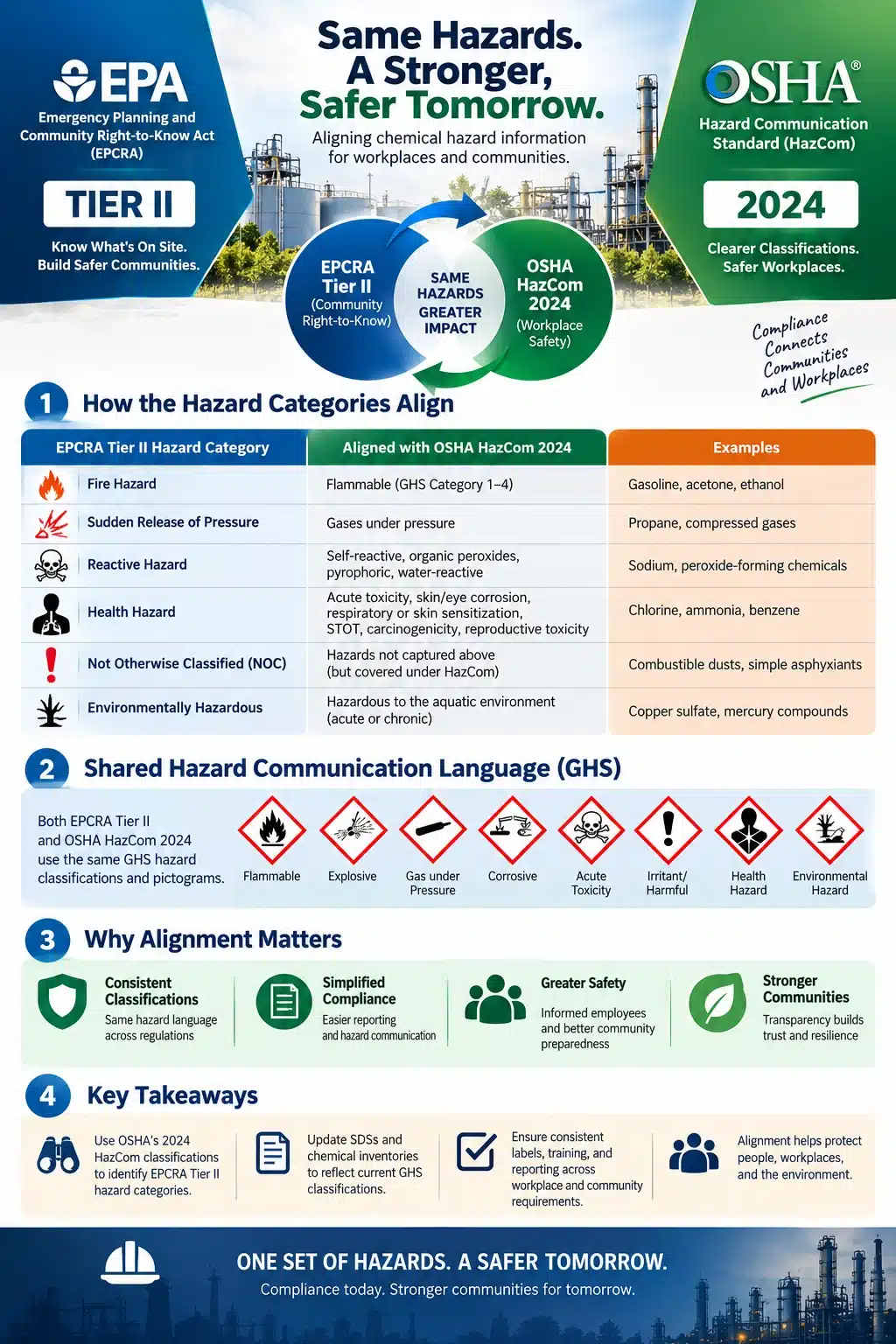
Practically, this means facilities will stop re-bucketing chemicals into EPCRA's roughly two dozen broad hazard groupings and will instead report the specific OSHA hazard category straight off the Safety Data Sheet—the same category already sitting in Section 2 of the SDS.
Why have EPCRA Tier II and OSHA HazCom drifted out of sync?
The 2012 baseline and EPA’s 2016 category rule
Tier II hazard categories aren’t EPA’s own invention—EPCRA’s statute requires that hazardous chemical inventory reporting be grouped using the same health and physical hazard categories OSHA sets under the Hazard Communication Standard. When OSHA overhauled HazCom in 2012 to adopt the UN’s Globally Harmonized System (GHS Revision 3), EPA followed with its own conforming rule in 2016. That 2016 rule swapped out a handful of legacy EPCRA groupings (dating to 1987) for hazard classes drawn from the 2012 OSHA definitions, and it’s the reason the Tier II form has used roughly 24 consolidated hazard categories ever since—categories like “Flammable (gases, aerosols, liquids, or solids)” that quietly absorb several distinct OSHA classes underneath a single label.
The 2024 OSHA update reopened the gap.
In May 2024, OSHA revised HazCom again, this time aligning primarily with GHS Revision 7. The update added an entirely new hazard class (Desensitized Explosives) plus several new categories, restructured how flammable aerosols and pressurized products are classified, split flammable gases into finer categories, and removed pyrophoric gases from the standard’s definition of a hazardous chemical altogether. SDSs started reflecting these changes well before Tier II did—until this rule, EPCRA’s ~24 categories simply hadn’t caught up.
OSHA’s Final Rule to Amend the Hazard Communication Standard (2024, GHS Rev 7): https://www.osha.gov/hazcom/rulemaking
| Milestone | What happened? |
| 2012 HCS (GHS Rev. 3) | OSHA adopts GHS-based hazard classification and the 16-section SDS. |
| 2016 EPA conforming rule | EPA builds the ~24 EPCRA Tier II hazard categories on the 2012 OSHA framework. |
| 2024 OSHA HazCom (GHS Rev. 7) | New hazard classes and categories created a gap between SDS content and the Tier II form—the gap this new rule closes |
- EPA’s EPCRA hazardous chemical inventory reporting page (the umbrella source for the 2016 conforming rule): https://www.epa.gov/epcra/epcra-hazardous-chemical-inventory-reporting-revisions-hazard-categories-and-reporting
- OSHA’s 2012 HazCom final rule / GHS Rev 3 background: https://www.osha.gov/hazcom/rulemaking
What's actually changing in the Tier II form?
From ~24 consolidated categories to SDS-matched reporting
Right now, a facility filling out Tier II has to translate the specific OSHA hazard classification sitting in Section 2 of a chemical's SDS into one of EPCRA's broader, older groupings — a manual interpretation step that introduces room for error and inconsistency between facilities, states, and even different preparers at the same facility. Once the new rule takes effect, that translation step disappears. EPA is having EPCRA directly adopt OSHA's hazard classes and their full set of categories (118 in total) instead of using its own abbreviated groupings, so the category printed on the SDS is the category that goes on the Tier II form.
The table below shows the shift for a sample of hazard groupings that are splitting into new Tier II reporting categories that match the SDS one-for-one.
| Old EPCRA Category | New OSHA-Aligned Categories It Used to Absorb | Example Chemical |
| Flammable (gases, aerosols, liquids, or solids) | Flammable Gas 1A/1B, Aerosol Categories 1–3, Flammable Liquid Categories 1–4, Flammable Solid Categories 1–2 | Propane, aerosol degreaser, acetone, sulfur |
| Explosive | Explosive Divisions 1.1–1.6, plus the new Desensitized Explosive Categories 1–4 | Desensitized nitrocellulose |
| Gas under pressure | Compressed, liquefied, and dissolved gas, plus the new chemical under pressure categories 1–3 | CO₂ cylinders, pressurized cleaning solvents |
| Acute toxicity (any route of exposure) | Acute Toxicity – Oral, Acute Toxicity – Dermal, Acute Toxicity – Inhalation (each with its own category tiers) | Concentrated cleaning acid (oral), industrial solvent (inhalation) |
| Oxidizer (liquid, solid, or gas) | Oxidizing Liquid, Oxidizing Solid, and Oxidizing Gas, each with distinct category numbers | Hydrogen peroxide (liquid), potassium permanganate (solid) |
Why this matters operationally
The upside EPA is pointing to is less interpretive burden: facilities copy the hazard category straight from the SDS rather than deciding which broad EPCRA bucket it belongs in. That should mean fewer mismatches between what a facility's SDS says and what its Tier II report says—the kind of inconsistency state regulators and LEPCs have historically flagged during reviews. For first responders, more granular categories also mean more specific hazard information tied to a chemical on-site, rather than a catch-all label that could mean several very different things.
The hazard classes EHS teams need to re-map.
1. Desensitized explosives (New Class)
Reporting desensitized explosives on Tier II is genuinely new territory, not a relabeling exercise. Desensitized explosives are explosive substances that have been wetted, diluted, or dissolved to suppress their explosive properties enough for safe handling, storage, and transport. The 2024 OSHA HazCom update created four categories for this class, distinguished largely by burning rate and other performance criteria, and gave them a flame pictogram in place of the exploding-bomb symbol traditionally associated with explosives. If your facility handles desensitized nitrocellulose or similar materials, this is a category that simply didn’t exist on prior Tier II forms—you’ll need to identify it on the SDS and report it as its own line item going forward.
2. Aerosols—new non-flammable category 3
Under the older scheme, aerosols were essentially binary for reporting purposes: flammable aerosol or not separately classified. The 2024 update splits aerosols into a three-category system, with two flammable tiers and a distinct non-flammable Category 3 for products like non-refillable fire extinguishers. Facilities that store what they’ve historically thought of as “non-hazardous” aerosol products—because they weren’t flammable—may find those products now carry a specific, newly reportable hazard category. Worth an inventory check even if you assumed your aerosol products were exempt from special handling.
3. Chemicals under pressure (New Hazard Class, ≥200 kPa)
Chemicals Under Pressure is a new hazard class covering non-flammable substances or mixtures packaged under gauge pressure of 200 kPa or more at 20°C, divided into three subcategories—and reporting Chemicals Under Pressure on Tier II is one of the more common questions EHS teams raise about this rule. We’ve covered the classification criteria and category breakdown for this hazard class in detail in a separate CloudSDS article—worth a read if your facility handles pressurized non-flammable products, since the sub-category distinctions matter for correct SDS classification.
4. Flammable gases split into 1A and 1B
Flammable gases previously reported as a single group are now divided into Category 1A and Category 1B. The practical distinction: Category 1A now explicitly captures pyrophoric and chemically unstable gases—gases that ignite spontaneously in air or that can react explosively even without air, oxygen, or an ignition source—alongside conventional flammable gases. Category 1B covers flammable gases that don’t meet those more severe criteria. For Tier II purposes, this means a gas your facility previously reported under one flammable-gas line item may now need to be reported under a specific subcategory depending on its ignition behavior.
5. Pyrophoric gases removed from the general hazardous-chemical definition
This is the most likely change to generate genuine confusion, and it’s worth reading carefully. The 2024 OSHA HazCom update removed pyrophoric gases from the standard’s overall definition of a hazardous chemical—even though, functionally, chemically unstable and pyrophoric gases are now folded into the Flammable Gas 1A category described above. For Tier II threshold-reporting purposes, this matters because a substance’s status as a “hazardous chemical” under the OSHA definition is the gate that determines whether it’s reportable at all. A pyrophoric gas that also meets Flammable Gas 1A criteria is still reportable through that classification, but the removal from the general definition is a technical change EHS teams should specifically verify against their own SDS library rather than assume nothing changed just because the substance still “sounds hazardous.” When in doubt, check how the current SDS classifies the specific gas rather than relying on how it was categorized in previous years.
How to prepare your tier II reporting process?
-
Inventory your SDS library against the five hazard-class changes above.
Flag every SDS that references "desensitized explosives," "non-flammable aerosol category 3," "chemicals under pressure," "flammable gas 1A/1B," or "pyrophoric gas"—these are the chemicals most likely to need a different category on your next affected Tier II report.
-
Confirm the compliance date applies to your facility.
Per EPA's final rule, the new categories apply to hazardous chemical inventory reports covering reporting year 2027, due by March 1, 2028. State-specific Tier II systems may vary—see the section below.
-
Note explicitly: no changes are required for your current reporting cycle.
Your 2026 Tier II report, filed by March 1, 2027, uses the existing hazard categories. Don't jump the compliance date.
-
Build an internal SDS-to-Tier-II mapping sheet now, ahead of the 2028 filing deadline.
Rather than scrambling to reclassify your entire chemical inventory at filing time.
-
Cross-check your state's Tier II portal requirements.
Since some states run their own systems independent of the federal timeline. If your team is using CloudSDS, hazard-class search and classification tools surface the updated OSHA categories directly from stored SDSs, which can shortcut the manual mapping work in step 4.
State Tier II systems may lag the federal timeline.
EPA’s compliance date governs the federal EPCRA requirement, but Tier II reports are actually filed with state and local recipients—the SERC, LEPC, and local fire department with jurisdiction over your facility—and some states operate their own SERC/LEPC reporting portals with independent update schedules. That means a state system could continue accepting (or even requiring) the older hazard categories for a period after the federal compliance date or could adopt the new categories on its own timeline. If you file in Alabama or California, for example, check our existing state-specific Tier II guides for those jurisdictions, and don’t assume your state portal will be updated the moment the federal compliance date arrives—confirm directly with your SERC.
EPA’s State Tier II Reporting Requirements and Procedures page: https://www.epa.gov/epcra/state-tier-ii-reporting-requirements-and-procedures
Frequently asked questions
Do I need to resubmit past Tier II reports under the new categories?
No. The new hazard categories apply prospectively, starting with reporting year 2027 (due March 1, 2028). Reports already filed under the prior category scheme don't need to be amended or resubmitted because of this rule.
Does this change SDS content itself, or only the Tier II form?
Only the Tier II (and Tier I/EPCRA Section 311 SDS-list) reporting requirements are changing here. SDS content itself is governed by OSHA's HazCom standard, and manufacturers have already been updating SDSs to reflect the 2024 HazCom categories independent of this EPA action. This rule simply brings EPCRA reporting into alignment with what's already on the SDS.
What happens if I keep using the old hazard categories after the compliance date?
Reports filed after the January 1, 2028 compliance date should use the new OSHA-aligned categories. As with any EPCRA Tier II filing, accuracy matters for enforcement purposes, so facilities should plan to transition their internal processes before the first affected filing deadline rather than after.
Does this apply to every EPCRA-covered facility, or only those above certain thresholds?
It applies to any facility already subject to EPCRA Sections 311 and 312 reporting—meaning any facility required to maintain an SDS for a hazardous chemical present above the applicable threshold quantity. The rule doesn't change who has to report; it changes the categories used once you're reporting.
Where can I find EPA's official new category list?
EPA's EPCRA hazardous chemical inventory reporting page hosts the finalized hazard category list and the updated Tier II form. That's the authoritative source to check your mapping against, rather than relying solely on secondary summaries.
Conclusion
EPA has finalized a rule realigning EPCRA Tier II hazard categories with OSHA's 2024 HazCom update, effective August 21, 2026, with a compliance date of January 1, 2028, for reporting year 2027 filings. Nothing changes for the report you're filing this coming March. The one thing to start now: pull your SDS library and flag every chemical touched by the five hazard-class changes covered above, so your mapping work is done well before the 2028 deadline instead of at filing time.

Automate Your Tier II Reports
CloudSDS auto-generates Tier II and EPCRA reports from your chemical inventory — no spreadsheets, no missed deadlines.
Leave A Comment