

Last Updated on September 18, 2026
Quick answer
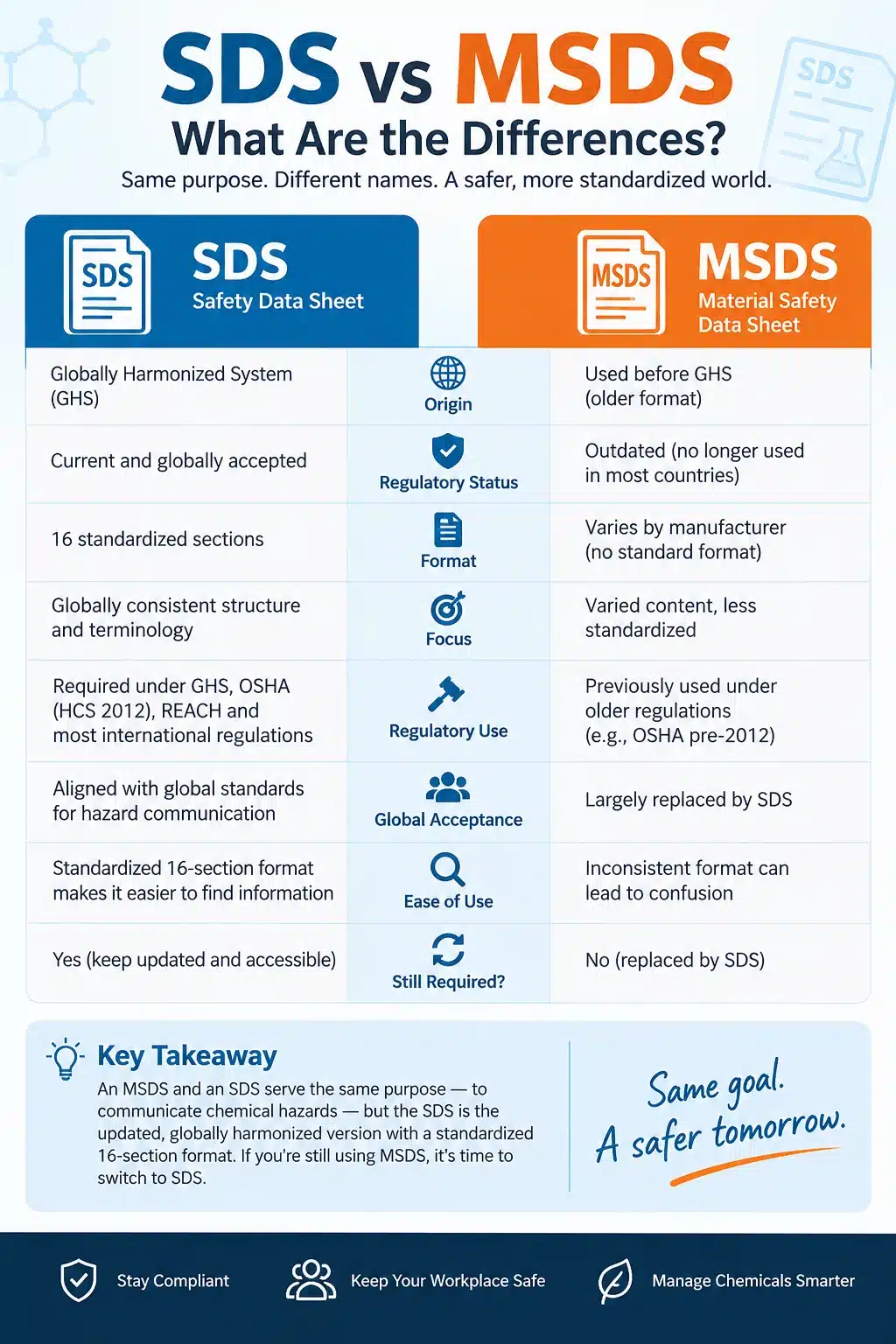
SDS and MSDS are both safety papers for chemicals. MSDS is the old name. SDS is the new name. SDS has a fixed format with 16 sections. MSDS did not have one fixed format. Every company wrote it in a different way. Now, SDS has replaced MSDS almost everywhere.
Blog summary
When beginning the chemical safety management process, you will frequently encounter two terms: “SDS” and “MSDS.” They are, of course, synonymous and essential for guaranteeing worker safety. They are distinct from one another, though, and each facility must thoroughly understand them to ensure compliance and disclose any chemical hazards.
Material safety data sheets, or MSDS, are essential records of any harmful chemical. It offers detailed alert information, most of which is found on labels. Moreover, it helps an organization and its staff understand a hazardous product. These days, these documents are referred to as SDSs or safety data sheets. The documents’ original intent has not been altered, of course. However, they differ; read the blog further to learn why and how.
MSDS and Its History in Brief
OSHA adopted the MSDS in the middle of the 1980s as an element of its Hazard Communication Standards’ Right to Know provision. According to those provisions, employees have a right to know about the chemicals to which they may be exposed while working. Therefore, employers must maintain an MSDS for every hazardous chemical to conduct proper hazard communication.
An MSDS provides a user with more thorough information about a hazardous product. Remember that a dangerous product has been marked as a controlled product on an MSDS. This document offers information on the health impacts of product exposure, hazard assessment details, worker protection measures, and emergency protocols.
Manufacturers must adhere to the standards of the Workplace Hazardous Materials Information System (WHMIS) regulation while creating an MSDS. As a result, to construct an MSDS, flexibility in design and phrasing is essential for every section. A minimum number of categories containing complete information is also a vital part of it.
The term MSDS was replaced with SDS in 2012, signaling a change in the chemical safety management process. This shift must be understood to properly comprehend SDS vs. MSDS. So, continue exploring more.
The Transition from MSDS to SDS
OSHA adopted the MSDS in the middle of the 1980s as an element of its Hazard Communication Standards’ Right to Know provision. According to those provisions, employees have a right to know about the chemicals to which they may be exposed while working. Therefore, employers must maintain an MSDS for every hazardous chemical to conduct proper hazard communication.
An MSDS provides a user with more thorough information about a hazardous product. Remember that a dangerous product has been marked as a controlled product on an MSDS. This document offers information on the health impacts of product exposure, hazard assessment details, worker protection measures, and emergency protocols.
Manufacturers must adhere to the standards of the Workplace Hazardous Materials Information System (WHMIS) regulation while creating an MSDS. As a result, to construct an MSDS, flexibility in design and phrasing is essential for every section. A minimum number of categories containing complete information is also a vital part of it.
In 2012, the term MSDS was replaced with SDS, signaling a change in the chemical safety management process. This shift must be understood in order to comprehend SDS vs. MSDS properly. So, continue exploring more. (Source link: https://www.osha.gov/laws-regs/standardinterpretations/2014-06-13)
What is the GHS?
GHS stands for the Globally Harmonized System of Classification and Labelling of Chemicals. It is a system developed by the UN that has been accepted globally. Its goal is to harmonize the chemical classification and labeling processes. By offering a globally uniform method for classifying chemicals and their dangers and communicating these hazards through labels and safety data sheets (SDS), it seeks to improve the protection of human health and the environment. However, GHS is a system and not a regulation.
GHS aims to:
- Unify chemical hazard communication elements and hazard classification criteria globally.
- Protect the environment and human health by providing safety information most comprehensively.
- Simplify regulations by adopting a standard to increase worker safety when handling dangerous substances.
SDS vs. MSDS: What are the differences?
In easy words, the only system to provide hazard information about toxic products or substances was MSDS. Its updated form, known as SDS, is more user-friendly. An MSDS and an SDS differ due to their structure and number of sections. There are numerous ways to emphasize how they differ, some of which we have listed below. So, to fully comprehend SDS vs. MSDS, keep reading.
1) Worldwide adherence
The discussion of SDS vs. MSDS will begin if we highlight its global adherence. When OSHA mandated the creation of MSDS, it did not create any standard format for the document. As a result, facilities merely needed to produce a document that contained information about the safety and hazards associated with dangerous products. On the other hand, every SDS complies with the GHS standard set by the United Nations. Because of this, all safety data sheets are divided into 16 rigid sections, each formatted according to a predetermined pattern.
2) Change in structure and format
When developing MSDSs, chemical manufacturers were not required to adhere to any particular format or structure. Hence, MSDSs with eight to sixteen parts were available with hazardous products. However, each SDS must prepare 16 sections; this is what primarily sets it apart from an MSDS.
3) Signal words
Users previously did not receive signal words along with the MSDS. Signal words are generally mentioned on toxic substance labels to indicate the hazard’s severity. Nowadays, SDSs have these kinds of helpful words. For example, users frequently see the terms “danger” and “warning” when searching SDSs for safety information. “Danger” conveys the seriousness of the hazard, while “warning” indicates less severe hazards.
4) Classification of hazards
OSHA rules have become stricter in terms of conveying hazard information. Because of this, the safety documentation must include comprehensive information about hazards. Because of this, the SDSs convey dangers in a more precise manner than that of the MSDS.
By going through the SDSs, the users get information on
a. Health hazards:
It shows how using the product could harm people’s health by causing respiratory troubles and other health issues.
b. Physical hazards:
It conveys how a product’s physical and chemical properties can be hazardous. Thus, users can find details on the product’s reactivity, stability, and flammability information.
c. Environmental hazards:
MSDS documents did not require a dedicated section for environmental hazards, leaving gaps in environmental risk assessment and disposal guidance.
SDS documents must include Section 12: Ecological Information. This section provides comprehensive environmental impact data. This section covers ecotoxicity, persistence and degradability, bioaccumulative potential, mobility in soil, and results of PBT (Persistent, Bioaccumulative, and Toxic) assessments. This addition reflects growing environmental awareness and regulatory requirements for proper chemical disposal and environmental protection.
5) Labelling updates:
With the MSDS, users did not get any requirement for the mandated specific labelling. However, each SDS manufacturer shares specific labeling instructions that should be followed with each document. While preparing a label, the following points should be kept in mind:
A hazard statement is crucial and a must with every hazard category.
Including a pictogram is a must to convey the hazard more effectively.
The label should also contain signal words.
6) The GHS pictogram system
MSDS documents lacked a standardized pictogram system, and chemical classification and labeling varied significantly between manufacturers, often leading to confusion among workers trying to understand chemical hazards quickly.
SDS documents, by contrast, feature standardized GHS pictograms: diamond-shaped symbols with red borders, containing black hazard symbols on white backgrounds. The GHS system includes 9 specific pictograms representing physical, health, and environmental hazards. These visual elements make hazard identification faster and more intuitive, particularly for workers with varying literacy levels or those in multilingual environments.
7) Classification of chemicals and labeling
With the MSDS, organizations did not have to adhere to any specific labeling pattern, which used to lead to inconsistency and confusion. However, the chemical classification and labelling process is more specific to the present-day SDS. It follows the GHS system, so it provides more details on the chemicals and their hazards and describes their elements to explain hazards thoroughly.
Role of SDS management software: how conveying hazards with SDSs has become more convenient
In the discussion of SDS vs. MSDS, we must highlight the role of SDS management software. By now it’s clear that an SDS conveniently provides more hazard information. After all, it comes with a more detailed structure that highlights hazards and provides advanced safety tips ideal for safeguarding workers. This process of chemical safety management has become more convenient with the help of SDS management software.
The following points will explain in detail how hazard communication has become easier with the help of SDS management software. So, continue exploring.
-
Centralized data management:
This software serves as a centralized repository for all safety data sheets. It allows easy access and retrieval of critical information across various locations and departments within an organization. Moreover, getting safety information whenever necessary is now possible due to this software.
-
Streamlined compliance:
Agencies need to prepare and share the 16-section format SDSs to ensure that they emphasize worker safety and conduct proper hazard communication. This software helps share the document with each employee by giving them easy access to the tool. Moreover, a single change is sent as a notification, which keeps everyone in the organization informed about the recently added hazards. Thus, staying compliant at each stage of hazard communication and SDS management is not difficult.
-
Proper hazard communication:
To ensure appropriate hazard communication, organizations need to provide an SDS instead of MSDSs these days. Ultimately, it offers separate sections to communicate the risks linked to a certain product. It provides information on every potentially dangerous ingredient found in a product. Moreover, it is also not at all difficult to understand its potential negative environmental repercussions. Using SDS management software, an organization can speed up the process and improve accuracy.
-
Improved accessibility:
Getting access to a specific document at any time is not difficult if one uses this software. Using these, employees only need a smart device to access safety data sheets anytime, anywhere. This accessibility improves responsiveness during emergencies. It also promotes safe handling practices in various work environments.
-
Proper mitigation of risks:
Faster identification of hazards is necessary to protect all workers, and an SDS helps with that. However, the process can be simplified if a facility chooses to use this software. It helps with regular audits based on the updated record, and thus quick identification of chemical hazards is possible. An SDS management software supports proactive risk assessment and mitigation strategies. With these organizations, implement appropriate controls, training programs, and emergency response plans to minimize risks to human health and the environment.
Conclusion:
It is not at all difficult to understand SDS vs. MSDS if one concentrates on its structure. Yes, the primary distinction between them is in the way they are designed and how hazards are categorized. SDSs are essential for chemical manufacturing companies above everything else for compliance and worker safety. To manage SDS properly and create a safer workplace, it’s also critical to use reputable SDS management software.
FAQs
1. What does SDS mean?
SDS means Safety Data Sheet. It tells you about a chemical’s dangers and how to use it safely. It also tells you what to do if there is a spill or an accident. Every workplace that uses chemicals needs these sheets on hand.
2. What does MSDS mean?
MSDS means Material Safety Data Sheet. It’s the old name for the same kind of paper. It served the same purpose as today’s SDS. Many older facilities may still have these papers in their files.
3. What is the main difference between SDS and MSDS?
SDS has a fixed 16-section format. MSDS did not have a fixed format. Each company wrote it in its own way. Naturally, an MSDS used to be harder to compare and understand.
4. Why did MSDS change to SDS?
The name changed when new rules called GHS came out. GHS made safety sheets more standard around the world. As a result, it became simpler for workers to understand chemical safety no matter where they worked. It also made it easier for companies to follow the same rules globally.
5. Can we still use old MSDS papers today?
Most places now use SDS. Some old MSDS papers may still exist. But they should be updated to SDS. Keeping old MSDS papers around can lead to confusion or outdated safety steps.
6. Is the safety information different in SDS and MSDS?
The safety information is almost the same. But SDS is more organized and easier to read. It also follows world safety rules. This makes it simpler for workers to find what they need quickly.
7. Do workplaces need to change old MSDS files to SDS?
Yes. Workplaces should replace old MSDS files with new SDS sheets. This keeps everything correct and follows today’s rules. It also helps during safety audits or inspections. Staying updated protects both the workplace and its workers.
FAQs
-
What does SDS mean?
SDS means Safety Data Sheet. It tells you about a chemical's dangers and how to use it safely. It also tells you what to do if there is a spill or an accident. Every workplace that uses chemicals needs these sheets on hand.
-
What does MSDS mean?
MSDS means Material Safety Data Sheet. It's the old name for the same kind of paper. It served the same purpose as today's SDS. Many older facilities may still have these papers in their files.
-
What is the main difference between SDS and MSDS?
SDS has a fixed 16-section format. MSDS did not have a fixed format. Each company wrote it in its own way. Naturally, an MSDS used to be harder to compare and understand.
-
Why did MSDS change to SDS?
The name changed when new rules called GHS came out. GHS made safety sheets more standard around the world. As a result, it became simpler for workers to understand chemical safety no matter where they worked. It also made it easier for companies to follow the same rules globally.
-
Can we still use old MSDS papers today?
Most places now use SDS. Some old MSDS papers may still exist. But they should be updated to SDS. Keeping old MSDS papers around can lead to confusion or outdated safety steps.
-
Is the safety information different in SDS and MSDS?
The safety information is almost the same. But SDS is more organized and easier to read. It also follows world safety rules. This makes it simpler for workers to find what they need quickly.
-
Do workplaces need to change old MSDS files to SDS?
Yes. Workplaces should replace old MSDS files with new SDS sheets. This keeps everything correct and follows today's rules. It also helps during safety audits or inspections. Staying updated protects both the workplace and its workers.

Simplify Your SDS Management
CloudSDS gives your team instant access to 23M+ safety data sheets with AI-powered search, automated updates, and full OSHA/GHS compliance — all from one platform.
Leave A Comment