

Last Updated on September 8, 2026
Diethyl Ether Safety Guide: Properties, Hazards, Storage, and Handling
Introduction
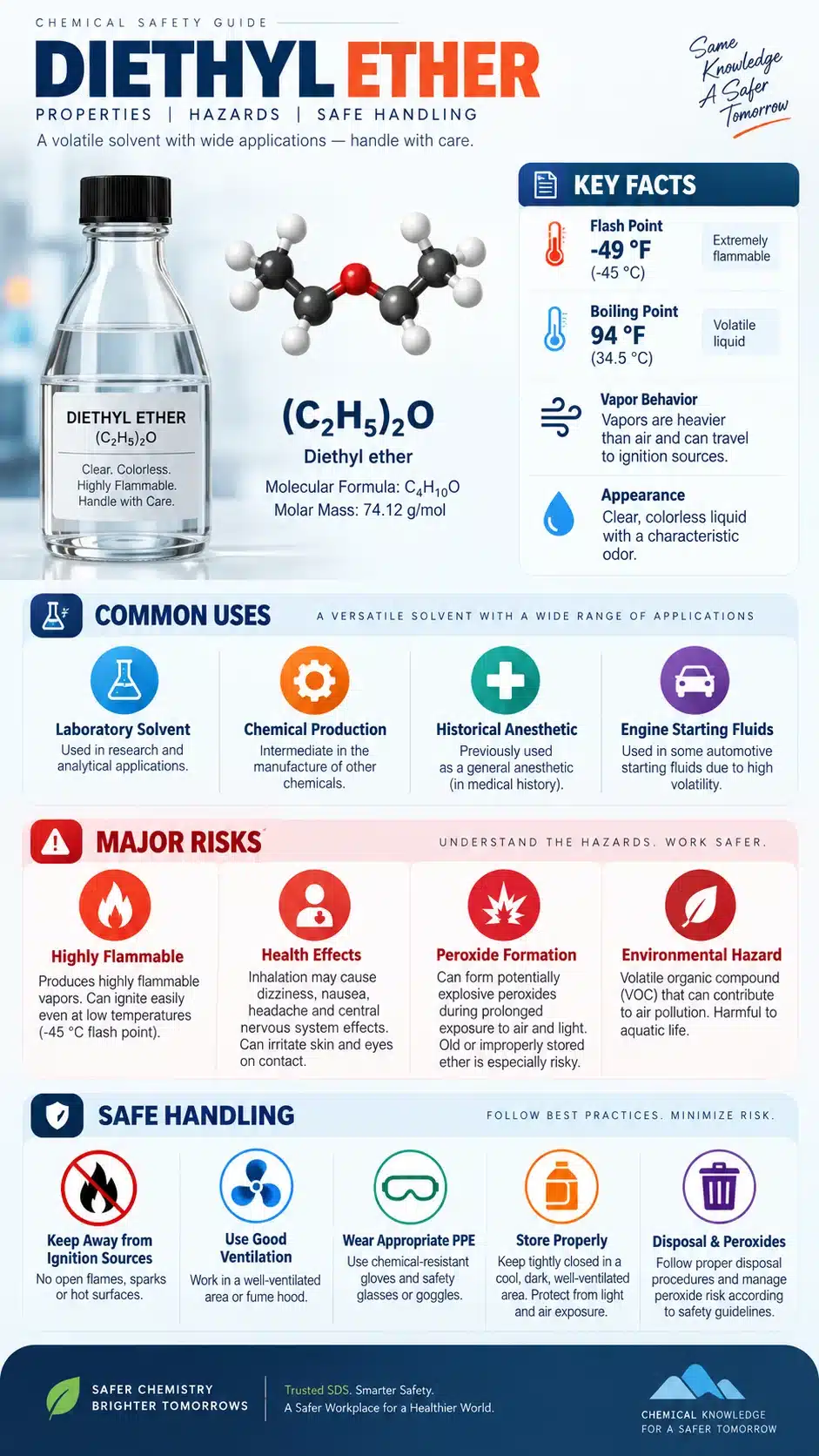
Diethyl ether (also called ethyl ether or simply “ether”) is a colorless, highly volatile organic solvent with the formula C₄H₁₀O and CAS number 60-29-7. Its two defining hazards are extreme flammability—it has a flash point of roughly −45°C and an autoignition temperature near 160°C—and its tendency to slowly react with atmospheric oxygen to form shock-sensitive, potentially explosive peroxides during storage. Safe handling means keeping the liquid and its heavier-than-air vapor away from every possible ignition source, using proper grounding and ventilation, storing it correctly in a cool, dark, tightly sealed container, and following a documented peroxide-testing and disposal schedule rather than trusting the container’s age or appearance alone.
1. Identity & physical properties
1. What Is Diethyl Ether?
Diethyl ether is known by several interchangeable names: diethyl ether, ethyl ether, ethoxyethane, and — informally — simply “ether.” It carries CAS Registry Number 60-29-7 and EC number 200-467-2, and its molecular formula is C₄H₁₀O (structure CH₃CH₂-O-CH₂CH₃), giving it a molar mass of about 74.12 g/mol. Chemically, it belongs to the ether family of organic compounds, characterized by an oxygen atom bonded between two carbon-containing groups.
At room temperature it is a clear, colorless, highly mobile liquid with a sweet, pungent, characteristically “ethereal” odor. The odor is detectable at very low concentrations—commonly cited around 0.3–0.8 ppm—which gives it reasonably good warning properties for accidental exposure, though this should never be relied on as a substitute for engineering controls.
1.2 Diethyl ether physical and chemical properties
| Property | Information |
| Molecular formula | C₄H₁₀O |
| CAS number | 60-29-7 |
| Molecular weight | 74.12 g/mol |
| Appearance | Clear, colorless liquid |
| Odor | Sweet, pungent, ethereal |
| Boiling point | 34.6 °C (94.3 °F) |
| Melting point | −116.3 °C (−177.3 °F) |
| Flash point | −45 °C (−49 °F), closed cup |
| Autoignition temperature | 160 °C (320 °F) |
| Vapor density | ~2.6 (air = 1) |
| Vapor pressure | ~440–442 mmHg at 20 °C |
| Water solubility | ~6–8 g/100 mL |
| Specific gravity | 0.713–0.714 (water = 1) |
| Lower/Upper explosive limit | ~1.9%–36% by volume in air |
Two figures on this table explain why diethyl ether behaves so differently from most common solvents. The flash point sits nearly 50 degrees below typical room temperature, meaning the liquid gives off flammable vapor essentially all the time it is open to air. The vapor density of roughly 2.6 means that vapor released at bench height will sink and can travel along a floor or bench to a distant ignition source — a spark from an outlet, a hot plate, or even static discharge — before flashing back to the original container.
1.3 Does diethyl ether occur naturally?
Trace, naturally occurring diethyl ether has been reported in a small number of plant sources, including Malabar spinach (Basella alba) and feijoa fruit (Acca sellowiana). This is a minor botanical curiosity rather than a commercially or industrially relevant source — essentially all diethyl ether in circulation is produced synthetically, typically via acid-catalyzed dehydration of ethanol.
2. Diethylether hazard classification
2.1 GHS classification
Under the Globally Harmonized System (GHS), diethyl ether is classified as an extremely flammable liquid and vapor (Flammable Liquid, Category 1), and it also carries classifications for acute toxicity (Category 5, oral, in some jurisdictions) and specific target organ toxicity–single exposure (narcotic effects, Category 3). The signal word assigned is Danger.
The pictograms typically applied are the flame symbol (GHS02, flammable) and the exclamation mark (GHS07, indicating irritation and narcotic/CNS effects). In practice, this classification means diethyl ether must be labeled, stored, and handled under an organization’s most stringent flammable-liquid controls: dedicated flammable storage, elimination of ignition sources in the work area, and staff training on both the fire hazard and the anesthetic/CNS effects of vapor exposure.
2.2 NFPA 704 rating
The NFPA 704 "fire diamond" for diethyl ether is commonly cited as:
| Category | Rating | Meaning |
| Health (blue) | 2 | Can cause temporary incapacitation or residual injury with intense or continued exposure |
| Flammability (red) | 4 | Vaporizes readily at normal temperature and pressure and burns readily |
| Instability/Reactivity (yellow) | 1 | Normally stable, but can become unstable at elevated temperature and pressure (peroxide formation is addressed separately as a storage hazard, not captured by this single digit). |
A flammability rating of 4 is the maximum on the NFPA scale and places diethyl ether in the same tier of fire risk as gasoline and propane.
2.3 Hazard statements and precautionary statements
Based on current SDS and GHS classification data, diethyl ether is typically assigned the following statements:
Hazard (H) statements:
- H224 — Extremely flammable liquid and vapor
- H302 — Harmful if swallowed
- H336 — May cause drowsiness or dizziness
Selected precautionary (P) statements:
- P210: Keep away from heat, hot surfaces, sparks, open flames, and other ignition sources; no smoking
- P233: Keep container tightly closed
- P240/P241/P242/P243: Ground and bond container and receiving equipment; use explosion-proof electrical, ventilating, and lighting equipment; take precautionary measures against static discharge
- P261/P264: Avoid breathing vapor; wash exposed skin thoroughly after handling
- P271: Use only outdoors or in a well-ventilated area
- P280: Wear protective gloves and eye/face protection
- P303+P361+P353, P304+P340 — Response measures for skin contact and inhalation
- P403+P233, P403+P235: Store in a well-ventilated place; keep container tightly closed and cool
- P501: Dispose of contents/container in accordance with local, regional, and national regulations
These statements should always be cross-checked against the current, product-specific Safety Data Sheet from the manufacturer, since exact statement sets vary slightly by supplier, grade, and stabilizer content.
3. Diethyl ether health hazards & exposure limits
3.1 Occupational exposure limits
| Organization | Limit type | Value | Notes |
| OSHA | PEL (8-hr TWA) | 400 ppm (~1,200 mg/m³) | Legally enforceable U.S. limit under 29 CFR 1910.1000, Table Z-1 |
| ACGIH | TLV-TWA | 400 ppm (~1,210 mg/m³) | Recommended, non-enforceable guideline |
| ACGIH | STEL | 500 ppm (~1,520 mg/m³) | 15-minute short-term exposure limit |
| NIOSH | REL / IDLH | 400 ppm TWA; IDLH 1,900 ppm | The IDLH value is set based on the lower explosive limit rather than acute toxicity alone. |
Because most OSHA PELs (including this one) were adopted in the early 1970s and have not been substantively updated since, many industrial hygiene programs design controls to the lower, more current ACGIH TLV rather than relying on the OSHA PEL as the sole target. Always verify current values against the specific SDS and applicable regulatory table, since exposure limits are periodically revised.
3.2 Acute health effects
Inhalation: Vapor is irritating to the respiratory tract and, at increasing concentrations, produces headache, dizziness, nausea, and central nervous system depression. Because the odor threshold is low and vapor density is high, meaningful vapor accumulation can occur in poorly ventilated or low-lying spaces before it becomes obvious.
Skin contact: Direct contact causes irritation; because ether is an effective degreasing solvent, repeated or prolonged contact tends to dry and crack the skin by stripping natural oils. It is not significantly absorbed through intact skin in toxicologically meaningful amounts, largely due to its high volatility.
Eye contact: Liquid or concentrated vapor causes irritation, and in some cases delayed irritation or damage has been reported hours after exposure. Eye protection is required whenever ether is handled outside a sealed system.
Ingestion: Swallowing is harmful and can cause irritation of the mouth, throat, and gastrointestinal tract, along with dizziness and CNS depression. There is also an aspiration hazard — if vomiting occurs, ether can be drawn into the lungs and cause chemical pneumonitis, which is a serious medical emergency. Anyone who has ingested diethyl ether should receive prompt medical attention.
3.3 Central nervous system and anesthetic effects
Diethyl ether's historical use as a surgical anesthetic reflects a real pharmacological effect: at sufficiently high airborne concentrations, it depresses the central nervous system. Reported effects escalate from mild drowsiness and dizziness to reduced coordination and impaired judgment to unconsciousness at severe, sustained exposure levels. Because impaired judgment can itself increase the risk of an ignition-related accident, any noticeable narcotic effect during work with ether should be treated as a signal to leave the area, increase ventilation, and reassess exposure controls immediately.
3.4 Chronic exposure considerations
Acute, high-concentration exposure effects are well documented, but the evidence base for chronic, low-level occupational exposure is more limited. Some sources describe chronic vapor exposure as potentially contributing to loss of appetite, fatigue, and recurring CNS symptoms such as drowsiness and dizziness with repeated sub-acute exposure, but diethyl ether is not classified as a carcinogen or reproductive toxicant by major regulatory bodies based on currently available data. Where evidence is limited or mixed, exposure should still be minimized as a matter of good industrial hygiene practice rather than waiting for more definitive long-term data.
4. Diethyletherperoxide formation
Peroxide formation is arguably the single most important hazard to understand about diethyl ether, because it turns an ordinary flammable-liquid hazard into a potential explosive-residue hazard that can develop invisibly over months of otherwise unremarkable storage.
4.1 Why does diethyl ether form peroxides?
Diethyl ether undergoes slow autoxidation: the carbon-hydrogen bonds adjacent to the ether oxygen are relatively weak and, in the presence of atmospheric oxygen, gradually react to form peroxide and hydroperoxide compounds. This reaction does not require any external catalyst—it proceeds spontaneously whenever ether is exposed to air, and it is accelerated by light (particularly UV) and heat.
The practical consequence is that the longer a container of ether has been opened, partially used, or stored under less-than-ideal conditions, the more peroxide it is likely to contain. Because peroxides are far less volatile than the parent ether, they concentrate as the more volatile ether evaporates—meaning the danger can actually increase as a container is used down toward empty or as an old container slowly loses ether through an imperfect seal. Some ether peroxides are shock-, friction-, and heat-sensitive, and dried or concentrated peroxide residue (for example, crystals formed around a cap or in a nearly empty container) can detonate with minimal disturbance.
4.2 When should store diethyl ether be tested?
There is no single universal shelf life for diethyl ether—how quickly peroxides accumulate depends on the presence of a stabilizer (such as BHT), how much headspace and oxygen exposure the container has seen, storage temperature, and light exposure. Because of this variability, safety programs generally rely on a testing schedule rather than a fixed expiration date:
- Unopened, stabilizer-containing containers are typically retested or discarded according to the timeframe set by the manufacturer’s SDS and the institution’s chemical hygiene plan—commonly on the order of 12 months from receipt.
- Opened containers are generally tested more frequently—often every one to three months—because exposure to air begins immediately upon first use.
- Unstabilized or peroxide-free grades used for specific applications (such as some Grignard or organometallic work) require closer attention, since they lack the stabilizer that slows peroxide buildup.
Institutional EHS or laboratory safety programs should be consulted for the specific interval that applies, and the container should always be labeled with the date it was received and the date it was first opened.
Critically, a container’s outward appearance or the fact that “it doesn’t look that old” is not a reliable indicator of peroxide content. Peroxides can form well within a manufacturer’s stated shelf window if storage conditions are poor, and a clear, apparently normal liquid can still contain hazardous peroxide levels.
4.3 How are ether peroxides detected?
Trained personnel typically use one of several accepted peroxide-testing approaches:
- Commercial peroxide test strips, which use a colorimetric reaction (often based on potassium iodide or a similar indicator) to provide a rapid, semi-quantitative peroxide concentration reading.
- Titration-based test kits provide a more quantitative result for programs that require documented peroxide concentrations.
- Iodide-starch-based spot tests, a classic qualitative method still used in many teaching and research laboratories.
Before testing or otherwise handling an old or unknown container, personnel should visually inspect it from a safe distance first, without shaking, opening, or moving it unnecessarily (see Section 4.4). Testing should only be performed by personnel trained in the specific method and only on containers that show no outward signs of already having formed a dangerous peroxide load.
4.4 Warning signs of potential peroxide formation
Certain visual cues suggest a container may already carry a dangerous peroxide burden and should not be handled using normal procedures:
- Visible crystal formation in the liquid, around the neck, or under the cap
- Crusty, waxy, or oily deposits around the cap threads or on the outside of the container
- Cloudiness, discoloration, or an unusual viscosity change in the liquid
- A container that is old, of unknown age, or has an unreadable or missing label
If any of these signs are present, the container should not be opened, moved, shaken, or have its cap manipulated. Standard practice is to leave the container exactly where it is, secure the area, and contact institutional EHS staff or a licensed hazardous-materials contractor, who can assess and, if necessary, arrange for remote-handling disposal by personnel equipped and trained for potentially explosive peroxide residues.
4.5 Disposal of peroxide-contaminated diethyl ether
Peroxide-contaminated ether cannot be treated as ordinary flammable-solvent waste. Concentrated or crystallized peroxide residue can be sensitive enough that normal handling—including the vibration of transport or the friction of removing a cap—poses a genuine detonation risk. For this reason:
- Suspected or confirmed peroxide-contaminated containers should be handled only by qualified hazardous-waste or EHS personnel, not by the routine laboratory or facility waste stream.
- Ordinary neutralization, dilution, or “pour it out” disposal approaches used for typical flammable solvents are not appropriate once significant peroxide contamination is suspected.
- Institutions should follow their documented chemical hygiene plan and applicable federal, state, and local hazardous-waste regulations, which will generally call for professional hazardous-waste disposal, and in higher-risk cases, coordination with a bomb squad or hazmat unit for extremely aged or heavily crystallized containers.
This guide intentionally does not provide a do-it-yourself procedure for neutralizing or treating peroxide residue. That work should always be performed by trained hazardous material professionals under controlled conditions.
5. Diethylether storage & handling
5.1 Flammable-liquid storage requirements
OSHA's flammable and combustible liquids standard (29 CFR 1910.106) governs the storage, dispensing, and use of Class IB flammable liquids such as diethyl ether, which — given its sub-zero flash point and low boiling point — sits toward the most hazardous end of that classification. Requirements generally include storing quantities beyond small working amounts in approved flammable-liquid storage cabinets or rooms, limiting the quantity kept at the open bench, using approved safety containers or original manufacturer packaging, and ensuring storage areas have adequate ventilation and are separated from ignition sources and incompatible materials.
Laboratory-scale storage (small volumes in approved cabinets, refrigerated where appropriate) differs meaningfully from bulk or industrial storage, which involves additional requirements around tank design, secondary containment, electrical classification of the storage area, and fire suppression systems. Facilities storing either in anything beyond small laboratory quantities should have their storage arrangement reviewed against the full requirements of 1910.106 and applicable local fire codes.
5.2 Grounding and bonding during transfer
Pouring or transferring diethyl ether between containers can generate static electricity, and because ether vapor forms flammable mixtures with air across an unusually wide concentration range, even a small static discharge can serve as an ignition source. Standard controls include:
- Bonding the source and receiving containers together with a conductive wire before transfer so they remain at the same electrical potential.
- Grounding both containers and any transfer equipment to earth ground, particularly for larger-volume transfers.
- Using approved, conductive safety cans and equipment rather than plastic or otherwise non-conductive containers for transfer operations.
- Transferring at controlled, moderate flow rates rather than rapid pouring, which reduces static generation.
- Eliminate all other ignition sources in the transfer area, including non-explosion-proof electrical equipment, open flames, and hot surfaces.
5.3 Recommended storage conditions
Good storage practice for diethyl ether includes:
- Keep containers tightly closed at all times when not actively in use to limit oxygen ingress and slow peroxide formation.
- Using containers made of suitable, compatible materials (typically glass or approved metal safety cans, as recommended by the supplier).
- Storing in a cool location—refrigeration is common for ether, but only in refrigerators specifically rated as explosion-proof or "flammable-material storage" units, since ordinary household or lab refrigerators contain internal ignition sources.
- Protecting containers from light, particularly UV, which accelerates peroxide formation—amber glass or opaque storage helps.
- Storing within an approved flammable-liquid storage cabinet or dedicated flammable storage room, separated from incompatible materials.
- Minimizing how long any single container is kept in inventory—purchasing smaller quantities more frequently and using older stock first reduces the population of aging, higher-peroxide-risk containers.
5.4 Chemical incompatibilities
Diethyl ether should be segregated from:
- Strong oxidizers (e.g., peroxides, nitric acid, perchlorates), which can react vigorously with the ether or accelerate hazardous decomposition.
- Halogens can react with ether under certain conditions.
- Strong acids and other reactive materials capable of initiating an exothermic reaction, fire, or contributing to peroxide-related decomposition.
- Sources of ignition of any kind should be avoided, given the extremely low flash point discussed above.
Storage segregation should follow the compatibility guidance in the current SDS and the facility's chemical segregation plan, keeping incompatible classes physically separated, typically in different cabinets or storage areas.
6. First aid & emergency response
6.1 First aid measures
| Exposure | Immediate response |
| Inhalation | Move the affected person to fresh air immediately. Keep them calm, warm, and resting. If breathing is difficult, seek medical attention promptly; if breathing has stopped, trained personnel should provide appropriate resuscitation. Never leave an affected person unattended. |
| Skin contact | Remove contaminated clothing immediately and flush affected skin with plenty of water. Seek medical advice if irritation persists. |
| Eye contact | Flush eyes immediately with plenty of water for at least 15 minutes, holding eyelids open, and remove contact lenses if present and easy to do. Seek medical attention. |
| Ingestion | Do not induce vomiting because of the aspiration risk. Rinse the mouth with water if the person is conscious and never gives anything by mouth to an unconscious person. Seek emergency medical attention immediately. |
Always consult the current, product-specific SDS for the exact first-aid wording applicable to the grade and formulation being used and treat any of the above as general guidance rather than a substitute for professional medical care.
6.2 What to do during a diethyl ether fire
Diethyl ether fires are a severe hazard given the liquid's extremely low flash point and wide flammable range. General guidance includes using extinguishing media appropriate for Class B (flammable liquid) fires—such as dry chemical, carbon dioxide, or alcohol-resistant foam—rather than a straight stream of water, which can spread the burning liquid. Because heated containers can build pressure and rupture violently, unaffected containers in a fire area should be cooled with water spray from a safe distance if it is safe to do so, and firefighting should be left to trained emergency responders. Any fire involving diethyl ether, however small it may initially appear, should prompt an immediate call to emergency services given the speed with which vapor can reignite or spread to a larger fuel source.
6.3 Spill response
For anything beyond a very small, controlled spill, general response principles include:
- Evacuating and isolating the affected area and alerting others nearby given the vapor's tendency to travel.
- Eliminate all ignition sources in and around the spill area before any further action is taken.
- Increasing ventilation where possible, since vapor can accumulate in low or confined spaces.
- Using appropriate personal protective equipment, including flame-resistant clothing and respiratory protection suited to the exposure level, before approaching the spill.
- Containing small spills with inert absorbent material and collecting the waste for proper hazardous-waste disposal—never washing ether down a drain.
- For large spills, spills in confined spaces, or any spill personnel are not trained and equipped to handle, evacuate the area, and contact trained emergency responders or the facility's hazmat team rather than attempting cleanup.
This guidance is intended as an overview of response principles, not a complete operating procedure for major spill events, which should be handled under a facility's formal emergency response plan.
7. Disposal & environmental considerations
7.1 Is diethyl ether a hazardous waste?
In the United States, diethyl ether is a listed hazardous waste under the Resource Conservation and Recovery Act (RCRA), assigned waste code U117, reflecting its ignitability. Facilities generating ether waste — including unused product, spill residue, and contaminated materials — must manage it under applicable RCRA generator requirements. For authoritative, current information on hazardous-waste classification and management obligations, consult the U.S. EPA’s RCRA resources directly at epa.gov/hw.
7.2 How should diethyl ether be disposed of?
Diethyl ether should never be poured down a drain, into the trash, or released to the environment. It should instead be collected in an appropriately labeled hazardous-waste container and picked up through an institution’s or facility’s licensed hazardous-waste collection program, in accordance with applicable local, state, and federal regulations, as well as any institutional environmental health and safety procedures. Peroxide-contaminated or suspect ether must be handled separately and more cautiously, following the guidance in Section 4.5, since it may require specialized handling beyond routine flammable-waste disposal.
7.3 Environmental considerations
Diethyl ether is volatile and will readily evaporate to air if released, and it is also water-soluble to a modest degree, creating potential for water contamination from spills or improper disposal. Preventing uncontrolled releases — through proper containment, spill response, and secondary containment where appropriate — along with routing all waste through proper hazardous-waste management channels, are the primary ways facilities limit environmental impact from this chemical.
8. Uses and applications of diethyl ether
8.1 Laboratory solvent
Diethyl ether is a long-standing laboratory solvent, valued for its low boiling point, low polarity, and ability to dissolve a wide range of organic compounds. It is widely used in organic synthesis (notably as the classic solvent for Grignard reagent formation), in liquid-liquid extractions, and in recrystallization and other purification techniques.
8.2 Industrial and pharmaceutical applications
Beyond the laboratory bench, diethyl ether serves as a solvent and processing aid in various chemical synthesis operations and in pharmaceutical manufacturing, and it is used as a starting material or process solvent in the production of certain other chemical compounds.
8.3 Historical anesthetic use
Diethyl ether holds a notable place in medical history as one of the first widely used general anesthetics, following its introduction into surgical practice in the mid-19th century. Its narcotic, CNS-depressant properties made it effective for this purpose, but its flammability, unpleasant side effects (including nausea), and slow onset/recovery profile led to its replacement by safer, more controllable modern anesthetic agents over the course of the 20th century. It is essentially no longer used for human anesthesia in modern clinical practice.
8.4 Automotive applications
Diethyl ether is a common component of engine starting fluids, particularly for diesel and cold-weather gasoline engines. It's very low autoignition temperature and high volatility allow it to ignite readily in a cold cylinder where normal fuel might not vaporize or combust reliably, making it useful as a cold-start aid — though this same property is exactly why starting fluid itself must be handled and stored with the same flammability precautions as bulk diethyl ether.
Frequently asked questions
How often should store diethyl ether be tested for peroxides?
There is no single fixed interval that applies to every container—testing frequency depends on whether the container is opened or unopened, whether it contains a stabilizer, and how it has been stored. As a general practice, unopened stabilized containers are often re-tested or replaced around the one-year mark from receipt, while opened containers are tested more frequently, often every one to three months. Follow your institution's chemical hygiene plan and the product's SDS for the specific schedule that applies.
Is diethyl ether regulated as an EPCRA Extremely Hazardous Substance?
Diethyl ether's primary federal regulatory hooks in the U.S. relate to its status as an OSHA-regulated flammable liquid and an RCRA-listed hazardous waste (U117), rather than a listing on EPCRA's Section 302 Extremely Hazardous Substances (EHS) list, which is reserved for chemicals capable of causing serious irreversible health effects from an accidental release above a threshold planning quantity. Facilities should always check the current EPA "List of Lists" directly, since chemical listings are periodically updated.
What is the shelf life of an unopened container of diethyl ether?
There isn't a single universal shelf life that applies across all products and storage conditions—peroxide accumulation depends heavily on the presence of a stabilizer, container integrity, temperature, and light exposure. Rather than relying on a fixed expiration date, safety programs generally manage this risk through a periodic peroxide-testing schedule (see Section 4.2) that accounts for how the specific container has actually been stored.
Can diethyl ether be disposed of down a drain?
No. Diethyl ether must never be poured down a drain. It is an RCRA-listed hazardous waste and must be collected and disposed of through a licensed hazardous-waste program in accordance with applicable regulations.
What extinguisher class should be used on an ether fire?
Diethyl ether fires should be fought with Class B flammable-liquid extinguishing agents—dry chemical, carbon dioxide, or alcohol-resistant foam are commonly cited as appropriate—rather than a straight water stream, which can spread the burning liquid. Any fire involving diethyl ether warrants immediate notification of trained emergency responders given how quickly it can escalate.
Conclusion
Diethyl ether remains a genuinely useful solvent across laboratory, industrial, pharmaceutical, and automotive applications, but its usefulness comes paired with two hazards that demand real respect: an extremely low flash point that makes it one of the most fire-prone liquids in common use, and a slow, invisible tendency to form potentially explosive peroxides during ordinary storage. Neither hazard is difficult to manage once it's understood — proper ventilation, rigorous ignition-source control, correct cool/dark/sealed storage, a documented peroxide-testing schedule, and disciplined emergency-response and disposal procedures address both risks directly. Treating diethyl ether with the same seriousness at the storage shelf as at the open flask is what keeps this old, valuable solvent safe to work with.
References:

Simplify Your SDS Management
CloudSDS gives your team instant access to 23M+ safety data sheets with AI-powered search, automated updates, and full OSHA/GHS compliance — all from one platform.
Leave A Comment