 Skip to content

Many industries require flammable fluids daily. The usage of solvents, fuels, and cleaning chemicals is common. But there are problems. If you don't take care of them right, they can be highly bad for your health, can pose a fire risk, or even explode. It's also true that most of the workplaces still have to deal with more chemicals and get things done faster. Clearly, flammable liquids are risky, so you need to be extra careful while handling them.
Preventing fires won't be enough to keep flammable liquids safe in 2026. It also involves making sure that workers don't breathe in fumes, that the environment isn't hurt, and also avoiding costly penalties for not following rules. Basic mistakes that could lead to a harmful situation include not storing the products appropriately, not having enough air flow, static discharge, or using the improper container. This means that if you want to manage your organization properly, you need to make safety information properly accessible and conduct proper practice of labeling.
Many businesses are using digital systems and are operating across locations. This means that workers need to be able to access safety information right away, no matter where they are—on the plant floor, in a warehouse, or out in the field. Teams can better comprehend the risks of flammable liquids when they have clear hazard communication, a lot of training, and up-to-date Safety Data Sheets (SDS).
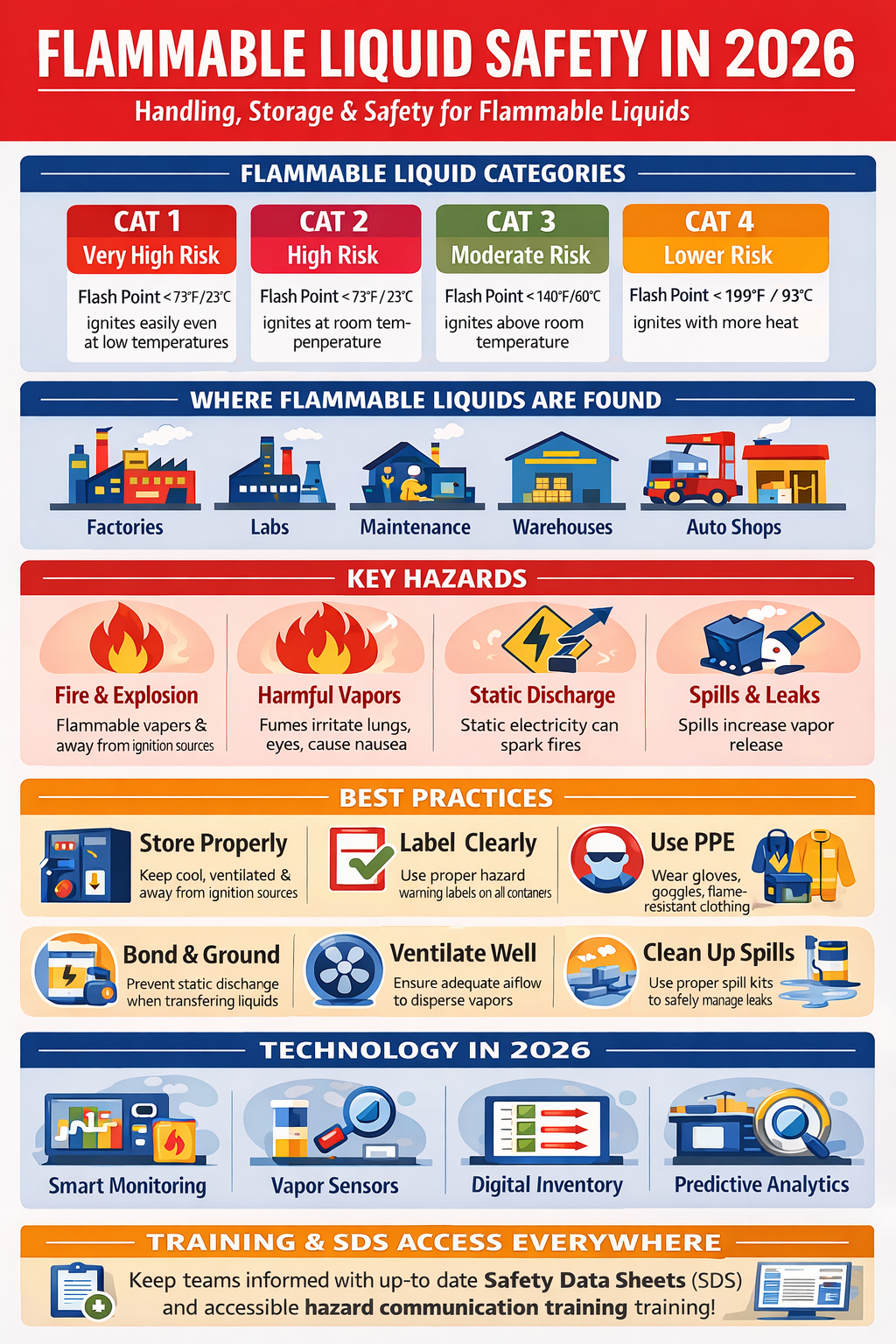
What are Flammable Liquids?
Flammable liquids can catch fire very fast when they are heated, lighted, or touched by an open flame. Even when the temperature isn't high, these chemicals send off vapors that can catch fire. They are exceedingly dangerous if they are not kept or used carefully. In many cases, the mist above the liquid burns first, not the liquid itself. These vapors can spark fires or even explosions when they mix with air and or come in contact with anything that is an ignition source.
Gasoline, diesel, acetone, toluene, alcohol-based compounds, paints, thinners, and various cleaning solutions are all common flammable liquids. While cleaning, producing items, working in a lab, or servicing equipment, workers may come into touch with flammable materials more often than they believe.
Most of the time, we put flammable substances into groups depending on their flash point. Liquids with lower flash points are more dangerous because they are more likely to catch fire. To help organizations store and handle such harmful materials, safety regulations like the Globally Harmonized System of Classification and Labelling of Chemicals help categorize these liquids.
Classification of flammable liquids
A brief overview of GHS Categories (1–4)
These liquids can catch fire almost instantly, even in cooler regions, because their flash points are so low. Be very careful when you store and handle them because they are the most likely to catch fire.
These liquids can easily transform into vapors that can catch fire at room temperature. Even though they are less likely to detonate than Category 1, they are still a big fire risk.
Even when the temperature isn't extremely high, some liquids will catch fire. They are a little less unstable, but they can still form deadly vapor-air combinations if they receive a spark or heat.
These liquids need more heat to catch fire and have higher flash points. They can still catch fire, though, so be careful with them.
Some practical examples
- Some common industrial solvents: Acetone, toluene, methanol, and isopropyl alcohol.
- Fuels: There are several kinds of fuel, like gasoline, aviation fuel, diesel, and kerosene.
- Cleaning agents: Disinfectants, cleaners with alcohol, degreasers, and paint removers are all examples of cleaning supplies.
Where flammable liquids are found
-
Factories
To create goods, clean equipment, and process materials, factories use a lot of volatile solvents, fuels, and process chemicals. You can store these liquids in big containers or use them right on the production lines. This means that proper labeling, ventilation, and ignition control are even more vital.
-
Laboratories
Labs employ flammable liquids for research, preparing samples, and chemical analysis. People often handle modest amounts of alcohols, solvents, and reagents, but they can still be dangerous in the air, especially in enclosed spaces.
-
Maintenance areas
Maintenance workers use things like cleaning solvents, lubricants, degreasers, and fuel for the servicing of equipment. These materials can be used near machinery or electrical systems if safety rules aren't followed, which makes them more susceptible to catching fire.
-
Warehouses
A lot of chemicals, paints, aerosols, and fuels are stored in warehouses. If containers aren't stored properly, don't get enough airflow, or are broken, vapors can build up and create fire hazards.
-
Automotive shops
Gasoline, diesel, brake cleaners, and solvents are some of the things that are regularly used in automobile environments. It's crucial to stay aware of fire hazards from the beginning since working with fuel, maintaining motors, and batteries can all make sparks.
-
Painting and coating operations
A lot of paints, thinners, and varnishes have solvents that can easily catch fire. Spray applications can release vapors into the air, so you need to make sure there is enough airflow, equipment that won't explode, and safe places to keep your products.
The main hazards of flammable liquids
-
Risk of Fire and Explosion
The risk of a fire is very harmful for everyone. Flammable liquids give off vapors that can catch fire when they are heated, lit, or contacted by static electricity or open flames. In small or poorly ventilated areas, vapor buildup can cause explosions that spread quickly and cause a lot of damage.
-
How breathing in vapor might be bad for your health
Fumes from anything that can catch fire can hurt your skin, eyes, and lungs. Depending on the chemical, breathing in these fumes for a long period could make you dizzy, give you a headache, make you ill, or even cause serious health problems.
-
Static electricity ignition
Pouring, moving, or pushing liquids can make static electricity build up. If this static discharge happens near gases, it can become an ignition source.
-
The dangers of spills and leaks
Spills increase the surface area of the liquid. Clearly, it leads to faster vapor release and higher fire risk. Spilled liquids can also spread quickly across floors. Thus, it may reach ignition sources and create slip hazards for workers.
-
Storage and container pressure risks
When combustible things are stored in sealed containers, the heat can build up pressure inside them. If you don't take care of it, this could cause containers to break, leak, or even explode.
-
Environmental impact
If you don't properly dispose of the chemicals that can catch fire or spill by accident, they can affect the air, water, and ground. This is not only detrimental for people, but it can also damage the environment.
The Best Practices and Storage Requirements
To avoid fires, vapor buildup, and accidental exposure, you need to take care of combustible objects properly. Following safe storage rules decreases risks and makes sure that safety standards are met at work.
Storage environment
✅️ Keeping an eye on the temperature
Do not put anything near the heat sources. For instance, heated machinery, bright sunlight, boilers, or electrical panels. So, keeping the storage areas cool and steady is stable to maintain safety.
✅️ Airflow
Good airflow stops the buildup of the flammable vapors. There should be natural or mechanical ventilation systems in storage rooms that make natural airflow possible. This keeps vapors from building up anything that can create explosive conditions.
✅️ Safety from fire
You should put liquids that can catch fire in cabinets that are fireproof or in places where flames can't spread. These cabinets make you safer in an emergency and reduce chances of damage.
✅️ Sealed Lids
Containers must be kept tightly closed when they are not being used. Sealing things up the appropriate way keeps vapors in and stops spills from happening by accident.
✅️ Labeling
Clear and correct labels help workers rapidly detect hazards and handle liquids correctly. Labels should provide warnings about hazards and directions on how to deal with them.
✅️ Bonding and Grounding
At the time of transfer or dispensing, grounding and bonding stop static charge from building up. Static electricity can produce gases that can catch fire.
Quantity Limits
1. Maximum quantities
Businesses should only keep as much flammable liquid as they need to do their daily work. To reduce the fire load, store the chemical products at a designated storage area.
2. Separation rules
Flammable liquids shouldn't be near things that don't mix well with them, including oxidizers, corrosives, and sparks. It helps prevent the products from reacting adversely.
3. Storage joining rules
Facilities should set aside certain spaces for storing flammable products that are not near exits, busy areas, or places near ignition sources. Clear zoning makes it easy to find objects and keeps emergency workers safe.
Safe handling process and transportation safety
Safe handling procedures
✅️Use proper protective equipment (PPE)
When workers need to, they should wear the necessary PPE, like gloves, goggles, flame-resistant garments, and masks. PPE makes it less likely that someone will get hurt through skin contact or inhalation at the time of spilling.
✅️Stay away from substances that could catch fire
You should keep liquids that can catch fire away from open flames, sparks, hot surfaces, and electrical equipment that isn't safe to touch. Even little sparks might start flames when the vapors are present.
✅️Good ventilation is Necessary
You should only handle vapor when there is good air flow to keep it from getting too thick. Open airflow or local exhaust systems can help keep vapor levels safe.
✅️Use safer transfer method
Stay careful about splashes and spill when you are pouring or pumping any of the flammable products. Grounding and connecting is necessary to lower the risk of static electricity.
✅️Clean spills immediately
If you need to clean up a leak or spill quickly, use the correct spill kits. Cleaning up fast decreases the risk of fires and keeps people from slipping and being near odors.
Transportation safety
✅️Use containers that are safe for transportation
You should only move flammable liquids in approved, sealed containers that are meant to prevent leaks from happening and to handle movement.
✅️Make sure the containers are safe during movement
When transferring containers, make sure they are securely fastened to carts, pallets, or vehicles so they don't fall over, break, or open by accident.
✅️ Make sure to label products accurately
People who handle and drive the products can see what the risks are and how to move the products securely due to clear warning labels.
✅️ Choose safe transport routes
Moving flammable liquids along certain paths decreases the chance of coming into contact with sources of ignition.
✅️ Be ready for emergencies
People who work in transportation should know what to do in an emergency, how to clear up a spill, and where to get fire extinguishers and safety information.
Technology trends improving safety in 2026
-
Smart systems for monitoring
Smart monitoring systems that work in real time keep a check on the temperature, humidity, and the state of containers, among other things. When something goes wrong, alerts can be triggered to allow teams time to solve the problem before it becomes worse. This constant monitoring makes it less required to verify products manually by hand and makes everyone more aware of safety.
-
Sensors for vapor detection
Vapor detection sensors help locate combustible vapors before they reach too high and constitute a threat. These sensors are quite useful in tight spaces, labs, and storage rooms where it would be hard to observe vapor buildup. Early detection allows ventilation adjustments, evacuation, or corrective action to prevent fires and exposure incidents.
-
Digital Chemical Inventory Platform
With digital inventory systems, it's easy to find out what flammable liquids you have, where they are, and how much of each one you have. This helps firms keep track of what they have, make sure they don't have too much, and acquire safety information quickly when they need it. It also makes audits go faster and makes planning for storage safer.
-
Automated compliance tracking
Compliance tools can keep track of inspections, storage demands, training records, and paperwork. Automated reminders and reporting systems help organizations stay ready for regulatory audits without having to undertake extra work at the last minute.
-
Predictive hazard analytics
Advanced analytics look at past data, usage trends, and environmental elements to discover prospective safety problems before they happen. Businesses can use predictive insights to avert problems, store the materials better, and be better prepared for emergencies. This indicates that being proactive is more important than being reactive when it comes to handling flammable substances.
Conclusion
In our everyday life, there are flammable liquids all over the place, but they are not safe at all. People make mistakes that cause accidents all the time, such as not labeling a container, not having proper ventilation, keeping too much, or not knowing the risks. In 2026, workplaces that always pay attention to flammable liquid safety are safer. Companies that use clear hazrad communication, store and handle things properly, train their employees, and use the right technology make it easier to discover and deal with threats early on. This keeps employees, property, and businesses safe and free of accidents.
Leave A Comment