

Last Updated on September 28, 2026
Class 3 Flammable Liquid: Properties, Hazards, and Safety Guidelines
Summary
This guide explains what makes a liquid a DOT Class 3 flammable liquid and clears up the common confusion between Class 3, GHS/OSHA flammable-liquid Categories 1–4, and transportation Packing Groups I–III. It covers how flash point and initial boiling point drive classification, common examples, fire/exposure/environmental hazards, storage and handling best practices, transportation requirements by ground, air, and sea, which SDS sections to check, emergency response steps, and the key regulations (OSHA 1910.106, HazCom, DOT 49 CFR, IATA DGR, IMDG, NFPA 30) that govern Class 3 liquids—closing with a safety checklist and FAQ.
Introduction
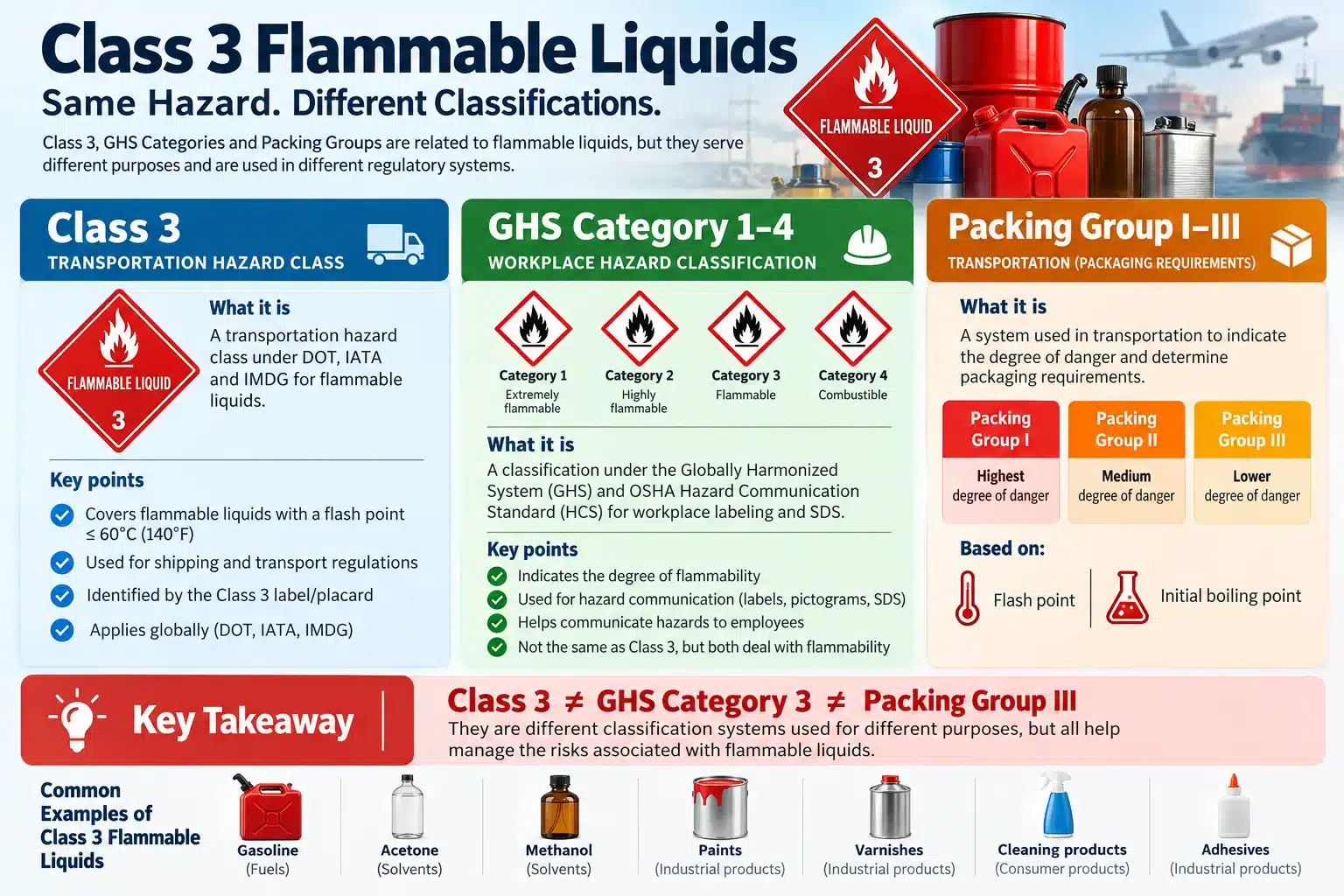
A Class 3 flammable liquid is a liquid that meets the U.S. Department of Transportation's (DOT) definition of a flammable liquid under 49 CFR 173.120—generally, a liquid with a flash point at or below 60°C (140°F). "Class 3" is a hazard class assigned for transportation purposes, not a workplace hazard category. It is closely related to, but not interchangeable with, the GHS/OSHA flammable-liquid Categories 1–4 used in hazard communication and with the transportation of Packing Groups I–III that determine how a liquid must be packaged. Within Class 3, a liquid is further assigned to a packing group based on its flash point and initial boiling point, which drives packaging, labeling, and quantity requirements. Because these three systems overlap in vocabulary but differ in purpose, anyone receiving, storing, handling, or shipping a Class 3 liquid should confirm the current classification and requirements on the product's Safety Data Sheet (SDS) rather than assuming based on the substance name alone.
What is a class 3 flammable liquid?
Under the U.S. hazardous materials transportation regulations (49 CFR Parts 171–180), Class 3 is one of nine hazard classes used to categorize dangerous goods for shipping. A material is classed as Class 3 primarily based on its flammability properties—most importantly its flash point, the lowest temperature at which a liquid gives off enough vapor to form an ignitable mixture with air near its surface.
The logic behind the classification is straightforward: a liquid with a low flash point can release flammable vapors at or near ordinary ambient or handling temperatures. Those vapors, not the liquid itself, are what typically ignite. If vapors accumulate in an enclosed or poorly ventilated space and encounter an ignition source—a spark, open flame, or hot surface—the result can be rapid fire or explosion.
Commonly transported Class 3 liquids include gasoline, acetone, ethanol-based products, methanol, toluene, and many industrial solvents, paints, adhesives, and fuels. Some products that are not obviously “fuels”—cleaning solvents, printing inks, certain adhesives, and alcohol-based hand sanitizers, for example—can also meet the Class 3 definition depending on their formulation.
A note on variability: a chemical classification can differ depending on its exact composition, concentration, the regulatory framework being applied, the test method used to determine flash point, and the mode of transportation involved. Two products containing the same base chemical are not guaranteed to carry the same classification. The SDS and, where applicable, a current classification/testing record for the specific product are the authoritative sources.
Class 3 vs. GHS flammable-liquid categories
This distinction causes more confusion in the field than almost any other flammable-liquid topic, so it’s worth addressing directly and early.
What does class 3 mean?
Class 3 is a transportation hazard class assigned under DOT (and, internationally, under the UN Model Regulations that IATA and IMDG are built on). It answers the question: how does this material need to be packaged, labeled, and documented to move it safely from one place to another?
What are the GHS/OSHA flammable liquid categories?
The Globally Harmonized System (GHS), as adopted by OSHA’s Hazard Communication Standard (29 CFR 1910.1200), uses a separate framework of flammable liquid Categories 1 through 4. This system answers a different question: how flammable is this material for the purposes of workplace hazard communication—labeling, pictograms, and SDS content?
GHS categories are assigned using two properties in combination: flash point and, for the most volatile category, initial boiling point.
| GHS/OSHA category | Flash point | Initial boiling point |
| Category 1 | <23°C (73°F) | ≤35°C (95°F) |
| Category 2 | <23°C (73°F) | >35°C (95°F) |
| Category 3 | ≥23°C to ≤60°C (73°F–140°F) | — |
| Category 4 | >60°C to ≤93°C (140°F–199°F) | — |
Category 4 liquids sit outside DOT’s Class 3 flash point ceiling of 60°C and are typically treated as combustible rather than flammable for transportation purposes, though DOT does regulate some combustible liquids in bulk quantities.
Class 3 vs. category 3 vs. packing group III
The similarity in naming between "Class 3," "GHS Category 3," and "Packing Group III" is coincidental, and treating them as synonyms is one of the most common compliance errors in this area.
| Term | Regulatory context | What it represents |
|---|---|---|
| Class 3 | Transportation (DOT/IATA/IMDG) | The broad hazard class covering flammable liquids |
| GHS Category 1–4 | Workplace hazard classification (OSHA HCS) | Degree of flammability for labeling and SDS purposes |
| Packing Group I–III | Transportation | Degree of danger, used to determine packaging requirements |
Key takeaway: Do not use "Class 3," "Category 3," and "Packing Group III" interchangeably. A liquid can be DOT Class 3 with Packing Group II while simultaneously being GHS Category 2 — the numbers do not line up automatically and matching them requires checking the actual flash point and boiling point data against each system's own criteria.
How are class 3 flammable liquids classified?
Flash point
Flash point is the lowest temperature at which a liquid produces enough vapor to ignite momentarily when exposed to an ignition source, under specified test conditions (commonly closed-cup methods such as ASTM D93 or D3278). It is the single most important property in both the DOT and GHS flammable-liquid systems.
As a general rule, a lower flash point means the liquid can generate ignitable vapor concentrations at lower, more commonly encountered temperatures—which is why low-flash-point liquids (such as acetone, with a flash point well below room temperature) are treated as posing a greater fire risk than liquids with flash points closer to or above typical ambient conditions.
Initial boiling point
The initial boiling point becomes relevant at the most volatile end of the classification systems. Under GHS, it separates Category 1 from Category 2, and under DOT Packing Group rules for Class 3, it separates Packing Group I from Packing Group II. A liquid with a very low initial boiling point vaporizes more readily and can build vapor concentration and pressure more quickly, which is part of why it is treated as posing a higher degree of danger.
Other factors that can affect classification
Flash point and boiling point are the primary drivers, but they are not the only variables that can influence a product’s final classification:
- Chemical composition: The presence of multiple flammable or non-flammable constituents changes the mixture’s overall properties.
- Mixtures: A blended product’s flash point is not always predictable from its individual ingredients and generally must be tested or calculated using recognized methods.
- Concentration: Diluting a flammable ingredient with water or another non-flammable component can raise the flash point enough to change the category.
- Test methods: Different closed-cup and open-cup test methods can yield different results for the same liquid.
- Applicable regulatory framework: DOT, OSHA, EPA, and international bodies do not always apply identical classification criteria.
- Mode of transportation: Ground, air, and sea regulations can impose additional or different requirements for the same material.
Flash point is central to classification, but it should not be treated as the sole determinant of every regulatory outcome. The SDS, and where necessary for the manufacturer’s classification documentation, should be consulted rather than relying on flash point alone.
Class 3 packing groups
Within DOT's Class 3, materials are assigned to one of three packing groups based on the combination of flash point and initial boiling point set out in 49 CFR 173.121. Packing Group assignments drive packaging performance standards, permitted quantities, and some labeling requirements.
Packing group I
- Degree of danger: High
- Classification criteria: Initial boiling point at or below 35°C (95°F), regardless of flash point
- Packaging implications: Requires packaging tested and certified to the most stringent performance level; typically involves the most restrictive quantity limits and handling controls
Packing group II
- Degree of danger: Medium
- Classification criteria: Initial boiling point above 35°C (95°F) and flash point below 23°C (73°F)
- Packaging implications: Requires packaging certified to an intermediate performance level, with corresponding quantity and handling requirements
Packing group III
- Degree of danger: Low
- Classification criteria: Initial boiling point above 35°C (95°F) and flash point at or above 23°C (73°F) but at or below 60°C (140°F)
- Packaging implications: Permits packaging certified to a lower (though still regulated) performance level compared to Packing Groups I and II
Packing group comparison table
| Packing Group | General degree of danger | Key classification considerations |
| I | High | Initial boiling point ≤35°C, any flash point |
| II | Medium | Initial boiling point >35°C, flash point <23°C |
| III | Low | Initial boiling point >35°C, flash point 23°C–60°C |
A Packing Group is not the same thing as a GHS hazard category. Packing Group governs how a material is packaged and shipped; GHS category governs how it is labeled and communicated as a workplace hazard. A liquid can carry a Packing Group II transportation designation, and a GHS Category 2 or Category 3 workplace classification depending on how its flash point and boiling point line up against each system’s separate thresholds.
Common examples of class 3 flammable liquids
| Substance/product | Common use | Relevant properties/classification |
| Gasoline | Fuel | Low flash point; verify current transport classification and Packing Group on the applicable SDS |
| Acetone | Solvent | Flammable liquid, low flash point |
| Ethanol | Solvent, disinfectant, fuel | Classification depends on concentration and formulation |
| Methanol | Solvent, fuel | Flammable liquid with additional toxicity hazards |
| Toluene | Industrial solvent | Flammable liquid with substance-specific health hazards |
| Kerosene | Fuel | Classification depends on applicable criteria and grade |
What hazards do class 3 flammable liquids present?
Class 3 is a transportation classification built around flammability. It is not, by itself, a statement about health or environmental hazards, which vary by chemical and must be evaluated separately.
Fire and explosion hazards
The primary hazard associated with Class 3 liquids is fire or explosion arising from flammable vapors. Relevant contributing factors include:
- Flammable vapor generation, especially in warm or enclosed spaces
- Ignition sources such as open flames, sparks, and hot surfaces
- Static electricity generated during pouring, pumping, or agitation
- Vapor accumulation in low-lying or poorly ventilated areas, since many flammable vapors are heavier than air
- Flashback along a vapor trail back to its source
- Electrical equipment and other spark-producing sources not rated for hazardous locations
Exposure hazards
Health effects from exposure to a Class 3 liquid are chemical-specific and are not implied by the Class 3 designation itself. Depending on the substance, possible effects may include:
- Skin and eye irritation
- Respiratory irritation or effects from vapor inhalation
- Central nervous system effects (e.g., headache, dizziness) associated with some solvent vapors
- Organ-specific toxicity for certain substances
- Aspiration hazards if the liquid is swallowed or enters the lungs
These effects should be confirmed on the specific product's SDS (particularly Sections 2, 4, and 11) rather than assumed to apply uniformly across all Class 3 liquids.
Environmental hazards
Environmental hazards—aquatic toxicity, persistence, bioaccumulation potential, and similar properties — are also chemical- and formulation-specific. They should be evaluated using the SDS (typically Section 12) and any applicable environmental regulations rather than generalized from the Class 3 designation.
Class 3 flammable liquid storage requirements
Storage requirements depend heavily on the applicable regulation, the quantity involved, and facility-specific conditions. The following principles are commonly applicable, but specific numeric limits should be verified against the regulations that apply to a given facility, jurisdiction, and product.
Approved containers and storage cabinets
Flammable liquids should be stored in containers appropriate for the substance and quantity involved, kept closed when not in active use, and inspected for integrity (no corrosion, damage, or degraded seals). Where required by facility fire codes or OSHA’s flammable liquid storage provisions (29 CFR 1910.106), listed or approved flammable liquid storage cabinets should be used for quantities above the applicable threshold.
Ventilation
Adequate ventilation reduces the accumulation of flammable vapors, which lowers both ignition risk and worker exposure. Storage areas should be designed and maintained so that vapors cannot collect in concentrations approaching the lower flammable limit, particularly in confined or low-lying spaces.
Ignition-source control
Storage and use areas should control or eliminate ignition sources, including:
- Open flames and smoking
- Sparks from tools, static discharge, or electrical equipment
- Hot surfaces and unshielded heating elements
- Electrical equipment not rated for use in a hazardous (classified) location where applicable
Segregation and compatibility
Class 3 liquids should be segregated from incompatible materials, particularly strong oxidizers and other reactive chemicals that could increase fire severity or trigger a reaction on contact. Compatibility requirements are chemical-specific and should be confirmed using SDS Section 10 (Stability and Reactivity) for each material stored together.
Spill prevention and secondary containment
Facilities should maintain leak- and spill-prevention measures appropriate to the quantities stored, including secondary containment where required, routine housekeeping to remove flammable residues, and regular inspection of storage containers and areas.
Quantity limits
Allowable storage quantities can depend on several variables working together:
- The applicable regulation (e.g., OSHA 29 CFR 1910.106, NFPA 30, local fire code)
- Container type and construction
- Storage location (inside vs. outside, proximity to exits, occupancy type)
- The liquid’s flammability classification
- Overall facility configuration, including fire suppression systems
- Local and state fire code amendments, which can be more restrictive than federal rules
Specific numeric OSHA storage quantity limits should be applied only where they are clearly the governing regulation for the facility and should be cited directly from the current version of 29 CFR 1910.106 rather than summarized generically.
Safe handling of class 3 flammable liquids
Before handling
- Identify the relevant fire, health, and reactivity hazards
- Confirm the PPE required for the task
- Check that ventilation is adequate for the work being performed
- Identify and remove or control ignition sources in the work area
During transfer and dispensing
- Use equipment appropriate for flammable liquid transfer
- Apply grounding and bonding where applicable to control static discharge during pumping or pouring between containers
- Take steps to prevent spills and overfilling
- Keep containers closed except when actively transferring product
- Avoid unnecessary release of vapors, including by minimizing open-container time
Personal protective equipment
PPE selection should be based on the specific task and chemical rather than a single default. Relevant inputs include SDS Section 8 (Exposure Controls/Personal Protection), the potential for skin or eye contact, the nature of the task, the concentration of the material, and any engineering controls already in place. There is no single PPE combination appropriate for every Class 3 liquid; selection should be evaluated per product and per task.
Housekeeping
- Clean up spills promptly using appropriate absorbent materials and procedures
- Dispose of flammable liquid waste and contaminated materials according to applicable waste regulations
- Keep work areas free of unnecessary combustible clutter
- Regularly inspect containers, cabinets, and dispensing equipment for damage or leaks
Class 3 flammable liquid transportation requirements
Proper classification
Before a Class 3 liquid is offered for transport, the shipper must correctly identify:
- UN number
- Proper shipping name
- Hazard class (Class 3)
- Packing Group (I, II, or III)
Misclassification at this stage can cascade into incorrect packaging, labeling, and documentation throughout the shipment.
Packaging
Packaging must meet performance standards appropriate to the assigned Packing Group and the applicable transportation regulation (49 CFR Part 173 for ground transport in the U.S., with corresponding requirements under IATA and IMDG for air and sea). Packaging that is certified for a lower Packing Group than the material’s actual classification is not compliant, even if it appears physically adequate.
Labels and markings
Shipments require the correct Class 3 hazard label, along with package markings identifying the proper shipping name, UN number, and other required transport information. Larger shipments or bulk transport may additionally require placarding on the transport vehicle or container; whether placarding is required depends on quantity thresholds and mode-specific rules, so this should be confirmed against the applicable regulation rather than assumed.
Shipping documentation
Accurate shipping papers—reflecting the correct classification, packing group, quantity, and emergency contact information — are required for regulatory compliance and are also critical for emergency responders in the event of an incident in transit.
Different modes of transportation
- Ground transportation: Governed in the U.S. by DOT’s Hazardous Materials Regulations under 49 CFR Parts 171–180.
- Air transportation: Governed by the IATA Dangerous Goods Regulations (DGR), which are generally more restrictive than ground transport rules for flammable liquids, including tighter quantity limits.
- Sea transportation: Governed by the International Maritime Dangerous Goods (IMDG) Code.
Transportation requirements vary meaningfully by mode, jurisdiction, quantity, packaging type, and the specific substance being shipped. A shipment that is fully compliant for ground transport may not meet air or sea requirements without additional review.
What to check in the SDS for a class 3 flammable liquid
| SDS section | What to check |
| Section 10 | Stability and incompatibilities |
| Section 14 | Transportation information |
| Section 2 | Hazard classification, pictograms, signal word, and hazard statements |
| Section 5 | Fire-fighting measures |
| Section 6 | Accidental release measures |
| Section 7 | Handling and storage |
| Section 8 | Exposure controls and PPE |
| Section 9 | Flash point and other physical properties |
How to identify the transport classification
SDS Section 14 (Transport Information) is the most direct source for a product’s UN number, proper shipping name, hazard class, and packing group. Because manufacturers are responsible for keeping this section current, it should be checked against the most recent version of the SDS available—ideally through a centralized system that flags when a document has been updated.
How to determine safe storage conditions
Sections 7 (Handling and Storage) and 8 (Exposure Controls/Personal Protection) provide the chemical-specific starting point for storage conditions, but they should be read together with facility-specific requirements—building and fire codes, quantities on site, and existing engineering controls—before finalizing handling or storage procedures.
Emergency response for class 3 flammable liquids
In the event of a spill
- Alert appropriate personnel immediately
- Remove or isolate ignition sources if it is safe to do so
- Prevent unnecessary exposure by limiting access to the area
- Follow SDS guidance for the specific material
- Use spill-response procedures and materials appropriate to the quantity and location
- Escalate to trained emergency responders when the spill exceeds what facility personnel are trained or equipped to handle
In the event of a fire
- Activate the facility's emergency response plan
- Evacuate as required by that plan
- Contact emergency responders (fire department)
- Consult SDS Section 5 for firefighting guidance specific to the material involved
- Use only firefighting methods and equipment appropriate to the specific hazard—some extinguishing agents are inappropriate or ineffective for certain flammable liquid fires, so no single agent should be treated as universally best across all Class 3 liquids
Exposure incident
If a worker is exposed through skin contact, eye contact, inhalation, or ingestion, follow the first-aid measures in SDS Section 4 and seek medical attention as indicated. Section 4 should be consulted directly rather than relying on generic first-aid assumptions, since appropriate responses can vary significantly between chemicals.
Regulatory requirements for class 3 flammable liquids
| Regulation/standard | Primary relevance |
| OSHA 29 CFR 1910.106 | Workplace storage and handling of flammable liquids |
| OSHA Hazard Communication Standard (29 CFR 1910.1200) | Hazard communication, labeling, and SDS requirements |
| U.S. DOT 49 CFR Parts 171–180 | Hazardous materials transportation |
| IATA Dangerous Goods Regulations | Air transportation |
| IMDG Code | Maritime transportation |
| NFPA 30 (Flammable and Combustible Liquids Code) | Design and storage standards, often adopted by reference in local fire codes |
| State and local fire codes | Facility-specific requirements, which may be more restrictive than federal rules |
Requirements may vary based on jurisdiction, chemical properties, quantity, storage configuration, use, and transportation mode. Always verify the requirements applicable to your specific facility and product before finalizing storage, handling, or shipping procedures.
Class 3 flammable liquid safety checklist
Before Receiving
- Obtain the current SDS
- Verify classification
- Confirm storage requirements
- Confirm appropriate containers
- Prepare the storage area
Before Handling
- Review SDS Sections 2, 7, and 8
- Identify ignition sources
- Confirm ventilation
- Check PPE
- Confirm spill-response equipment is available
During Storage
- Keep containers closed
- Control ignition sources
- Maintain housekeeping
- Separate incompatible materials
- Inspect containers regularly
During Transportation
- Verify UN number
- Confirm proper shipping name
- Confirm hazard class
- Confirm packing group
- Verify packaging, labeling, and documentation
FAQs
-
What is a Class 3 flammable liquid?
A Class 3 flammable liquid is a liquid that meets DOT’s transportation definition of a flammable liquid—generally a flash point at or below 60°C (140°F)—and is assigned to Hazard Class 3 for shipping purposes.
-
What does Class 3 mean in hazardous material transportation?
It is one of nine DOT hazard classes, used to identify materials that pose a flammability risk during transport and to determine required packaging, labeling, and documentation.
-
Is Class 3 the same as Category 3?
No. Class 3 is a DOT transportation hazard class covering all flammable liquids meeting the definition. GHS/OSHA Category 3 is one specific workplace hazard communication category (flash point 23°C–60°C) within a four-category system. A material can be Class 3 without being GHS Category 3.
-
What are the three Class 3 packing groups?
Packing Group I (high danger), Packing Group II (medium danger), and Packing Group III (low danger), assigned based on flash point and initial boiling point under 49 CFR 173.121.
-
What is the difference between a Class 3 flammable liquid and a GHS Category 3 flammable liquid?
Class 3 is a transportation classification governing packaging and shipping. GHS Category 3 is a workplace hazard communication classification governing labels, pictograms, and SDS content. They use overlapping but distinct criteria and should not be assumed to match.
-
What are examples of Class 3 flammable liquids?
Commonly cited examples include gasoline, acetone, ethanol, methanol, toluene, and kerosene, though actual classification depends on the specific product’s formulation and test data.
-
How should Class 3 flammable liquids be stored?
In appropriate, closed containers or approved storage cabinets, with adequate ventilation, controlled ignition sources, segregation from incompatible materials, spill containment, and quantities consistent with applicable regulations such as OSHA 29 CFR 1910.106 and NFPA 30.
-
Where can I find a chemical’s Class 3 classification on its SDS?
Section 14 (Transport Information) lists the UN number, proper shipping name, hazard class, and packing group for the product.
-
Are all Class 3 flammable liquids equally hazardous?
No. Packing Group and GHS category both reflect that flammability risk varies significantly within Class 3, and health and environmental hazards vary independently by chemical.
-
What SDS sections should workers check before handling a Class 3 liquid?
At minimum, Sections 2 (hazard classification), 7 (handling and storage), 8 (exposure controls/PPE), 9 (physical properties, including flash point), and 5 (fire-fighting measures).
Conclusion
Class 3 is a transportation hazard class, not a workplace hazard category or a stand-in for GHS Category 3 or Packing Group III — the three systems use related criteria but serve different regulatory purposes and should never be treated as interchangeable. Beyond that distinction, the safe storage, handling, transportation, and emergency response requirements for any specific Class 3 liquid depend on its actual classification data and the regulations that apply to your facility, quantity, and shipping mode.
Because that information changes as formulations, regulations, and SDS versions are updated, teams need reliable access to the current SDS for every product on site — not a static PDF that may already be outdated. CloudSDS centralizes SDS access across your organization, keeps your chemical inventory aligned with the latest safety data, gives workers instant access to the current SDS from any device, and supports the documentation and training records needed to demonstrate compliance. If your team is still tracking flammable liquid classifications manually, it may be time to see how a centralized system can close that gap.
References

Simplify Your SDS Management
CloudSDS gives your team instant access to 23M+ safety data sheets with AI-powered search, automated updates, and full OSHA/GHS compliance — all from one platform.
Leave A Comment