
Last Updated on March 30, 2026
For efficient risk management in a wide range of contexts, from busy university labs to high-stakes hospitals, safety routines that are customized to each institution are essential. These workflows are more than just standard processes; they take into account the specific risks of each activity and combine regulatory compliance, technology, and human factors to make workplaces safer. This in-depth blog article will cover their definition, development, real-world examples, and strategic implementation. It will provide lists, tables, and actionable insights to help EHS specialists improve their programs.
If you work in a research facility to keep track of chemical inventory or in a healthcare facility to keep track of infection control, you need to know these routines to develop a culture of safety.
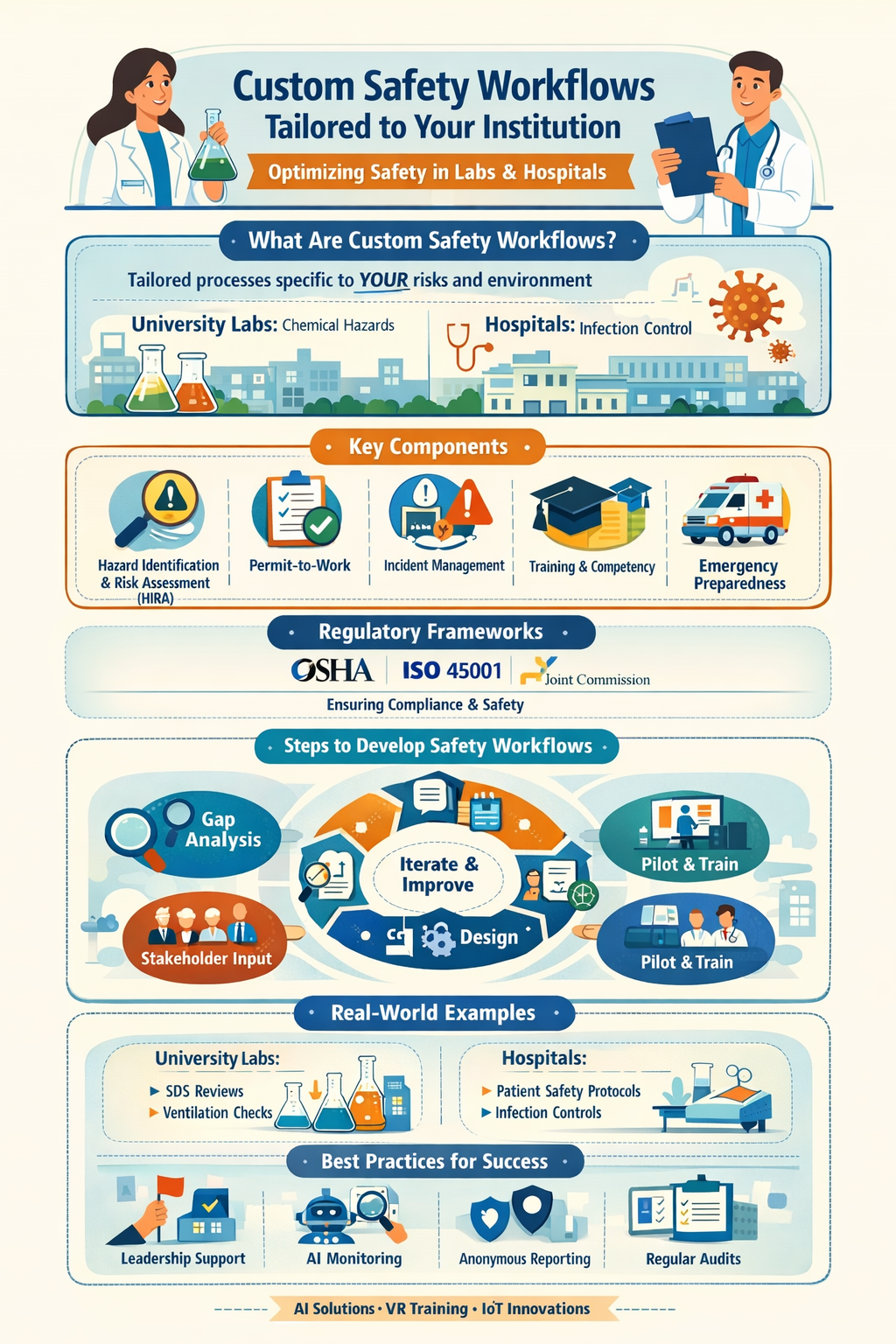
Safety Workflows That Are Specific to Each Institution
What Are Safety Workflows That Are Unique to Your Institution?
Customized, step-by-step safety workflows for an institution focus on identifying, mitigating, and monitoring hazards specific to the organization’s operations, facilities, and staff. They are not like industrial standards that work for everyone; instead, they change based on things that are specific to the place, such as the dangerous chemicals in a university’s organic chemistry lab or the biohazards in a hospital’s ICU. This makes them relevant and enforceable.
These workflows standardize important safety tasks, including risk assessments, permit approvals, incident investigations, and emergency exercises. They also make people more responsible by making roles explicit and keeping digital audit trails. They use frameworks like OSHA’s Recommended Practices for Safety and Health Programs, which stress the need for the Plan-Do-Check-Act (PDCA) cycle for ongoing development.
They reduce errors, delays, and the need to follow many rules, like OSHA 29 CFR 1910, EPA guidelines, and ISO 45001, by adding specific features for each institution, such as custom standard operating procedures for old equipment or evacuation routes based on where they are located.
In real life, these procedures change from reactive checklists to predictive systems that use data analytics to identify dangers before they get worse. For EHS executives, this task involves more than just following the rules. It also means having an edge over the competition by having fewer accidents and happier employees.
Key Parts of Strong Workflows
A good safety workflow has modules that are connected to each other and cover the whole risk lifecycle, from prevention to response and recovery. All of the parts must be able to grow, be checked, and work with institutional tools like learning management systems (LMS) or enterprise resource planning (ERP) software. The important parts are:
- Hazard Identification and Risk Assessment (HIRA): tools for continuing evaluations that include job hazard analyses (JHAs) and feedback loops from employees.
- Permit-to-Work (PTW) Systems: Digital gates that let people into limited spaces, do heated work, or do experiments that are dangerous.
- Incident Management: Automated reporting with templates for root cause analysis (RCA) and recording near misses.
- Training and competency checks: role-based modules with tests, certifications, and plans for refresher courses.
- Compliance Monitoring Dashboards: KPIs that show how many people have finished their training, how many inspections are past due, and what the audit found.
- Getting ready for emergencies: drills, communication trees, and post-event debrief that are specific to the layout of the location.
These parts are connected via workflow automation platforms, which send out reminders (like “PPE inspection due”) and escalate issues (such as department heads for issues that haven’t been fixed). In institutions with limited resources, priority is based on high-frequency/high-severity risks, which ensures the most impact with the least amount of work.
| Component | Primary Function | Key Metrics Tracked |
| HIRA | Proactive threat mapping | Risk scores, exposure hours |
| PTW | Activity authorization | Approval times, violation rates |
| Incident Mgmt. | Post-event learning | MTTR (mean time to resolution) |
| Training | Skill assurance | Completion %, recency scores |
| Dashboards | Oversight | Compliance index, trend alerts |
Finding your way through the rules and regulations
Regulatory compliance is the foundation of institution-specific workflows. For example, OSHA requires that construction-affected sites have Site-Specific Safety Plans (SSSPs) and labs that handle certain carcinogens or reproductive poisons have Chemical Hygiene Plans (CHPs).
29. CFR 1450 says that labs must keep CHPs that list standard operating procedures (SOPs), physician consultations, and fume hood certifications. NIH and NSF grants make these standards even stricter in academic settings. The Joint Commission has criteria for the environment of care (for example, EC.02.01.01) that hospitals must follow, and the Centers for Medicare and Medicaid Services (CMS) has rules for preventing infections. The CDC and NIH set biosafety levels (BSL-1 to 4) for research institutes. The NRC or state equivalents set radiation safety limits.
ISO 45001 promotes global alignment and the incorporation of PDCA, with audits checking to see if workflows are working. If you don’t obey the rules, you could face fines (up to $156,259 for each willful violation as of 2026), suspensions of grants, or lawsuits. This requirement means that adjustments for each institution are not optional.
| Regulation | Scope | Institution Examples |
| OSHA 1910.38 | Emergency Action Plans | Hospitals: Patient evacuations |
| OSHA 1910.1450 | CHPs | Universities: Lab SOPs |
| ISO 45001 | EHS Systems | Research: Risk registers |
| Joint Commission EC | Life Safety | Hospitals: Interim measures |
Guide to Step-by-Step Development
Making these workflows requires a collaborative, iterative process based on data from the institution.
- Gap Analysis: Look at historical events, near-misses, and audits to see where you are now and where you want to be.
- Getting Stakeholders Involved: Obtain input on problems from people in other departments (EHS, ops, legal).
- Use technologies like bow-tie analysis to find site-specific risks, like cryogenics in physics labs.
- SOP Design: Make procedures that are easy to read and understand, and include prerequisites, controls, and backup plans.
- Choosing a tech stack: Make sure that the EHS software you choose can work on mobile devices.
- Piloting and Training: Start with small groups, use simulations, obtain feedback, and evaluate skills.
- Monitoring and Iteration: Set up quarterly evaluations that happen after accidents or changes to the rules.
University guides like WSU’s also employ this strategy to ensure everyone is on board and adaptable to change.
Examples from the Real World: Hospitals and Universities
-
Labs at the University
Academic labs are a wonderful example of customization. For example, Stanford’s Chemical Safety Toolkit requires principal investigators (PIs) to write lab-specific CHPs that include inventory, training rosters, and SOPs for peroxides or nanomaterials. WSU’s manual says that checklists must be used every year to examine eyewashes, signs, and waste separation. It also says that Schedule A chemical (such as arsine gas) must be approved ahead of time.
| Lab Workflow Phase | Stanford/WSU Practices |
| Procurement | SDS review, inventory limits |
| Operations | Ventilation logs, glove box protocols |
| Decommissioning | Decon surveys, waste manifests |
-
Hospital Settings
Hospitals like the University of Kentucky use patient-centered processes and do risk assessments for slips, violence, and utilities during renovations. Protocols break care down into three parts: admission (such as 16-point screenings), inpatient (like fall bundles), and discharge. Checklists help cut down on mistakes.
These examples show how scalable things are: labs focus on substances and hospitals on people.
Proven Ways to Put Things into Action
Get leaders on board: hire safety champions, make sure workflows match KPIs, and use applications to make training more fun. Digital twins run drills, and IoT sensors, including gas detectors, send real-time data to dashboards. Use open communication and rapid victories, like cutting approval times for automated PTW by 70%, to encourage others to agree. Table-top activities every year: assess for resilience.
Best Ways to Succeed in the Long Run
- Include safety in onboarding and reviews of performance.
- Use AI to find strange things in logs.
- Encourage a culture of reporting by giving people anonymous ways to do so.
- Use industry forums to compare yourself to others.
- Regular audits by outside parties ensure that things are fair.
Problems, Pros, and Tech Horizons
Cloud EHS platforms, like AI-driven PTW, can help with problems like departments working in silos or old systems. They can minimize incidents by 25% to 40%. The benefits include saving money (for example, avoiding claims worth more than $4 million), making sure the company obeys the rules, and changing the culture.
New technologies, including drones for inspections and virtual reality training, promise to keep workflows ahead of dangers.
Conclusion
To sum up, safety procedures that are customized to an institution are not just paperwork; they are active tools that help create settings with minimal harm. You protect lives, property, and reputations by tailoring your institution’s needs, whether that means lab reagents or patient flows.
People who work in EHS: Verify your present setup today, make dramatic changes, and be the leader of the safety revolution. Do a danger walk-through first, and then watch compliance develop into excellence.
Simplify Your SDS Management
CloudSDS gives your team instant access to 23M+ safety data sheets with AI-powered search, automated updates, and full OSHA/GHS compliance — all from one platform.
Leave A Comment