 Skip to content
The shift from previous hazard symbols to the modern Globally Harmonized System (GHS) represents one of the most significant transformations in chemical safety communication in recent decades. The transformation is not only related to the visual aspect of hazard symbols but also encompasses the system of classification, documentation, and communication in general.
Differences Between Latest GHS SDS Symbols and Old Hazard Symbols
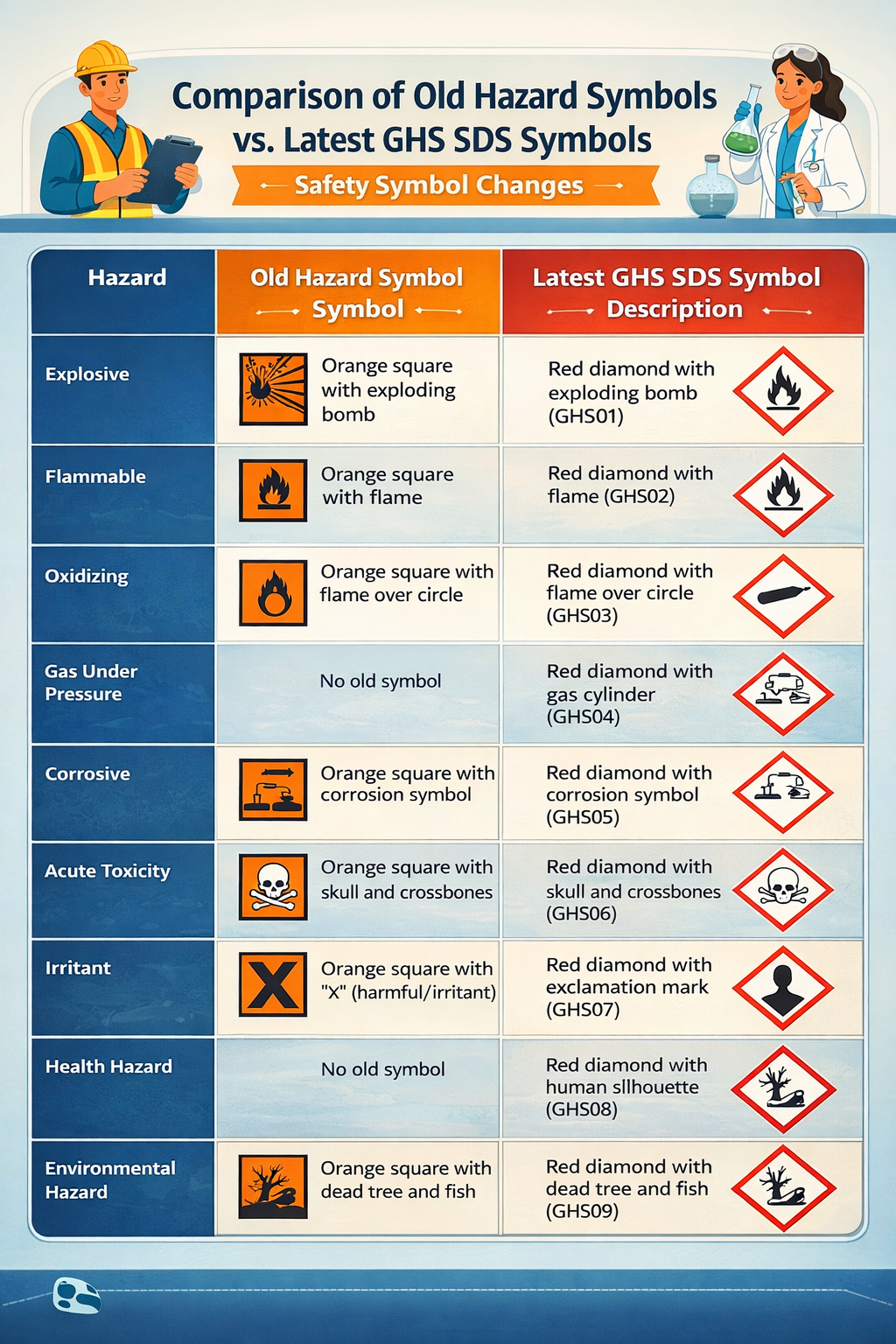
Here is a clear table that shows the changes between the previous danger symbols and the new GHS SDS symbols:
Key Points:
- The old symbols were black on orange squares. The new GHS symbols are black on white squares with red diamond outlines.
- GHS added new symbols for dangers that weren’t already represented, like Gas Under Pressure (GHS04) and Health Hazard (GHS08).
- The symbol for an irritation went from an “X” to an exclamation point.
- The emblem for environmental hazards is still the same, but it is now inside a red diamond.
This table shows the change that took place completely by June 1, 2017. The previous CHIP symbols were replaced by the GHS system, which is used all around the world to make hazard communication clearer and more consistent.
Documentation Changes: MSDS to SDS
-
Format Standardization
One of the most significant changes in the GHS involved switching from Material Safety Data Sheets (MSDS) to Safety Data Sheets (SDS). This was more than a name change; it created a global format that ensures consistency.
The new SDS format includes 16 defined sections. This format is different from the old MSDS formats, which might be very distinct from one country or manufacturer to the next. The standardized structure with 16 sections includes:
- Identification: Information about the product and the supplier
- Hazard Identification: Requirements for classification and pictograms
- Composition/Information on Ingredients: Information about the chemicals that make up the product
- First Aid Steps—How to respond in an emergency
- Firefighting Measures—Rules for fire safety
- Accidental Release Measures—How to respond to a spill
- Safe handling and storage instructions
- Personal Protection/Exposure Controls—Requirements for safety gear
- Technical requirements for physical and chemical properties
- Information on chemical behavior, such as stability and reactivity
- Toxicological Information—Data on health risks
- Ecological Information—Data on how things affect the environment
- Things to think about when throwing things away: waste management rules
- Shipping and handling requirements for transport
- Information on regulations and compliance
- Other Information—more important details
-
Enhanced Hazard Classification
The GHS system made danger classifications more detailed than prior systems. The danger categories on the SDS are more detailed than those on the MSDS. This helps make sure that evaluations are the same across different manufacturers and jurisdictions.
Recent Updates: GHS Revision 10 (2023)
-
Latest Developments
The most recent version, GHS Revision 10, came out in July 2023. It made a number of major changes that continue to improve the system:
- Non-Animal Testing Methods: The revision includes ways to classify health hazards that don’t require testing on animals. These include skin corrosion/irritation, major eye damage/irritation, and respiratory or skin sensitization.
- Improved Precautionary Remarks: The approach made precautionary remarks more understandable for users while still being useful for labeling practitioners.
- Classification of Desensitized Explosives: Chapter 2.17 sets up new rules for how to classify desensitized explosives.
Annexes 9 and 10 were changed to provide better instructions on how to classify metals and metal compounds for long-term aquatic hazard assessment.
-
Implementation Timeline
The GHS system has changed a lot since it was first published in 2003. The initial edition came out in 2003, and every two years since then, it has been modified to reflect new scientific knowledge and problems with putting it into practice.
Signal Words and Hazard Communication
-
Improved Warning System
The GHS system added standard signal words like “DANGER” or “WARNING” to show how serious a hazard is. This replaced the various indication terms used in different countries. “DANGER” is shown for very dangerous dangers, and “WARNING” is shown for less dangerous ones.
-
Hazard and Precautionary Statements
The old “Risk (R) Phrases” were replaced by “Hazard (H) Statements,” which are grouped by kind of hazard:
- H200-H299: Physical Hazards
- H300-H399: Health Hazards
- H400-H499: Environmental Hazards
“Safety (S) Phrases” were changed to “Precautionary (P) Statements” and put into these groups:
- P100-P199: General
- P200-P299: Prevention
- P300-P399: Response
- P400-P499: Storage
- P500-P599: Disposal
-
Impact on the World and Harmonization
The move to GHS is a big step toward making chemical safety communication more consistent around the world. The GHS is a single international system that makes it easier to handle chemicals safely across borders. This approach is distinct from the old fragmented system where different countries used different symbols and forms.
The system covers 16 physical hazard classes, 10 health hazard classes, and 2 environmental hazard classes. This approach is much more than what previous national systems did. This new classification system makes it easier to discuss hazards and make better judgments about how to control risks.
The implementation of GHS has led to a stronger, science-based way to discuss chemical hazards that keeps getting better as new scientific discoveries and real-world experiences from around the world are made.
Leave A Comment