

Summary:
Most companies don’t fail employee safety training because they don’t care. They fail because they treat it as a one-time task instead of an ongoing process. Long sessions, outdated materials, and boring content make it hard for employees to stay engaged or remember what they learn. On top of that, important safety information is often hard to access when it’s actually needed, and companies rarely check if the training is truly effective. The good news? With the right approach, like using simple, interactive, and digital tools such as LMS platforms, training can become easier, more engaging, and much more effective, helping employees stay safe and organizations stay compliant.
Organizations that handle chemical products must prepare their teams to be well-trained to handle chemical products with proper skills and efficiency. Besides, the Occupational Safety and Health Administration’s (OSHA) HazCom standard makes it mandatory for all organizations handling chemical products. It’s true that many organizations spend a lot for employee training programs. However, they still face workplace incidents, compliance gaps, and unsafe behaviors.
So, where are companies going wrong?
The truth is, most safety training programs for employees fail not because organizations don’t care. They may rely on outdated, ineffective, and inconsistent approaches.
Let’s explore the key reasons behind these failures and what companies can do to fix them.
Is Employee Safety Training Difficult?
In theory, training employees on safety may seem simple, but in reality, it’s much more complicated than most companies think it will be. Companies typically have to train a wide range of employees who work in different positions, departments, and locations, each of which has its own risks and responsibilities. It can be hard to make sure that all of your employees get the right training for their jobs, that it is up to date, and that it is easy to grasp.
Also, safety rules and hazards at work are always changing, so training materials need to be looked at and updated on a regular basis. It gets even more complicated when you have to plan sessions, keep track of who is participating, and make sure that all teams are on the same page. If you don’t have a planned and scalable way to do it, employee safety training can quickly become a waste of time, inconsistent, and hard to manage well.
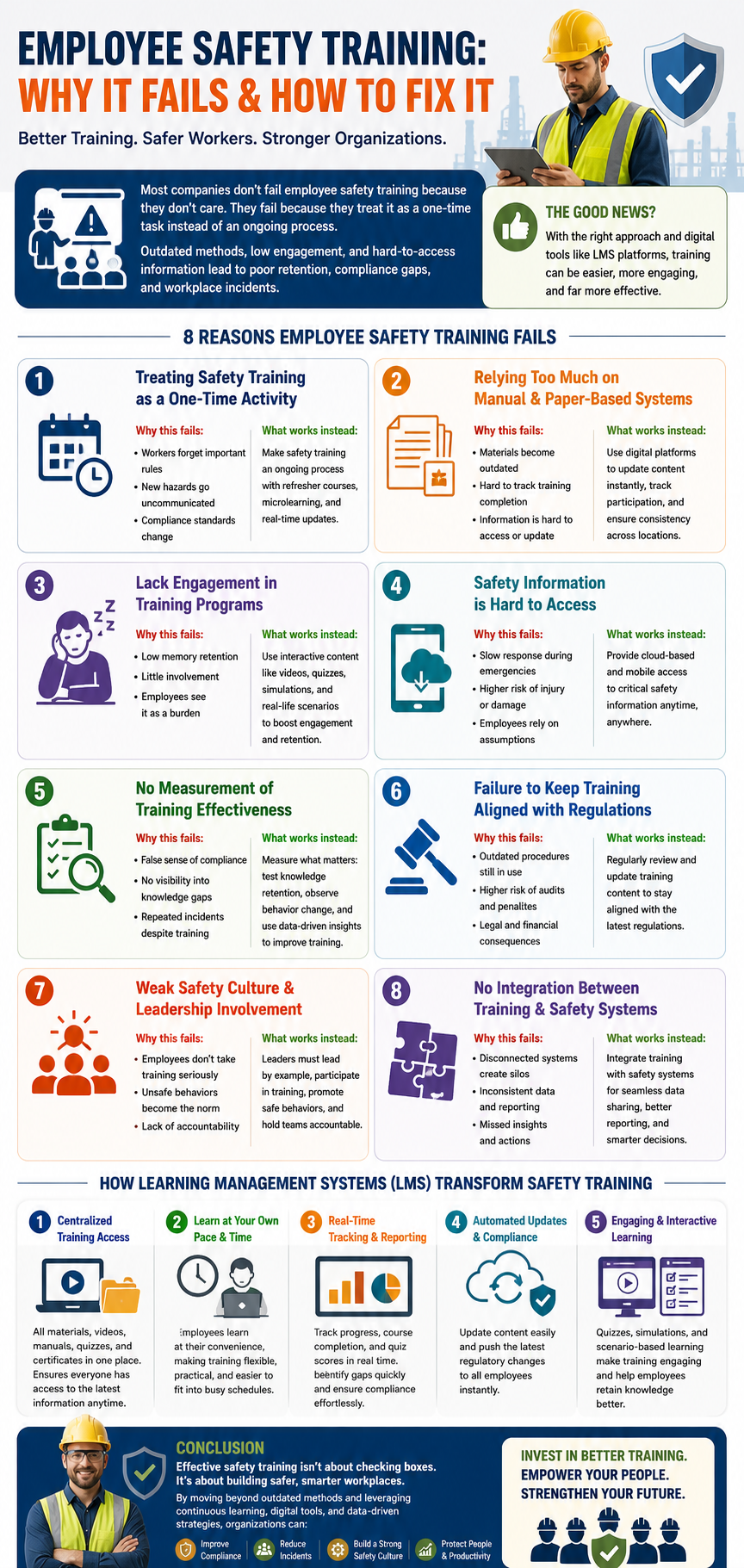
Reasons why employee training fails
1. Treating safety training as a one-time activity
One of the most common misconceptions that businesses make is seeing safety training as something they have to do. During onboarding, employees are routinely taught everything they need to know and then expected to remember it all forever. Knowledge fades, methods of change, and hazards vary with time, but training methods stay the same.
Why this fails:
- Workers forget important safety rules
- No one tells you about new hazards.
- Standards for compliance change without notice
What works instead:
Training for safety should happen all the time, not just sometimes. Regular refresher courses, microlearning modules, and updates in real time keep personnel up to speed and ready.
2. Relying too much on manual and paper-based systems
Many companies still use printed SOPs, physical training manuals, and classes to train their employees. These tactics may have worked in the past, but they don’t work anymore in today’s fast-paced, multi-location workplaces.
Why this fails:
- Training materials go old very quickly.
- Hard to keep track of who finished training
- There is no easy way to get or update required information.
- Not easily accessible whenever needed
What works instead:
Digital training platforms and centralized systems allow organizations to update content instantly, track participation, and ensure consistent training across all locations.
3. Lack engagement in training programs
Let’s be honest: most safety training courses are dull. Employees generally don’t pay attention during long presentations, dense materials, and technical jargon. When workers aren’t interested, they are less likely to remember or use what they learn.
Why this doesn’t work:
- Low memory retention
- Little involvement
- Workers see training as a burden
What works instead:
Videos, quizzes, real-life situations, and simulations are all examples of interactive content that can greatly increase engagement and retention.
4. Safety information is hard to access
When you need it, important safety information like protocols, emergency steps, or Safety Data Sheets (SDS) is not always easy to find when necessary. When there is an emergency, workers can’t afford to look through files or binders.
Why this fails:
- Response time is slow during emergencies.
- Higher chance of getting hurt or damage
- Instead of confirmed information, employees have to assume
What works instead:
Cloud-based solutions and mobile access make sure that employees can get safety information right away, no matter where they are or when they need it.
5. Measurement of training effectiveness
Most companies keep track of whether or not their employees finish their training, but not training effectiveness.
Finishing a session doesn’t guarantee its proper understanding. It also doesn’t ensure change in behavior.
Why this fails:
- False feeling of following the rules
- No understanding of gaps in knowledge
- Repeated safety problems even after training
What works instead:
Each organization must verify:
- Knowledge retention through tests
- Changes in behavior at work
Insights based on data help make training programs better always.
6. Failure to keep training aligned with regulations
Safety rules are always changing. Companies that don’t update their training programs as needed could face penalties and not be in compliance.
Why this fails:
- Old procedures are still being used.
- Higher risks of audits
- Legal and money problems
What works instead:
Companies need to make sure that the training materials are routinely checked and updated to meet the most recent rules.
7. Weak safety culture and leadership involvement
Strong leadership support is necessary for safety training to work. When management sees safety as a formality instead of a priority, workers do it too.
Why this fails:
- Employees don’t take training seriously
- Unsafe behaviors become the norm.
- Not being responsible
What works instead:
Leadership must actively foster a culture of safety by:
- Taking part in training
- Encouraging safe behaviors
- Making teams responsible
8. No integration between training and safety systems
Strong leadership support is necessary for safety training to work. When management sees safety as a formality instead of a priority, workers do it too.
Why it fails:
- People who work don’t take training seriously.
- Unsafe behavior becomes the norm.
- Not being responsible
What works instead:
Leadership must actively foster a culture of safety by:
- Taking part in training
- Encouraging safe behaviors
- Making teams responsible
How learning management systems are transforming safety training
1. Centralized training access
Learning Management Systems (LMS) keep all of the safety training materials, including videos, manuals, quizzes, and certificates, in one location. Employees may obtain the most up-to-date information any time, which cuts down on the number of in-person sessions and makes sure that everyone is on the same page.
2. Learning at your own speed and on your own time
An LMS lets employees learn at their own pace, which makes it easier to fit training into busy schedules. Employees are more interested in this since it gives them freedom and helps them understand crucial safety rules without feeling rushed.
3. Reporting and tracking in real time
LMS comes with built-in metrics that let you see how well your employees are doing right now, how many courses they have finished, and how well they did on examinations. This helps firms quickly figure out where they need to learn more and make sure they are following safety rules.
4. Automated updates and compliance alignment
The rules and regulations regarding safety keep changing. You can easily update training materials and make them available to everyone. This way, employees will always have access to the most up-to-date safety information.
5. Learning that is exciting and hands-on
Modern LMSs have interactive features like quizzes, simulations, and scenario-based learning to make safety training more exciting. This helps people remember what they’ve learned and get ready to deal with difficulties in the real world.
Conclusion
Most companies don’t fail employee safety training because of a lack of intent. They fail because of outdated methods, poor engagement, and lack of strategic execution.
Effective safety training is not about checking boxes. It’s about ensuring employees understand risks, retain critical knowledge, and apply it in real-world situations.
Organizations that embrace continuous learning, digital tools, and data-driven strategies will not only improve compliance but also create safer, more resilient workplaces.
Simplify Your SDS Management
CloudSDS gives your team instant access to 23M+ safety data sheets with AI-powered search, automated updates, and full OSHA/GHS compliance — all from one platform.
Leave A Comment