
Introduction
PFAS are dominating environmental compliance news because EPA has been revisiting multiple PFAS rules at once: drinking water standards, reporting obligations, and implementation timelines. In 2025–2026, the agency proposed to retain some protections while rescinding or narrowing others, which created headlines about a “rollback” even though many federal requirements still remain active.
The word “rollback” is only partially accurate because it suggests a wholesale retreat from PFAS regulation. In reality, EPA is keeping the strictest drinking water limits for PFOA and PFOS, reconsidering some standards for other PFAS, and proposing compliance extensions and TSCA reporting changes that reduce burden in some areas while preserving data collection and enforcement in others.
For EHS managers, manufacturers, laboratories, distributors, and water utilities, the practical message is simple: do not assume PFAS compliance is going away. Companies still need inventory visibility, SDS review, supplier disclosure tracking, testing awareness, and state-law monitoring because federal changes in 2026 do not erase the broader PFAS compliance landscape.
Understanding the EPA’s PFAS Regulatory Rollback: A Comprehensive Guide
EPA’s 2026 PFAS actions are best understood as a targeted revision of parts of the federal PFAS framework, not a full repeal. The core drinking water limits for PFOA and PFOS remain in place, CERCLA’s hazardous substance designation for PFOA and PFOS remains in place, and PFAS reporting obligations under TSCA are still moving forward, even as EPA proposes narrower scopes and longer implementation windows for some rules.
Biggest changes
The biggest federal PFAS changes announced in 2025–2026 are a proposed extension of the drinking water compliance date for PFOA and PFOS to 2031; a proposed rescission of the drinking water standards for PFHxS, PFNA, and HFPO-DA (GenX), a proposed removal of the Hazard Index mixture standard tied to PFHxS, PFNA, HFPO-DA, and PFBS; and proposed TSCA reporting changes that would add exemptions and shorten the reporting window.
These proposals do not mean PFAS are being deregulated across the board. EPA still considers PFAS a serious public health issue, and the agency’s own 2024 drinking-water materials describe long-term PFAS exposure as capable of causing cancer and other illnesses, while emphasizing the need for national standards and ongoing monitoring.
What PFAS are
PFAS, or per- and polyfluoroalkyl substances, are a large family of synthetic chemicals valued for resistance to heat, grease, oil, and water. They have been used in industrial processes and consumer products such as coatings, fire-fighting foams, stain-resistant materials, plating operations, and some specialty formulations.
They are often called “forever chemicals” because many PFAS are highly persistent in the environment and can remain in water, soil, and living systems for long periods. That persistence is one reason they are difficult to remove and one reason EPA has treated them as a national regulatory priority.
The PFAS most commonly discussed in federal drinking-water regulation include PFOA, PFOS, PFHxS, PFNA, HFPO-DA (GenX), and PFBS. EPA’s 2024 drinking-water rule set enforceable limits for PFOA and PFOS at 4.0 ppt each and set standards or a mixture-based hazard index for the other four compounds.
Why EPA prioritized PFAS
EPA has prioritized PFAS because of their persistence, widespread occurrence, and potential health effects. EPA’s 2024 materials state that long-term PFAS exposure can cause cancer and other illnesses, can affect pregnancy and early childhood, and can disproportionately burden small, disadvantaged, and rural communities.
PFAS also pose a practical compliance problem because they can appear in multiple media and across the product life cycle, from manufacturing inputs and imported articles to wastewater, drinking water, landfill leachate, and treatment residuals. That makes PFAS not just a drinking-water issue, but a product stewardship, reporting, waste management, and supply chain issue as well.
EPA timeline
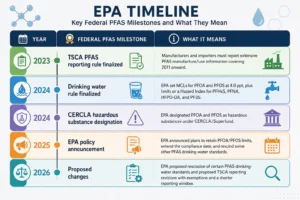
This timeline matters because it shows that the 2026 story is not a clean break from earlier regulation. It is a recalibration layered on top of a still-active federal PFAS program.
Why EPA is revising
EPA’s stated reasons for revising parts of the PFAS framework include legal vulnerability, implementation concerns, and feasibility issues. In drinking-water rulemaking, EPA has acknowledged Safe Drinking Water Act procedural requirements, while water systems and commenters have raised issues around monitoring, treatment lead time, infrastructure upgrades, and cost.
The proposed TSCA reporting revisions reflect similar concerns about practicality and burden. EPA’s 2026 proposal cites situations where manufacturers are least likely to know whether PFAS were present at low levels, and it shortens the reporting window from a six-month period starting in April 2026 to a three-month period beginning 60 days after the final rule becomes effective.
EPA is also trying to make the rules more defensible in court. That does not mean EPA has abandoned the science; it means the agency appears to be narrowing or revising certain provisions to reduce procedural risk while preserving the parts that are most likely to survive challenge.
Drinking water standards
The most important point for drinking water is that PFOA and PFOS limits remain. EPA’s 2025 announcement said it intended to keep the current standards for those two PFAS, while extending the compliance date from 2029 to 2031.
That extension matters for public water systems because it gives them more time to plan, finance, design, and install treatment or source-water solutions. The 2024 rule had already built in flexibility, including monitoring options and a nationwide two-year capital improvement extension under SDWA, but EPA is now proposing even more time for full compliance with the PFOA/PFOS standards.
Importantly, a later compliance date does not mean a weaker health finding. EPA’s 2024 materials still describe PFOA and PFOS as compounds for which there is no safe exposure level anticipated, and the final rule set the MCLG at zero for both substances.
Standards under review
EPA’s 2026 proposal would rescind the drinking-water determinations for PFHxS, PFNA, and HFPO-DA (GenX) and would also remove the related Hazard Index standard for mixtures containing PFHxS, PFNA, HFPO-DA, and PFBS.
A rescission means EPA is proposing to withdraw or reverse a prior regulatory determination. It does not mean EPA is declaring the chemicals safe or irrelevant; it means EPA is reconsidering whether the existing drinking-water standards should remain in force in their current form.
That distinction matters. The proposal is about regulatory structure, timing, and legal durability, not about a scientific conclusion that these PFAS pose no risk.
TSCA reporting changes
EPA’s PFAS reporting rule under TSCA Section 8(a)(7) remains one of the most consequential federal PFAS obligations for manufacturers and importers. The 2023 rule requires reporting on PFAS manufactured or used since 2011, including volumes, uses, exposures, byproducts, and hazards.
The 2026 proposal would add major exemptions, including PFAS in mixtures or products at or below 0.1%, imported articles, byproducts, impurities, non-isolated intermediates, and chemicals made solely for research and development. EPA also proposes to shorten the reporting window from six months to three months after the final rule becomes effective, which would compress internal data-gathering timelines for companies that have been preparing for the April 2026 reporting start.
This is a major operational change, but it is not a cancellation of PFAS reporting. Companies still need a defensible process for identifying PFAS in portfolios, gathering supplier data, and documenting why products are or are not reportable under the final rule once it is issued.
Compliance deadlines
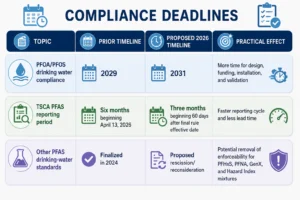
The compliance-date changes are particularly important for water utilities and large industrial users because capital projects often take years. EPA’s earlier drinking-water materials already recognized the need for monitoring, treatment selection, public notification, and phased implementation, and the 2026 proposals further extend that schedule for selected obligations.
What is not changing
PFOA and PFOS remain regulated under the drinking-water framework, and EPA’s 2026 proposals do not eliminate those standards. EPA also continues to treat PFAS as a major public health and environmental concern, as shown in its 2024 rulemaking materials and ongoing PFAS program pages.
PFAS testing and monitoring are not disappearing. Public water systems still need to monitor for regulated PFAS, and the broader PFAS data environment continues through EPA’s drinking-water programs and TSCA reporting requirements.
The CERCLA hazardous substance designation for PFOA and PFOS also remains in effect, which means Superfund liability and reporting implications continue for those substances. State PFAS restrictions also continue independently, so a federal adjustment does not preempt every state requirement.
Myths vs facts
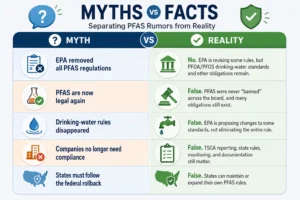
This is the cleanest way to explain the issue to non-specialists. The federal picture is changing, but the compliance burden is not going away.
State rules matter more
States such as California, Maine, Minnesota, New York, and Washington have been active on PFAS restrictions, reporting, or product-related controls, and many state programs continue to move independently of federal timing. That means a company with national operations can be compliant federally and still noncompliant in one or more states.
For multistate organizations, that reality is likely to become more important, not less. If EPA narrows some federal requirements, state regulators may fill the gap with tighter product, water, or remediation rules, especially where local contamination concerns are already high.
A practical compliance approach is to treat federal law as the floor, not the ceiling. Companies should map federal obligations alongside state-specific restrictions and update that map whenever a rule is proposed, finalized, or litigated.
Business impacts
Manufacturers
Manufacturers are most affected by TSCA reporting, product stewardship reviews, and substitution planning. A PFAS inventory should include ingredients, process chemicals, byproducts, imported articles, and supplier declarations so the company can respond quickly to final reporting requirements.
Chemical suppliers
Chemical suppliers need accurate SDS updates, customer communication, and downstream disclosure processes. If a product contains PFAS or may be subject to reporting or state restrictions, customers will increasingly expect transparent documentation and prompt updates.
Laboratories
Laboratories may see stronger demand for PFAS testing, method validation, and low-level detection work. The 2024 drinking-water rule relied on practical quantitation levels in the low-ppt range, so reliable analytical capability remains central to compliance.
Water utilities
Water utilities need to keep monitoring, treatment planning, and public notification workflows active. EPA’s drinking-water materials still emphasize initial monitoring, ongoing compliance monitoring, public reporting, and treatment or source-water actions when standards are exceeded.
EHS managers
EHS managers should treat PFAS as a cross-functional compliance issue involving inventory review, waste streams, reporting, due diligence, and risk assessment. In many organizations, the immediate challenge is not only technical compliance but also document control and enterprise visibility across sites and suppliers.
How Companies Should Respond
A good response plan is straightforward and auditable. Companies should review PFAS inventories, identify affected chemicals, track EPA rulemaking, monitor state laws, update SDS documentation, review supplier disclosures, maintain compliance records, and prepare for more rule changes.
That checklist is especially important because rulemaking is still in motion. The final 2026 outcomes may differ from the proposals, and businesses that wait for certainty often end up compressing months of work into a few weeks.
The best practice is to build a repeatable PFAS governance process rather than treating each rule as a one-off event. That is the only realistic way to manage reporting, monitoring, product stewardship, and customer inquiries across multiple business units.
Why SDS Management Matters
SDS management plays an important role in PFAS compliance because PFAS may appear in formulations, coatings, process aids, surfactants, or imported products in ways that are not obvious from a casual inventory review. A centralized SDS library helps identify PFAS-containing chemicals, track updated supplier information, and support internal reporting workflows.
For organizations using SDS management software such as CloudSDS, the value is not just storage but traceability. Updated SDS libraries, supplier document management, regulatory reporting support, and audit readiness can help teams answer basic questions faster: where PFAS may be present, which sites use them, and whether disclosures align with current rules.
This is especially useful when state rules, federal reporting, and customer requests all arrive at once. Strong SDS governance reduces the chance that PFAS issues remain hidden until an inspection, due-diligence review, or utility procurement questionnaire exposes them.
FAQ
-
What is changing in EPA PFAS regulations in 2026?
EPA is proposing to keep PFOA and PFOS drinking-water standards, extend their compliance deadline to 2031, rescind standards for PFHxS, PFNA, and GenX, and revise TSCA PFAS reporting with exemptions and a shorter reporting window.
-
Has EPA banned PFAS?
No. EPA has not banned PFAS across the board; it has regulated specific PFAS in specific programs.
-
Are PFOA and PFOS still regulated?
Yes. EPA’s 2026 proposals retain the current drinking-water limits for PFOA and PFOS.
-
What is the PFAS Hazard Index?
It is a mixture-based compliance metric EPA used in the 2024 drinking-water rule for PFHxS, PFNA, HFPO-DA, and PFBS; EPA is proposing to rescind that standard in 2026.
-
Which PFAS standards are being rescinded?
The EPA proposed rescinding the drinking-water regulatory determinations for PFHxS, PFNA, and HFPO-DA (GenX), along with the mixture Hazard Index tied to PFHxS, PFNA, HFPO-DA, and PFBS.
-
Do businesses still need PFAS reporting?
Yes. TSCA PFAS reporting still exists, although EPA has proposed exemptions and a shorter reporting window.
-
What are TSCA PFAS reporting requirements?
The 2023 TSCA rule requires manufacturers and importers to report PFAS manufacture or use information dating back to 2011, including volumes, uses, exposures, byproducts, and hazards.
-
How do state PFAS regulations differ from federal rules?
States can regulate PFAS independently and may impose stricter or broader requirements than federal law.
-
What industries are most affected by PFAS regulations?
Manufacturers, water utilities, chemical suppliers, laboratories, waste handlers, and organizations with large procurement or product-stewardship footprints are especially affected.
Conclusion
The 2026 PFAS changes are a targeted revision rather than a wholesale rollback. Core protections for PFOA and PFOS remain in place, while EPA is proposing to reconsider standards for several other PFAS and extend certain compliance deadlines.
Organizations should continue preparing for PFAS compliance because state regulations, reporting obligations, and future EPA actions remain active and subject to further rulemaking. In practical terms, the compliance burden is changing shape, not disappearing.
Simplify Your SDS Management
CloudSDS gives your team instant access to 23M+ safety data sheets with AI-powered search, automated updates, and full OSHA/GHS compliance — all from one platform.
Leave A Comment