
Imagine a situation from 2015 at a chemical plant. Its chemical inventory has 4,200 products. The EHS manager enters with a paper-based SDS binder, which was last updated in 2012. The manager has been searching for an SDS for acetone for the past hour and will probably find a document that does not contain updated information. Clearly, he or she will have followed outdated handling protocol, and nobody will know about it until the next audit.
Now, let's come back to 2026. The EHS manager retrieves that desired SDS using an AI-powered environmental health and safety management platform in seconds. Apart from the document, he or she can also access additional information like the last time the SDS was updated. Moreover, the platform may have already flagged the California regulatory change overnight, automatically cross-referenced it against the chemical inventory, and generated a prioritized action list.
Well, this is not a story but a reality.
In 2025, a survey conducted among 162 EHS professionals at the Wolters Kluwer Sustainable Performance Forum (SPF) revealed a growing interest in AI adoption across EHS functions (source link: https://hsereview.com/regional-coverage/middle-east/wolters-kluwer-survey-highlights-growing-ai-investment-in-ehs-management)
- 28% of EHS practitioners reported currently using AI within their departments.
- 49% of EHS functions plan to invest in AI within the next 12 months.
Why Did the Traditional Method Fail?
Mainly because it was built for a system from a different time. It's about a time when organizations used to collect paper-based SDSs. Workers were trained with laminated cards. Compliance audits ran on spreadsheets. Incident reports moved through email chains. Certainly, the system was not bad. However, it's not ideal for a dynamic world. Organizations these days are expanding fast; regulations keep changing rapidly. To keep up with the speed, a faster method is required.
Compliance gap
- Chemical hazards remain a major workplace risk, with OSHA estimating that 32 million workers across more than 3.5 million workplaces are regularly exposed to hazardous chemicals during their jobs. (source link: https://www.tdi.texas.gov/)
- Workplace health and safety challenges continue to grow globally, as the ILO reports that nearly 3 million workers lose their lives each year due to work-related accidents and diseases, marking an increase of more than 5% since 2015. (source link: https://www.ilo.org/resource/news/nearly-3-million-people-die-work-related-accidents-and-diseases)
- Occupational diseases account for the vast majority of work-related deaths, with approximately 2.6 million fatalities annually linked to long-term exposure to workplace hazards, highlighting the importance of proactive safety and chemical management programs.
What AI does in an EHS context
1. Predicts incidents before they happen
It becomes simple to analyze multiple leading indicators if using AI-powered predictive analytics. A report shows that AI-driven predictive maintenance alone can reduce equipment-related incidents by up to 20%. Also, it cut unplanned downtime by 50%.
2. Automates regulatory compliance tracking
AI platforms are great help in monitoring regulatory databases in real time. Besides, these platforms automatically highlight changes. Thus, EHS professionals can always stay ready for any types of audits with the right preparations.
3. Reduces incident reporting time
The manual incident reporting is not always perfect. These are time-consuming and error-prone. Besides, these are often inconsistent across sites. Many studies have found that AI-assisted EHS platforms reduced incident reporting time by up to 75% compared to traditional paper or spreadsheet-based methods.
4. Enhances chemical management
With an AI platform, managing thousands of SDSs and chemical products becomes easier. It reduces time required to locate any required SDS or information related to the chemical inventory. This directly reduces the risk of workers being exposed to hazards due to outdated or inaccessible safety information.
5. Improves worker safety through computer vision
AI-powered systems also equip a team with a tool that allows prior risk analysis. Thus, all the team members can understand all the potential hazards around them and take necessary precautions.
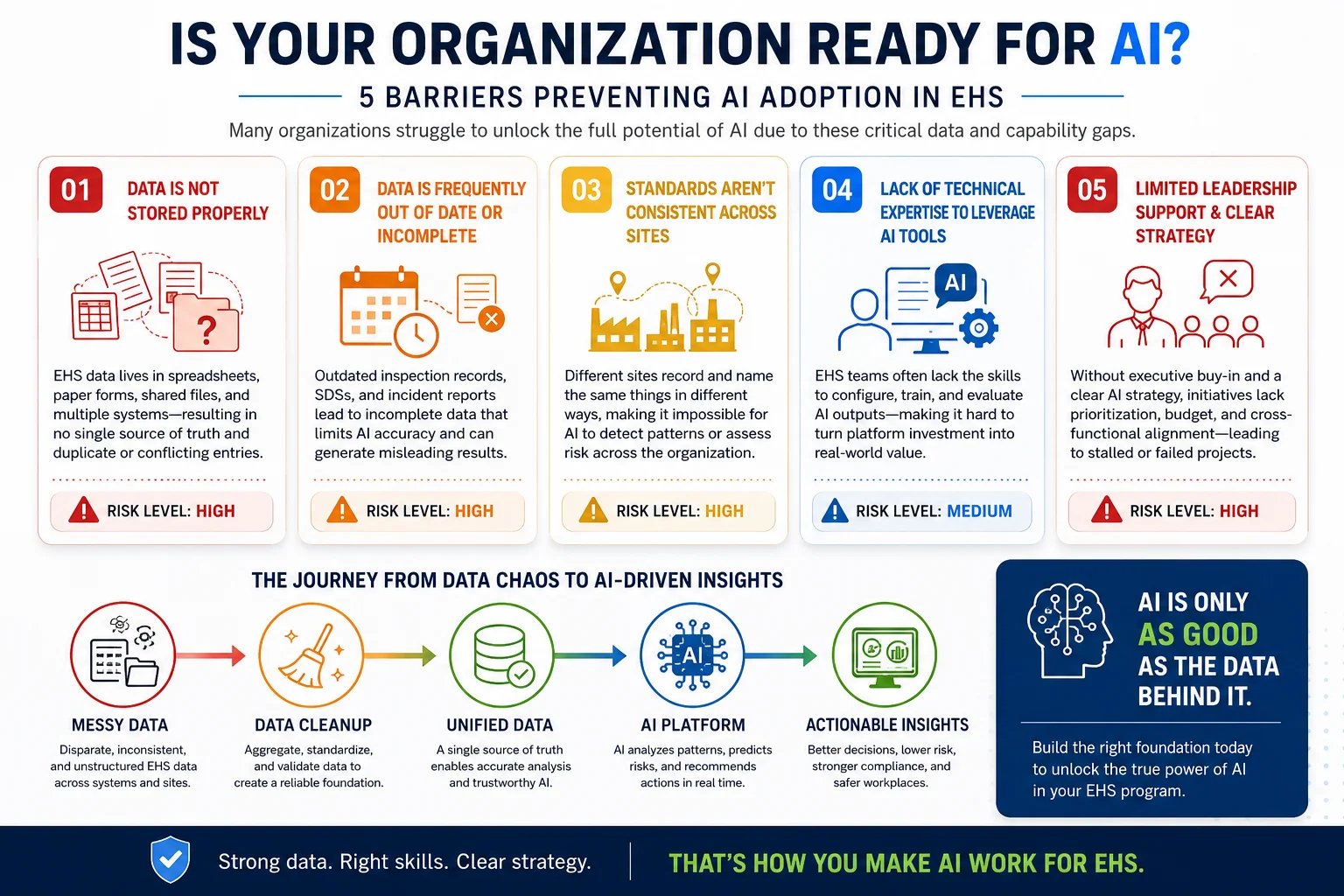
Why most companies are not ready to utilize AI platforms
1. Data is not stored properly
Most firms keep their EHS data in a combination of spreadsheets, paper forms, shared files, and several standalone software solutions. So, there is no one source of truth; the same chemical can have three distinct entries across three different platforms. But before AI can do anything meaningful, all this scattered data has to be aggregated and cleaned up, which is a major effort in itself.
2. Data isfrequently out of date or incomplete
Inspection records, SDS documents, and incident reports that were last updated years ago are still functioning documents for many organizations. Incomplete data not only limits what AI can do, but it can also mislead AI, generating recommendations based on conditions that no longer exist.
3. Standards aren't consistent across sites
A corporation with ten sites will often have ten somewhat different ways of recording the same incidence or naming the same substance. Because of the irregularity, it's practically impossible for an AI system to evaluate data across sites or spot company-wide risk patterns. A great number of organizations have never taken the fundamental step of standardizing data collection and entry.
4. Many EHSteams lack the technical expertise to leverage AI tools
Purchasing an AI platform is one thing, but knowing how to configure, train, and evaluate its outputs is another. A lack of digital skills across EHS teams is one of the major obstacles to successful implementation of technology. The most powerful AI technology will be underutilized or exploited if the team lacks even basic data literacy.
5. Leadership doesn't always view EHS as a data problem
In many firms, EHS is simply a compliance checkbox, not a data-driven role that requires the right digital infrastructure. That means EHS teams are often the last to get investment in current software, clean data systems, or IT assistance. AI adoption in EHS will, at best, be superficial unless leadership recognizes that better EHS results begin with better data.
How AI platforms are improving compliance
1. Automated management
AI platforms can automatically collect, organize, and update Safety Data Sheets (SDSs) from multiple suppliers. This helps ensure employees always have access to the latest hazard and safety information.
2. Faster regulatory monitoring
AI tools can track changes in chemical regulations and compliance requirements across different regions. This reduces the risk of non-compliance caused by outdated policies or manual oversight.
3. Intelligent chemical inventory tracking
AI can analyze inventory data in real time to identify missing records, expired chemicals, or storage issues. This improves inventory accuracy and supports safer chemical handling practices.
4. Predictive risk assessment
AI platforms can evaluate chemical usage patterns and historical incident data to identify potential safety risks. Organizations can take preventive actions before incidents occur, reducing workplace hazards.
5. Enhanced compliance reporting
AI can automatically generate compliance reports and maintain audit-ready documentation. This saves time for EHS teams and simplifies inspections, audits, and regulatory submissions.
How to choose the right AI-based EHS platform
1. Begin with your biggest pain point
All AI-based EHS platforms are going to show you a great product demo, but the real question is, can it solve your biggest pain point? When your team is spending hours chasing down updated SDS documents, you need a platform with robust chemical management capabilities. If incident reporting is your bottleneck, find one with automated workflows and mobile reporting tools. Never let the sales pitch drive the buying decision.
2. How the platform handles regulatory updates
EHS regulations are always changing at the federal, state, and international levels, and your platform needs to automatically stay current. Ask the vendor specifically how they track regulatory changes, how quickly they are updated in the system, and if they send alerts proactively. If your platform is forcing your team to manually update compliance rules, you're defeating the point of AI.
3. Ensure it integrates with your current systems
If your new EHS platform can't talk to your existing HR, operations, or chemical inventory systems, you'll create more silos, not fewer. Before signing any contract, do a full map of all the systems your EHS data currently lives in, and ask the vendor for a clear integration roadmap. AI creates insights that are truly relevant to your unique organization by enabling seamless data flow between systems.
4. Assess the quality of support and onboarding
Many EHS teams are small, and few have dedicated IT support, so the amount of implementation help a vendor can provide is hugely important. Check if onboarding includes data migration help, staff training, and an account manager dedicated for the first few months. If you pick a technically powerful platform with bad onboarding support, your team will be frustrated and adoption will slow down significantly.
5. Demand evidence, not promises
Any vendor will tell you that their platform reduces compliance risk or saves hundreds of hours a year. But ask them to show you real case studies from companies that are the same size and in the same industry as yours. Ask for a pilot program or a trial period so your team can test the platform with your actual data before you commit to the long haul. The right platform will embrace such scrutiny.
Is this replacing EHS professionals?
-
This is a support:
An AI-based platform is certainly not a replacement. This type of software mainly automates all the repetitive tasks like managing SDSs, tracking inventory, and data analysis. It can never replace the requirement of decision-making and experience of EHS professionals.
-
Human assessments are necessary:
Making the right decision is not possible without the critical verification or assessments that the professionals make. The AI-based platforms only simplify the process of decision-making.
-
Improves efficiency:
The EHS professionals can also improve their efficiency to handle critical tasks using such tools. They can reduce workload and stay focused on strategic safety initiatives, employee engagement, and risk prevention.
Conclusion
AI integration only simplifies the process of chemical safety and compliance management. However, it's necessary to find the right product to get the actual benefits. So, first understand your team's requirements, check the features of the available platforms, and make your final decision. Ultimately, with the right decision, your team can always stay prepared for all types of audits without requiring much effort daily.

Simplify Your SDS Management
CloudSDS gives your team instant access to 23M+ safety data sheets with AI-powered search, automated updates, and full OSHA/GHS compliance — all from one platform.
Leave A Comment