
Last Updated on October 16, 2026
Quick Answer
School chemical management is how a school buys, stores, tracks, uses and disposes of hazardous chemicals safely. That covers science labs, art rooms, custodial closets, pools, and shops. A working program includes a current chemical inventory, labeled containers with SDSs staff can find quickly, storage by compatibility, staff training, regular inspections, disposal through a qualified hazardous waste vendor, and a Chemical Hygiene Plan wherever OSHA’s Laboratory Standard applies.
School chemical management: OSHA rules, storage, disposal, and inventory guide
Introduction
Ensuring a safe and compliant learning environment within schools critically depends on establishing robust chemical management practices that address every stage of a substance's lifecycle. This comprehensive approach necessitates stringent adherence to OSHA regulations, the implementation of meticulous storage protocols, the adoption of environmentally responsible disposal methods, and the maintenance of a precise chemical inventory guide.
OSHA standards, for example, provide the essential framework for hazard communication and workplace safety, mandating how schools must identify, label, and convey risks associated with various chemicals to staff and students. Furthermore, proper storage is paramount, requiring chemicals to be segregated by compatibility, housed in appropriate containers, and maintained under conditions that prevent degradation, leaks, or accidental reactions.
Equally vital are environmentally sound disposal methods, which must strictly comply with all local, state, and federal guidelines to prevent pollution and protect public health.
Ultimately, an accurate and continuously updated inventory guide serves as the indispensable backbone of effective management, enabling schools to track chemical quantities, anticipate potential hazards, and optimize purchasing decisions. Together, these integrated components form a critical system designed to minimize risks and foster a secure educational experience for all. The key facts include:
- Laboratory Standard: 29 CFR 1910.1450 (Written Chemical Hygiene Plan)
- Hazard Communication Standard: 29 CFR 1910.1200 (labels, SDSs, training)
- Hazardous waste: RCRA, generator rules at 40 CFR 262
- Fire protection: NFPA 45 for laboratories, NFPA 30 for flammable liquids
- Coverage: Federal OSHA covers private-school employees. Public-school employees are covered only where a state-plan program applies.
What is a school chemical management program?
A school chemical management program is the set of written rules and routines that control a chemical from the day it’s ordered to the day it leaves the building. It’s broader than “lab safety.” The chemistry stockroom is only one part of it. The pool pump room, the art kiln area, and the custodian’s closet all count.
What does a chemical management program cover?
- Purchasing and receiving
- Storage, use, and handling
- A current chemical inventory
- SDS access and hazard communication
- Waste disposal and periodic cleanouts
Who is responsible for chemical management in schools?
Responsibility is shared, and it fails when nobody owns it. The usual split looks like this:
- Chemical Hygiene Officer (CHO): Owns the program and the written plan.
- Science department head and lab staff: Run day-to-day ordering, storage, and prep-room practice.
- Facilities and custodial teams: Handle cleaning products, pool chemicals, paints, and pesticides, which fall under hazard communication rather than the Laboratory Standard.
- District environmental health and safety (EHS): Sets district policy, arranges waste pickups, and audits individual buildings.
Why does chemical management matter in schools?
1. Student and staff health risks
Exposure routes in a school are ordinary ones: inhalation in poorly ventilated prep rooms, skin contact during demonstrations, and fumes from a spill that nobody reported. Children may be more vulnerable than adults to some chemicals. EPA and ATSDR point out, for example, that children breathe more air relative to body weight and that mercury vapor is heavy and settles low, closer to where small children are. That risk varies by chemical and dose, so treat it as a reason for caution, not a blanket claim.
2. Fines and penalties
Current federal OSHA maximums are $16,550 per serious or other-than-serious violation and $165,514 per willful or repeated violation, with failure to abate running $16,550 per day. OSHA published no inflation adjustment for 2026, so the 2025 figures still apply. These are ceilings, and proposed penalties are usually lower. Public schools are a special case: OSHA notes that state plans aren't required to impose monetary penalties on state and local government employers, so enforcement depends on your state.
3. Evacuations, closures, and lost instructional time
The best-documented school chemical incident is mercury. At Ballou High School in Washington, DC, in 2003, a student took about 250 mL of elemental mercury from a science lab and shared it with classmates. According to EPA's case study, the school closed for 35 days, more than 200 homes were tested, and cleanup cost roughly $1.5 million. A few hundred milliliters of an obsolete lab chemical cost a school more than a month of classes.
4. Community trust and environmental impact
Parents hear "chemical spill" and assume the worst, whether or not anyone was harmed. A slow or vague response damages trust faster than the incident itself. Contamination can also leave the building, on shoes, clothing, buses, and, in the Ballou case, into students' homes. Chemicals dumped down a drain can also pass through to a local wastewater system that wasn't designed to treat them.
Which regulations apply to chemicals in schools?
Does OSHA apply to your school?
The OSH Act covers private employers directly, so private schools fall under federal OSHA. It excludes state and local government employees, so public-school staff are protected only if the state runs an OSHA-approved plan that covers public employers. Also, OSHA protects employees, not students. Students are protected indirectly through the practices staff are required to follow.
| School type | Where it operates | OSHA coverage for employees |
|---|---|---|
| Private school | Any state | Federal OSHA (or the state plan, in a state-plan state) |
| Public school | State-plan state covering public employers | State-plan OSHA, with state-specific enforcement |
| Public school | State with no plan covering public employers | No OSHA coverage. State labor or employee safety rules may apply. |
Check out your state agency’s website. State plans must be at least as effective as federal OSHA, and many adopt the Laboratory Standard verbatim.
OSHA Laboratory Standard: The Chemical Hygiene Plan
Where 29 CFR 1910.1450 applies, a school lab must have a written Chemical Hygiene Plan (CHP) and designate a CHO. The plan has to cover standard operating procedures, criteria for choosing control measures such as fume hoods, how to confirm that ventilation works, and when particularly hazardous operations need prior approval. Employees must get training at the assignment and before new exposure hazards. Exposure monitoring is required if there’s reason to believe an exposure exceeds an OSHA action level or permissible limit. Employees who show signs of overexposure, or who are involved in a spill or leak, must have access to medical consultation. The standard also bars removing or defacing labels on incoming containers and requires labs to keep SDSs accessible.
Hazard Communication Standard and HCS 2024
The Hazard Communication Standard (29 CFR 1910.1200) covers everything outside the lab, including custodial, maintenance, art, and shop. It requires labeled containers, SDSs for each hazardous chemical, and training on what’s in the workplace.
OSHA’s 2024 update aligned the standard with GHS Revision 7, and a January 15, 2026 final rule pushed each compliance date back four months. The dates split by role, and it’s easy to mix them up:
- Manufacturers, importers, and distributors: May 19, 2026, for substances; November 9, 2027, for mixtures
- Employers, including schools: November 20, 2026, for updating workplace labels, hazard communication programs, and training on substances, and May 19, 2028, for mixtures
For a school, the practical consequence is that SDSs and labels arriving from suppliers will increasingly show the new format. Staff training should explain what’s changed.
EPA RCRA hazardous waste rules
Under 40 CFR 262, hazardous waste generators fall into three categories by monthly volume. Very small quantity generators (VSQGs) produce 100 kg or less per month. Small quantity generators produce more than 100 kg and less than 1,000 kg. Large quantity generators produce 1,000 kg or more. Most schools qualify as VSQGs, but that status doesn’t mean the rules don’t apply. A VSQG must still identify its hazardous waste, store it safely, and send it to an approved facility. Acute hazardous wastes have a much lower threshold of 1 kg per month. Some states regulate VSQGs more strictly than the EPA does, and EPA’s alternative lab rule (Subpart K) is limited to colleges, universities, and teaching hospitals, so K-12 schools can’t use it.
Fire codes and NFPA 45
NFPA 45 covers fire protection for laboratories using chemicals, and NFPA 30 covers flammable and combustible liquids. Local fire marshals enforce whichever edition your jurisdiction has adopted. The recurring issues in schools are quantity limits, which vary with how the lab is classified, flammable liquids stored outside approved cabinets, and refrigerators that aren’t rated for flammable vapors. Cabinets are subject to capacity limits (NFPA 30 caps a cabinet at 120 gallons of Class I, II, and IIIA liquids). Ask your fire marshal for the quantity limits that apply to your building.
State school chemical management programs
Several states, including Massachusetts, New York, and Oklahoma, have supported school programs aimed at removing mercury and legacy lab chemicals. Funding, eligibility, and rules differ, and they change. Check with your state environmental agency before you budget for a cleanout. You may be able to get help with the cost.
Where are hazardous chemicals found in schools?
-
Science laboratories and preparation rooms
Reagents, acids, bases, solvents, and older stocks. Prep rooms and back shelves usually hold the biggest surprises.
-
Art rooms and theaters
Solvents, glaze components, pigments, aerosol fixatives, adhesives, and theatrical paints.
-
Custodial and maintenance areas
Cleaning agents, disinfectants, pesticides, paints, strippers, and floor-care products. These are often the largest volumes in the building.
-
Pools, CTE, automotive, and woodworking shops
Pool-treatment chemicals (never store oxidizers like chlorine near acids), fuels, coatings, finishes, brake and parts cleaners, and welding supplies.
Legacy and high-risk chemicals to remove
| Material | Why it's a problem | What to do |
|---|---|---|
| Mercury and mercury thermometers | Toxic vapor, expensive to clean up, banned in schools in several states | Replace with alcohol or digital instruments. Use professional removal. |
| Picric acid | Can become shock- and friction-sensitive as it dries | Do not move it. Call a hazardous waste professional. |
| Peroxide-forming ethers | Form explosive peroxides over time, especially when opened | Date containers. Dispose of old ones through a specialist. |
| Sodium and potassium metals | React violently with water, and potassium can form unstable crusts | Dispose of professionally. Check storage under oil. |
| Benzene | Carcinogen | Remove, and substitute a safer solvent. |
| Formaldehyde specimens | Carcinogen and sensitizer, regulated under 29 CFR 1910.1048 | Switch to preserved or digital specimens. |
| Old or unidentified stock | Unknown hazard and no way to dispose of it correctly | Segregate and have it professionally assessed. |
Compare this list with your state's restricted-chemical rules and any cleanout guidance it offers.
How do you build a school chemical management program?
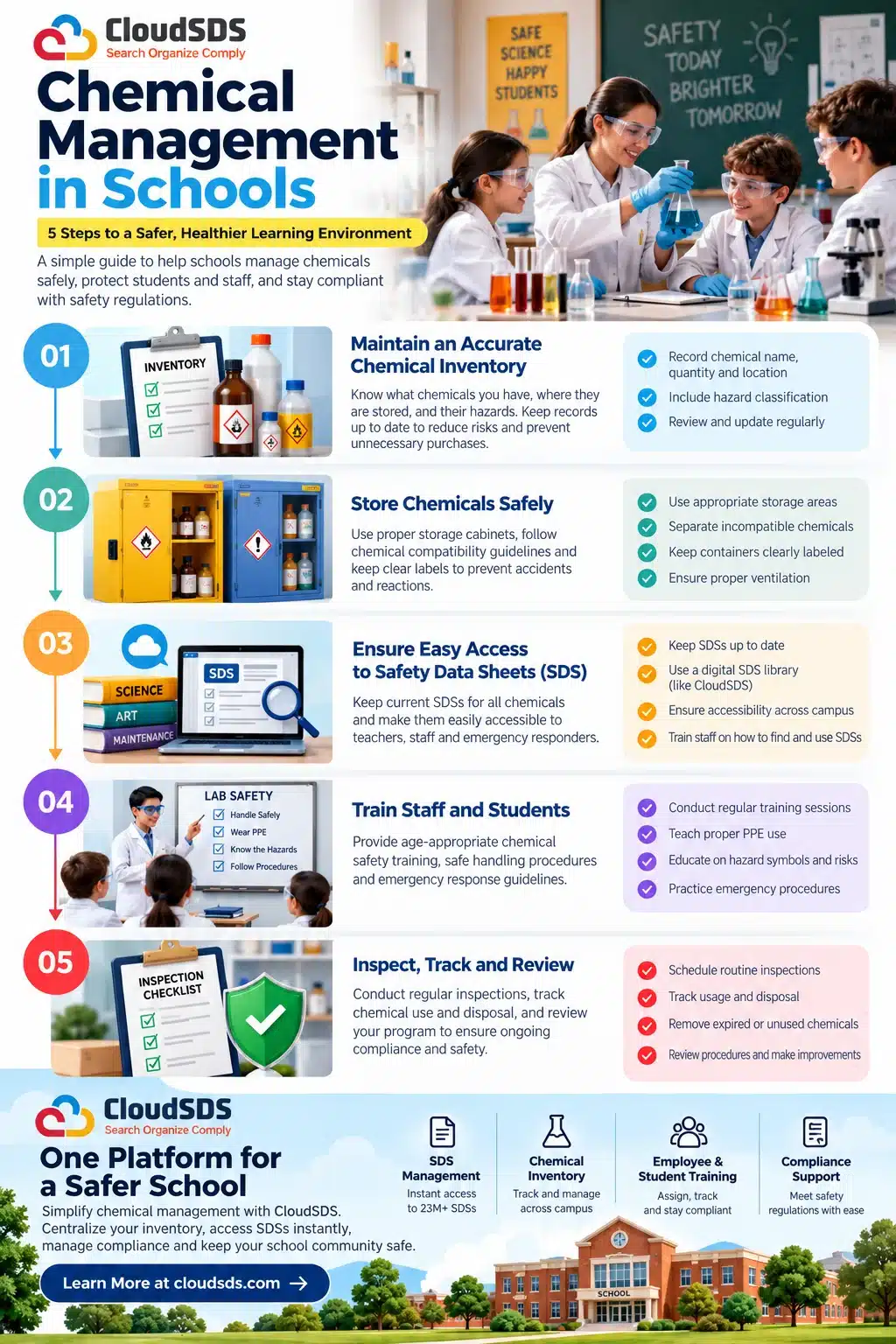
Step 1: Take a complete chemical inventory.
Walk every space that could hold a chemical: labs, prep rooms, art rooms, custodial closets, shops, and storage rooms. Record the name, concentration, quantity, container type, location, hazard class, and age. Flag anything without an SDS or a legible label.
Step 2: Clean out unneeded and legacy chemicals.
Separate expired, deteriorated, duplicate, and unidentified material from what you actually use. Have professionals handle anything unstable or unknown, and use any state or local cleanout program available to you.
Step 3: Write policies, including a chemical hygiene plan.
Document how you’ll purchase, handle, store, train, respond to emergencies, and dispose. Name the people responsible. Where the Laboratory Standard applies, the plan must include the elements described above.
Step 4: Set a purchasing and receiving policy.
Buy the smallest quantity that gets the job done, and require approval before ordering. Don’t accept donations of chemicals unless they’re approved in advance. At receiving, check the label, the container’s condition, and that an SDS has arrived, and date the container.
Step 5: Label containers and keep SDSs accessible.
Keep manufacturer labels intact. Add workplace labels to secondary containers where required. Anyone who works with a chemical should be able to find its SDS in a minute or less. Keep the inventory matched to what’s on the shelf.
Step 6: Conduct risk assessments
For each activity, identify the hazard, who might be exposed, how, and what could go wrong. Choose controls (ventilation, substitution, quantity limits), PPE, and handling steps accordingly. Use OSHA requirements and published laboratory safety guidance as the baseline.
Step 7: Train staff and students.
Staff training should cover safe handling, SDS access, emergency response, and your CHP. Students need age-appropriate instruction and constant supervision. A learning management system (LMS) can assign and track staff training.
Step 8: Run regular inspections.
Look at storage areas, labels, containers, and workspaces for leaks, crystals, bulging lids, spills, and incompatible storage. Write down what you found, who will fix it, and when you’ll look again.
How should chemicals be stored in school labs?
1. Store by compatibility, not alphabetically
Alphabetical storage puts nitric acid next to nitrites and organics. Group chemicals by hazard class and then alphabetize within each group. Oxidizers, acids, bases, flammables, and water-reactives each need separation. A compatibility chart posted in the stockroom keeps new staff from guessing.
2. Use flammable-liquid and corrosive cabinets.
Flammable liquids beyond small working quantities belong in listed flammable cabinets. Corrosives belong in corrosion-resistant cabinets with secondary containment. Keep acids and bases in separate compartments. Check quantity limits with your fire marshal.
3. Secure stockrooms and control access.
Lock the stockroom, give keys only to named staff, and keep a record of who holds them. Students shouldn’t be in chemical storage areas without a teacher. The Ballou incident began with an unlocked lab.
4. Manage shelf life, dating, and peroxide formers.
Write the received date and open date on every container. Inspect for crusting, discoloration, and corroded caps. Peroxide formers need their own procedure, and the usual rule is to test or discard them within months of opening, with a shorter window for the more dangerous ones. If you find crystals around a cap, don’t touch the container.
How should schools dispose of chemicals?
1. Run a school laboratory cleanout.
Begin with the inventory. Split what you have into known, unknown, incompatible, and potentially unstable. Don’t open or move anything that’s suspect. A document trail showing what was removed, when, and by whom protects the school later.
2. Work with a qualified hazardous waste vendor.
A qualified vendor classifies the waste, packs it for transport according to Department of Transportation rules, and sends it to a permitted facility. Ask the vendor for its EPA ID number, its experience with school labs, and a signed manifest after the pickup.
3. Know what must never go down the drain or into the trash.
What’s allowed depends on the chemical, its waste classification, and your local wastewater authority. Solvents, heavy-metal solutions, mercury, oxidizers, water-reactive metals, and unknowns should never go in the drain or the dumpster. If you aren’t sure, treat it as hazardous until a professional says otherwise. Check federal, state, and local requirements, because the stricter rule applies.
How does chemical inventory software help schools?
What does a chemical inventory system track?
- Names, quantities, and storage locations
- Hazard classifications linked to SDSs
- Receipt, use, movement, and disposal history
- Searchable records, with barcode scanning where available
- Role-based user access and mobile access where available
How does inventory software support compliance and emergency response?
Software supports the records behind your CHP and hazard communication procedures. It makes chemicals and their SDSs faster to find, which matters most when a fire department asks what's in the room. It helps with inspections and flags of mismatches between records and shelves. It doesn't make you compliant or prevent a penalty. That still depends on what people do.
School chemical safety checklist
Use this once a year as an internal review:
- Review the complete chemical inventory.
- Confirm quantities and storage locations.
- Identify unknown, outdated, deteriorated, or unneeded chemicals.
- Arrange removal of anything that needs a cleanout.
- Verify SDS availability for hazardous products.
- Check labels and container conditions.
- Inspect compatibility and segregation.
- Review flammable liquid and corrosive storage.
- Verify that access to storage areas is restricted.
- Review the CHP and other chemical safety policies.
- Check training records and emergency procedures.
- Document findings and corrective actions.
Frequently asked questions
-
Does OSHA apply to public schools?
Federal OSHA doesn’t cover state and local government employees. Public-school staff are covered only in states with an OSHA-approved plan that includes public employers. Check your state agency.
-
Do schools need a chemical hygiene plan?
If employees use hazardous chemicals in a laboratory covered by 29 CFR 1910.1450, yes, the plan must be in writing. Some states add their own requirements, so confirm locally.
-
Who is responsible for chemical safety in a school?
The CHO owns the program. Lab staff run daily practice, facilities teams manage cleaning and maintenance of chemicals, and district administration provides funding, policy, and oversight.
-
How often should a school update its chemical inventory?
Update records whenever chemicals are received, moved, used up, or disposed of, and do a full physical check at least once a year. Some states or programs set their own intervals.
-
What chemicals should be removed from school labs?
Mercury, picric acid, old peroxide formers, sodium and potassium metals, benzene, formaldehyde specimens, deteriorated containers, and anything unidentified need assessment and, usually, removal.
-
How do schools dispose of old laboratory chemicals?
Inventory first, identify the waste, have professionals assess anything unstable or unknown, and then ship through a licensed hazardous waste vendor with documentation.
Conclusion
Good chemical management isn't about one big cleanout or one well-written binder. It's a handful of habits that hold up when staff change: an inventory that matches the shelves, SDSs people can find, chemicals stored by hazard, and waste that leaves through proper channels. Start with the inventory. Most schools find something they didn't know they had, and it's far cheaper to deal with it on a calm Tuesday than after a spill.
Then work through the rest in order: clear out what you don't need, write down who's responsible, train the people who handle chemicals, and review the whole system every year. Check your state's rules as you go, because they differ more than most people expect. Do those things consistently and you'll lower the odds of an injury, an evacuation, or a citation.

References
Track Every Chemical on Site
CloudSDS chemical inventory management tracks quantities, locations, and expiration dates across all your sites — linked directly to up-to-date SDS.
Leave A Comment