
- Summary
- Key Takeaways
- Introduction
- What are hazard statements?
- What are precautionary statements?
- How does the codification system work?
- Hazard statement codes (H-Codes)
- How are hazard statements assigned?
- How are precautionary statements selected?
- Relationship between H-Codes and P-Codes
- Where do H-codes and P-codes appear?
- Hazard statements vs. precautionary statements
- Common examples by hazard type
- Common mistakes in chemical labeling
- Regulatory requirements
- How does SDS management software help?
- Frequently asked questions
Summary
Hazard statements and codes (H-codes) are the standard phrases assigned to a chemical hazard under GHS. The precautionary statements and codes (P-codes) are the standard phrases assigned to a chemical precaution under GHS. This codification is to communicate hazards in a consistent, understandable way across countries, sectors, and languages. Knowing how to classify H and P statements can also help companies maintain compliance with regulations, improve safety in the workplace, and speed up SDS authoring and chemical labeling activities.
Key Takeaways
- Hazard (H) and Precautionary (P) statements are GHS-standardized alphanumeric identifiers. Consistent chemical hazard communication at the country and business level.
- H-statements are classified into three types depending on the country’s hazard level. physical (H200 series), health (H300 series), and environmental (H400 series) hazards.
- The P-statements are divided into four functional categories: General, Prevention, Response, and Storage/Disposal. The P-statements give consumers directions for safe handling of a hazard.
- Each hazard category has a pre-approved statement, so companies can’t change the language, but they can choose the right codes for their product.
- The right coding is essential for both labels and Safety Data Sheets (SDS), which has a direct impact on regulatory compliance with OSHA, REACH, and CLP.
- There also are combined-statement codes (e.g., H314 + H400), which help to reduce label clutter when there are many hazards with overlapping cautionary language.
- Incorrect or missing H/P codes are among the biggest violations of SDS and label compliance, which carry higher legal and safety risks at work.
- CloudSDS and other digital solutions help ensure H/P codes are assigned correctly by auto-populating categories from validated GHS databases, which reduces the risk of manual entry errors.
Introduction
Chemical labels and Safety Data Sheets (SDS) are all about a system of standardized codes that communicate risk and safety instructions in a consistent and universally understood manner. These codes—Hazard Statements (H-codes) and Precautionary Statements (P-codes)—constitute the backbone of the Globally Harmonized System (GHS) of Classification and Labelling of Chemicals.
If you are a safety professional, an EHS manager, or anyone else who is responsible for chemical labeling or Hazard Communication (HazCom) compliance, then understanding how these codes are organized, assigned, and used is critical. This guide goes into detail on the codification system, the relationship between H-codes and P-codes, and how businesses can stay compliant with OSHA, GHS, CLP, and WHMIS requirements.
What are hazard statements?
A hazard statement is a standard phrase for a hazard class and category that outlines the nature of a chemical hazard and, where relevant, the degree of hazard. Each hazard statement has a unique alphanumeric code consisting of the letter “H” followed by three digits (for example, H225 or H314).
What risk does this chemical pose? That’s the one core question that hazard statements exist to answer. They describe things such as flammability, toxicity, corrosivity, or environmental harm—but they don’t tell the user how to protect themselves. That is the purpose of precautionary statements, which are addressed in the next section.
Key characteristics of hazard statements:
- Definition – A pre-approved, standardized phrase tied to a specific hazard classification.
- Purpose – To clearly communicate the type and severity of a hazard to anyone handling, storing, or transporting the chemical.
- Standardized wording – The exact text of each hazard statement is fixed under GHS; companies cannot reword or paraphrase it.
- Relationship with hazard classes – Every hazard statement is directly linked to a specific hazard class and hazard category (e.g., Flammable Liquids Category 2).
- Why they exist – To remove the ambiguity and inconsistency that existed before GHS, when different countries and manufacturers used their own hazard language.
- International standardization—Because the wording and codes are harmonized globally, a worker in one country can recognize the same hazard statement—and the risk it represents—on a label printed in another country, even in translation.
What are precautionary statements?
A precautionary statement is a standardized phrase that describes recommended measures to minimize or prevent adverse effects resulting from exposure to a hazardous chemical or from its improper storage or handling. Precautionary statements are identified by codes beginning with “P,” followed by three digits (for example, P210 or P280).
Where hazard statements answer “What’s the risk?” precautionary statements answer “What should I do about it?”
Precautionary statements typically cover:
- Definition—An instruction that exists for one or more hazard classes.
- Purpose – To give practical, real-world advice that will reduce the risk or severity of injury.
- Risk reduction – Measures to prevent exposure in the first place.
- Safe handling advice such as wearing gloves, using ventilation and/or an approved respirator, and keeping away from ignition sources.
- Emergency actions—First aid or action to be taken in case of exposure (e.g., wash eyes, obtain medical attention).
- Storage – Guidance on how and where a chemical should be stored to avoid problems.
- Disposal – Information on the safe disposal of the chemical, its container, or contaminated material in accordance with local regulations.
In short, precautionary statements tell users how to minimize or prevent undesired effects from exposure or improper handling—turning the danger information into an actionable plan.
How does the codification system work?
Numbering is where the GHS system gets its power. Instead of randomly assigning codes, H-codes and P-codes are systematically numbered to organize related risks and precautions. Once you get the idea, you can usually tell the general class of hazard from the code alone before you ever read the entire statement.
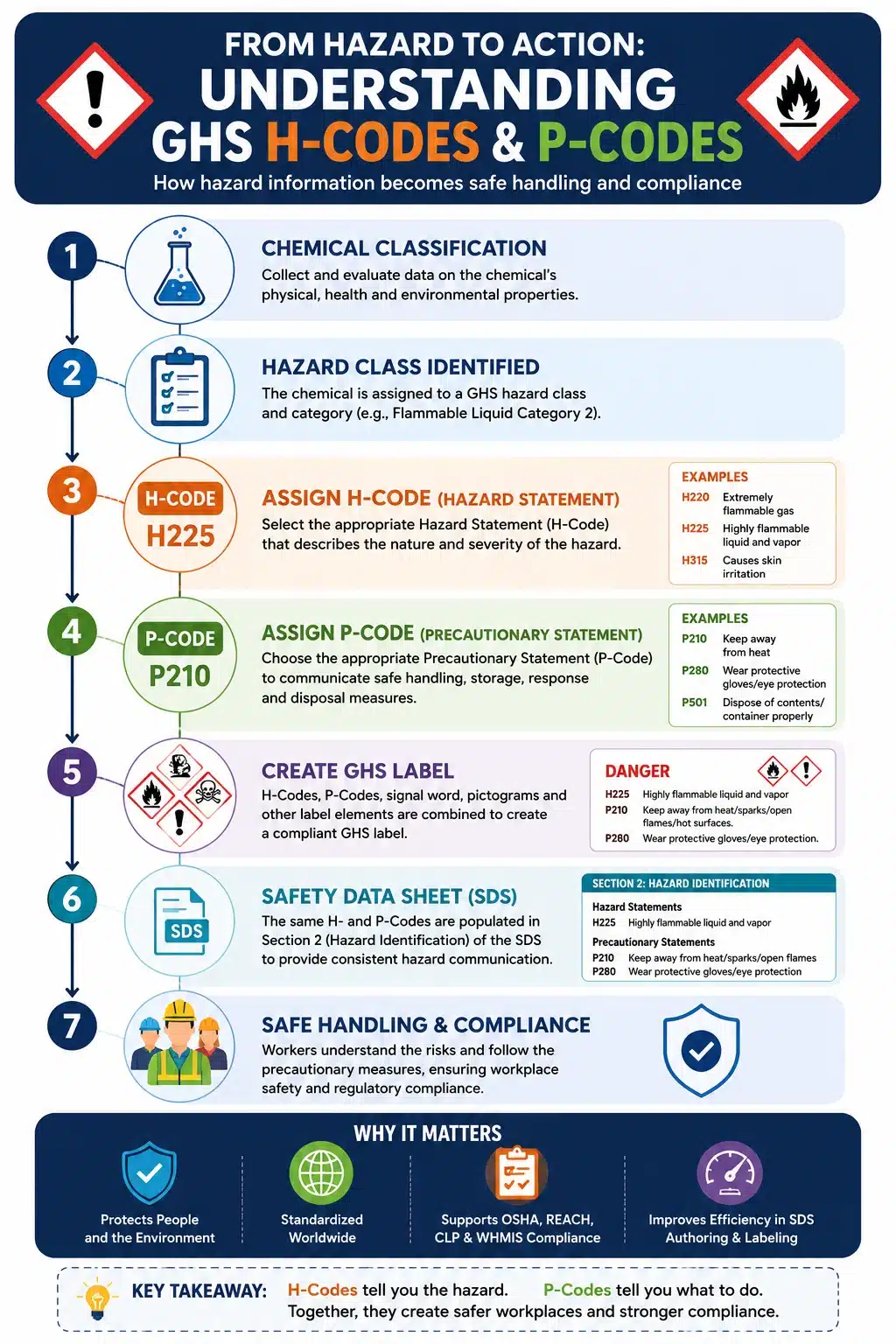
Hazard statement codes (H-Codes)
Hazard statement codes are grouped by the first digit into three broad categories:
| Code Range | Hazard Category |
|---|---|
| H2xx | Physical hazards |
| H3xx | Health hazards |
| H4xx | Environmental hazards |
Examples:
| Code | Statement |
|---|---|
| H220 | Extremely flammable gas |
| H225 | Highly flammable liquid and vapor |
| H300 | Fatal if swallowed |
| H315 | Causes skin irritation |
| H400 | Very toxic to aquatic life |
This numbering system exists because it supports consistent classification across languages and jurisdictions. A safety professional reviewing an SDS from a supplier in Germany, Japan, or Brazil can immediately recognize that an “H3xx” code relates to a health hazard, even without reading the full translated text. This consistency is a major part of why GHS adoption has improved cross-border chemical safety communication.
Precautionary statement codes (P-Codes)
Precautionary statement codes follow a similar logic, grouped into five functional categories:
| Code Range | Category |
| P1xx | General |
| P2xx | Prevention |
| P3xx | Response |
| P4xx | Storage |
| P5xx | Disposal |
Examples:
| Code | Statement |
| P101 | If medical advice is needed, have product container or label at hand |
| P210 | Keep away from heat, hot surfaces, sparks, open flames, and other ignition sources |
| P280 | Wear protective gloves/protective clothing/eye protection/face protection |
| P305+P351+P338 | If in eyes, Rinse cautiously with water for several minutes. Remove contact lenses, if present and easy to do so. Continue rinsing |
| P501 | Dispose of contents/container in accordance with local/regional/national/international regulations |
Employees must keep in mind that some precautionary statements, such as P305+P351+P338 above, combine many codes into a single instruction. It's intentional. Many response activities tend to naturally occur together as a sequence; hence, combined P-codes are used to eliminate repetition and label clutter. It consolidates the three overlapping instructions into a single, unambiguous, actionable statement. The merged code makes labels easier to read without losing vital safety information.
How are hazard statements assigned?
Hazard statements are not selected by the manufacturer or the writer of the label but are the product of a systematic hazard classification process. This method often includes:
- Hazard classification–Assessment of the chemical (or mixture) against the prescribed GHS criteria to classify the relevant hazard classes.
- Hazard categories – Chemicals are further categorized into categories within each hazard class that indicate severity (for example, Category 1 is generally the most severe hazard within a class).
- Physical hazards – Assessed by standardized test procedures (e.g., flammability, explosivity, oxidizing potential).
- Health hazards – Determined based on toxicological data, existing research, or read-across from structurally comparable chemicals.
- Environmental hazards – Based on aquatic toxicity and environmental persistence/bioaccumulation data.
- Testing – The data for classification is generated by physical and toxicological testing (or verified alternative methods).
- Supplier responsibility—The chemical maker or importer is responsible for the right classification of the hazard in compliance with the applicable regulatory procedures.
In other words, danger statements are not randomly assigned but are based on the chemical's GHS categorization. Once a danger class and category are determined, the H-code and the exact phrasing of the statement are required and there is no choice as to how to word the statement.
How are precautionary statements selected?
Unlike hazard statements, which are a direct one-to-one output of classification, precautionary statement selection involves a bit more judgment. GHS guidance allows label authors some flexibility in choosing which precautionary statements are most relevant, based on factors such as the following:
- Hazard category—The severity and type of hazard influence which precautionary measures are appropriate.
- Exposure routes – Whether the primary risk is through inhalation, skin contact, ingestion, or eye contact.
- Storage – Specific conditions needed to prevent degradation, reaction, or accidental release.
- Disposal – Requirements based on the chemical's classification and local waste regulations.
- Emergency response – What actions are most critical if exposure or an incident occurs.
Relationship between H-Codes and P-Codes
Because hazard statements describe what’s wrong, and precautionary statements describe what to do about it, the two are deeply interconnected. Each hazard classification typically has a recommended set of associated precautionary statements, though, as noted above, not all of them need to appear on a given label.
| Hazard Statement | Related Precautionary Statements |
| H225 (Highly flammable liquid and vapor) | P210, P233, P403 |
| H315 (Causes skin irritation) | P264, P280, P302+P352 |
| H318 (Causes serious eye damage) | P280, P305+P351+P338 |
| H330 (Fatal if inhaled) | P260, P271, P304+P340 |
This mapping is one of the most useful things to understand about the codification system, because it shows the logical chain from hazard to protective action: classification determines the hazard statement, and the hazard statement, in turn, points toward a defined set of appropriate precautionary responses. Once this relationship clicks, reading an unfamiliar SDS or label becomes far less intimidating — even a long list of codes starts to read as a coherent risk-and-response story rather than a wall of jargon.
Where do H-codes and P-codes appear?
Hazard and precautionary statements aren't confined to just one document — they appear in two primary places: the product label and the Safety Data Sheet.
On GHS labels
A compliant GHS label includes several standardized elements working together, including:
- Product identifier
- Signal word
- Pictograms
- Hazard statements
- Precautionary statements
- Supplier information
Here, the hazard and precautionary statements are displayed as full text (not just the code), giving workers immediate, readable information without needing to reference a separate document.
On safety data sheets
Within the 16-section SDS format, hazard and precautionary statements appear primarily in Section 2: Hazard Identification, which lists the chemical GHS classification, applicable hazard statements, precautionary statements, and signal word. However, elements of this information may also be referenced or expanded upon in other sections — such as Section 4 (First-Aid Measures), Section 7 (Handling and Storage), and Section 13 (Disposal Considerations) — since these sections elaborate on the practical application of the precautionary statements introduced in Section 2.
Hazard statements vs. precautionary statements
Because these two code types are so closely linked, it helps to see them side by side:
| Hazard Statements | Precautionary Statements |
| Describe the hazard | Describe the protective action |
| Assigned after classification | Assigned after hazard evaluation |
| Begin with ” H” | Begin with “P” |
| Communicate the nature of risk | Communicate risk-reduction measures |
| Wording cannot be modified | Selected from a standardized list |
Understanding this distinction is fundamental — not just for compliance, but for effective worker training. Employees don't need to memorize every code, but they should understand that an "H" code tells them about danger, while a "P" code tells them what action to take.
Common examples by hazard type
To see the codification system in action, it helps to look at how H-codes and P-codes work together for specific categories of chemicals.
Flammable chemicals
Flammable chemicals are typically classified under the H2xx series. A common example is a highly flammable solvent classified with H225 (highly flammable liquid and vapor), which is commonly paired with precautionary statements like P210 (Keep away from heat/sparks/open flames) and P233 (keep container tightly closed). Many flammable liquid SDS documents will list these codes together in Section 2, giving a clear, at-a-glance picture of both the fire risk and the handling precautions required.
Corrosive chemicals
Corrosive compounds are often classed with H314 (it causes serious skin burns and eye damage). This danger is generally associated with cautious statements such as P280 (Wear protective gloves/eye protection/face protection) and the combined response statement P305+P351+P338 (IF IN EYES: Rinse off well with water…). These codes together signal both the seriousness of a chemical burn hazard and the first-aid response necessary immediately.
Toxic chemicals
Many toxic substances will have numerous danger statements. A toxic chemical, for example, would be H300 (Fatal if eaten) and H331 (Toxic if inhaled). They are often used in conjunction with cautious statements aimed at prevention, such as P260 (Do not breathe dust/fume/gas/mist/vapor/spray) and P264 (Wash … hands completely after handling), based on the need to prevent exposure through numerous channels.
Oxidizers
Oxidizing chemicals are often classified with H271 (May cause fire or explosion; strong oxidizer). Associated precautionary statements typically include P220 (Keep/store away from clothing/combustible materials) and the response statement P370+P378 (In case of fire: use appropriate extinguishing media)—reflecting both the storage precautions and emergency response needed for this hazard class.
Common mistakes in chemical labeling
Even with a standardized system in place, labeling errors remain common — and they're often the root cause of compliance citations or workplace incidents. The most frequent mistakes include:
-
Missing H statements
Omitting a hazard statement that applies based on the chemical's actual classification.
-
Incorrect P statements
Including precautionary statements that don't match the listed hazards or omitting critical ones.
-
Wrong signal word
Using "Warning" when "Danger" is required, or vice versa, based on the hazard severity.
-
Wrong pictograms
Displaying pictograms that don't correspond to the chemical's actual hazard classification.
-
Outdated classifications
Continuing to use hazard information based on an old SDS version after a reclassification has occurred.
-
Copying labels without verification
It means reusing a label or SDS template from a similar product without confirming that the classification still applies.
-
Translation errors
Introducing inconsistencies or inaccuracies when the hazard and precautionary statement text is translated for international markets.
Because H-codes and P-codes are meant to be exact and standardized, even small deviations—like a slightly reworded hazard statement—can create compliance gaps and confuse workers who rely on consistent language safety decisions.
Regulatory requirements
The codification of hazard and precautionary statements underpins several major regulatory frameworks around the world:
OSHA Hazard Communication Standard (HazCom)
Adopts the GHS classification and labeling criteria in the United States, requiring employers and chemical manufacturers to use standardized hazard statements, precautionary statements, pictograms, and SDS formatting.
UN GHS
The foundational international framework from which most national regulations, including OSHA’s HazCom standard, derive their hazard statement and precautionary statement systems.
CLP Regulation (EU)
The European Union’s Classification, Labelling and Packaging regulation, which implements GHS principles with some region-specific additions.
WHMIS (Canada)
Canada’s Workplace Hazardous Materials Information System, aligned with GHS to ensure consistency with U.S. and international labeling practices.
How does SDS management software help?
Given the complexity of correctly classifying chemicals and assigning the right combination of H-codes and P-codes, many organizations turn to dedicated SDS management platforms like CloudSDS to reduce manual error and streamline compliance. These platforms typically support:
- Automated classification support – Helping cross-reference chemical data with GHS classification criteria to reduce manual guesswork.
- Centralized SDS library—Storing all Safety Data Sheets in one accessible, searchable system rather than scattered across departments or binders.
- Label consistency – Ensuring that hazard and precautionary statements on generated labels match the underlying SDS classification exactly.
- Version control – Tracking SDS updates and reclassifications, so outdated hazard information isn’t accidentally left in circulation.
- Regulatory updates – Keeping classification criteria current as GHS revisions or regional regulations change.
- Multi-language SDS access – Supporting accurate, consistent hazard communication for multinational or multilingual workforces.
- Audit readiness – Making it easier to demonstrate compliance during OSHA inspections or internal safety audits by keeping documentation organized and traceable.
For organizations managing hundreds or thousands of chemical products, software-driven consistency is often the difference between a label that’s technically compliant and one that’s actually accurate.
Frequently asked questions
What are H-codes?
Hazard statement codes, or H-codes, are the standardized alphanumeric codes (starting with "H") that characterize the nature and severity of a chemical hazard under the GHS.
What are P-codes?
P-codes, or precautionary statement codes, are standardized alphanumeric identifiers (starting with "P") that identify recommended procedures to prevent or reduce harm from a hazardous substance.
Are H-codes mandatory?
Yes. Under OSHA's Danger Communication Standard and other GHS-aligned standards, danger statements are required on both labels and Safety Data Sheets.
Do P-codes appear on every label?
Not always. Hazard statements are normally necessary in their entirety. However, in order to maintain readability of the label, label authors may select the most relevant precautionary statements instead of providing all linked P-codes.
Can one chemical have multiple H-statements?
Yes. A chemical can belong to more than one hazard class; for instance, a compound might be both flammable and poisonous, necessitating more than one hazard statement on its label and SDS.
Why are some P-statements combined?
Combined P-codes (e.g., P305+P351+P338) combine related response actions in a single instruction to avoid redundancy and improve the readability of the label.
Simplify Your SDS Management
CloudSDS gives your team instant access to 23M+ safety data sheets with AI-powered search, automated updates, and full OSHA/GHS compliance — all from one platform.
Leave A Comment