
Last Updated on September 22, 2026
Summary
Formaldehyde is a Group 1 carcinogen that remains essential to modern medicine—sterilizing equipment, fixing tissue for diagnosis, and inactivating pathogens in vaccines. This guide covers its chemistry and mechanism of action, its major clinical and pharmaceutical uses, and the safety framework built around it: OSHA’s enforceable exposure limits, NIOSH’s stricter recommendations, vaccine safety-margin data, required engineering controls, and disposal rules, closing with the lower-formaldehyde alternatives now emerging in histology and manufacturing.
Key Takeaways
- Formaldehyde’s medical utility comes entirely from one property—its ability to form methylene bridges that cross-link proteins and nucleic acids, which is what fixes tissue, sterilizes equipment, and inactivates pathogens.
- Instrument/device sterilization, histological tissue fixation (typically 10% neutral buffered formalin), vaccine antigen/toxoid inactivation, and various pharmaceutical/research applications (e.g., ChIP, gel capsules).
- Residual formaldehyde in vaccines is trace-level and far below the amount naturally present in an infant’s own bloodstream from normal metabolism—CDC/CHOP data puts the safety margin in the 600–1,500x range.
- IARC classifies formaldehyde as Group 1, with the strongest evidence linking occupational exposure to nasopharyngeal carcinoma and, with prolonged higher-level exposure, leukemia.
- OSHA’s enforceable PEL (0.75 ppm TWA) is considerably less conservative than NIOSH’s recommended exposure limit (0.016 ppm TWA).
- Engineering and work-practice controls (fume hoods, local exhaust ventilation, downdraft stations) are the required first line of defense; respirators are a backstop only when those controls can’t bring exposure below regulatory limits.
- Unused/off-spec formalin is federally listed hazardous waste (U122); spent formalin is often non-hazardous but still typically requires institutional EHS sign-off before any drain disposal.
- Medical surveillance records tied to formaldehyde exposure must be retained for the duration of employment plus 30 years.
- Glyoxal-based and alcohol-based fixatives offer lower-hazard alternatives to formalin, with adoption strongest in the EU and in molecular-testing-heavy institutions, but formalin remains the default almost everywhere due to validation burden.
Use of Formaldehyde in the Medical Field: A Detailed Guide
Chemical identity & properties
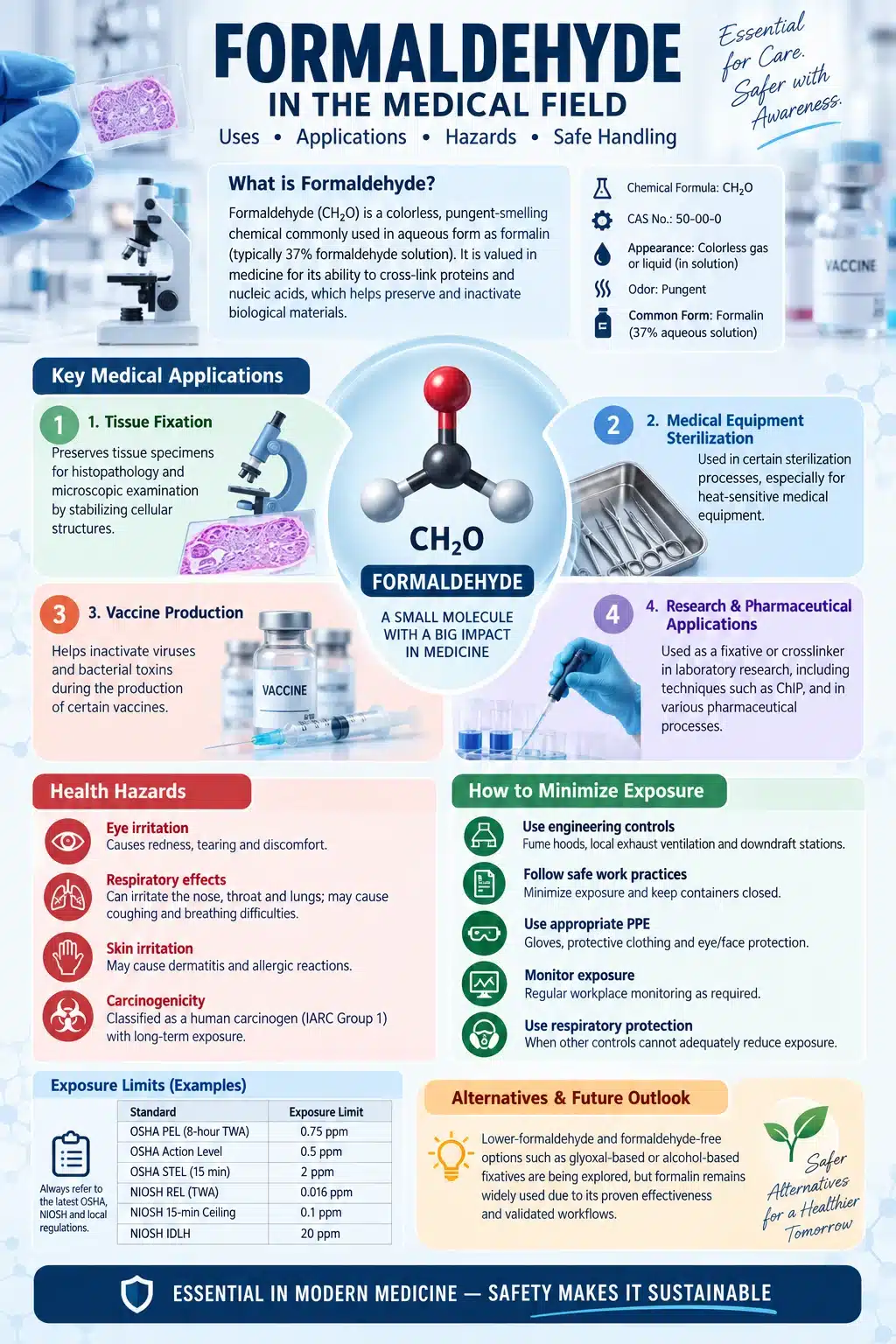
Formaldehyde is registered under CAS number 50-00-0, with the chemical formula CH₂O (H₂C=O) and a molecular weight of 30.03 g/mol. In aqueous form, it is sold as formalin, typically a 37–40% w/v solution stabilized with methanol.
Physical & chemical properties
At room temperature, formaldehyde is a colorless, pungent, flammable gas that is highly soluble in water. Its reactivity with proteins and nucleic acids is what makes it useful medically—and hazardous occupationally.
Mechanism of action
Protein & nucleic acid cross-linking
Formaldehyde works by forming methylene bridges between proteins and nucleic acids, cross-linking them in place. This single chemical property underlies nearly every medical use of the compound: it's what fixes tissue for microscopy, what sterilizes equipment, and what inactivates viruses and bacterial toxins for vaccine production.
Medical applications overview
Formaldehyde's cross-linking action is put to work across four main areas of medicine: instrument and device sterilization, histological tissue fixation, vaccine antigen inactivation, and a range of pharmaceutical and research applications. Each is detailed below.
Sterilization of medical equipment
Procedures & safety
Formaldehyde gas or solution is used to sterilize heat-sensitive medical devices that can’t tolerate autoclaving. Because concentration and exposure-time protocols vary by device type, complexity, and the specific sterilization system in use, facilities should follow the manufacturer’s validated cycle and the CDC’s Guideline for Disinfection and Sterilization in Healthcare Facilities rather than a single fixed figure.
Tissue fixation & histopathology
Standard fixation protocol
The histology standard is 10% neutral buffered formalin (NBF), which delivers roughly 4% free formaldehyde to the tissue—the concentration histopathology labs are built around for routine specimen processing.
Technical considerations
Fixation quality depends on adequate penetration time relative to block thickness, and formalin fixation is well documented to cause measurable tissue shrinkage and to be markedly hyperosmolar compared to physiological fluid. Exact figures for penetration rate, percent shrinkage, and osmolality vary across published histology references and specimen types, so a page making specific numeric claims here should cite a named source (e.g., College of American Pathologists guidance) for each figure rather than presenting a single number as universal.
Vaccine production; viral & toxoid inactivation
Formaldehyde is used to inactivate whole viruses and bacterial toxins, converting toxins into safe toxoids for vaccines such as DTaP and inactivating hepatitis A virus for hepatitis A vaccines, per CDC and FDA vaccine ingredient documentation.
Vaccine residual formaldehyde & safety margins
Per-dose content by vaccine
Trace residual formaldehyde remains in some finished vaccines after purification. Per-dose amounts include roughly 0.005–0.1 mg for Td/DT and DTaP-containing vaccines and about 0.05 mg (pediatric) to 0.1 mg (adult) for hepatitis A vaccines.
Endogenous comparison & safety margin
A 2-month-old infant's own bloodstream naturally contains roughly 1.1 mg of formaldehyde—a byproduct of normal metabolism—which is about 1,500 times more than the amount in any single vaccine dose, and animal studies have safely fed doses at least 600 times higher than vaccine content in drinking water. That 600–1,500x range is where the safety-margin figure comes from, and it's directly attributable to CDC/CHOP vaccine-safety documentation rather than needing a separate citation.
Pharmaceutical & research applications
Anti-infective formulations & gel capsules
Formaldehyde and its derivatives appear in some anti-infective drug formulations and in gel capsule manufacturing, where cross-linking properties help control capsule structure.
Omics research uses
In research settings, formaldehyde is a standard fixative and crosslinker in molecular biology techniques such as chromatin immunoprecipitation (ChIP) and certain proteomics workflows, where it captures protein–DNA and protein–protein interactions in place for analysis.
IARC carcinogen classification
carcinogen classification
The International Agency for Research on Cancer (IARC) classifies formaldehyde as a Group 1 carcinogen—a substance with sufficient evidence of carcinogenicity in humans. The strongest associations are with nasopharyngeal carcinoma, and the evidence base also points to a leukemia risk with prolonged, higher-level occupational exposure (IARC Monographs, Volume 100F).
OSHA occupational exposure standard
OSHA’s formaldehyde-specific standard, 29 CFR 1910.1048, sets a permissible exposure limit (PEL) of 0.75 ppm as an 8-hour time-weighted average, an action level of 0.5 ppm (also an 8-hour TWA), and a short-term exposure limit (STEL) of 2 ppm over any 15-minute period. Once exposure reaches the action level or STEL, the standard requires initial and ongoing exposure monitoring, along with regulated areas and medical surveillance for affected workers—obligations that apply directly to histology, pathology, and embalming settings where formaldehyde is in regular use.
NIOSH recommended exposure limit
NIOSH’s recommended exposure limit is considerably more conservative than OSHA’s enforceable PEL: a TWA of 0.016 ppm, with a 15-minute ceiling of 0.1 ppm, reflecting NIOSH’s position that formaldehyde is a potential occupational carcinogen. The Immediately Dangerous to Life or Health (IDLH) concentration is set at 20 ppm, based on acute inhalation toxicity data. The gap between NIOSH’s REL and OSHA’s PEL explains why “compliant with OSHA” and “at the level NIOSH recommends” are two different bars.
Acute & chronic health effects
Acute irritation effects
Formaldehyde is an acute irritant to the eyes, nose, and throat, with effects documented even at low airborne concentrations. Symptom severity tends to scale with concentration and exposure duration, and sensitized individuals can react at levels below what most people notice.
- Eyes, nose, and throat irritation are the most commonly reported symptoms, typically starting in the range where OSHA’s exposure limits apply.
- Odor is not a reliable warning sign. The odor threshold sits close to occupational exposure limits, and sensitized individuals may experience irritation below the point where they can smell it.
- Sensitized individuals can react at lower concentrations than the general population, sometimes with delayed onset and symptoms that persist for hours or days.
Respiratory & asthma-like effects
With higher or more prolonged exposure, formaldehyde effects extend beyond simple irritation into the lower respiratory tract, per ATSDR’s Toxicological Profile for Formaldehyde and OSHA health-effects documentation.
-
Asthma-like reactions:
Higher exposures are associated with asthma-like symptoms, including coughing, wheezing, chest tightness, and shortness of breath.
-
Airway inflammation:
More serious exposure can cause swelling of the throat and inflammation of the windpipe and bronchi.
-
Bronchial narrowing:
Previously sensitized individuals can develop significant airway narrowing at concentrations as low as 0.3 ppm.
-
Delayed and prolonged effects:
Symptoms can begin immediately or be delayed by several hours, and pulmonary injury may continue to worsen 12 hours or more after exposure ends.
-
Threshold context:
The commonly cited 0.1 ppm irritation threshold aligns with NIOSH’s 15-minute ceiling value, reinforcing that it reflects a regulatory judgment rather than an isolated figure.
Occupational biomonitoring evidence
Ghelli et al. (2021), Toxics
A 2021 study published in Toxics (Ghelli et al.) investigated oxidative and inflammatory changes in a hospital working population exposed to formaldehyde. The 68 workers recruited wore a personal air-formaldehyde passive sampler, provided a urine sample to measure 15-F2t-isoprostane and malondialdehyde (MDA), and gave a blood sample to measure tumor necrosis factor α (TNFα). Workers were split after the fact into a formalin-exposed group (mean air concentration 57.3 µg/m³) and a non-exposed group (13.5 µg/m³). The exposed group showed significantly higher levels of all three biomarkers (p < 0.001) than the non-exposed group (Ghelli et al., Toxics, 2021, DOI: 10.3390/toxics9080178).
Primary Source
Federica Ghelli, Valeria Bellisario, Giulia Squillacioti, Marco Panizzolo, Alfredo Santovito, and Roberto Bono, "Formaldehyde in Hospitals Induces Oxidative Stress: The Role of GSTT1 and GSTM1 Polymorphisms," Toxics (MDPI), 9(8), 178, published July 30, 2021. Verified via the MDPI Toxics landing page and indexed on PubMed (PMID: 34437496).
Engineering controls & PPE in healthcare settings
Ventilation & fume hood use
OSHA’s formaldehyde standard requires employers to reduce and maintain exposure at or below the PEL and STEL primarily through engineering and work-practice controls, not PPE. In practice, that means local exhaust ventilation; chemical fume hoods, vented dissection or downdraft grossing stations, snorkel arms, or covered immersion tanks—used in pathology and histology labs, autopsy suites, and embalming settings wherever formaldehyde solutions are handled. Because the odor threshold for formaldehyde (roughly 0.2–0.8 ppm) sits close to the PEL, any noticeable smell in a work area is itself a signal that ventilation isn’t adequately capturing vapor from the breathing zone. Only when engineering and work-practice controls can’t feasibly bring exposure below the PEL and STEL does the standard call for supplementing them with respirators—PPE is a backstop, not the first line of control.
PPE selection by task
PPE requirements scale with the task and the concentration of formaldehyde involved:
Routine handling / low-splash risk
Nitrile exam-style gloves, safety goggles, and a lab coat or gown—the baseline for most bench-level work.
Larger-volume work or direct contact risk
(specimen transfer, embalming, bulk decanting): heavier utility-grade nitrile or butyl rubber gloves, face shields in addition to goggles, and impervious aprons or arm sleeves, since OSHA requires protective clothing impervious to formaldehyde wherever skin could contact solutions of 1% or greater.
Above the PEL, or where engineering controls alone can’t achieve compliance
With the standard specifically requiring formaldehyde-approved chemical cartridges—ordinary organic-vapor cartridges are not rated for formaldehyde. Anyone using a tight-fitting respirator must first complete a medical evaluation questionnaire and pass a fit test before being cleared to wear one.
A quick safety shower and eyewash should be available anywhere when splash exposure to 1%-or-greater solutions is possible, consistent with OSHA and CDC laboratory safety guidance.
Waste & disposal management
Hazardous waste handling of formaldehyde solutions
Formaldehyde waste doesn’t get one blanket disposal rule—how it’s classified under RCRA depends on what stream it’s coming from.
Unused or off-spec Formaldehyde/Formalin
Unopened or expired commercial product, off-specification stock, and spill residue from unused product are federally listed as hazardous waste under EPA waste number U122 (40 CFR 261.33(f)). This must go out through licensed hazardous-waste disposal—manifested pickup by a permitted hauler—not down the drain or into regular trash.
Used Formalin
A working solution that’s already been used for fixation or specimen storage is treated differently: because it’s no longer the original commercial product and typically doesn’t exhibit the RCRA characteristics of ignitability, corrosivity, reactivity, or toxicity (40 CFR 261.21–261.24), it’s often classified as a non-hazardous spent material rather than U122 waste. In some facilities this means sewer disposal is technically permissible—but only with prior approval from the institution’s environmental authority or the receiving wastewater treatment plant, and subject to any state rules or BOD/discharge limits that apply locally.
The practical rule
Because the RCRA status of a given formaldehyde waste stream depends on its history (unused vs. spent), its methanol content, and state-level rules that can be stricter than federal ones, no lab or clinical facility should default to drain disposal without written sign-off from institutional biosafety/EHS. When in doubt, or when a stream contains other contaminants (tissue, methanol above certain thresholds), routing it through licensed hazardous-waste disposal is the safer default.
Regulatory recordkeeping & medical surveillance program
Exposure monitoring requirements
Once initial monitoring shows exposure at or above the action level (0.5 ppm) or STEL, employers must periodically re-measure exposure for affected workers and repeat monitoring any time a change in process, equipment, personnel, or controls could raise exposure—or if a worker reports respiratory or skin symptoms consistent with formaldehyde exposure.
Medical surveillance triggers
Medical surveillance kicks in for employees exposed at or above the action level or STEL, employees who develop signs or symptoms of formaldehyde exposure, and those with exposures during a spill or other emergency release. It typically includes a medical disease questionnaire, with a physician-directed physical exam for anyone the questionnaire flags for further evaluation.
Recordkeeping under 29 CFR 1910.1048(l)–(m), read alongside 29 CFR 1910.1020: exposure monitoring results, medical questionnaires and exam findings, and training records all have to be maintained and kept accessible to the employee or their representative. Medical records in particular must be retained for the duration of employment plus 30 years—a retention period long enough that many facilities keep records with the examining physician’s office under a custody agreement rather than in-house, so access, transfer, and confidentiality procedures need to be spelled out in advance.
Future alternatives & emerging substitutes
Low-formaldehyde & non-formalin systems
To reduce occupational exposure, histology labs and manufacturers have been exploring alternatives such as glyoxal-based fixatives and alcohol-based fixative systems, which aim to preserve tissue morphology while cutting formaldehyde use. Adoption remains partial—formality, familiarity, and validated performance still make it the default in most labs—but these substitutes are an active area of applied histology research worth watching.
Glyoxal-based fixatives
Not classified as a carcinogen and largely non-volatile, so it avoids formalin's main occupational exposure risk. A 2023 non-inferiority study found a glyoxal acid-free (GAF) formulation performed comparably to formalin, though IHC assays sometimes need re-optimization on glyoxal-fixed tissue.
Alcohol-based systems
Ethanol/methanol/acetic acid blends (Methacarn-type) skip cross-linking entirely, better preserving nucleic acids for molecular testing—but the different fixation mechanism changes tissue morphology, which pathologists are used to.
Adoption
Fastest in EU labs and molecular-testing-heavy institutions; formalin still dominates elsewhere since switching means re-validating diagnostic assays, not just swapping reagents.
Conclusion
Formaldehyde occupies an unusual place in medicine: a compound classified as a proven human carcinogen that is, at the same time, foundational to how healthcare diagnoses disease, sterilizes equipment, and manufactures vaccines. That tension is managed through dose, engineering controls, and regulation. The same cross-linking chemistry that makes formaldehyde hazardous at high, sustained occupational exposure is what makes it effective at fixing tissue for accurate diagnosis and inactivating pathogens for safe vaccines. The safety framework around it — OSHA's enforceable limits, NIOSH's more conservative recommendations, engineering controls as the first line of defense, task-specific PPE, and waste-stream-specific disposal rules — exists to keep the benefit while containing the risk. As lower-formaldehyde alternatives mature, especially in histology, that risk profile may keep shrinking without sacrificing diagnostic quality.

Simplify Your SDS Management
CloudSDS gives your team instant access to 23M+ safety data sheets with AI-powered search, automated updates, and full OSHA/GHS compliance — all from one platform.
Leave A Comment