
Last Updated on September 2, 2026
What Are the Different Forms of Hazardous Energy?
Summary
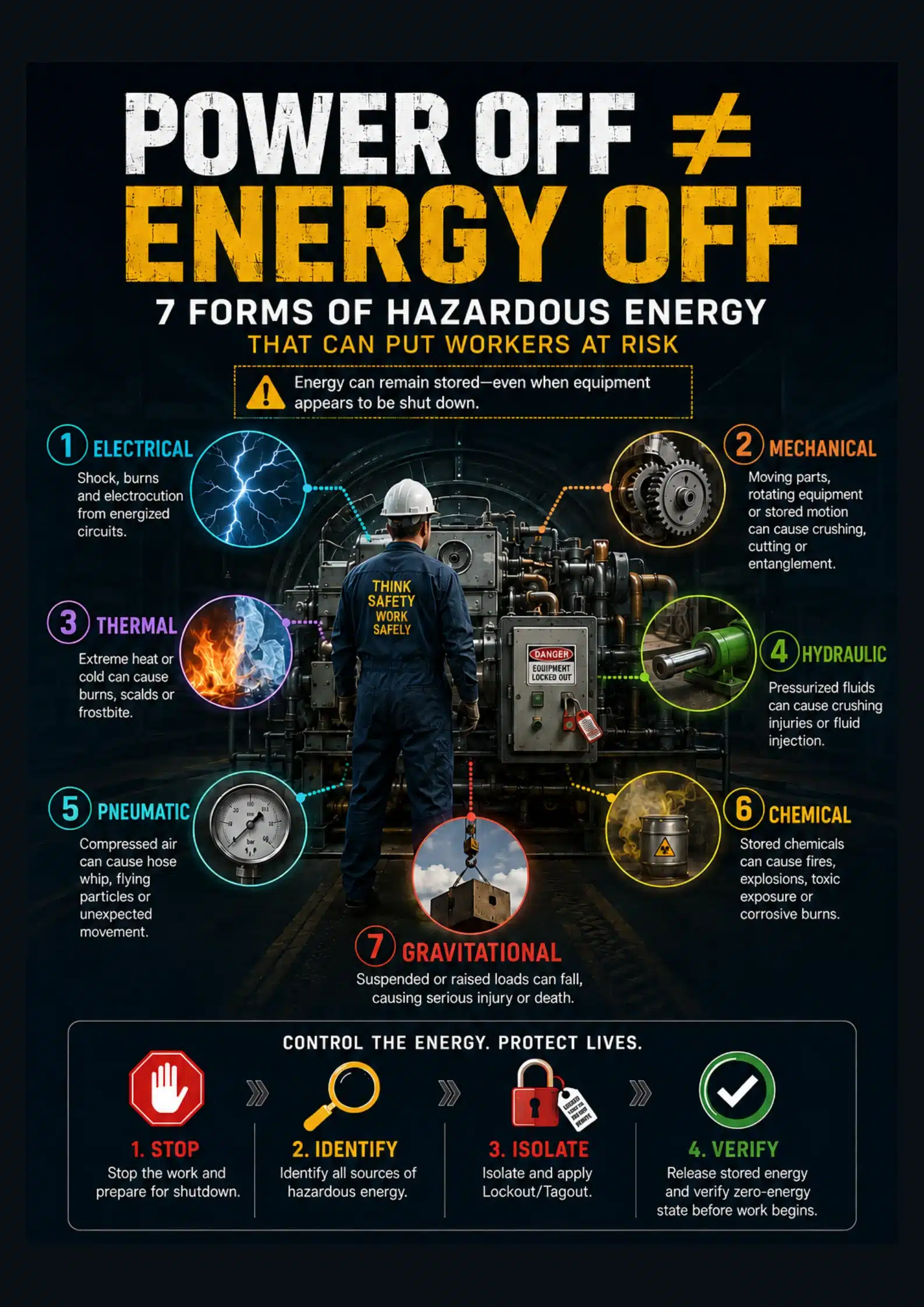
Hazardous energy is any energy that can cause injury or damage when it is released unexpectedly. Under lockout/tagout (OSHA 1910.147), it takes several forms: electrical, mechanical, hydraulic, pneumatic, chemical, thermal, and stored or potential energy. Each type demands specific identification, isolation, and control procedures before maintenance begins. Understanding these categories helps employers build safer energy-control programs and prevent serious injuries and fatalities.
Introduction
Hazardous energy is any form of energy—electrical, mechanical, hydraulic, pneumatic, chemical, thermal, or “other” energy such as gravity—that can cause injury if it is unexpectedly released while a machine, system, or piece of equipment is being serviced or maintained. OSHA’s Control of Hazardous Energy standard, 29 CFR 1910.147(b), defines an energy source using exactly these terms and applies whenever servicing or maintenance work exposes employees to the unexpected energization, startup, or release of stored energy that could cause injury.
Most discussions of hazardous energy stop at that list of seven categories. That’s a mistake, because the categories themselves aren’t where people get hurt most often. Workers get hurt when energy that everyone assumed was “off” turns out to still be present—trapped in a capacitor, coiled in a spring, suspended overhead, or sitting in a pipe that was never actually drained. OSHA’s standard addresses this directly by requiring that stored or residual energy be relieved, disconnected, restrained, or otherwise rendered safe before work begins, not just that the primary power source be switched off.
What does OSHA mean by hazardous energy?
OSHA’s definition of an energy source
Under 29 CFR 1910.147(b), an energy source is any electrical, mechanical, hydraulic, pneumatic, chemical, thermal, or other energy that can cause injury to employees. The standard governs the servicing and maintenance of machines and equipment where the unexpected energization, startup, or release of stored energy could injure a worker.
In practical terms, hazardous energy is anything with the capacity to do work on a human body without warning—to shock it, crush it, burn it, cut it, or expose it to a harmful substance. That capacity doesn’t disappear the moment a machine is switched off. It’s useful to think of hazardous energy in three states:
- Active energy: Energy currently doing work, motor turning, current flowing, and fluid moving through a line.
- Stored energy: Energy that has been captured and held, ready to release if disturbed: a charged capacitor, a compressed spring, or a pressurized accumulator.
- Residual energy: Energy left behind after a process stops, heat retained in a furnace wall, product remaining in a drained-looking pipe, and pressure trapped between two closed valves.
A shutdown switch addresses active energy. It does nothing, by itself, about stored or residual energy—which is precisely why 1910.147 treats energy control as a multi-step process rather than a single action.
When does hazardous energy become a LOTO concern?
The standard scope trigger is specific. Lockout/tagout applies during servicing or maintenance activities where an employee could be injured by:
- Unexpected energization of the equipment
- Unexpected startup of the equipment
- Release of stored energy
If none of those three conditions is possible during a given task, 1910.147 doesn't apply to that task. If any one of them is possible, the employer must have an energy control procedure in place before work begins.
Why hazardous energy is a serious workplace risk
OSHA estimates that approximately three million workers who service equipment face the greatest risk of exposure to hazardous energy, spanning roles from craft workers to machine operators and laborers. According to OSHA, compliance with the lockout/tagout standard prevents an estimated 120 fatalities and 50,000 injuries every year, and workers injured on the job from exposure to hazardous energy lose an average of 24 workdays for recuperation. Those lost-time figures matter because they point to the severity of a typical LOTO-related injury: this isn't a category dominated by minor first-aid cases. It skews toward amputations, crush injuries, burns, and fatalities, which is also why the standard consistently ranks among OSHA's most frequently cited regulations in general industry.
What are the seven forms of hazardous energy?
OSHA's energy-source definition names six specific categories—electrical, mechanical, hydraulic, pneumatic, chemical, and thermal—plus a catch-all "other energy" category. Gravitational energy is not named explicitly in 1910.147(b); it is addressed as "other energy," most commonly in the context of elevated or suspended loads. In practice, most safety professionals treat gravitational energy as a de facto eighth category because it shows up so consistently in incident investigations.
The table below is meant to work as a standalone reference—something you can scan before a job briefing without reading the full article.
| Form of energy | Common sources | Stored/residual energy examples | Typical isolation/control |
| Electrical | Motors, panels, wiring | Capacitors, batteries, UPS | Disconnect, lockout, discharge, test |
| Mechanical | Moving machinery | Springs, flywheels, rotating components | Block, restrain, secure |
| Thermal | Furnaces, boilers, process lines | Residual heat, cryogenic cold | Cool, drain, isolate |
| Hydraulic | Presses, lifts, cylinders | Trapped fluid pressure, accumulators | Isolate, bleed, block |
| Pneumatic | Air tools, actuators, receivers | Compressed air/gas | Isolate, bleed, restrain |
| Chemical | Process lines, tanks, reactors | Residual chemicals/reactive material | Drain, purge, flush, blind |
| Gravitational/other | Elevated loads, raised equipment | Suspended/elevated components | Block, crib, lower, restrain |
Electrical energy
What is electrical hazardous energy?
Electrical hazardous energy comes from live power sources feeding equipment—utility supply, on-site generation, or stored charge — and from the motors, panels, control circuits, and wiring that carry it. It’s the form of energy most workers picture first when they hear “lockout/tagout,” largely because the consequences of contact are immediate and severe: shock, arc flash, arc blast, and thermal burns.
Where can electrical energy remain stored?
Switching off a breaker interrupts the incoming supply, but several components can hold a charge well after that point:
- Capacitors, particularly in motor starters, variable frequency drives, and power factor correction equipment, can retain a dangerous charge for minutes or longer after de-energization.
- Batteries and battery banks, including those backing up control systems, remain live regardless of the state of the main disconnect.
- UPS systems are specifically designed to keep supplying power when upstream circuits go dead—which makes them a classic source of unexpected re-energization if they aren’t isolated as part of the procedure.
- Other residual sources include charged cables, transformers with capacitive coupling, and photovoltaic input that continues to energize inverter circuits in daylight.
How is electrical energy isolated?
A compliant procedure typically works through several layers rather than relying on a single point of isolation:
- Disconnects, opening the primary disconnecting means for the circuit or equipment.
- Circuit breakers, where they serve as the energy-isolating device, locked in the open position.
- Lockout devices applied to each isolating point identified in the machine-specific procedure.
- Discharge or grounding, where required, to bleed off capacitive charge rather than simply cutting supply.
- Verification and testing, using a rated meter to confirm zero energy state before work begins—never relying on an indicator light or the absence of noise as proof.
Important regulatory boundary: 1910.147 governs the control of hazardous energy during servicing and maintenance broadly, but it explicitly carves out electric-utilization equipment hazards addressed under Subpart S—OSHA’s electrical safety standards, including 1910.333, which covers work practices for electrical installations. In practice, this means electrical hazards are not automatically a 1910.147 issue just because electricity is involved; employers need to apply the correct standard, and often both, depending on the nature of the work.
Mechanical energy
What is mechanical hazardous energy?
Mechanical hazardous energy is associated with motion—parts that move, rotate, or have the potential to move. It covers everything from a conveyor belt in operation to a component that looks stationary but is under enough stored tension to move violently if released.
Common sources
- Springs under compression or tension
- Flywheels and other rotating masses that continue spinning after power is cut, purely from momentum
- Rotating blades, augers, and cutting heads
- Moving machine members generally, including linkages, cams, and gear trains
Stored mechanical energy
There’s a meaningful difference between energy from active movement—a blade still spinning because the drive hasn’t fully stopped—and energy stored in a component that can move unexpectedly even though nothing appears to be running. A compressed spring holding tension in a clutch mechanism, or a counterweighted arm resting against a stop, both represent stored mechanical energy: the equipment can be fully de-energized electrically and still be capable of sudden, forceful movement.
How is mechanical energy controlled?
- Blocking the path of potential travel with a rated mechanical stop.
- Restraining components with pins, chains, or straps rated for the load.
- Securing loose or free-moving parts so they can’t shift during the task.
- Repositioning components to a neutral or resting state before work begins.
- Preventing movement through combinations of the above, verified before hands go near the point of operation.
Thermal energy
What is thermal hazardous energy?
Thermal hazardous energy includes both extreme heat and extreme cold. Burns are the obvious risk, but cryogenic exposure—frostbite, tissue damage, and even asphyxiation from displaced oxygen in confined spaces—belongs in the same category.
Common sources
- Boilers, furnaces, and ovens
- Heated process equipment and jacketed vessels
- Process lines carrying hot fluids or steam
- Cryogenic systems and refrigeration equipment
Residual thermal energy
Shutting equipment down doesn't necessarily bring it to a safe temperature. Heat retained in vessel walls, insulation, and hot fluids can persist for hours. Steam trapped in a line after the boiler is off is still capable of causing a serious burn. On the cold side, cryogenic piping can remain dangerously cold long after the supply is isolated, and residual liquid nitrogen or similar gases can still displace breathable oxygen in an enclosed space.
How is thermal energy controlled?
Control methods depend heavily on the specific task, but generally involve allowing equipment to cool (or warm) to a safe temperature, draining hot or cryogenic fluids to a safe location, isolating the heat or cold source itself, and verifying temperature — with an instrument, not by touch — before work begins.
Hydraulic energy
What is hydraulic hazardous energy?
Hydraulic hazardous energy is energy stored in pressurized liquid, typically hydraulic oil, used to transmit force through a system. Because liquids are essentially incompressible, hydraulic systems can hold and deliver very high forces through relatively small components.
Common sources
- Hydraulic presses
- Lifts and jacks
- Cylinders used for actuation or clamping
- Broader hydraulic machinery and process equipment using pressurized fluid power
Hidden hydraulic energy
Hydraulic systems are notorious for holding energy in places that aren't obvious from a visual inspection:
- Trapped pressure downstream of a closed valve—closing a valve can isolate a section of the system while leaving full system pressure locked inside it.
- Accumulators are specifically designed to store hydraulic energy and release it on demand, and they can remain charged long after the pump has been shut off and locked out.
- Pressure can remain in hoses and cylinders, especially in systems with check valves or load-holding valves that prevent normal bleed-down.
Hydraulic energy hazards
The injury patterns from hydraulic energy tend to fall into three groups: crushing injuries from unexpected cylinder movement or falling loads, puncture and injection injuries from pinhole leaks in high-pressure hose (which can inject fluid under the skin with deceptively minor-looking entry wounds), and sudden equipment movement when trapped pressure releases unexpectedly during disassembly.
How is hydraulic energy isolated?
- Close and lock out the valves that isolate the section of the system being worked on
- Bleed residual pressure to a safe, contained location using rated bleed-down procedures
- Block or mechanically restrain any component—a ram, platen, or load—that could move under gravity or residual pressure
- Verify zero energy using a pressure gauge rather than assuming bleed-down is complete
Hydraulic energy
What is hydraulic hazardous energy?
Hydraulic hazardous energy is energy stored in pressurized liquid, typically hydraulic oil, used to transmit force through a system. Because liquids are essentially incompressible, hydraulic systems can hold and deliver very high forces through relatively small components.
Common sources
- Hydraulic presses
- Lifts and jacks
- Cylinders used for actuation or clamping
- Broader hydraulic machinery and process equipment using pressurized fluid power
Hidden hydraulic energy
Hydraulic systems are notorious for holding energy in places that aren’t obvious from a visual inspection:
- Trapped pressure downstream of a closed valve: closing a valve can isolate a section of the system while leaving full system pressure locked inside it.
- Accumulators are specifically designed to store hydraulic energy and release it on demand, and they can remain charged long after the pump has been shut off and locked out.
- Pressure can remain in hoses and cylinders, especially in systems with check valves or load-holding valves that prevent normal bleed-down.
Hydraulic energy hazards
The injury patterns from hydraulic energy tend to fall into three groups: crushing injuries from unexpected cylinder movement or falling loads, puncture and injection injuries from pinhole leaks in high-pressure hose (which can inject fluid under the skin with deceptively minor-looking entry wounds), and sudden equipment movement when trapped pressure releases unexpectedly during disassembly.
How is hydraulic energy isolated?
- Close and lock out the valves that isolate the section of the system being worked on
- Bleed residual pressure to a safe, contained location using rated bleed-down procedures
- Block or mechanically restrain any component—a ram, platen, or load—that could move under gravity or residual pressure
- Verify zero energy using a pressure gauge rather than assuming bleed-down is complete
Pneumatic energy
What is pneumatic hazardous energy?
Pneumatic hazardous energy is energy stored in compressed air or other compressed gases used to power tools, actuators, and process equipment.
Common sources
- Pneumatic tools
- Actuators on valves and process equipment
- Air receivers and storage tanks
- Plant air pipelines and distribution systems
- Pneumatically driven industrial equipment generally
Stored pneumatic energy
Compressed gas systems store energy throughout the system, not just at the compressor. Trapped pressure between isolation points, receiver tanks holding pressure independent of the compressor’s run state, and pressurized hoses that stay charged after the supply valve is closed are all common sources of stored pneumatic energy that a simple shutoff won’t address.
Pneumatic hazards
- Hose whip—an uncontrolled, pressurized hose that comes loose can move with enough force to cause serious injury
- Flying components—fitting, plugs, or parts can be ejected forcefully from a pressurized system
- Sudden movement of actuators or cylinders driven by trapped air
- Pressure release at the point of disassembly, which can cause both direct injury and secondary hazards such as flying debris
Note that pneumatic energy hazards are limited to the physical and mechanical effects of compressed gas—sudden movement, hose whip, and pressure release. Any hazard involving the chemical properties of a released substance, such as a dangerous chemical release, is properly addressed under chemical energy rather than pneumatic energy, even where the delivery mechanism happens to be a pressurized line.
How is pneumatic energy controlled?
- Isolate the compressed air or gas supply at the identified isolation point
- Bleed or vent trapped pressure to a safe location
- Restrain hoses and components that could move when pressure is released
- Verify zero pressure with a gauge before beginning work
Chemical energy
1. What is chemical hazardous energy?
Chemical hazardous energy differs from the other six forms in an important way: it isn’t purely mechanical or electrical potential, but the capacity of a substance to cause harm through its chemical properties—toxicity, flammability, reactivity, or corrosivity. It can come from stored chemicals, ongoing or potential chemical reactions, flammable materials and vapors, reactive substances, and residual process chemicals left in equipment after a process has been shut down.
2. Why chemical energy is different
This is the point where lockout/tagout, on its own, stops being sufficient. Locking out the pump on a chemical line isolates the mechanical and electrical energy driving that pump—it does not make the chemical itself safe to encounter. Residual product routinely remains inside pipes, tanks, vessels, pumps, valves, and other process equipment after the driving energy has been controlled, and that residue carries its own hazard profile independent of whether the equipment can move or energize.
A worker can follow a textbook-perfect lockout procedure, verify zero mechanical and electrical energy, and still be exposed to a toxic, flammable, or corrosive substance the moment a line is opened. That’s a chemical energy problem, not a lockout failure.
3. Chemical energy and line breaking
Line breaking—the point at which a worker physically opens a pipe, hose, or vessel that has carried process chemicals—is where energy control and chemical hazard management intersect most directly. Before breaking a line, the questions that matter go beyond “Is it locked out?”
- What are the residual chemical contents, and in what quantity?
- Is there residual pressure behind the point being opened?
- What is the toxicity of the contents, and what exposure limits apply?
- Is the material flammable, and what ignition sources are present?
- Is the material reactive, and could it react with air, moisture, or an incompatible substance introduced during the work?
- What is the temperature of the residual material?
- Are there incompatibilities between the process chemical and any substance likely to contact it during the work—cleaning solvents, for example?
For processes covered under OSHA’s Process Safety Management standard, 29 CFR 1910.119, this connects directly to the safe work practices required under 1910.119(f)(4), which mandates procedures to control hazards during operations such as line breaking, in addition to lockout/tagout itself.
How an SDS supports chemical energy control
This is where safety data sheets stop being a paperwork requirement and start functioning as an operational tool. Before a line is broken or a vessel is opened, a worker may need to know the chemical identity of the residual material, its hazards, its reactivity with common substances, conditions to avoid, materials it’s incompatible with, decomposition products it can form under heat, the PPE required to handle it safely, and the emergency measures to take if something goes wrong.
The practical gap most facilities run into is this: maintenance controls the energy, EHS controls the chemical hazard information, and the worker standing at the point of work needs both at the same time, in the field, not after the fact. A locked-out line and an inaccessible SDS binder in an office three buildings away don’t add up to a safe job. Centralized, searchable SDS management software closes that gap by putting the chemical hazard information directly in the hands of the person opening the line at the moment they need it—which is what actually connects energy control to chemical hazard management in practice, rather than leaving them as two separate compliance programs.
Methods for controlling chemical energy
- Draining residual product to an appropriate containment or disposal system
- Purging lines and vessels with an inert gas to remove residual vapor or reactive atmosphere
- Flushing with a compatible medium to remove residual chemical contact
- Isolation of the section being worked on from the rest of the process
- Double block and bleed, isolating a line segment between two closed valves with a bleed valve in between to confirm zero pressure and no leak-through
- Blanking or blinding physically inserts a solid barrier into the line to provide positive isolation beyond what a valve alone can guarantee
- Depressurization, where applicable, before any mechanical work begins
Gravitational energy: The "other energy" category
Gravitational energy is not separately named as one of the six specific categories in 1910.147(b); it falls under the standard's broader "other energy" language. That regulatory detail doesn't make it any less dangerous in the field—elevated and suspended loads are a recurring cause of serious injury during maintenance work, precisely because they're easy to overlook once the "real" energy sources have been locked out.
Where gravitational energy occurs
- Suspended loads on cranes, hoists, or slings
- Elevated machine parts, such as a raised press ram or platen
- Raised platforms or lift equipment left in an elevated position
- Hoisted equipment awaiting further work
- Elevated components generally—anything held up against gravity rather than resting on a fixed support
Stored gravitational energy
An elevated object retains the potential to fall even after the mechanism that raised it has been fully de-energized and locked out. A hydraulic lift with its pump locked out doesn't stop the platform from being able to descend under its own weight if the load-holding valve fails or is bypassed. The energy in this case isn't in the equipment—it's in the object's position relative to the ground.
How to control gravitational energy
- Lowering the load or component to a resting position whenever the task allows it
- Blocking with rated blocks positioned to support the full weight if the primary holding mechanism fails
- Cribbing to distribute and support elevated loads securely
- Restraining with rated chains, pins, or straps
- Securing suspended or elevated components as a standard part of the energy control procedure, not as an afterthought
OSHA's own lockout guidance specifically cites elevated machine members among the examples of stored or residual energy that must be dissipated or restrained—through methods including blocking—before work begins, placing gravitational hazards squarely inside the standard's intent even though the term itself doesn't appear in the regulatory text.
Where does OSHA's lockout/tagout standard apply?
What 1910.147 covers
The standard applies to the control of hazardous energy during servicing and maintenance of machines and equipment, specifically where unexpected energization or startup of the machinery, or release of stored energy, could cause injury to employees.
Situations excluded from 1910.147
| Situation | Does 1910.147 apply? | Relevant provision |
| Construction, agriculture | No | 1910.147(a)(1)(ii) |
| Certain maritime employment | No | 1910.147(a)(1)(ii) |
| Certain electric utility installations | No | 1910.147(a)(1)(ii) |
| Electric-utilization electrical hazards | Covered under Subpart S | 1910.147(a)(1)(ii)(D) |
| Normal production operations | Generally no | 1910.147(a)(2)(ii) |
| Certain cord-and-plug servicing | Exception | 1910.147(a)(2)(ii) |
| Qualified hot-tap operations | Exception | 1910.147(a)(2)(iii) |
These exclusions and exceptions are narrower than they first appear, and the exact regulatory language should always be checked directly against the current text of 1910.147 before being applied to a specific task — the categories above are a starting point for scoping a task, not a substitute for reading the provision itself.
The minor servicing exception
The cord-and-plug and minor servicing exceptions deserve their own explanation because they're widely misapplied. The exception generally covers minor tool changes and adjustments and other minor servicing activities that take place during normal production operations, provided the work is routine, repetitive, and integral to the use of the equipment for production, and provided alternative measures — such as specially designed tools, guarding, or other means — provide effective protection equivalent to lockout/tagout.
The useful way to apply this in the field isn't as a checklist of exemptions, but as a decision point: does this specific task meet every one of those conditions, or does it just resemble a task that once did? "Does 1910.147 apply to this task?" is a question that has to be answered fresh each time, not assumed from precedent.
Stored and residual energy: The hazard workers often miss
What is stored or residual energy?
Stored and residual energy spans every category covered above: charge held in capacitors, tension held in springs, momentum held in flywheels, pressure held in hydraulic and pneumatic systems, position held by elevated machine components, heat held in fluids and equipment, and chemical residue held in process equipment after shutdown. OSHA's own lockout/tagout guidance identifies examples along these same lines—capacitors, springs, elevated machine members, rotating flywheels, hydraulic systems, and air, gas, steam, or water under pressure—as the kinds of stored energy that a procedure has to specifically address.
How must store energy be controlled?
29 CFR 1910.147(d)(5) requires that stored or residual energy be relieved, disconnected, restrained, or otherwise rendered safe. That's a deliberately broad set of verbs, because the right method depends entirely on the form of energy involved—bleeding a hydraulic accumulator, discharging a capacitor, and blocking an elevated load are all different actions serving the same regulatory requirement.
What if energy can build up again?
Some systems can reaccumulate energy even after the initial isolation and stored-energy control steps are complete—a system with a slow leak-back past a valve, for instance, or a thermal process that continues generating heat from residual chemical reaction. Where that possibility exists, the procedure has to account for continued verification throughout the task, not just a single check at the start.
How do you verify zero energy?
Verification is a required, distinct step—not an assumption that follows automatically from locking out the isolating devices. OSHA requires authorized employees to verify that isolation and de-energization of the machine or equipment have been accomplished before starting work on equipment that has been locked out or tagged out. In practice, that means:
- Try-start: Attempting to operate the equipment through its normal controls to confirm it will not run
- Test: Using rated test equipment to confirm the absence of electrical energy
- Measure: Checking gauges for zero pressure in hydraulic and pneumatic systems
- Verify isolation: Generally, using whatever method is appropriate to the specific energy form, before any body part enters the point of operation
How to build a compliant hazardous energy control program
1. Establish a written energy control program.
29 CFR 1910.147(c)(1) requires employers to establish a program consisting of energy control procedures, employee training, and periodic inspections to ensure that energy is controlled before employees perform servicing or maintenance.
2. Determined whether lockout or tagout is required
Where an energy-isolating device is capable of being locked out, the standard requires lockout to be used. Tagout may be used only in limited circumstances — typically where the isolating device cannot accept a lock — and requires additional employee protection measures to achieve a level of safety equivalent to lockout.
3. Develop machine-specific energy control procedures
1910.147(c)(4) requires procedures specific to each machine or equipment, documenting the steps for shutting down, isolating, blocking, and securing equipment, as well as the specific requirements for testing to verify the effectiveness of the control measures.
4. Conduct periodic inspections
Energy control procedures must be inspected at least annually, and the inspection must be performed by an authorized employee other than the one(s) utilizing the procedure being inspected, with required certification documenting the machine, the date, the employees involved, and the person performing the inspection.
5. Train employees
The standard defines three categories of employees with different training requirements:
- Authorized employees, who lock out or tag out machines to perform servicing or maintenance, and who need the most comprehensive training on energy control procedures
- Affected employees, who operate or work near equipment being serviced, and need to understand the purpose of the procedure and the prohibition against attempting to restart or re-energize locked-out equipment
- Other employees, whose work may occur in an area where energy control procedures are in use, and who need enough training to recognize a lockout/tagout in progress and understand the prohibition against interfering with it
6. Retrain when conditions change
Retraining is required whenever any of the following occurs:
- A change in job assignment
- A change in machines, equipment, or processes that presents a new hazard
- A change in the energy control procedures
- Periodic inspection reveals inadequacies in an employee's knowledge or use of energy control procedures
7. Manage group lockout and shift changes
Group lockout situations, where multiple employees work under one procedure, and shift or personnel changes during an ongoing lockout both require specific continuity measures to ensure protection is maintained without gaps. Outside contractors performing work on-site introduce an additional coordination requirement between the host employer's and the contractor's energy control programs.
Training, retraining, and certification are the elements of an energy control program most likely to produce a citation when they're missing or incomplete — which also makes them the elements most worth solving with a structured training and record-keeping system rather than an informal, paper-based process.
What are the six basic steps of energy control?
At the task level, energy control comes down to six sequential steps, which map directly to the requirements of 1910.147(d):
- Prepare for shutdown—identify the equipment, the energy sources involved, and the hazards
- Shut down the equipment using normal operating controls
- Isolate all energy sources at the identified isolation points
- Apply lockout/tagout devices to each energy-isolating device
- Control stored and residual energy, relieving, restraining, or otherwise rendering it safe
- Verify isolation before work begins, using try-start, testing, or measurement as appropriate to the energy form
Once servicing or maintenance is complete, equipment is returned to service through its own defined sequence—clearing the work area, removing lockout/tagout devices in the proper order, and notifying affected employees before re-energizing.
Frequently asked questions about hazardous energy
What are the seven forms of hazardous energy?
OSHA's definition of an energy source under 29 CFR 1910.147(b) names electrical, mechanical, hydraulic, pneumatic, chemical, thermal, and other energy. Gravitational energy is typically treated as the seventh form in practice, addressed under the "other energy" category rather than being named explicitly in the regulatory text.
Is gravitational energy covered by OSHA's lockout/tagout standard?
Yes, indirectly. Gravitational energy isn't one of the six specifically named categories, but it falls under 1910.147(b)'s "other energy" language. OSHA's guidance treats elevated or suspended loads as a recognized source of stored energy requiring control through blocking, cribbing, or restraining before servicing begins.
What counts as stored or residual energy?
Stored or residual energy is energy that remains in a system after the primary power source has been shut off — for example, charge in a capacitor, tension in a spring, pressure in a hydraulic accumulator, heat retained in process equipment, or product residue left in a pipe. It must be relieved, disconnected, restrained, or otherwise rendered safe under 1910.147(d)(5).
Does lockout/tagout apply to cord-and-plug equipment?
Generally, cord-and-plug equipment is exempt from full lockout/tagout requirements under 1910.147(a)(2)(ii) when the plug is under the exclusive control of the employee performing the servicing. If the plug isn't under that employee's exclusive control, standard lockout/tagout procedures apply.
How often must a lockout/tagout program be inspected?
Energy control procedures must be inspected at least annually under 1910.147(c)(6), by an authorized employee other than the one using the procedure being inspected, with the results documented and certified.
Conclusion
Hazardous energy takes seven recognizable forms — electrical, mechanical, hydraulic, pneumatic, chemical, thermal, and gravitational/other — but identifying which form is present on a given piece of equipment is only the first step in controlling it. The injuries that lockout/tagout programs exist to prevent most often come from energy that was assumed to be gone and wasn't: a charged capacitor, a pressurized accumulator, an elevated load, or residual product sitting in a line that was locked out but never actually drained.
A compliant program addresses all of this deliberately — written procedures, correct use of lockout versus tagout, machine-specific steps, annual inspection, and training tailored to authorized, affected, and other employees. Chemical energy adds one more layer that lockout/tagout alone doesn't resolve: knowing what's still inside the pipe or vessel once the mechanical and electrical energy has been controlled. That's a question of chemical hazard information as much as energy isolation, and it's exactly where an accessible, up-to-date SDS system earns its place in a maintenance workflow — not as a compliance file, but as the piece of information standing between a locked-out line and a worker who's about to open it.
References:

Simplify Your SDS Management
CloudSDS gives your team instant access to 23M+ safety data sheets with AI-powered search, automated updates, and full OSHA/GHS compliance — all from one platform.
Leave A Comment