
Last Updated on April 21, 2026
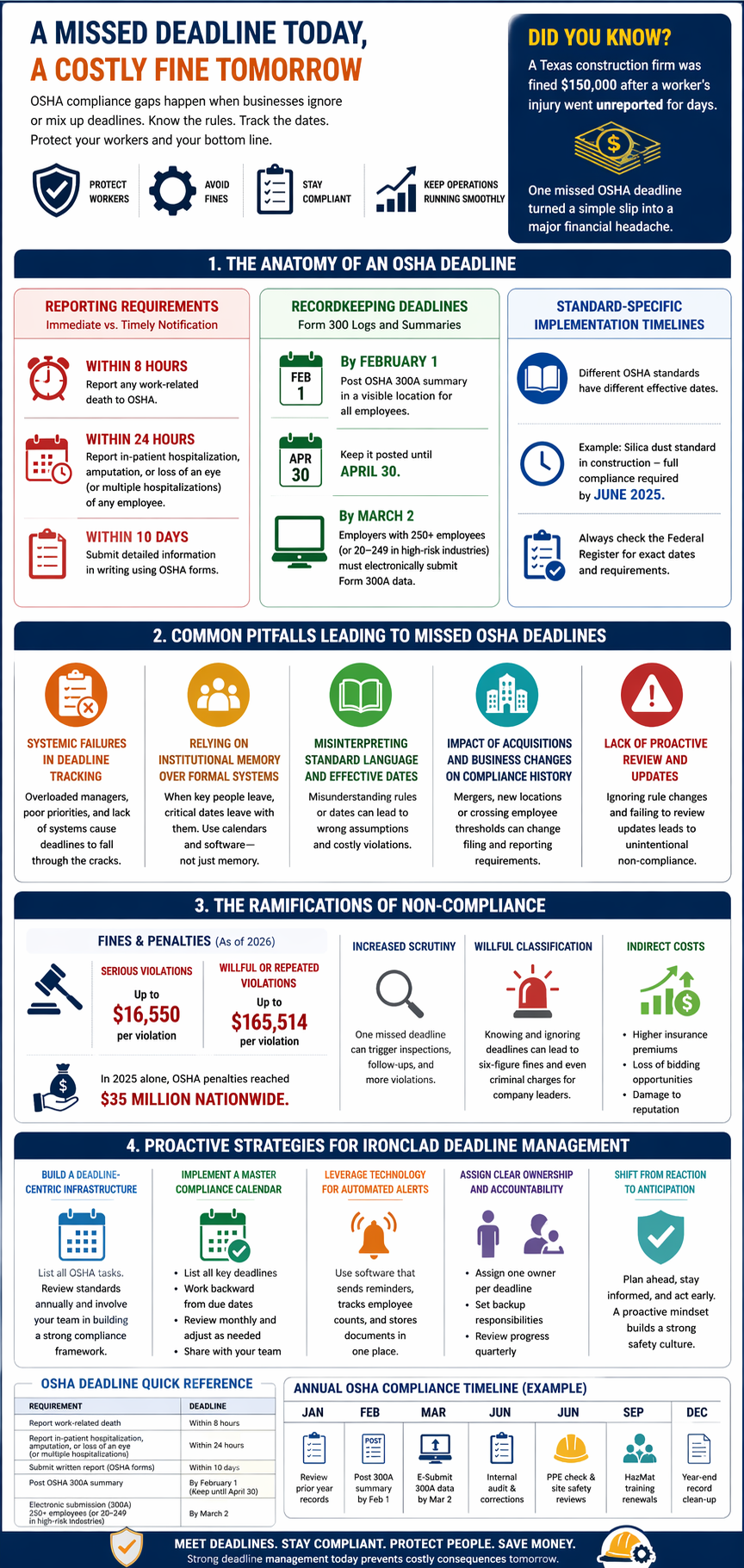
Imagine this: A construction firm in Texas faces a $150,000 fine after a worker’s injury goes unreported for days. That real case from last year shows how one missed OSHA deadline turned a simple slip into a major headache. OSHA compliance gaps happen when businesses ignore or mix up these timelines, leaving safety protocols weak and empty wallets. These gaps aren’t just paperwork slips—they’re breaking in the chain that protects workers and keeps operations smooth. Deadlines act like firm anchors; ignore them, and your whole setup drifts into risky waters.
Decoding the OSHA Regulatory Calendar
1. The Anatomy of an OSHA Deadline
OSHA sets deadlines in different shapes and sizes, each tied to a clear purpose. Some demand action right away, like after an accident. Others stretch out over weeks or months for updates and reports. Understanding this mix helps you spot where gaps might form. Businesses often trip up by treating all deadlines the same, but they vary by urgency and scope. For instance, some rules kick in on a set date for all companies. Others depend on your industry or workforce size. This variety means no one-size-fits-all approach works. Track them carefully to avoid surprises during inspections.
Reporting Requirements: Immediate vs. Timely Notification
You must report serious incidents fast to OSHA—speed saves lives and cuts fines. For a work-related death, call within eight hours. That’s the rule for most cases, no excuses. If it’s an in-patient hospitalization, amputation, or loss of an eye for one worker, notify within 24 hours. Delays here create big compliance gaps. Picture a factory where a machine cuts off a finger; waiting a full day to report could trigger an investigation. For multiple hospitalizations, the 24-hour window still applies. These short fuses ensure a quick response from authorities. Beyond the basics, you have ten days to submit details on forms. Miss that, and records stay incomplete. Always log the who, what, and when right away.
Recordkeeping Deadlines: Form 300 Logs and Summaries
Always ensure your injury logs are up to date with Form 300 for every recordable event. But the real crunch comes at year’s end. By February 1, please post the OSHA 300A summary in a location visible to all employees. It stays until April 30. For bigger outfits—those with 250 or more workers, or 20-249 in high-risk fields—electronic submission hits March 2. That’s for the prior year’s data. Smaller shops skip the e-file but still post the form. These steps ensure you monitor hazards effectively. Skip them, and you blind yourself to patterns that could prevent future issues. Set reminders well in advance.
Standard-Specific Implementation Timelines
Some OSHA regulations also have their own timetables associated with changes in the regulation or new regulations. For example, the Hazard Communication regulation was revised in 2013 regarding labeling and material safety data sheets, but complete implementation deadlines did not come until 2016. You will be cited for failure to train your employees on this by a specific deadline. If you want to control silica dust in construction, the deadline is June 2025, which is only months away now. These timelines push you to install guards or ventilation fast. Consult the Federal Register for exact dates; they spell out when rules start and end. Tailor your plan to your site’s needs.
Standard-Specific Implementation Timelines
Some OSHA regulations also have their own timetables associated with changes in the regulation or new regulations. For example, the Hazard Communication regulation was revised in 2013 regarding labeling and material safety data sheets, but complete implementation deadlines did not come until 2016. You will be cited for failure to train your employees on this by a specific deadline. If you want to control silica dust in construction, the deadline is June 2025, which is only months away now. These timelines push you to install guards or ventilation fast. Consult the Federal Register for exact dates; they spell out when rules start and end. Tailor your plan to your site’s needs.
2. Common Pitfalls Leading to Missed OSHA Deadlines
Systemic Failures in Deadline Tracking
Companies rarely miss OSHA deadlines on purpose—it’s the cracks in daily routines that cause trouble. Overloaded managers juggle too many tasks, and safety slips down the list. Without a solid system, dates blur together. Turnover adds chaos; new staff don’t know the old rhythms. Audits reveal these flaws when records show holes. Build checks into your workflow to catch issues early. One overlooked step snowballs. A late report might flag you for deeper reviews later.
Relying on Institutional Memory Over Formal Systems
Long-time workers carry knowledge in their heads, but that’s risky when they leave. What if the person who remembers the February posting date retires? Suddenly, compliance gaps appear. Shift to tools like shared calendars or apps that notify everyone. Pick software with customizable alerts and easy access for teams. Free options exist, but paid ones link to your email for reliability. This move cuts errors and spreads the load. No single person becomes the weak link.
Misinterpreting Standard Language and Effective Dates
OSHA rules use simple language, but subtle shifts in meaning can lead to confusion among individuals. A company once thought a silica deadline was optional training—it turns out it meant full equipment by mid-2025. During a site visit, they incurred significant costs. The Federal Register holds the truth; read the full notice, not just headlines. Effective dates mark when rules apply, but compliance might lag for prep time. Ask: Does “must comply” mean to install now or plan presently? Please clarify with experts if needed.
The Impact of Acquisitions and Business Changes on Compliance History
Buying a company means inheriting its safety baggage. You might assume past owners filed all reports, but gaps hide in old logs. Mergers demand a full review of records. Changes like adding sites or workers alter filing needs—say, crossing the 250-employee line for e-submissions. Update your status fast. One overlooked merger detail led a firm to miss postings, sparking fines. Audit histories right away after deals close.
3. The Ramifications of Non-Compliance: Financial and Operational Fallout
Fines, Citations, and Increased Scrutiny
OSHA hits sharply for missed deadlines—current max fines top $16,550 for serious violations and $165,514 for willful ones as of 2026. Repeat offenses double that sting. In 2025 alone, penalties reached $35 million nationwide. Citations arrive via mail after inspections, listing fixes and costs. Late reports often bump a minor issue to serious status. You pay for a day of delay in some cases. Scrutiny ramps up; one gap invites more visits. Keep everything current so it stays off the radar.
Navigating the Citation Process After a Missed Deadline
Spot a violation? OSHA sends a notice within six months. For unreported events, it might be classified as failure to abate. Respond in 15 days with a contest or plan. Late action worsens it—if an inspector finds the gap during a follow-up, penalties climb. Document every step to show good faith. Many firms settle by fixing fast, but ignored citations lead to court. Act quick to limit damage.
The “Willful” Classification: When Ignorance Becomes Aggravated Negligence
Willful tags apply when you know a deadline and blow it off. It’s not just forgetful; it’s considered reckless. Fines jump to six figures, and jail time lurks for top brass in serious cases. A bakery chain faced willful charges for ignoring dust reports—a $250,000 hit. Repeated misses prove the point. Train teams on rules to dodge this label. Knowledge shows you’re trying, not ignoring.
Indirect Costs: Insurance Premiums and Bidding Disqualification
Compliance slips raise your EMR, the rate insurers use to set premiums—up 20-30% for poor safety scores. That means higher costs are yearly. Bids suffer too; clients check OSHA logs before awarding contracts. A gap disqualifies you from big jobs in construction or manufacturing. Fix these quietly to protect your bottom line. Safety pays off in saved cash.
4. Proactive Strategies for Ironclad Deadline Management
Building a Deadline-Centric Compliance Infrastructure
Start with a strong base: List all OSHA tasks in one place. Review standards yearly to spot changes. Involve your team in the setup for buy-in. This framework turns chaos into order. Gaps shrink when everyone knows the plan. Test it with mock drills—see if alerts fire on time.
Implementing a Master Compliance Calendar
Create a shared calendar for all deadlines. Mark annual items like PPE checks every June and HazMat training renewals in September. Add reporting windows too.
Work backward: For a February post, plan reviews in January. Use color codes—red for urgent, yellow for prep.
- List key dates: Death reports (8 hours), hospitalizations (24 hours), 300A posting (Feb 1).
- Review monthly and adjust for any business
- Share access via cloud tools.
This keeps you ahead, not scrambling.
Leveraging Technology for Automated Alerts
Go for apps that send pings for due dates. Link them to your HR system so employee counts update automatically for filing rules. Features to seek: Recurring reminders, mobile access, and report templates. Some integrate with calendars for seamless flow. Tech saves hours and catches what humans miss. Start small—pick one tool and scale.
Assigning Clear Ownership and Accountability
Pick one person per deadline, with a backup. The safety manager owns reporting; HR handles summaries. Meet quarterly to review progress. No vague “team does it”—names lock in duties. Reward on time wins to build habits. This setup ends finger-pointing. Everyone pulls weight.
Shifting from Reaction to Anticipation in OSHA Management
OSHA deadlines shape your safety backbone—treat them like sales targets, not afterthoughts. Master the big three: eight-hour fatality reports, 24-hour injury notices, and February 1 summaries. Get these locked in your calendar today. Strong tracking builds a culture where safety leads, not follows. You’ll cut fines, boost morale, and win more bids. Step up now; your team depends on it.
Simplify Your SDS Management
CloudSDS gives your team instant access to 23M+ safety data sheets with AI-powered search, automated updates, and full OSHA/GHS compliance — all from one platform.
Leave A Comment