
Your company has just been notified of an upcoming compliance audit of its chemical stock. Your team hurriedly starts looking for appropriate documents stored in a filing cabinet that is locked. This hurried search is a huge risk for any company in 2026. The Safety Data Sheet becomes the base for safety in dealing with chemicals. While traditional methods worked effectively for many years, currently the advent of artificial intelligence gives rise to new possibilities. You can compare the difference between AI vs. Traditional SDS Management: What's Changed in 2026? if you keep yourself abreast of industry changes.
It is impossible to cope with demands of international business and stringent safety requirements manually. Companies using paper-based solutions or static digital documents usually get fined, face safety gaps, and lose their time. Knowing what modern technologies address these problems will help your company choose the right approach to its safety program.
The Evolution of SDS Management: From Paper to Pixels
Safety management did not start with software. It began with binders, shelves, and manual tracking systems. Understanding this history explains why some companies still resist change.
1. The Reign of Paper-Based Systems
For decades, safety offices relied on paper binders. Employees kept physical copies of SDS documents in drawers. If a new chemical entered the facility, someone had to manually print, file, and update the binder.
This system created significant problems. Documents were often out of date because updates arrived late or stayed in a pile on a desk. Finding a document during an emergency took far too long. If a spill occurred, workers might search through heavy binders while seconds ticked away. Human error during data entry meant critical hazard warnings sometimes went unnoticed until it was too late.
2. The Dawn of Digitalization
Later on, organizations started putting their documents on shared drives or simple databases. This move made the process of finding things much simpler. Rather than going through piles of papers, one had only to look for a filename or folder name. This, however, was just an illusion of safety. Files were often saved in inconsistent formats. Version control remained a nightmare.
When a regulator updated a hazard classification, staff still had to manually hunt down every PDF to replace it. The issue of access has been resolved through digitalization; however, the question of maintenance has remained unresolved because the data was still stuck within static documents that were not readable by the computer.
Traditional SDS Management: Strengths and Persistent Weaknesses
Old methods are not going away overnight. They persist because they feel comfortable and familiar to many long-term employees.
1. The Advantages of Familiarity and Simplicity
Small shops with a handful of chemicals often stick to manual tracking. They argue that the initial cost of new software is too high. Employees know the old system well. They do not want to learn new interfaces. For a very small operation, direct human oversight feels secure. They think they can maintain control by doing everything by hand.
2. Inefficiencies and Compliance Risks
The downside of this approach is the high potential for failure. Manual systems cannot scale. As your chemical inventory grows, the risk of a missed update grows too. Regulatory bodies update standards, such as GHS revisions, on a rolling basis. If you track files manually, you will miss these updates. An obsolete SDS could result in audit failure, costly penalties, or even a worker getting hurt. The process of manually entering and verifying data consumes the time needed for more important jobs. In 2026, the risk of human error in manual systems is a liability most companies cannot afford.
Key AI-Driven Advancements in 2026
The shift toward AI is about more than just finding files faster. It is about total oversight of your chemical risks.
1. Real-Time Regulatory Monitoring and Updates
Modern AI systems scan global databases every day. They watch for changes in local, state, and international regulations. Whenever there is a change in regulation, the AI will detect the impact of the change on the documents and, in some cases, even update the sections of your SDSs. Your document library will always remain up to date and in compliance without having to constantly do manual checks.
2. Predictive Hazard Analysis and Risk Assessment
The use of artificial intelligence does not end with compliance. AI considers the bigger picture by looking at your chemical inventory in detail. Through analysis of your incident reports and scientific data, the system will reveal any unseen risk.
3. Automated SDS Generation and Validation
Developing an SDS from the ground up is challenging and can be prone to errors. The use of AI technology makes the entire process easier since it relies on the raw data of chemicals and formulas used to create products. In this way, it ensures that all SDSs contain the required information in accordance with the GHS standards.
Integrating AI into Your SDS Management Workflow
Adopting AI changes how your team works. Success depends on how you introduce these tools to your organization.
1. Choosing the Right AI Solution
Not all AI tools are equal. Look for solutions that fit your specific needs. Start by checking if the platform integrates with your existing ERP or LIMS software. Compatibility matters. If your safety data cannot be connected to your inventory system, you will create more work for your team. Also, verify that the vendor provides strong support for your industry, as chemical safety needs vary by sector.
2. Training and Change Management
Technology is only useful if people use it. Bring your staff into the process early. Explain why the move to AI helps them. Focus on the benefits, such as fewer hours spent on data entry and better protection in the field. Clear training helps overcome resistance and builds confidence in the new system.
3. Measuring the ROI of AI in SDS Management
How can one determine whether the return on investment is worth it? Measure certain performance indicators:
- The number of compliance fines/citations
- The time taken to search or update SDS documents
- The error rate during manual data entry
- How quickly safety information is communicated to employees
This will help demonstrate the ROI of adopting AI technology.
The Future Outlook: AI as the Standard
The debate between AI and manual systems is ending. By 2026, the industry has clearly picked a side.
1. Bridging the Gap: AI vs. Traditional in 2026
Effectiveness and precision distinguish our era. Conventional approaches usually do not work since they depend on people's memory and stationary file cabinets. The success of AI comes from the fact that it operates with live data. For progressive companies, AI is no longer an advantage; it is an imperative.
2. Key Takeaways for Modern SDS Management
- Manually driven, paper-based processes are highly risky and out of date.
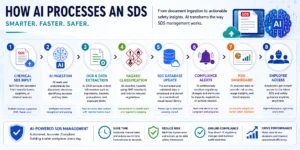
- Automation of the processes using AI technology is essential for the sake of document extraction, regulation update, and risk assessment.
- Integration with your current business system is important in order to ensure the smooth shift.
- Training for the staff will lead to increased adoption rates and better safety outcomes.
Using AI-based SDS process management will make your employees and companies safe. Start analyzing your current workflow now.

Leave A Comment