
Last Updated on March 26, 2026
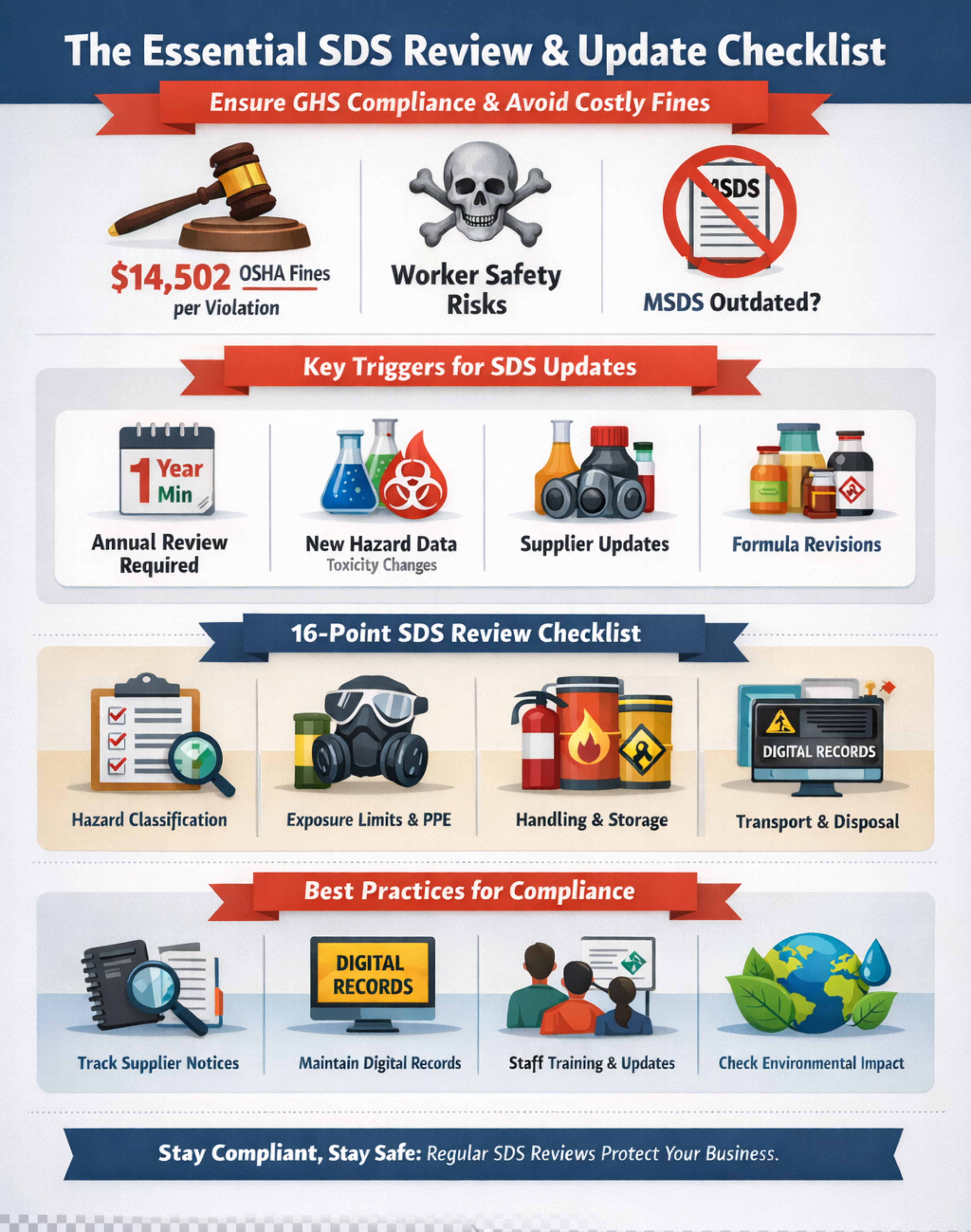
Your business could face serious consequences if its Safety Data Sheets are outdated. As of 2026, fines from OSHA reach up to $14,502 per violation. And that’s just the start—workers face real risks without accurate info on hazards. Back in the day, we used MSDS, but now GHS sets the global standard for clear labels and sheets. The shift happened over a decade ago, yet many sites still struggle to keep up.
Think about it. New studies pop up on chemical risks. Suppliers tweak formulas. Rules change across borders. Your SDS (Safety Data Sheet) review and update checklist becomes your best defense. This guide walks you through every step. It turns compliance into a simple habit that protects your team and operations.
Understanding Regulatory Triggers for SDS Review
Rules demand you check SDS files often. But what sparks a full review? Let’s break it down. RF
1. Periodic Review Requirements and Best Practices
OSHA’s Hazard Communication Standard under 29 CFR 1910.1200 requires you to keep SDS current. That means reviewing them at least once a year. In the EU, REACH pushes for similar checks every 12 months. Canada follows WHMIS with the same vibe.
Even if nothing seems off, do a desktop review yearly. Scan for expired dates or old formats. This catches small issues before they grow. Set a calendar reminder for your EHS team. It takes little time but saves headaches. In one factory case, a skipped review led to a $50,000 fine. Simple habits can be extremely effective in the long run.
2. Identifying External Triggers for Immediate Updates
New data on toxins can flip an SDS overnight. Watch for updates to permitted exposure limits from NIOSH or ACGIH. If ECHA in Europe reclassifies a chemical, your sheet must match. The same goes for EPA shifts in the US.
Say a study shows higher cancer risks for a solvent. You update right away. Ignore it, and you risk injury claims. Remember the 2024 chemical plant incident? An outdated SDS caused a fire mishap, hurting three workers. Feds hit them with penalties. Track alerts from agencies via email subscriptions. Act fast on these triggers. Your workers count on it.
3. Supplier Notification and Downstream User Responsibilities
Manufacturers must alert you to big changes in hazards. GHS (Globally Harmonized System) rules say they send revised SDS (Safety Data Sheets) within three months. As the end user, you grab those updates and swap them in your files. Don’t wait for them to knock. Ask suppliers for confirmation emails on any tweaks. If they drag their feet, follow up in writing. This procedure builds a paper trail. In supply chains, delays happen. But your site stays liable. Prompt action keeps everyone safe downstream.
The Comprehensive 16-Section SDS Review Checklist
SDS sheets have 16 parts under GHS. Each needs a close look during reviews. Use this checklist to verify them all. Start with the basics and move through.
✅️ Verification of GHS Classification Accuracy (Sections 2 & 3)
Section 2 lists hazards with pictograms and words like “Danger.” Check if they match the product’s mix. Section 3 details ingredients and amounts. Does the concentration trigger new labels?
Pull the latest GHS purple book from the UN or your country’s version. Compare H-codes for health risks and P-codes for safe steps. If a filler chemical hits 1% threshold, add it. One tip: Use software to flag mismatches. This ensures your labels sync with the sheet. No guesswork needed. Errors here lead to wrong storage. Fix them during SDS updates.
✅️ Occupational Exposure Limits (OEL) and PPE Validation (Sections 8 & 11)
Section 8 covers exposure limits and PPE needs. Match OELs to current OSHA PELs or company data. Section 11 dives into toxic effects—does it back up Section 2’s claims? Cross-check with your air-monitoring results. If internal tests show higher exposures, note it. Update PPE from gloves to respirators if needed.
Here’s a quick method: List supplier OELs (Occupational Exposure Limits) in a spreadsheet. Also, include your site’s numbers alongside them. Highlight differences and adjust. Please add your site’s numbers next to them. Highlight differences and adjust. Do this every review. Fresh data from 2025 studies raised limits on some solvents. Stay on top or face audits.
✅️ Handling, Storage, and Emergency Procedures Consistency (Sections 4, 5, 6, 7)
Section 4 outlines first aid steps. Does it fit your product’s form, like liquid or powder? Section 5 details fire response—check extinguisher types. Section 6 addresses spills and includes updates for new kit rules, such as absorbent pads. Section 7 covers storage—segregated from incompatibles? Align all with your site’s plans. Train on these during shifts. A mismatch caused a 2023 lab spill that cost $20,000 in cleanup. Review photos of your storage areas. Please ensure that the SDS, or Safety Data Sheet, accurately reflects the current situation.
✅️ Transportation and Disposal Compliance (Sections 14 & 13)
Section 14 lists shipping rules from DOT or IATA. Verify UN numbers and packing groups. Changes in classifications affect how you ship. Section 13 on disposal—match waste codes to local EPA or state regs. Your facility’s stream might need RCRA labels. Call your waste hauler for updates. One wrong code led to a trucking fine in 2025. Keep transport docs handy during reviews. This section ties into daily ops. Get it right for smooth moves.
Integrating New Toxicological and Ecotoxicological Data
Science moves fast. New findings demand SDS tweaks. Know how to fold them in.
i) Incorporating New Scientific Research into Section 11
Agencies like IARC classify carcinogens yearly. If a chemical jumps to Group 1, update Section 11 on toxins. Check for repro or skin effects too. Use GHS rules: If data shows new risks, reclassify. The precautionary approach says act even on strong hints.
For example, a 2026 NTP report flagged a dye for liver damage. Firms updated SDS and avoided lawsuits. Search PubMed or agency sites monthly. This keeps your sheet honest and workers informed.
ii) Evaluating Environmental Impact Updates (Section 12)
Section 12 tracks eco effects like water harm. New tests on bioaccumulation? Add them if they change hazard levels. Persistence data might shift disposal methods. Tie it to Section 14 for transport. In 2024, updated aquatic toxicity data banned a pesticide in streams. Your review catches these. Consult OECD guidelines for standards. Protect the planet while staying legal.
iii) Supply Chain Data Gaps and Manufacturer Communication
Suppliers sometimes skimp on details. If Section 11 lacks full studies, ask for more. Escalate to their compliance team. Build templates for requests: List needed info on endpoints. Track responses in logs. Gaps weaken your SDS. One company faced recalls in 2025 over missing repro data. Fill holes to stand strong.
Documentation and Record-Keeping for Audits
Proof matters in inspections. Solid records show your effort.
-
Maintaining Version Control and Revision History
Date every SDS change. Note why: Consider a new rule or an update from a supplier. Keep old versions for five years at least. Go digital with tools like SDS (Safety Data Sheet) binders or cloud apps, which are software applications that run on the internet. They log everything automatically. They log everything automatically. Auditors love this. It proves diligence. Skip it, and fines follow.
-
Training Verification Post-Update
OSHA (Occupational Safety and Health Administration) advises that workers be trained quickly on new SDS (Safety Data Sheet) information. Cover fresh hazards or PPE in sessions. Document who attends and when. Use quizzes to check grasp. After a 2026 update on a cleaner, one site retrained 50 staff. No incidents since. Always link to training updates.
- Internal Stakeholder Sign-Off and Approval Workflow
Start with your chemist or toxicity expert. They check the scientific aspects, then the Environmental, Health, and Safety (EHS) manager reviews operational fit, and finally, the boss signs off last. Use forms or emails for the chain as it spreads ownership. This workflow caught an error in several reviews, ultimately saving your time and money.
Conclusion: Proactive SDS Management as Risk Mitigation
Maintaining the relevance of SDS transitions the focus from problem-solving to problem prevention. This checklist builds a strong hazard communication system. It cuts legal risks, boosts safety, and keeps work flowing.
Key takeaways:
- Run a full SDS (Safety Data Sheet) review every year, no excuses.
- Track supplier updates in a log for quick action.
- Ensure that every SDS change is promptly integrated into staff training.
- Use digital tools for version control to ease audits.
- Check the ecological and toxic data to stay ahead.
Start your next review today. Your team will thank you. For more on GHS compliance, check out our guides on OSHA updates.
Simplify Your SDS Management
CloudSDS gives your team instant access to 23M+ safety data sheets with AI-powered search, automated updates, and full OSHA/GHS compliance — all from one platform.
Leave A Comment