
1-Bromopropane (1-BP) Regulatory Status: TRI Reporting to TSCA Risk Management in 2026
Introduction
1-Bromopropane illustrates in real time how the TSCA prioritization → evaluation → management pipeline plays out over a decade. It was added to the Toxics Release Inventory (TRI) reporting list effective November 30, 2015 (reportable for calendar year 2016), based on the National Toxicology Program’s classification of 1-BP as “reasonably anticipated to be a human carcinogen.” In 2020, EPA released the initial TSCA risk evaluation for 1-BP as one of the first ten chemicals evaluated under the 2016-amended TSCA. In December 2022, EPA finalized a revised risk determination that found unreasonable risk for 1-BP as a whole chemical substance even if workers consistently use PPE. The EPA suggested a TSCA risk management rule in July 2024 to address the unreasonable risk. The deadline for completion of this rule is August 2026, as per the 2026 Unified Agenda. This scenario will serve as an excellent case study for EHS professionals on how the TSCA process proceeds and on why it is necessary to track both TRI reporting and TSCA risk management obligations.
Summary
1-Bromopropane (1-BP) is a brominated solvent found in adhesives, degreasers, cleaning agents, and automotive care products. In December 2022, 1-BP was subject to an unreasonable risk determination under the Toxic Substances Control Act (TSCA), and in July 2024, the agency proposed a rule for 1-BP’s comprehensive risk management, which is set to be finalized in August 2026. Critically, OSHA has not established a chemical-specific permissible exposure limit (PEL) for 1-BP—a fact that carries real practical weight for EHS teams, as the EPA explicitly does not assume consistent PPE use in its risk assessment.
What is 1-bromopropane?
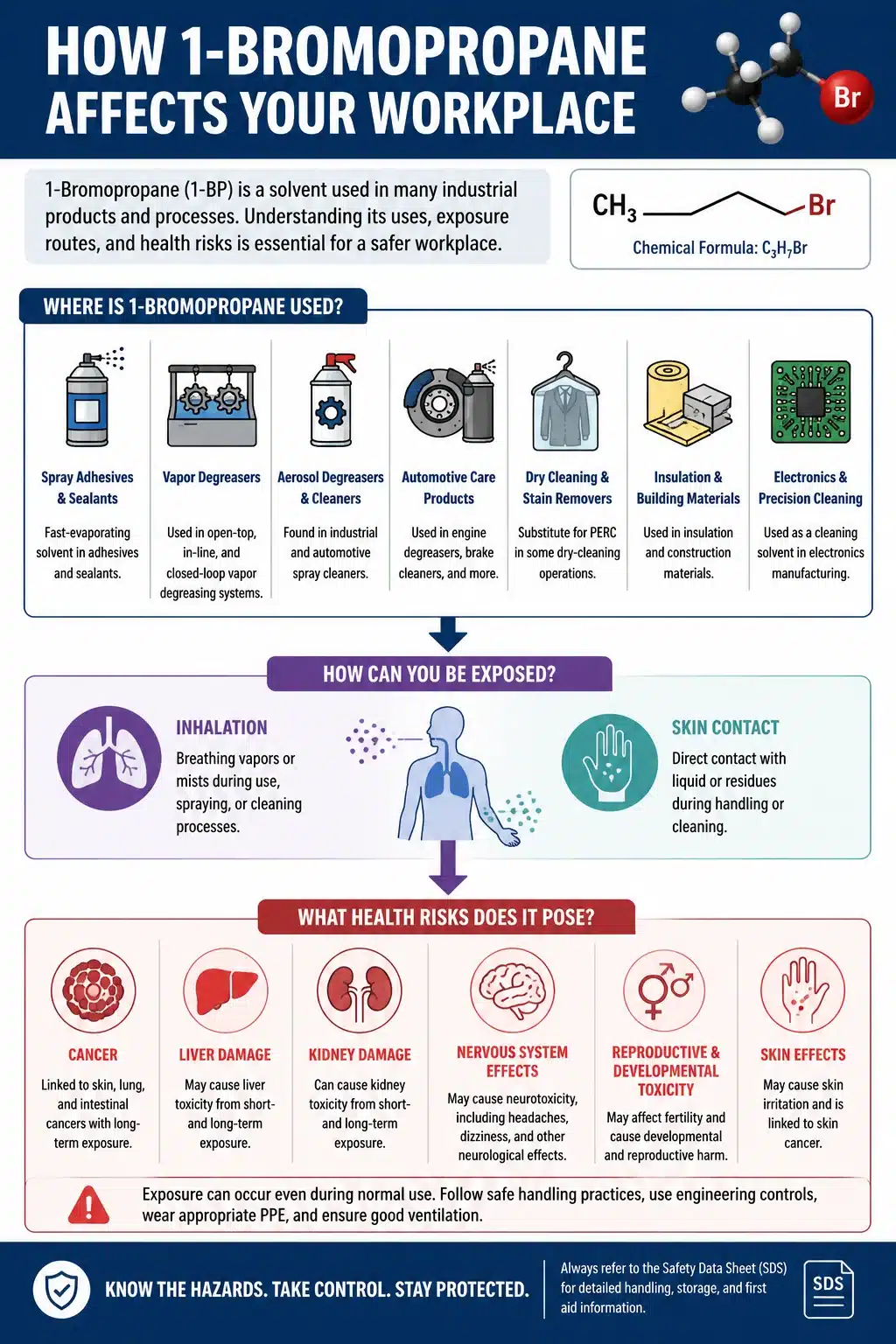
One-bromopropane (chemical formula C₃H₇Br) is a colorless chemical compound with a sweet smell, which is primarily used as a solvent in industrial processes and a raw material in the production of chemicals. Typical uses include the following:
- Carrier solvent in adhesives and sealants: One-bromopropane is employed as a fast-evaporating solvent in spray adhesives, contact adhesives, and sealants.
- Degreasers: They are popular substances used in the process of degreasing, including in open-top batch vapor degreasers, in-line conveyorized degreasing systems, and closed-loop batch systems for degreasing metal parts.
- Aerosol degreasers and cleaners: One-bromopropane is utilized in aerosol spray degreasers and general cleaners for industrial and automotive purposes.
- Automotive care products: 1-BP is used in engine degreasers, brake cleaners, and other automotive maintenance products.
- Dry cleaning and stain removers: 1-BP has been used as a substitute for perchloroethylene (PERC) in some dry-cleaning operations and as a spot cleaner.
- Insulation and building materials: 1-BP is used as insulation for building and construction materials; this use was identified as contributing to the determination that no unreasonable risk exists.
1-BP matters to EHS teams specifically because it is often adopted as a substitute for other regulated solvents such as trichloroethylene (TCE), perchloroethylene (PCE), or certain chlorinated solvents restricted under OSHA or EPA rules. Since the facilities were moving from TCE or PCE, 1-BP might have been used without undergoing a regulatory process for approval and might have ended up in the inventory of chemicals that the EHS department is not monitoring. Its use in vapor degreasing, aerosol spray applications, and adhesives means exposure can occur through inhalation of vapors and dermal contact with liquid or residue.
Health hazards
1-Bromopropane is classified by the National Toxicology Program (NTP) as "reasonably anticipated to be a human carcinogen" in its 13th Report on Carcinogens—the original 2016 basis for its TRI listing. EPA's TSCA risk evaluation confirmed and expanded on these findings, identifying significant health risks across multiple exposure pathways.
Key health effects identified by EPA
EPA's TSCA evaluation found that exposure to 1-BP can cause:
- Cancer – Skin, lung, and intestinal cancers associated with long-term inhalation and dermal exposure.
- Organ damage – Liver and kidney toxicity from both short- and long-term exposure.
- Nervous system damage – Neurological effects, including neurotoxicity, from inhalation and dermal exposure.
- Reproductive and developmental toxicity – Reduced fertility, developmental effects, and reproductive harm.
EPA's risk evaluation identified developmental toxicity from short-term and long-term inhalation and dermal exposure as primary health risks, as well as cancer from long-term inhalation and dermal exposure. Risk to workers, occupational non-users (workers nearby but not in direct contact with the chemical), consumers, and bystanders to consumer use all drive the whole-chemical determination of unreasonable risk.
OSHA PEL status: A critical gap
Explicitly, OSHA has not established a chemical-specific Permissible Exposure Limit (PEL) for 1-BP. NIOSH also does not have a Recommended Exposure Limit (REL). The American Conference of Governmental Industrial Hygienists (ACGIH) recommends an 8-hour time-weighted average (TLV) of 0.1 ppm (10 ppm in some older sources) to provide protection against neurotoxicity, hepatotoxicity, and reproductive and developmental toxicity. Other professional organizations and manufacturers have recommended exposure limits ranging from 20 to 100 ppm, and EPA stated in 2007 that exposures within or below the range of 17 to 30 ppm are anticipated to be protective against reproductive effects.
For EHS teams, the absence of an OSHA PEL means that regulatory compliance alone cannot serve as a safety benchmark for 1-BP. This is an actionable, genuinely important fact: reliance on OSHA PEL compliance as a de facto safety threshold is not possible for 1-BP.
Regulatory timeline
The following table provides a chronological overview of 1-BP's regulatory trajectory from TRI listing through TSCA risk management.
| Date | Action |
| 2015 (effective Nov 30) | Added to EPCRA Section 313 / TRI toxic chemical list based on NTP carcinogen classification; reportable for 2016 calendar year, with first TRI reporting forms due by July 1, 2017. |
| Aug 2020 | EPA released initial TSCA risk evaluation for 1-BP (4th of the first 10 chemicals evaluated under amended TSCA), reviewing exposures, hazards, and risk findings. |
| Dec 2022 | EPA finalized a revised risk determination, finding unreasonable risk based on 1-BP as a whole chemical substance, without assuming workers consistently use PPE. |
| July 2024 | EPA proposed a TSCA risk management rule for 1-BP to address unreasonable risk, including bans on certain consumer and industrial/commercial uses and worker protection requirements. |
| 2025 | EPA released a further draft revised risk determination for public comment, reflecting updated policy on PPE assumptions in whole-chemical risk determinations. |
| 2026 (expected Aug) | EPA intends to finalize the risk management rule for 1-BP, per the 2026 Unified Agenda. |
This timeline is effectively a single-chemical zoom-in on the broader TSCA process that EHS teams are tracking across multiple substances. Understanding how 1-BP moved from TRI listing to TSCA risk management provides a template for anticipating how other chemicals on EPA's risk evaluation list may progress.
Why EPA didn't assume PPE use and why that matters
EPA's risk determination for 1-BP does not assume that workers are always provided or correctly using personal protective equipment (PPE). This is a genuinely useful nuance that EHS teams should internalize for compliance planning.
EPA's reasoning
EPA explicitly recognizes that certain subpopulations of workers may be highly exposed because
- Not all workers are covered by OSHA standards: Some worker populations (e.g., certain public sector workers and small employers) fall outside OSHA jurisdiction.
- Employers may be out of compliance: Even where OSHA standards apply, EPA acknowledges that some employers are not in compliance with applicable federal standards.
- OSHA PELs are outdated and inadequate: OSHA's own description notes that many chemical-specific PELs were largely adopted in the 1970s and are "outdated and inadequate for ensuring protection of worker health."
- No chemical-specific PEL for 1-BP: OSHA has not issued a PEL for 1-BP, creating a regulatory gap.
Practical tension: TSCA vs. OSHA standards
This reflects a fundamental distinction between TSCA and OSHA regulatory frameworks:
- TSCA (EPA) applies an unreasonable-risk standard that is independent of technological and economic feasibility. EPA's risk determination is based on whether a chemical presents unreasonable risk under its conditions of use, without assuming consistent PPE use.
- OSHA standards must be shown to be feasible at the time they are issued, and PELs are often decades old.
For EHS teams, this means that OSHA PEL compliance alone should not be treated as a safety benchmark for 1-BP. The absence of an OSHA PEL, combined with the EPA's explicit non-assumption of PPE use, means that EHS teams should treat current EPA risk evaluation findings as the operative hazard benchmark now—not wait for the final risk management rule.
Who's affected
The proposed 1-BP risk management rule affects a broad range of industries where 1-BP is used as a solvent or reactant. Rather than reproducing the full regulatory NAICS table, the following plain-language summary identifies the primary affected sectors. The industries and operations that get affected the most are:
- Solvent and degreasing operations – Facilities using 1-BP in vapor degreasing, cold cleaning, and aerosol degreasing to clean metal parts.
- Adhesives and sealants manufacturing – Formulators and manufacturers of spray adhesives, contact adhesives, and sealant products containing 1-BP.
- Automotive care product formulators – Manufacturers of engine degreasers, brake cleaners, and other automotive maintenance products.
- Metal cleaning and coating operations – Facilities using 1-BP to clean metal parts before coating or painting.
- Dry cleaning and stain removal – Operations using 1-BP as a substitute for PERC in dry cleaning or as spot cleaners.
- Insulation and building materials – Commercial and consumer use of 1-BP in insulation (this use was identified as not contributing to unreasonable risk but is still regulated).
- Electronics and electronic product manufacturing – Facilities using 1-BP in electronics cleaning and degreasing applications.
For the exhaustive list of affected NAICS codes, EHS teams should consult the Federal Register notice for the proposed rule.
What EHS teams should do now
Given the regulatory trajectory of 1-BP and the absence of an OSHA PEL, EHS teams should take proactive steps now to ensure compliance and worker protection.
1. Confirm 1-BP inyourchemical inventory
- Review SDS Section 1 and Section 3: The quickest method of verifying the presence of 1-BP is to review the Safety Data Sheets (SDS) for adhesives, degreasers, cleaners, and car care products. Check for alternate names like "n-propyl bromide" or "1-bromopropane."
- Check solvent substitution: If your company replaced any solvents like TCE, PCE, or others, then 1-BP was likely substituted.
2. Don't wait for the final rule
- Consider EPA risk evaluation results as the benchmark from this point on: As there is no existing OSHA PEL, EPA's unreasonable risk determination for 2022 and proposed rule results for 2024 will help to define your controls against workplace hazards right away.
- Set up exposure control measures: The proposed rule of EPA contains the Workplace Chemical Protection Program (WCPP) with specific exposure concentration limits, and your facilities applying 1-BP in the vapor degreasing process might already have controls matching those limits.
3. Watch for thefinalrule in 2026
- August 2026 is the deadline for issuing the rule: In its 2026 Unified Agenda, the EPA has signaled that it will issue the risk management rule by August 2026.
- Proposal regarding transition periods: Compliance deadlines for the ban on consumer uses will start 6 months from the date of issuance of the final rule, taking full effect 15 months later; the ban on industrial/commercial uses will take effect 6 months after issuance.
4. Tie totier II/EPCRAreporting obligations
TRI reporting has been in effect since 2016: 1-BP was added to the TRI list effective November 2015, reportable for the 2016 calendar year, with the first reports due July 1, 2017. If your facility meets TRI reporting thresholds for 1-BP, ensure ongoing compliance with Tier II and EPCRA Section 313 reporting obligations.
Key Takeaways
- 1-bromopropane became a TRI reportable substance in 2016, and there are no changes to date; facilities subject to EPCRA Section 313 have to keep reporting on 1-BP as it falls under the TRI thresholds.
- The TSCA review by EPA concluded unreasonable risk from 1-BP as a whole chemical; there is an active risk management rulemaking process expected to be finalized in August 2026.
- OSHA has no chemical-specific PEL for 1-BP, and EPA explicitly does not treat PPE use as a given: This is a critical gap for EHS teams; reliance on OSHA PEL compliance alone is not possible.
- 1-BP is common in vapor degreasing, cold cleaning, adhesives, and automotive care products: If your facility uses these applications, 1-BP may be present, especially if it was adopted as a substitute for other regulated solvents.
- The adverse health impacts that exist include various types of cancer, organ damage, and reproductive impacts: The risk evaluation by the EPA included several cancers such as skin, lung, and intestinal; damage to organs like the liver, kidney, and nervous system; and reproductive impacts such as decreased fertility.
- EHS teams need to view the current findings from the EPA as the standard at this point rather than waiting until the final rule comes into effect because of the lack of OSHA PEL and the explicit non-assumption of proper PPE usage.
FAQ section
1. Is 1-bromopropane banned?
No, 1-bromopropane is not currently banned, but EPA has proposed a TSCA risk management rule that would prohibit all consumer uses of 1-BP except insulation and ban certain industrial and commercial uses where safer alternatives exist. The proposed rule would also require worker protections, including a Workplace Chemical Protection Program with exposure concentration limits, for remaining industrial and commercial uses. Finalization is expected in August 2026.
2. What are the uses of 1-Bromopropane?
1-Bromopropane is used as a solvent for adhesives, sealants, degreasers, cleaners, and automotive care; vapor degreasing and cold cleaning processes; dry cleaning and stain removal; and insulation for building materials. It is also used as a chemical reactant in manufacturing processes and in electronics cleaning processes.
3. Does OSHA have an exposure limit for 1-BP?
No, OSHA has not established a chemical-specific Permissible Exposure Limit (PEL) for 1-bromopropane. NIOSH also does not have a Recommended Exposure Limit (REL). ACGIH recommends an 8-hour time-weighted average (TLV) of 0.1 ppm (or 10 ppm in some sources) to protect against neurotoxicity, hepatotoxicity, and reproductive/developmental toxicity.
4. Is 1-BP a carcinogen?
Yes, 1-bromopropane is considered “reasonably anticipated to be a human carcinogen” under the 13th Report on Carcinogens by the National Toxicology Program (NTP). According to the TSCA risk evaluation conducted by the EPA, exposure to 1-BP causes skin cancer, lung cancer, and colon/intestinal cancer.
5. What month will the final 1-BP risk management rule be finalized?
According to the 2026 Unified Agenda from OMB, which was published in July 2026, the final 1-BP risk management rule will be issued in August 2026. The proposal for this regulation was issued in July 2024 with a 45-day comment period ending in September 2024.
References and Additional Resources
- EPA Risk Management for 1-BP: https://www.epa.gov/assessing-and-managing-chemicals-under-tsca/risk-management-1-bromopropane-1-bp
- EPA Final Risk Evaluation for 1-BP: https://www.epa.gov/assessing-and-managing-chemicals-under-tsca/final-risk-evaluation-1-bromopropane-1-bp
- TRI Addition of 1-BP (2015): https://www.epa.gov/toxics-release-inventory-tri-program/addition-1-bromopropane
- 2026 Unified Agenda (TSCA Rulemakings): https://natlawreview.com/article/epas-2026-unified-agenda-includes-tsca-rulemakings
- NIOSH 1-BP Bulletin: https://www.cdc.gov/niosh/bulletin/2008/1-bromopropane.html
- OSHA Annotated PELs (Table Z-1): https://www.osha.gov/annotated-pels/table-z-1

Simplify Your SDS Management
CloudSDS gives your team instant access to 23M+ safety data sheets with AI-powered search, automated updates, and full OSHA/GHS compliance — all from one platform.
Leave A Comment